Week-11 Challenge: Braking
Aim: Solve the following questions on the challenge 11 Braking:
- For a defined driving cycle, calculate the energy required for braking.
- Why electric motor can’t develop braking torque at high speed similar to starting? How electric and mechanical brakes are coordinated?
- Make a MATLAB program which plots contour of given motor speed, torque and efficiency values. Attach the code as a .m file attach a screenshot of all the plots.
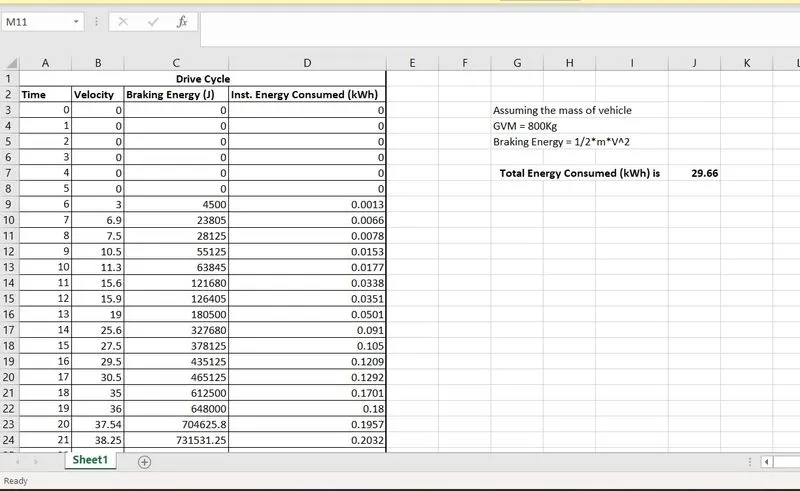
Solution 1: Defined driving cycle in the excel sheet:
Hence we will import data from the tis sheet For values of Time and Velocity.
Program MATLAB Code to run :
clc
mass = 800;
Time=DriveCycle(:,1);
vel=VarName2(:,1);
E=zeros(1,100);
for i=1:(length(vel)-1)
if vel(i)>vel(i+1)
E(i)=0.5*mass*vel(i)-vel(i+1)^2;
end
end
fprintf('Braking Energy is %d',sum(E));
fprintf('Average Braking Energy is %d',mean (E));
figure(1)
subplot(2,1,1)
plot(Time,vel,'linewidth',3,'color','r')
xlabel('Time in seconds')
ylabel('velocity in m/sec')
title('Drivecycle')
hold on
grid on
subplot(2,1,2)
plot(Time,vel,'linewidth',3,'color','y')
xlabel('Time in seconds')
ylabel('Energy in Joules')
title('Braking Energy')
Now To find the Kinetic Energy KE is given by,
Formula = `1/2 mv^2`
Where m = mass of the vehicle
v = velocity of the vehicle
and when there is a change in velocity ,the speed of the vehicle Initial velocity (vi) to the Final velocity(vf) the Braking Energy is given by,
Formula for BE= `1/2 m(〖vi-vf)〗^2`
- Results :
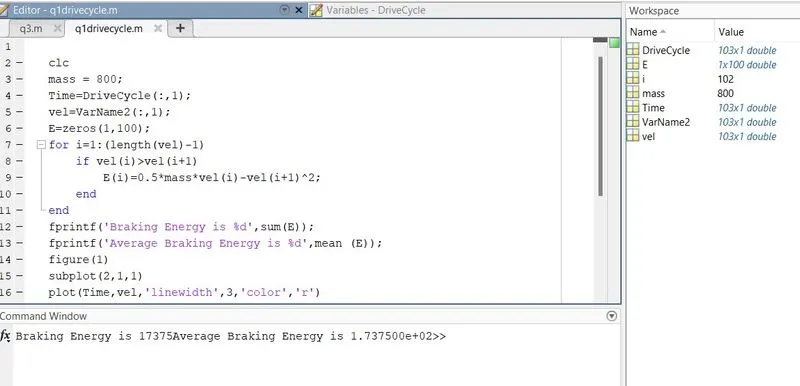
- Below Image shows the code Run and result for Average Braking Energy is 1.737500e+02 Joules. Observations can be Viewed in the image.
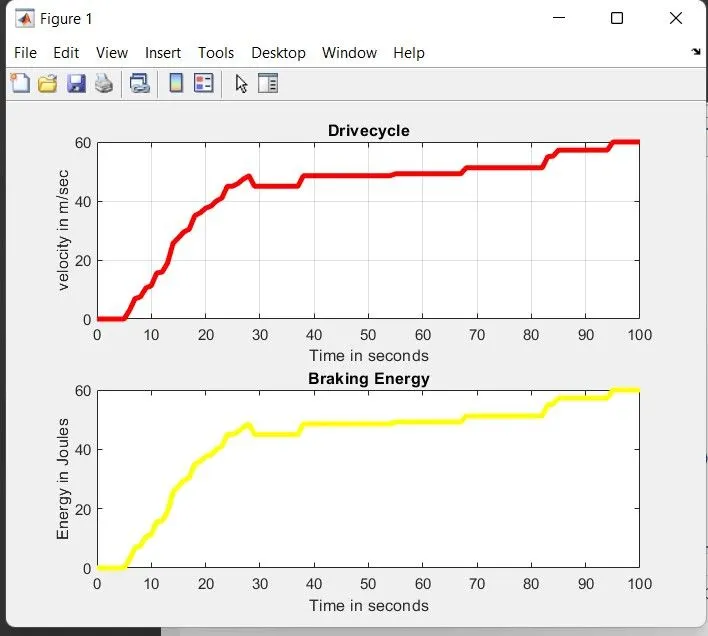
- Below the image shows the plots developed by running the program.
- The results are plotted in two Graphs such as
Plot 1. Shows the Results from the Drive Cycle as X axis as the Time of travel and the Y axis as the Velocity of the Vehicle having Maximum Speed as 60
Plot 2. Shows the Braking Energy for the applied Brakes in the Vehicle here X axis as Time in seconds and the Y axis as the Energy in Joules.
Solution 2: Why electric motor can’t develop braking torque at high speed similar to starting?
The above question can be answered as:
Brake torque is the force applied at the brake wheel to stop the motion of the moving vehicle. Unfortunately, Electric motor can’t develop braking torque at higher speed similar to starting because Braking torque applied in the opposite direction of the rotation.
As of a Electric motor (Induction Motor) Braking takes as Electric Braking in the vehicle as Regenerative braking takes place whenever the speed of the motor exceeds the synchronous speed. This braking method is called regenerative braking because here the motor works as a generator and the supply itself is given power from the load, i.e., motors. The main criterion for regenerative braking is that the rotor must rotate at a speed higher than synchronous speed, only then the motor will act as a generator and the direction of current flow through the circuit and direction of the torque reverses and braking takes place. The only disadvantage of this type of braking is that the motor must run at a super synchronous speed which may damage the motor mechanically and electrically, but regenerative braking can be done at sub-synchronous speed if the variable frequency source is available. Also Motoring and the braking Regions are the vice versa characteristics. For acceleration, we usually have high torque for low speed and low torque for high speeds. It shows that , the motor producing torque XNM for acceleration cannot produce -XNM for braking. Motor is operated in the field weakening region or above base speed, so that the torque is compromised. So the braking torque of motor is not as high as Acceleration.
Hence Electric motor can’t develop braking torque at high speed similar to starting.
Part(B): How electric and mechanical brakes are coordinated:
Braking in the Electric Vehicle are generally as Two Types
- Electric Braking – As generally Regenerative Braking, Plugging Type of Braking and Dynamic Braking.
- Mechanical Braking – As Air braking , Hydraulic Braking.
- Braking Strategy:
- Both the Braking techniques are managed in such away that coordination should go with best results and the Brake Force Distribution should be uniform as Electric motors generally cannot produce braking Torque at high speeds, Such that series braking is applied combined braking comes in use.
- Also if the Regenerative Braking is more than the Regenerative capacity of the machine (Electric Motor) than the Mechanical Brakes are applied to Control the vehicle speed.
- Now In most of the modern cars Electric Driven Intelligent Braking (EDIB) Combination of Braking of both Electric and Mechanical braking is implemented in parallel as per the criteria Vehicle at lower speeds uses Regenerative braking is implemented also at Initial braking and high speed Braking Combinational Technique is used .
Solution 3:
MATLAB program which plots contour of given motor speed, torque and efficiency values
Here we have made a program to plot a contour given motor speed, torque and efficiency values
Making a script file shown by the image below
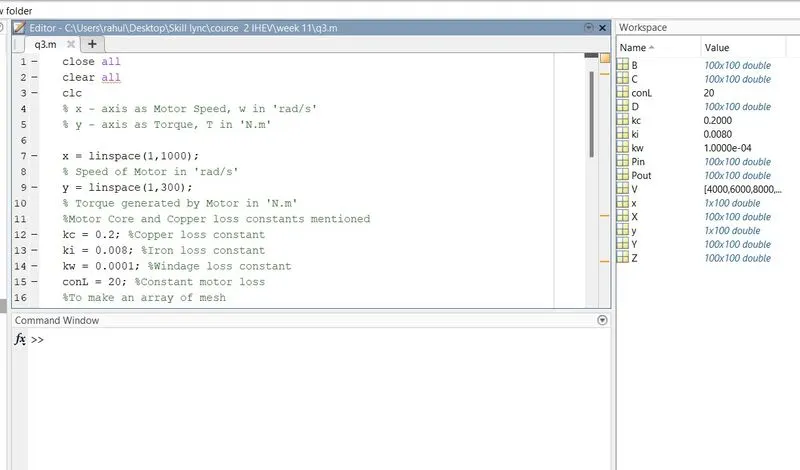
program used is in the .m file attached to the document with also given below:
close all
clear all
clc
% x - axis as Motor Speed, w in 'rad/s'
% y - axis as Torque, T in 'N.m'
x = linspace(1,1000);
% Speed of Motor in 'rad/s'
y = linspace(1,300);
% Torque generated by Motor in 'N.m'
%Motor Core and Copper loss constants mentioned
kc = 0.2; %Copper loss constant
ki = 0.008; %Iron loss constant
kw = 0.0001; %Windage loss constant
conL = 20; %Constant motor loss
%To make an array of mesh
[X, Y] = meshgrid(x,y);
%To calculate Output Power,
Pout = (X.* Y); %Power = Torque * Speed
%To find losses
B = (Y.^2)*kc; %Equation to find Copper loss
C = X.*ki; %Equation to find Iron loss
D = (X.^3)*kw; %Equation to find Windage loss
%Relation between Input Power and Output Power
%Input Power = Output Power + Losses
Pin = Pout + B + C + D + conL;
Z = Pout./ Pin; %To calculate efficiency
%Efficiencies for which Contour to be plotted
V = [0.8:0.06:0.99];
box off
grid off
contour(X, Y, Z, V)
xlabel('Speed of Motor (rad/s)');
ylabel('Developed Torque (N.m)');
hold on
%Plot contour for Output Power
%The array for Output Power is already calculated, now we draw contour
V = [4000:2000:10000];
contour(X, Y, Pout, V);
hold off
title('Plot for efficiency Contour, Speed vs Torque')
- Results And Observations:
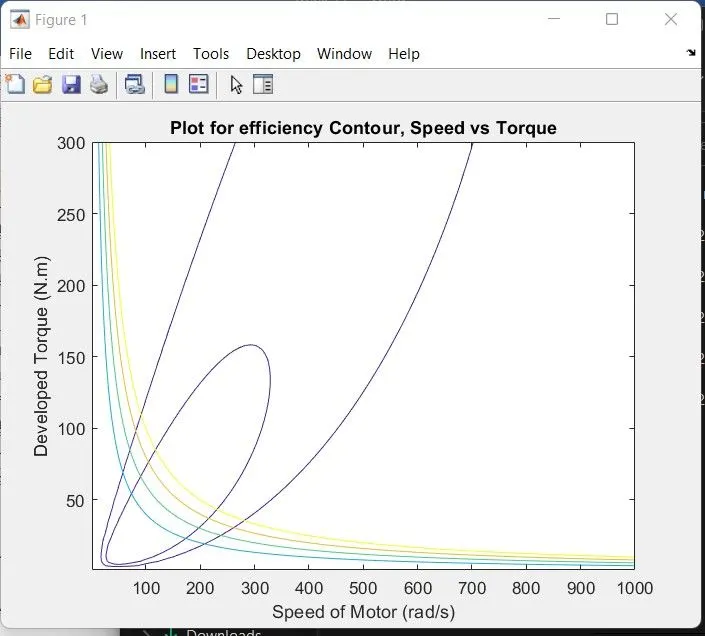
Now as per the question we get the contour plot as in the below image:
Which is a plot on x axis as Speed of the motor Vs the Developed Torque.
- Conclusion :
- In question 1. We defined a Driving Cycle and implemented it for calculating the total Energy consumed.
- In question 2. We understood that Why electric motor can’t develop braking torque at high speed similar to starting also electric and mechanical brakes are coordination.
- In question 3. We have plotted contour of given motor speed, torque and efficiency values.