Week-11 Challenge: Braking
1) For a defined driving cycle, calculate the energy required for braking.
SOLUTION:
CODE:
close all
clc
%Read the Drive Cycle data
DC=xlsread('drive cycle.xlsx');
%Time and Speed in seconds
T=DC(:,1);
S=DC(:,2);
%other data
m=1000; %mass in Kg
V=S./3.6; %speed in m/s
%Creating an array to store values for Deceleration and Braking Energy
Z=length(T);
deceleration=zeros(1,Z);
acceleration=zeros(1,Z);
BE=zeros(1,Z);
AE=zeros(1,Z);
speed_decrease=zeros(1,Z);
speed_increase=zeros(1,Z);
%Creating a loop to find out braking points and then calculate BE
for i=1:(length(T)-1)
if V(i)>V(i+1)
BE(i)=0.5*(V(i)-V(i+1))^2; %Braking energy in Joules
speed_decrease(i)= V(i+1)-V(i);
deceleration(i)=speed_decrease(i);
end
if V(i)
AE(i)=0.5*m*V(i)-V(i+1)^2; %Accelerating Energy in Joules
speed_increase(i)=V(i+1)-V(i);
acceleration(i)=speed_increase(i);
end
end
%Total Braking Energy in KJ
B_E=(sum(BE)/1000);
%Total Acceleration Energy in KJ
A_E=(sum(AE)/1000);
%Plotting Curves
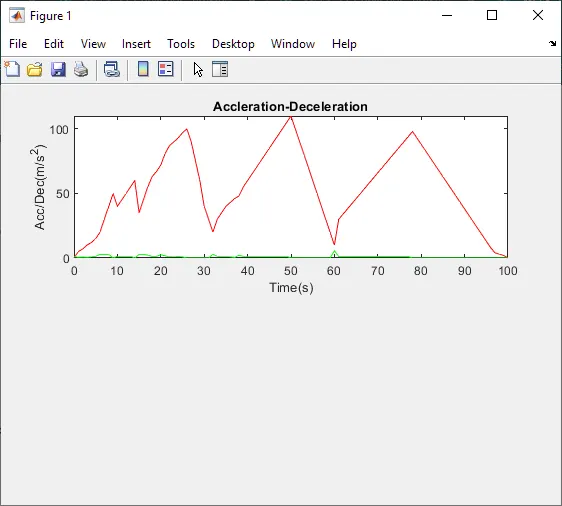
figure(1)
subplot(2,1,1)
plot(T,S,'color','r')
hold on
plot (T, acceleration, 'color','g')
hold on
xlabel('Time(s)')
ylabel('Acc/Dec(m/s^2)')
title('Accleration-Deceleration')
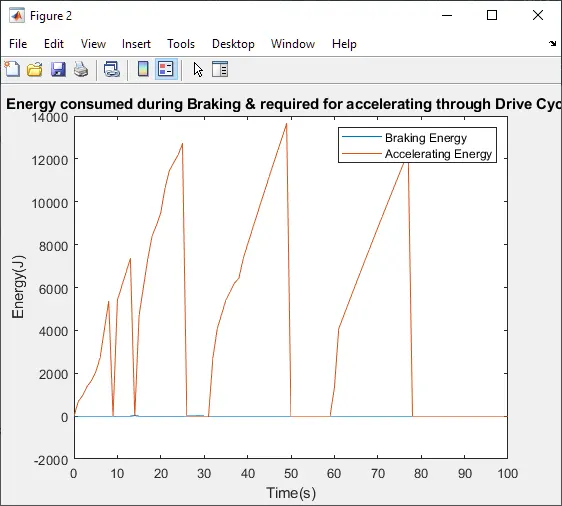
figure(2)
plot(T,BE)
hold on
plot(T,AE)
xlabel('Time(s)')
ylabel('Energy(J)')
title('Energy consumed during Braking & required for accelerating through Drive Cycle')
legend('Braking Energy','Accelerating Energy')
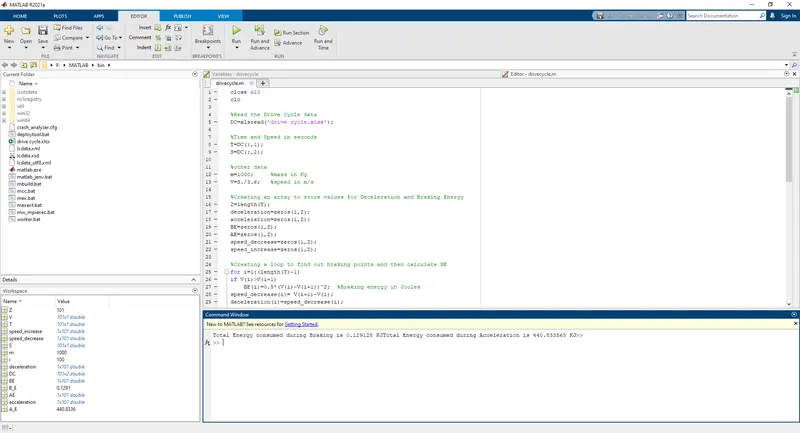
fprintf('Total Energy consumed during Braking is %f KJ',B_E)
disp('')
fprintf('Total Energy consumed during Acceleration is %f KJ', A_E)
EXPLANATION:
- First, we need to create an excel sheet with the Time and Speed inputs and import it into excel.
- Variables like mass, velocity etc has to be defined in the code
- A loop for the length of time has to be created and the values for Braking Energy and Acceleration Energy has to be calcluated.
- Graphs are then ploted.
RESULTS:
PLOT:
2) Why electric motor can’t develop braking torque at high speed similar to starting? How electric and mechanical brakes are coordinated?
ANSWER:
Regenerative Braking:
This are the type kinectic energy recovery system that transfer the kinectic energy of an object into potential or stored energy to slow down the vehicle and as a result to increase the fuel efficiency. There are multiple methods of energy conversion in Regenerative Braking System including spring, flywheel, electromagnetic and hydraulic. More recently, an electromagnetic-flywheel hybrid.
They are are installed along the drive train or fitted to the drive wheels of a vehicle where they inhibit the motion of the wheels using magnetic fields or mechanical torque. These methods of motion inhibition allow energy to be generated under braking, as opposed to friction brakes which simply waste away energy to slow the vehicle by turning the kinetic energy into thermal energy.
Regenerative Braking system can improve fuel consumption and reduce the overall braking load taken on by the vehicles friction brakes, reducing the wear on the brake pads. In HEV and EV the transmission of the car is set up such that when the driver applies the brakes, the electric motor reverses itself and applies a resistance to the wheels rather than power, this resistance applied to the wheels is then put through the electric motor where it is used to recharge the batteries.
Limitations:
There is a limitation due to the maximum recharging rate of the circuit and the capacity of battery, the braking force from an electromagnetic is always limited.
Why electric motor can't develop braking torque at high speed similar to starting?
In EV application there is a motor-generator, and a battery pack to supply power, as the electric current travels through the motor within a magnetic field, it generates a force. The more current applied, the more the motor will spin.
For Regenerative Braking a motor will act as a generator i.e. the direction of the electric flow is reversed, the electric motor will rather than taking in current to spin the armature, the armature is spun through the field by the deceleration of the vehicle. The electricity produces is used to recharge the battery, and the motor can switch between powering the car and regenerating electricity as fast as the driver can accelerate and lift off.
As the motor revsere increase, it also creates "back electromotive force" or "back EMF." The faster the motor spins, the more back EMF is created, reducing the effective voltage it can deliver. But at zero RPM, all of the electricity the motor creates from the time electric power is applied becomes instant torque-without any back EMF to reduce its output. The higher the revs, the more back EMF, meaning that instantaneous torque effect diminishes.
The reason behind this no matter how much the current loop wants to increase current (proportional to torque) by increasing the PWM duty cycle of the power stage, the Vmotor is too close to Vbemf and therefore current can't increase more.
- Whenever Friction torque+ Additional loads = Motor Torque, the load remain in equilibrium (moves under a constant speed)
- Whenever Friction torque + Additional loads < Motor Torque, the load accelerates (Motor torque - Friction torque - Additional loads = Acceleration 1 torque>0) .
- But, at high speed the BEMF is so close to Vbus that the applicable Motor torque gets limited, the bigger the Friction torque+ Additional load is, the smaller the Acceleration torque becomes.
- This situation does not occur at the beginning of an acceleration because most of the torque is used to increase the kinetical energy of the load (and motor). But when the speed is already high and no extra load is applied it is not possible to increase the torque.
We can prevent this by,
- Increase DC bus voltage.
- Unlimit system acceleration.
- Use a motor with less resistance and lower back EMF proportion.
How electric and mechanical brakes are coordinated?
A Regenerative Braking system is used to convert waste energy(heat) into useful energy (stored in battery) with the help of a motor which acts as a generator when reversed. There are certain limitation with RBS i.e. the electric motor is unable to provide all the brake torque necessary for large decelerations. In case of braking if the braking torque is applied only one axle, there are chances stability and maneuverability issues can occur. So to avoid such situations, regenrative braking is operated in conjuction with a friction brake system.
The Regen Braking and Mechanical Brakes systems are used in a particular manner, some types listed,
- Series Brake Control
- Parallel Brake Control
3) Make a MATLAB program which plots contour of given motor speed, torque and efficiency values. Attach the code as a .m file attach a screenshot of all the plots.
SOLUTION:
Common Losses seen in Electric Motors,
- Copper Loss
- Iron Loss
- Windage Loss
- Constant Loss
CODE:
%Efficiency Mapping for Electric Motors
close all
clc
x =linspace(1,1000); % Speed in rad/s
y =linspace(1,250); % Torque in Nm
%Motor loss constants
Kc = 0.2; % Copper Loss
Ki=0.008 ; %Iron Loss
Kw = 0.00001; %Winding Losses
C=20; %Constant Motor Losses
[X,Y] = meshgrid(x,y);
Output_Power=(X.*Y);
C_l=(Y.^2)*Kc; %Copper Loss
I_l=(X*Ki); %Iron Loss
W_1=(X.^3)*Kw; %Winding Loss
Input_Power= Output_Power + C_l + I_l + W_1 +C;
Z = Output_Power./Input_Power;
V = [0.70,0.80,0.85,0.90,0.91,0.92,0.925,0.93];
box off
grid off
[c,h]=contour(X,Y,Z,V);
xlabel('Speed(rad/s)');
ylabel('Torque(N/m)');
clabel(c,h);
EXPLANATION:
- First, we insert Speed and Torque values using linspace command.
- Using meshgrod command, we then create 2D grids.
- Using formulas we calculate the motor losses like Copper, Iron and Windage.
- Input Power, Output Power and finally Efficiency values are calculated.
- Last, we plot the values.
RESULT & PLOT:
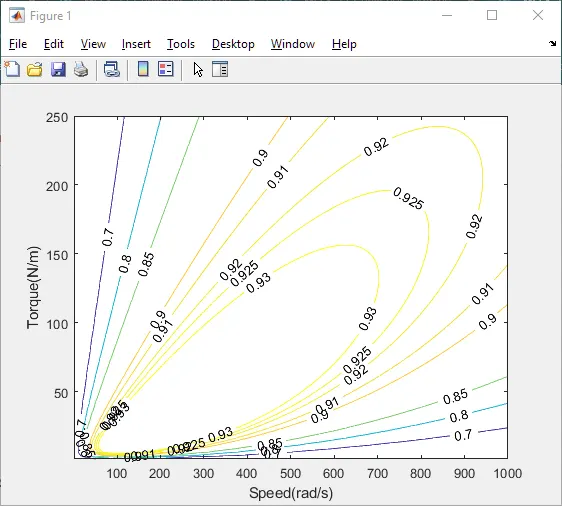
As from the above figure, we can see the output result, various efficiency values.