Week-11 Challenge: Braking
1.For a defined driving cycle, calculate the energy required for braking.
Driving Cycle:
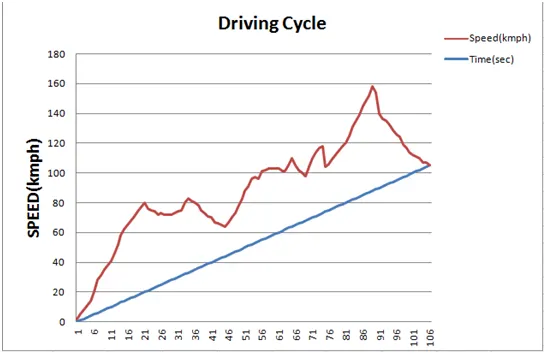
Driving Cycle is nothing but the Speed versus Time data curve. Transient driving cycles involve many changes, representing the constant speed changes typical of on-road driving. Modal driving cycles involve protracted periods at constant speeds. From the Time data and Speed curve of the vehicle will test the vehicle in typical case. Driving cycle is a design constant speed computation gives the instantaneous power.
Assuming the driving cycle upto 105sec of time and calculations of energy required for the braking are done in Google sheets.
google sheet
https://docs.google.com/spreadsheets/d/1XD7Jeg8ph-o5Y1Sd9-gxrllcWSMArgiv/edit#gid=1441741901
2.Electric motor can’t develop braking torque at high speed similar to starting? How electric and mechanical brakes are coordinated.
Torque: Torque is the measure of the force that can cause an object to rotate about an axis. Force is what causes an object to accelerate in linear kinematics. Hence, torque can be defined as the rotational equivalent of linear force. The point where the object rotates is called the axis of rotation. Torque can be either is static or dynamic. Static torque is a torque that does not produce an angular acceleration. The drive shaft in a racing car accelerating from the start line exhibits dynamic torque because it must be producing an angular acceleration of the wheels, given that the car is accelerating along the track.
Starting Torque: Starting torque is the maximum torque that can be produced by a motor in order to start rotational movement of the load.
Stall torque: Stall torque is the maximum torque that can be applied to the shaft and cause the motor to stop rotating. When there is no rotation in the motor, the wound coils are acting as a fixed resistance.
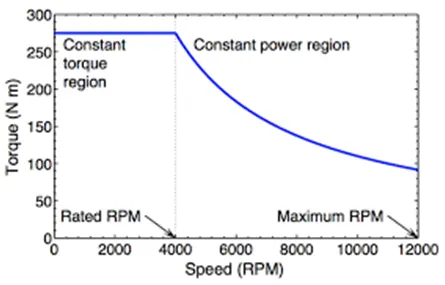
Electric motor can’t develop braking torque at high speed similar to starting because when the vehicle runs at constant speed is in the constant power region the motor torque will reduces gradually so that the motor can’t develop the braking torque. Peak torque during Acceleration and Deceleration is not equal. In peak torque acceleration increase and Deceleration decreases.
Electric and Mechanical Brakes are Coordinated:
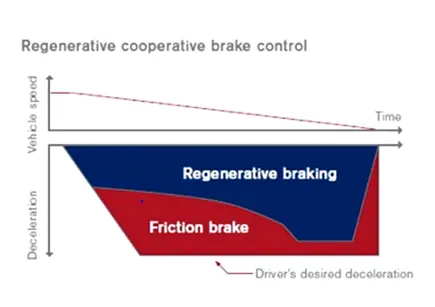
Braking: The Braking power requirement have identified the vehicle Deceleration condition which is similar to Acceleration condition. The total brake forces are classified as Electrical braking (Regenerative Braking) and Mechanical Braking.
The Electrical Braking or Regenerative braking to recharge their batteries as they’re being driven. Electric vehicles (EVs) run primarily off the charge they stored when plugged into an outlet, but use regenerative braking to help top up the battery. The Regenerative system all electrified vehicles have conventional braking systems as regular vehicles do. These use metal discs, called rotors, that are located behind the wheels and which turn with them. When you press the brake pedal, the pressure of hydraulic fluid squeezes metallic brake pads tightly against the rotors, and the resulting friction slows the car.
The Mechanical Braking system powers the hand brake or emergency brake. It is the type of braking system in which the brake force applied on the brake pedal is carried to the final brake drum or disc rotor by the various mechanical linkages like cylindrical rods, fulcrums, springs etc in order to stop the vehicle.
Limitations of Braking
1.The Braking torque of an Electric Vehicle Motor us not as high as the Acceleration torque and therefore the regenerative braking cannot happens so effectively that all power go back to the battery.
2.Based on the Battery where the battery can accept the typical charging current .
Braking Control Strategies:
Braking Control Strategies are two type 1.Series control strategy and 2.Parallel control strategy. In Series control strategy the brakes can apply either mechanical brake or regenerative brake at a time. The series control strategy further classified into comfort of driver and energy efficiency. In Parallel control strategy the brakes are apply both mechanical brake and regenerative brake simultaneously at a time.
Electric Driven Intelligent Brake (EDIB):
The Electric Driven Intelligent Brake is the combination of hydraulics braking and Regenerative braking. Parallel braking techniques initially have both regenerative braking and frictional braking. Whenever the speed of the vehicle reduces at low speed the braking torque is higher. The percentage share of frictional and regenerative braking is increases at lower speed.
3.MATLAB program which plots contour of given motor speed, torque and efficiency
clc
velocity = linspace(1,1000); % speed in rad/s
Torque = linspace(1,250); % Torque in Nm 0 to 40 Nm
Kc=0.2; % Kc copper losses coeffiecient
Ki=0.008; % for iron losses
Kw=0.00001; % for windage losses
ConL=20; % for constant motor losses
[X,Y] = meshgrid(velocity,Torque);
outputpower=(X.*Y);
copperlosses=(Y.^2)*Kc;
ironlosses=X*Ki;
windagelosses=(X.^3)*Kw;
inputpower = outputpower + copperlosses + ironlosses + windagelosses + ConL;
Efficiency = outputpower./inputpower;
V=[0.70,0.80,0.85,0.90,0.91,0.92,0.925,0.93];
box off
grid off
contourf(X,Y,Efficiency,V);
xlabel('Rotor speed (rpm)');
ylabel('Torque induced N.m');
zlabel('Efficiency')
title('Torque speed curve of induction motor with Efficiency values')
Output:
From above figure represents the Torque Speed of induction motor with Efficiency characteristics. The contour is a group of Efficiencies. These are the contour plotted by the matlab function. Here there is point on the typical characteristics. The inner most contour indicates the highest value of efficiency (x is283.5rpm, y is 94.06Nm, and efficiency is 92%) because where the height is maximum and height is reduces keep on going outward. The efficiency contour is increases from the outward to inward. The outermost contour the efficiency is 69%. This contour plot helps us to understand the motor efficiency in a typical format.