Week-11 Challenge: Braking
1) For a defined driving cycle, calculate the energy required for braking.
The drive cycle is created in excel with time, velocity is KMPH and m/s and energy is calculated and we used chart option and we got the drive cycle with respective time and velocity in KMPH. Now we have to find the braking energy so now we choosed the time were braking is done and then the energy of braking energy is calculated in KJ
velocity(m/s) = `(VELOCITY*1000)/3600`
ENERGY(KJ) = `(1/2*m*V^2)/1000`
Braking energy (KJ) = `(1/2*m*(V_1-V_2)^2)/1000`
Mass = 800kg
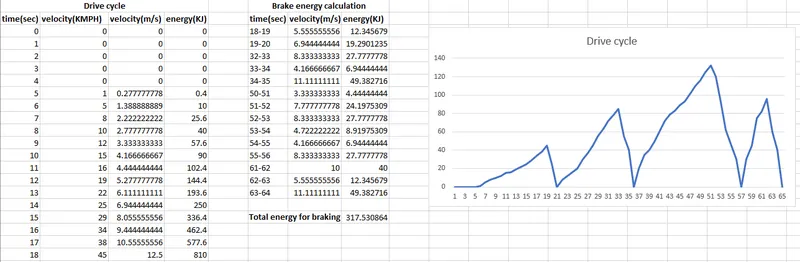
The braking energy required for defined drive cycle is 317.53 KJ
2) Why electric motor can’t develop braking torque at high speed similar to starting?
The electric motor cannot provide high braking torque at high speed this is due to some of the limitations in it.
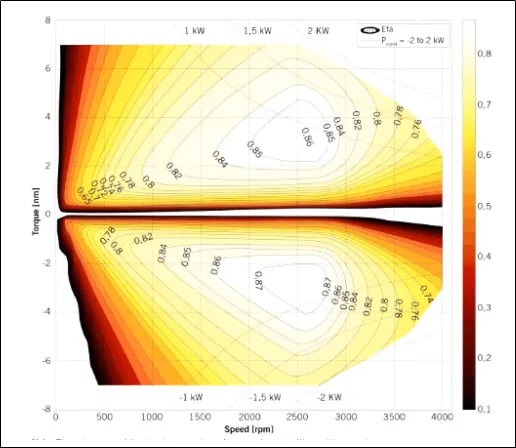
The above image is the speed torque characteristics electrical vehicle motor in first quadrant and second quadrant. In thre above image we can see that the torque required for motor during acceleration is higher that the torque required during braking so peak torque of acceleration and braking is not equal. so vehicle can reach top speed in less second due to high torque but vehicle cannot come to rest suddenly from top speed due to low braking torque. This is one of the limitations due to motor. There are other limitations due to battery also, during acceleration the discharing rate of battery is more than charging rate. Then the other limitation is also due to power converters.
How electric and mechanical brakes are coordinated?
Elecrical and mechanical brake can be coordinated by the system called parallel brake system were we use both mechanical braking and regenerative braking. For example we can take the Nissan leaf model
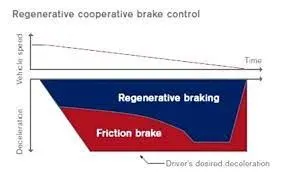
In the above picture we can see the both mechanical and electrical braking happens evenly during the initial condition(high speed) and at low speed electrical braking is higher than mehcanical braking this is because electrical braking will work effeicient in low speed. In this way we can coordinate both mechanical and electrical braking
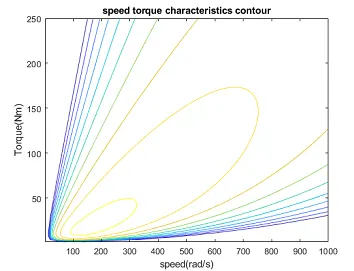
3) Make a MATLAB program which plots contour of given motor speed, torque and efficiency values. Attach the code as a .m file attach a screenshot of all the plots.
First the speed and torqu of motor is given. Then coefficient of losses like copper loss coefficient, iron loss coefficient, windage coefficient, constant are given. Then mesh grid is done. The output power of motor is calculated. Then all the losses is founded and the input power is also calculated. Then efficiency is founded. Then finally contour plotting is done.
clear all
close all
clc

%speed
w=linspace(1,1000);
%Torque
t=linspace(1,250);
%we also need to consider all losses
%Coppper loss coefficient
kc=0.2;
%iron loss coefficient
ki=0.008;
%winding loss coefficient
kw=0.00001;
%constamt loss
cons=20;
%meshgrid
[W,T]=meshgrid(w,t);
%motor power
power=W.*T;
%copper losses
Cl=(T.^2)*kc;
%iron losses
Il=W*ki;
%windage losses
Wl=(W.^3)*kw;
%Total power
Tpower=power+Cl+Il+Wl+cons;
%efficiency
eff=power./Tpower;
%efficiency for contour
E=linspace(0.75,0.95,10);
box off
grid off
contour(W,T,eff,E);
xlabel("speed(rad/s)");
ylabel("Torque(Nm)");
title("speed torque characteristics contour");
Plotting: