Week-11 Challenge: Braking
1) For a defined driving cycle, calculate the energy required for braking.
As we require to stop vehicle in stipulated time we cannot allow vehicle to stop as per its inertia value for stopping the vehicle we require to apply brake.Braking of vehicle require to decelerate vehicle to lower speed within a given time.
We take an example of Drive Cycle from excel(user defined)
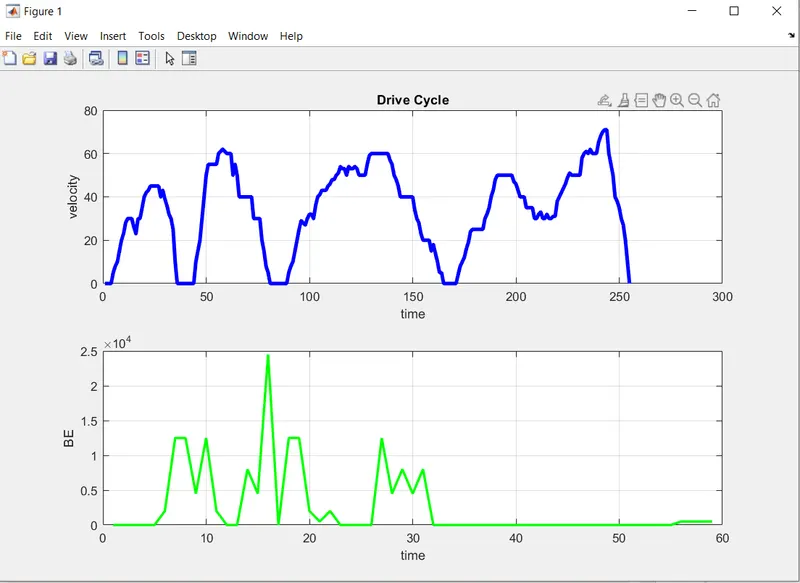
A driving cycle is a series of data points representing the speed of a vehicle versus time. Total Braking energy required for drive cycle is calculated.
The Kinetic energy of a vehicle is given by the formula
`E=1/2mv^2`
where m is the mass of vehicle and v is the speed at the start of braking.
If the vehicle speed decreases from inital velocity Vi to final velocity Vf then the required braking is given by formula
Braking energy required`=1/2m(V^2i -V^2f)`
Using this formula whenever deceleration occurs in the drive cycle the decrease in velocity, deceleration value, brake energy required calculated.
The Mass of the vehicle is assumed as 1000kg and 5% of vehicle mass is added as moment of inertia of all rotating parts in the vehicle.
clear all
close all
clc
% Parameter
drive_cycle =xlsread('drive cycle')
mass =1000; % mass of vehicle(kg)
t = drive_cycle(:,1); % time period
v = drive_cycle(:,2); % velocity data

for i = 1:(length(drive_cycle)-1)
    if v(i)>(i+1)
        B(i) = 0.5*mass*(v(i)-v(i+1))^2;
    end
end
fprintf('Brake Energy is %d',sum(B))
fprintf('Average Brake Energy is %d',mean(B))

% Plotting results
figure(1)
subplot(2,1,1)
plot(t,v,'linewidth',3,'color','b')
xlabel('time')
ylabel('velocity')
title('Drive Cycle')
grid on

subplot(2,1,2)
plot(B,'linewidth',2,'color','g')
xlabel('time')
ylabel('BE')
grid on

2) Why electric motor can’t develop braking torque at high speed similar to starting? How electric and mechanical brakes are coordinated?
When vehicle is required to start and accelerate at certain speed the high torque is required to a motor. As motor starts decelerating motor characteristics are shifted towards braking region and vehicle is at high speed, we dont have the max torque availble for braking as motor is already running and limit is reached by the motor operation and further torque could not be obtained. The braking operation happens in the motion which can be distributed as per proportion in the brake energy and regenerative braking. Due to this operation electric motor cannot develop braking high torque at high speed similar to starting torque.
Electric and Mechanical Brakes Coordination.
Electric motor don't have high capacity to handle all of the vehicle braking due to this mechanical brakes are used during initail braking time than regenerative braking. Once the braking torque starts to decrease the regenrative braking increased.
Control strategy:
Series Braking : In series braking mechanical brakes and regeneration brakes are applied one after the other. In this the brake torque is passed to brake control strategy block here the battery state of charge is checked depending upon the set of maximum permissible level of charge the battery is recharged.The brake torque is compared to maximum regenerative torque limit of the motor generator. If the overall brake torque is required is less than the maximum regenrative torque then the vehicle purely on regenrative torque and the battery is charged. If the overall brake torque required is greater thab the motor generator can provide then the mechanical brakes are applied.In a front driven car if the total torque required from front is less than regenerative torque capacity of motor generator torque the front braking is provided purely on regeneration and rear by mechanical braking. If the total brake torque required is more the front mechanical brakes are applied along with rear mechanical brakes and front regenerative brake to satisfy the overall brake torque.
Parallel Braking : In case of parallel braking mechanical brakes and regeneration brakes are applied simultaneously. The brake torque is passed on through the brake control strategy and get divided between regeneration and friction braking at all times. EBID(Electric driven intelliget brake) is a parallel braking technique which is developed by Nissan leaf which uses a combination of both mechanical and regenerative brake.During low speed regenrative braking is higher and at high speed its a combination of both.
As deceleration torque is less thab the acceleration torque and the braking torque of electric vehicle is not high as compared to acceleration torque we cannot get all power back to battery.
clear all
close all
clc

omega = linspace(0,1000);
torque = linspace(0,200);
% Motor loss conatants
% for copper loss

k_c = 0.2;
% for iron loss
k_i =0.008;
% winding loss
k_w = 0.00001;
% for conduction loss
c_l =20;

% Making 2d matix
[T,W] = meshgrid(omega,torque);

% output power = torquexspeed
out_power = (T.*W);

% Copper loss
b =(W.^2)*k_c;

% Winding loss
c = (T.^3)*k_w;

% Iron loss
d = T*k_i;

% therefore for input power
In_power = out_power+b+c+d+c_l;

% Efficiency
E = out_power./In_power;

% Efficiency level for contour
e =[0.70,0.80,0.82,0.87,0.89,0.90,0.92];

% Creating contour
contourf(T,W,E,e);
xlabel('Speed')
ylabel('Torque')
title('Contour for motor speed torque and effciency')
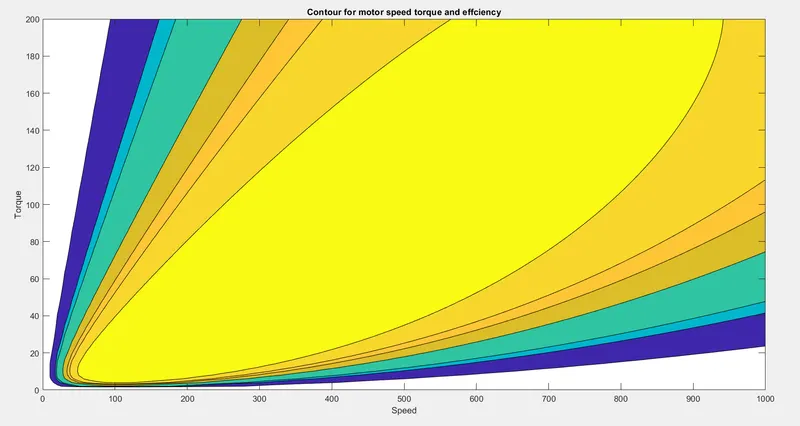
The inner most contour has the highest efficiency i.e for the values in this contour the value of efficiency is same.