Week-11 Challenge: Braking
Objectives:
- For a defined driving cycle, calculate the energy required for braking.
- Why electric motor can’t develop braking torque at high speed similar to starting? How electric and mechanical brakes are coordinated?
- Make a MATLAB program which plots contour of given motor speed, torque and efficiency values. Attach the code as a .m file attach a screenshot of all the plots.
SOLUTIONS:
1) The driving cycle data and the graph is given below:
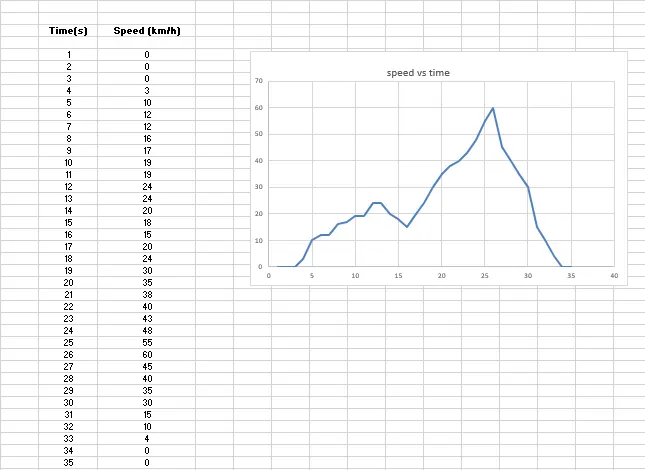
Consider one of the cases from the drive cycle where the car deccelerates from 24 km/h to 12 kmph in 5 seconds. The energy can be calculated as:

The power required for braking is calculated as energy required for unit amount of time.
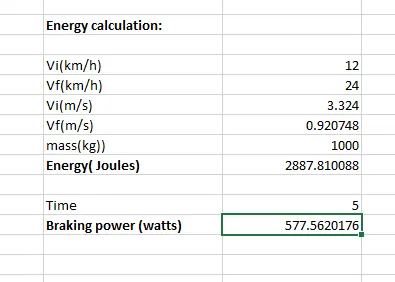
The power required for the above case is approximately 577 watts.
2)
The maximum regenerative braking force produced by an electric motor is closely related to the electric motor’s speed. At lower speeds (lower than its base speed), the maximum torque is constant. However, at high speed (higher than its base speed), the maxing torque decreases hyperbolically with its speed. Therefore, the mechanical brake torque at a given vehicle deceleration varies with vehicle speed. At high speeds, the torque will be less & operates at constant power region hence it is difficult to bring the vehicle to rest or decelerate immediately. The peak acceleration torque is greater than the peak deceleration torque. Hence Braking torque of EV motor is not as high as acceleration Torque.
Coordination of Electric and Mechanical Brake :
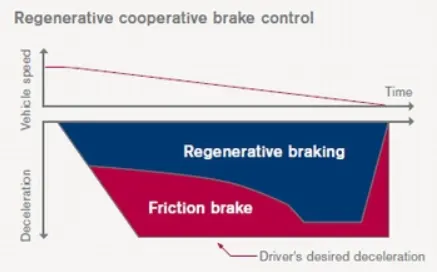
In an electric Motor, the Total Brake distribution is in two aspects which are Electrical Brake which is called Regenerative Brake, and Mechanical Brake or Classical Brake with a hydraulic cylindrical system. Brake Force distribution must be uniform, If the Regenerative braking power requirement is more than the charging limit of the battery or more than the regenerative capacity of the machine we must apply Mechanical brakes as well. In a practical case, the combination of these two is applied. So usually it is a combined response of Mechanical brake and Regenerative brake. The reason for how this braking force is combined, that particular phenomena are called Brake Control Strategies. There are two Brake Control Strategies, which are Series - In case of Series, Mechanical and Regenerative electric brakes are applied one after another. The Series Brake Control Strategy has a further classification,based on the preference of comfort of the driver or Brake behavior compared to energy efficiency. Parallel - In the case of Parallel, both brakes are applied simultaneously. Electric Driven Intelligent Brake (EDIB) is a combination of Hydraulic brake or Mechanical brake along with a Regenerative brake. It is a Parallel braking technique. The Control criteria is such that at lower speeds, regenerative braking is dominant and at higher speeds, both are combined to deliver the required braking energy.
3) A range of speed and torque values are considered. The iron, copper, windage and other constant conduction losses are considered for evaluating the efficiency.
close all
clear all
clc
omega=linspace(0,1000) %rpm
T=linspace(0,300) % torque (N.m)
% loss coefficients
kc=0.2       % copper loss coeff
ki=0.008 % iron loss coeff
kw=0.0001 % windage loss coeff

[X,Y]=meshgrid(omega,T)
copper_losses=(Y.^2)*kc
iron_losses=X.*ki
Windage_losses=(X.^3)*kw
con=20 % constant conduction loss

o_p =X.*Y  % ouput power (T.w)

input_power = (copper_losses)+(iron_losses) +(Windage_losses)+(o_p)+(con)
Eff=(o_p)./(input_power)
n=linspace(0.7,0.95,10)
grid off
box off
contourf(X,Y,Eff,n)
colorbar
xlabel('rotor rpm')
ylabel('Torque')
zlabel('Efficiency')
title('torque speed efficiency curves')
The plot obtained is shownn below:
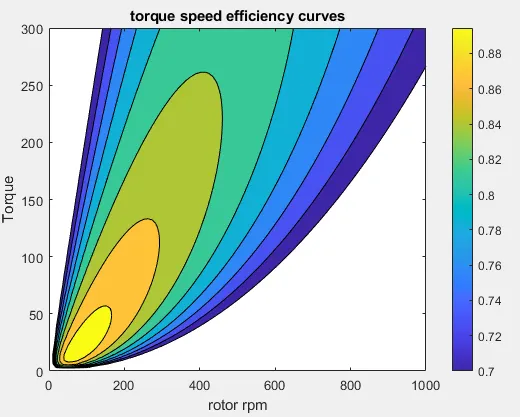
Notice that the central region(yellow) is the most efficient region followed by the surrounding regions as shown.