Week-11 Challenge: Braking
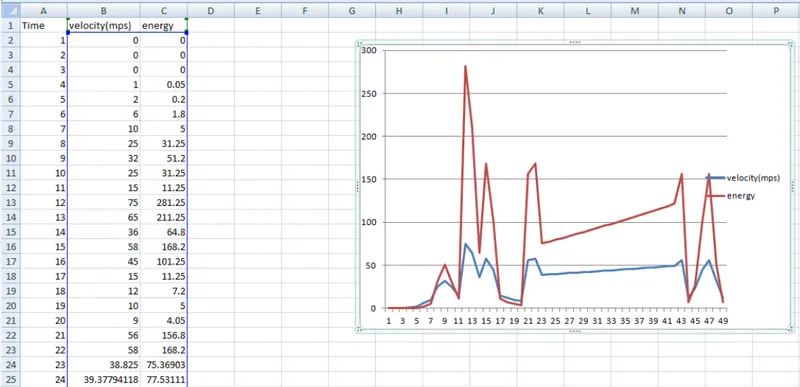
1.For a defined driving cycle, calculate the energy required for braking.
The driving cycle is a series of data points representing speed of the vehicle vs the time of the vehicle.
Mass = 1000kg (assumed)
where,
Energy = `(1/2)*m*v^2`
Here the maximum energy required is 270J as shown in the below graph.
2.Why electric motor can’t develop braking torque at high speed similar to starting? How electric and mechanical brakes are coordinated?
Mechanical Brakes: Now a days in all vehicles, we can observe both normal brakes and hand brakes. Normal brakes are used to stop the vehicle at higher speeds and lower speeds. Hand brakes are used to stop the vehicle at parking spot. These are used for lower speeds. Hand brakes are used when service brakes(normal brakes) doesn't function. These brakes are hydraulic in nature. These are directly connected the tyres of the vehicle.
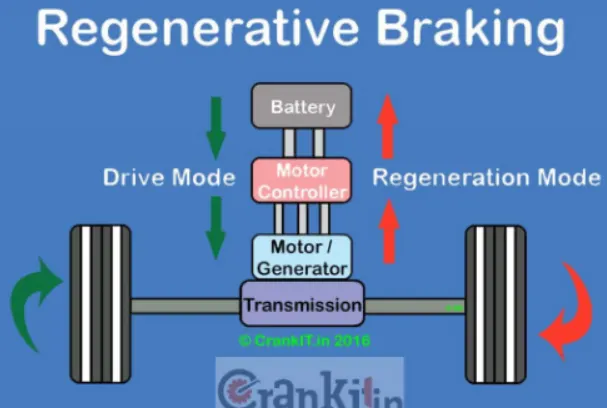
Regenerative Braking: Regenerative braking stores energy in the form of kinetic energy during acceleration. When the brakes are applied the energy is dissipated in the form of heat or used as stopping the vehicle. The energy is typically too high. Regeneration can save a significant portion of energy, extending the range of a vehicle. The motor acts as a generator when it is reversed. Thus, energy is reversed and goes to source. As it runs as a generator, car speed reduces with regerative resistance of the electric motors. Thus slowing down of speed is done using regenerative braking.
Electric motor can't develop high torque during high speeds. Initially the torque is high when the motor is on and the speed is low. Here the torque attains maximum and run the vehicle. Since the speed and torque are inversely proportional to each other, we can say that at high speeds, the torque is decreased and cannot operate further. But when the speed is already high and no extra load is applied it is not possible to increase the torque. Initially, the constant develops, further the vehicle attains in contain power region where braking torque cannot be applied. Thus, electric motor can't develop high torque during high speeds.
Electric and mechanical brakes are coordinated to stop the vehicle by two strategies:-
Series: In this strategy, either regenerative braking or mechanical braking is used. Brakes are applied one after other. Thus, we can say as series strategy.
Parallel: Both the brakes are applied simultaneously to stop the vehicle. EDIB(Electric Driven Intelligent Braking) is a combination of mechanical and electric brake. It controls the reactive force from the pedal in order to unify the feeling when stepping down th pedal and sense the deceleration.
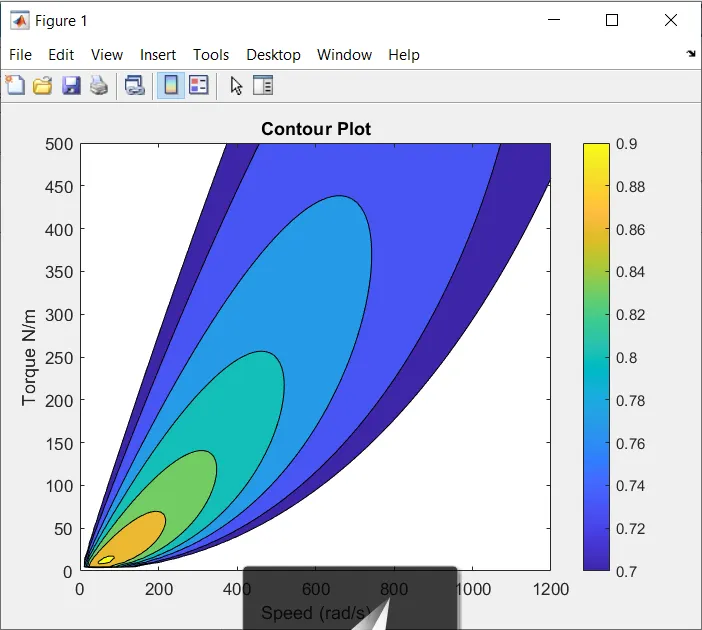
3.Make a MATLAB program which plots contour of given motor speed, torque and efficiency values. Attach the code as a .m file attach a screenshot of all the plots.
MATLAB CODE -
clear all
close all
clc

%speed and torque values
S = linspace(0, 1200); %speed array
T = linspace(0,500);   %torque array

% converting into matric form
[X, Y] = meshgrid(S, T);

% calculating the values
OP = (X.*Y);
Kc = 0.3;
Ki = 0.008;
Kw = 0.0001;
C = 10;

% calculating the Losses
CL = Kc.*(Y.^2);
IL = Ki.*X;
WL = Kw.*(X.^3);
TL = CL + IL + WL + C;

% calculating input power and efficiency
IP = OP + TL;

E = OP./IP;

%plotting the graph
V = [0.7, 0.73, 0.77, 0.8, 0.83,0.86,0.9];
contourf(X, Y, E, V)
colorbar
title('Contour Plot');
xlabel('Speed (rad/s)');
ylabel('Torque N/m');
zlabel('Efficiency');
GRAPH PLOT -