Week 11 Car Crash simulation
Objective :-We will have to perform a parametric study using three different values of thickness for the car body.Analyse the total deformation and Equivalent stresses acting on the model.
Different Cases based on the thickness of the Car Body will be as given below:
CASE_1: Thickness 0.3 mm
CASE_2: Thickness 0.5mm
CASE_3: Thickness 0.6mm
Procedure :-
- We will carry out the Frontal Impact Test using the Explicit Dynamics Analysis System.
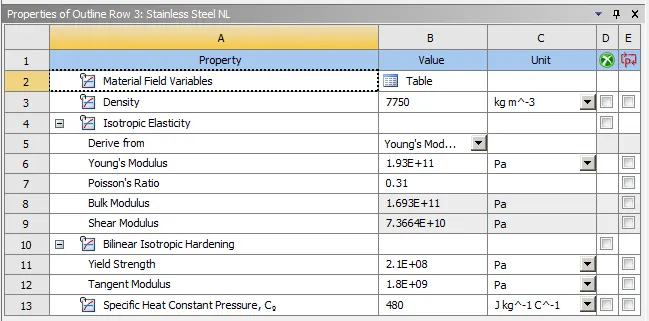
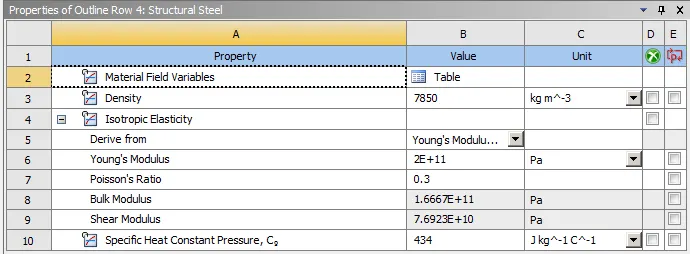
- This project involves a Car Body and Wall we used Stainless steel NL as material for the car body and Structural steel for the wall.
Material properties of Stainless steel NL
Material properties of Structural steel
-
Now we upload the model to the geometry and open it in space clam and see if there are any discontinuities in the model.Update the model to the mechanical module.
- The model involves a Car Body and a Wall.Car body is assigned with a thickness of 0.3mm.We will carry out parametric study for the different thicknesses of the car body.
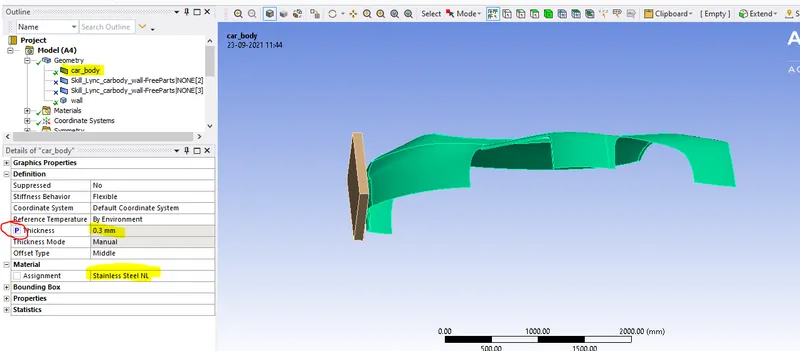
- For the Explicit dynamic analysis we are not intrested in the contacts so we delete the contacts.
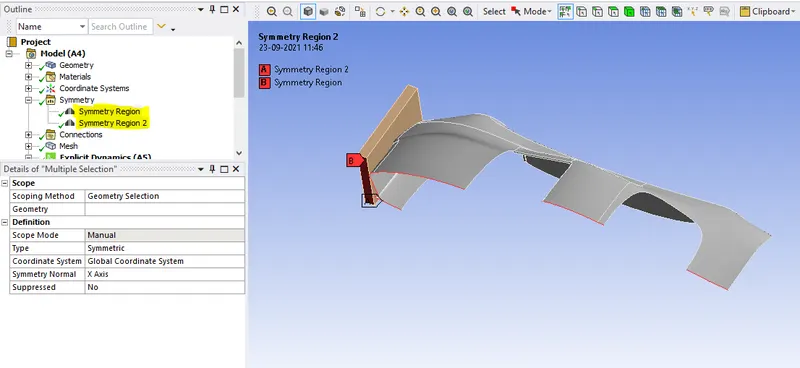
- Symmetry Region is provided to one of the side face of the wall.Another symmetry region is used for the edges of the car.
Mesh
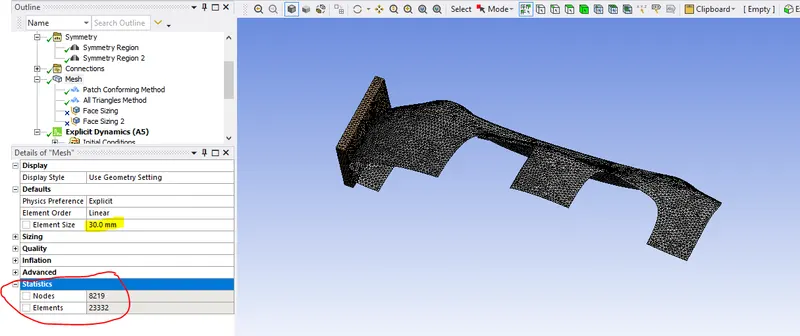
- we add a tetrahedrons method to the wall and triangles method to the car body with an element size of 30mm to the both car_body & wall.
Analysis Settings
- End time- 0.01
- Maximum Energy Error- 0.1
- Maximum Number of Cycles:1e+07
- Initial,Minimum & Maximum Time step- Program Controlled.
Boundary Conditions
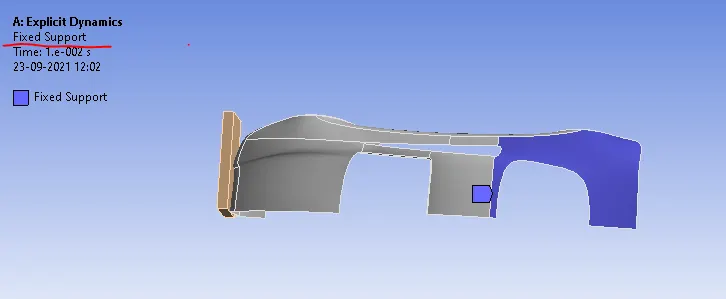
Fixed Support (For CASE_1, 2, & 3):
- Keep Rear face of the Car Body as a fixed to hold it while the Wall is impacting on the Frontal portion of the Car Body.
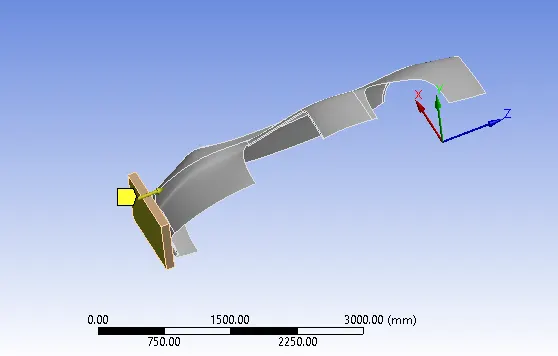
Displacement (For CASE_1, 2, & 3):
- Apply Displacement to the Rear face of the Wall in the positive Z-Direction as given below:
Parametric Study:
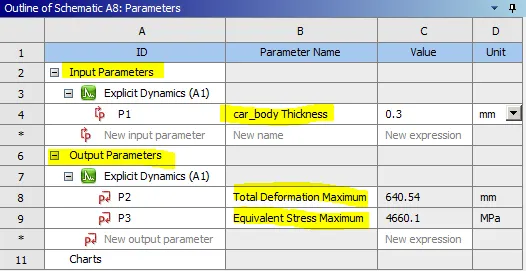
For Parametric study of the Car Body on different thickness, assign parameter to the following parameters for Input as well as Output.
- Input Parameter: Thickness
- Output Parameter = Total Deformation & Max. Equivalent Stress
Results:
- Now we will see all the results for CASE_1, CASE_2 & CASE_3. On updating all the Design Points, we can get all the Output results in Parameter set as given below:
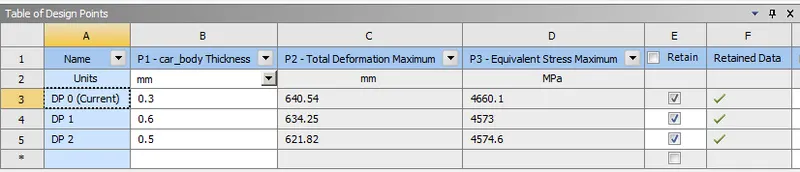
- By giving “Set as Current”, we can see all the results in details as given below:
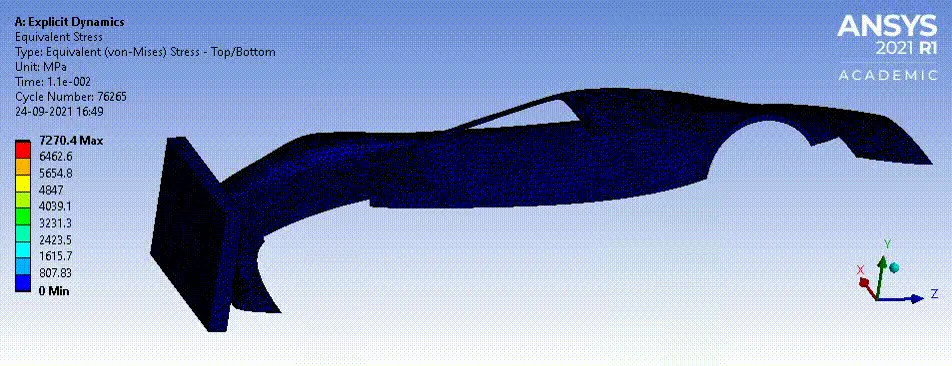
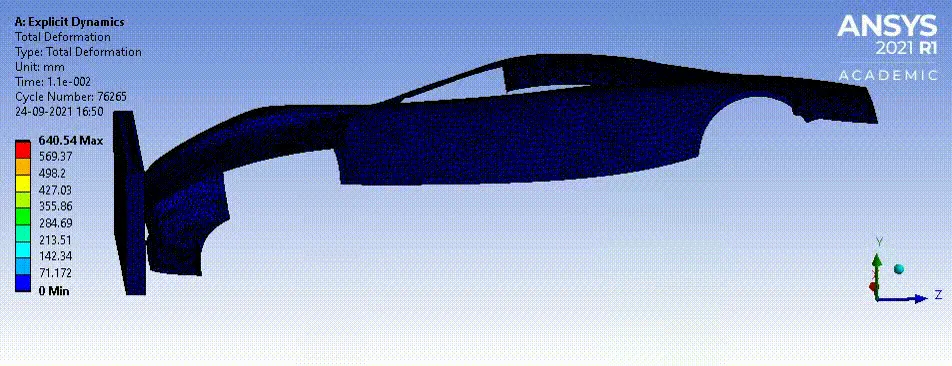
CASE_1 (Thickness = 0.3 mm)
Equivalent Stress
Total deformation
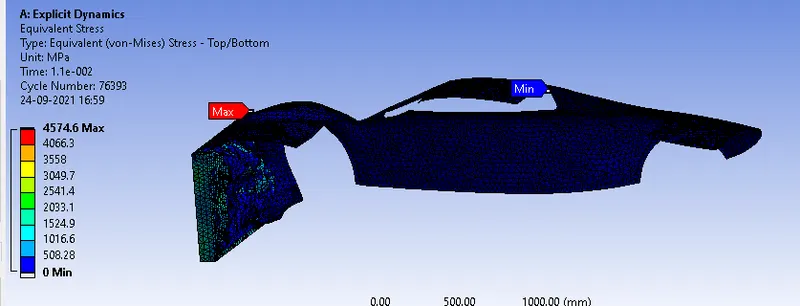
CASE_2 (Thickness = 0.5mm)
Equivalent Stress
Total deformation
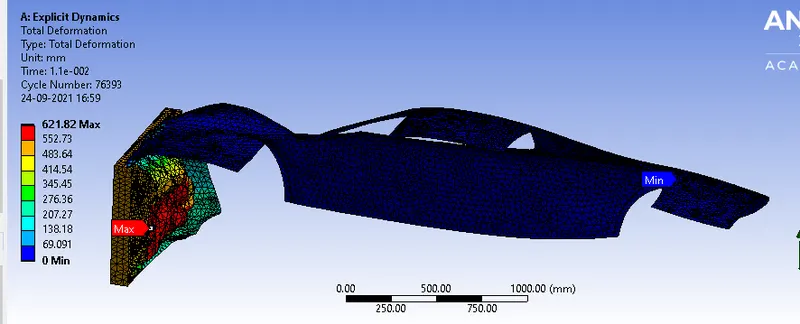
CASE_3 (Thickness = 0.6mm)
Equivalent Stress
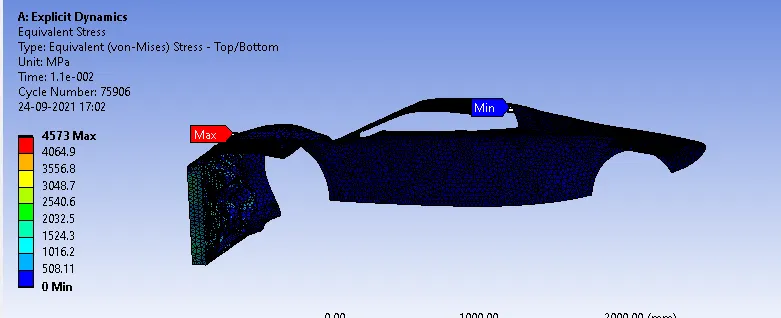
Total deformation
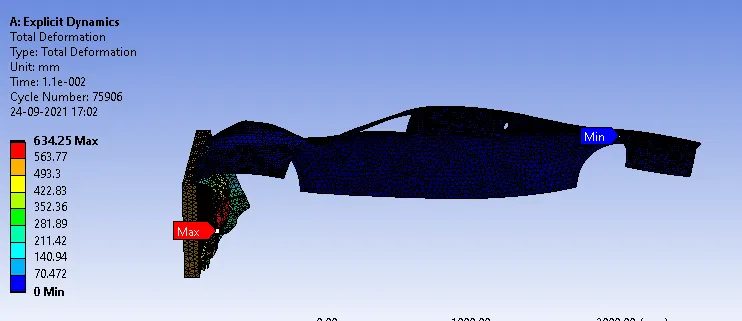
Conclusion
From the above table we can observe that increasing the thickness of the material will result in less deformation.But on the other side if we increase the thickness the weight of chassis will increase and inturn reducer the efficiency of engine.Thus we need to select the thickness depending upon the safety factor for any vehicle.
google link
https://drive.google.com/file/d/1erwyKvqy1yZ4bO18SztyRDzn2A2D7yMK/view?usp=sharing