Car Crash simulation
OBJECTIVE:
To perform a frontal car crash simulation using explicit dynamics and perform a parametric study for the thickness of car body for the values 0.3,0.5and 0.7mm.
THEORY:
Crashworthiness is the ability of a structure to protect its occupants during an impact. This is commonly tested during the safety of aircrafts or vehicles. Depending on the nature of impact and the vehicle involved different criteria’s are followed.Crashworthiness can be assessed either by using computer softwares such as Radioss,LS-Dyna,,or through experiments. Several criteria are used to asses crashworthiness prospectively including the deformation pattern of the vehicle structure , the acceleration experienced by the vehicle , the force transfer to various links of BIW etc.Injury criteria is defined using various mechanical parameters like force, acceleration or deformation.
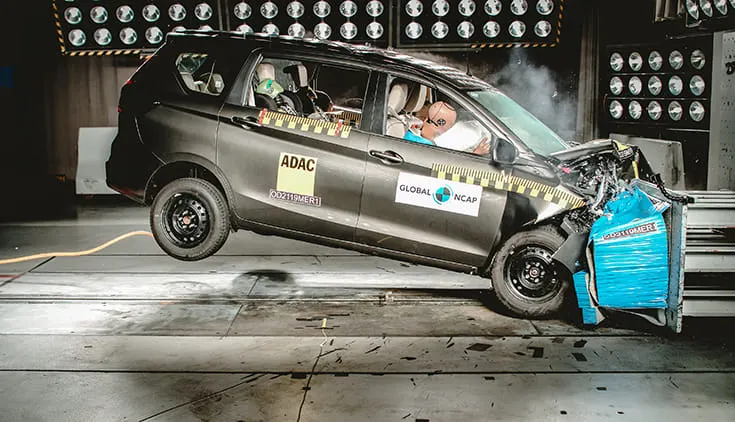
The full frontal fixed barrier crash test represents a vehicle to vehicle full engagement with each part moving with the same velocity. A schematic of the test is shown below.This test is intended to represent most real time crashes which includes both vehicle - vehicle and vehicle- fixed object with a significant frontal engagement in a perpendicular impact direction
MATERIAL USED:
PROCEDURE:
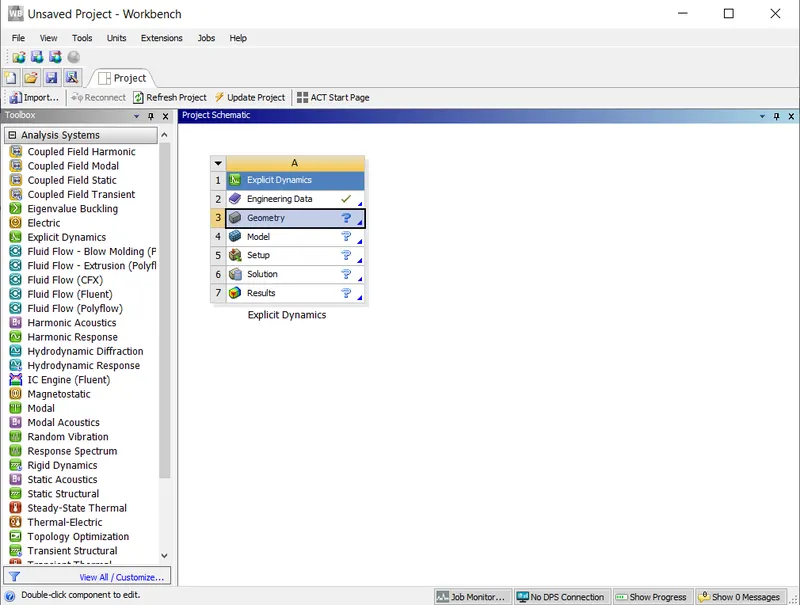
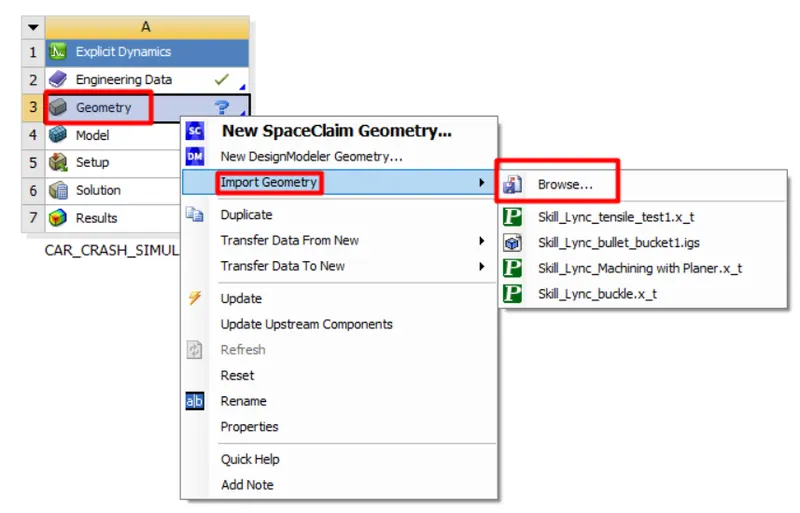
1.We import the explicit dynamics module into Ansys workbench,this can be done by simple drag and drop.
With the ANSYS Explicit Dynamics module, the user can perform transient explicit dynamic analyses. These types of analyses are used to determine the behaviour of a geometry
1. When a stress wave propagates through it during the events such as an impact or a drop or
2. During the presence of loads which are rapidly changing and time-dependent.
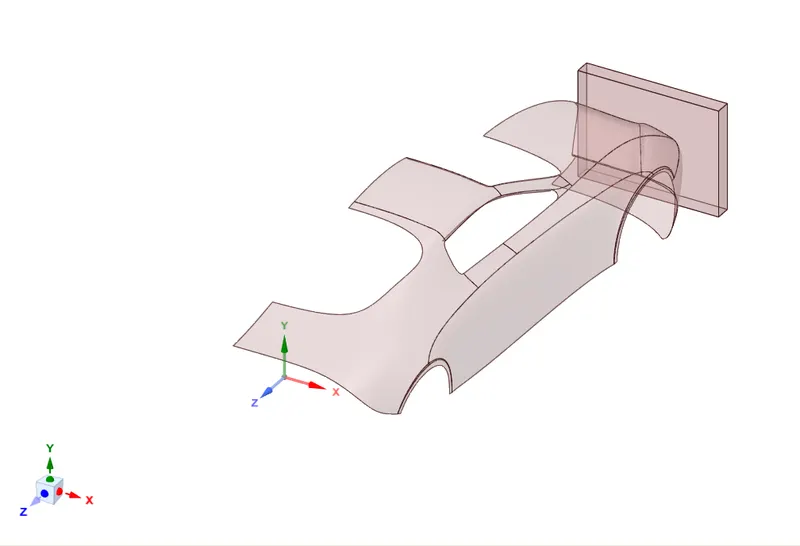
2.Import the cad geometry into explicit dynamics system. Now we open the model in SpaceClaim to check for any errors
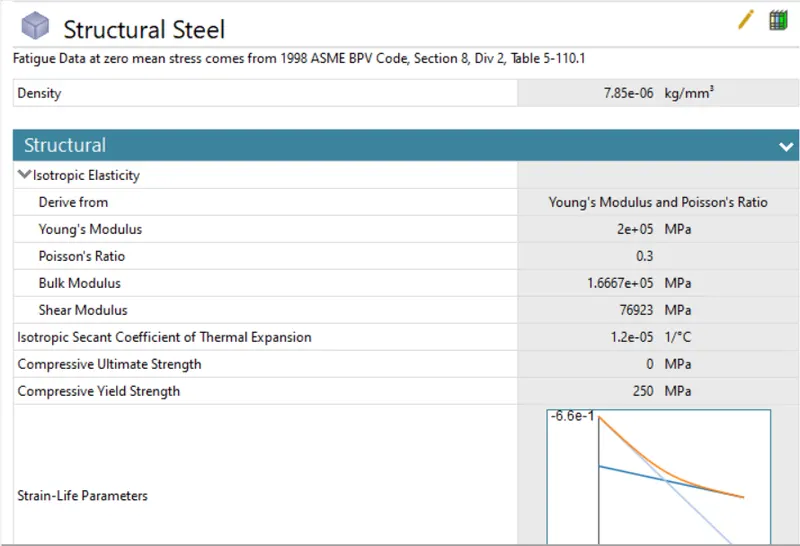
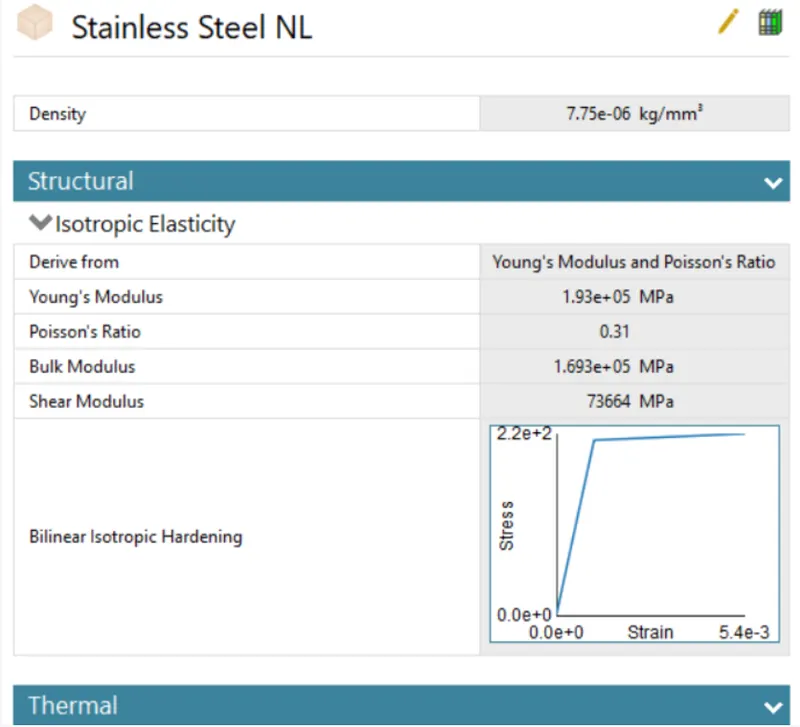
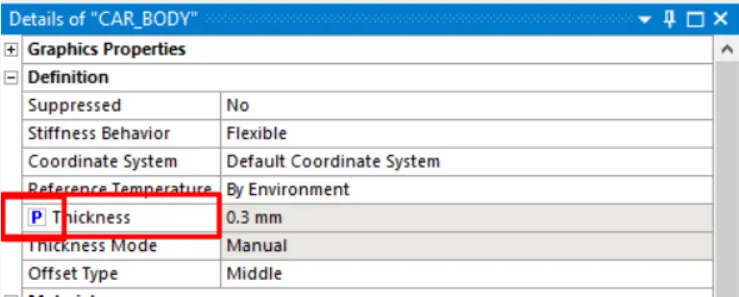
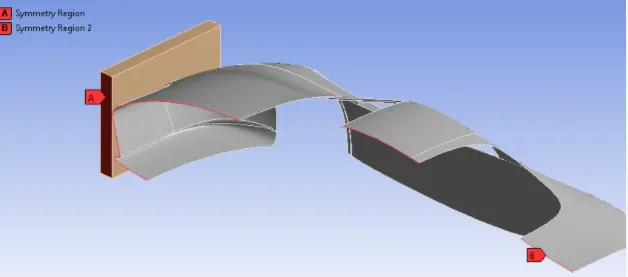
3.Assign the materials and thickness to the car body in the mechanical model cell and apply symmetry region to car body as shown below. A thickness of 0.3, 0.6 and 0.9 mm was taken for car body by assigning parametric(P) for thickness.
4. Delete all the contact set by default.We just keep the default body interactive with contact detection as trajectory. If you set the contact detection to Trajectory the solver will track the trajectory of each node and face that are in initial contact or which come in contact as the solving proceeds.
5. Meshing: The car rear body was first meshed using face sizing of element size 300 mm and later the whole car body was meshed using triangular method .The wall was meshed using the tetrahedron method. An element size of 300mm was used for meshing the car body.
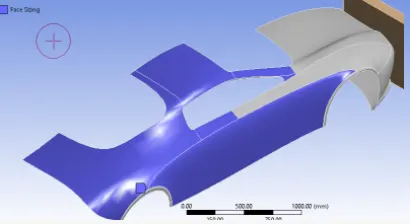
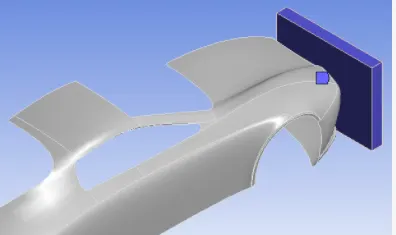
Face sizing Tetrahedron method (wall)
6. Analysis setting: Now we have to define the analysis settings under the explicit dynamics module
- End time for this simulations was 0.001 sec
- Maximum energy error: 0.1
- Initial Time step: Program Controlled
- Minimum Timestep:Program Controlled
- Maximum Time Step:Program Controlled
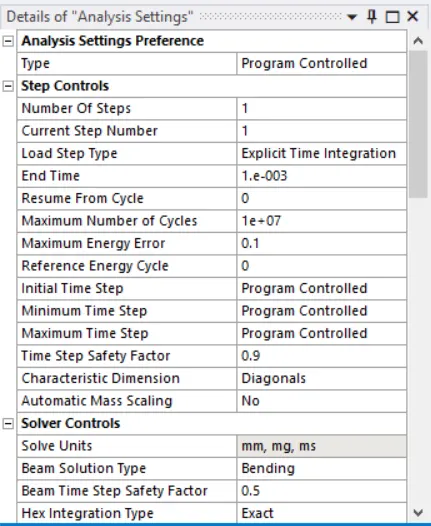
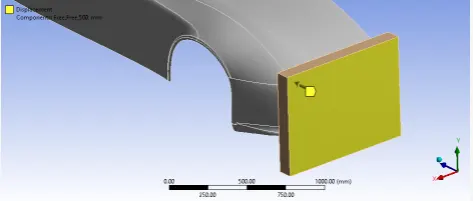
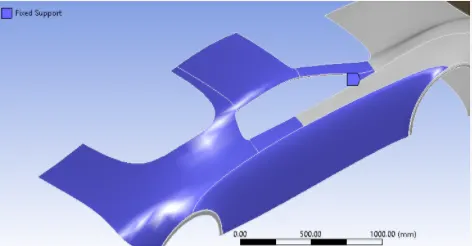
7.Boundary conditions: A fixed support was given to the rear face of the car body to take the impact and displacement of 500mm given to the wall in z-direction.
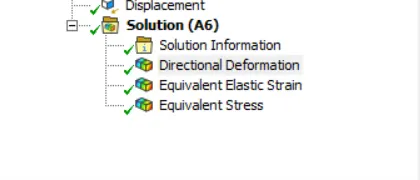
Now we request the required outputs in the solution panel and run the analysis
RESULTS:
We had initially given the thickness i.e input parameter as 0.3 hence we get to view the simulation for that corresponding thickness
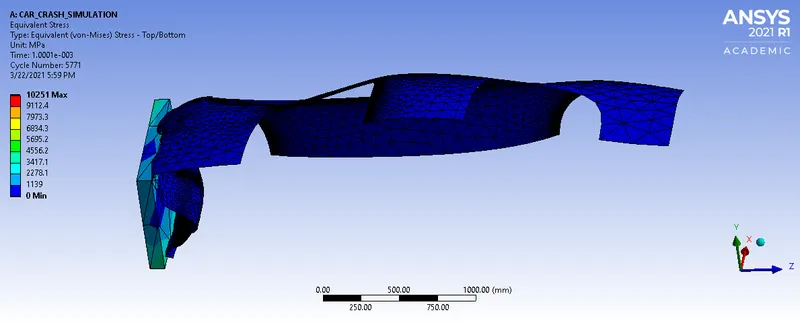
Equivalent Stress
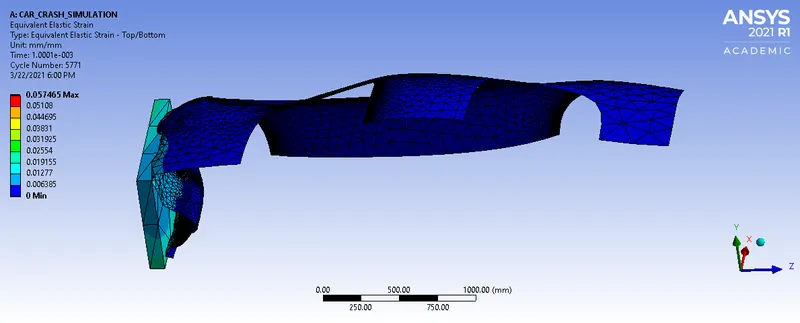
Equivalent Elastic Strain
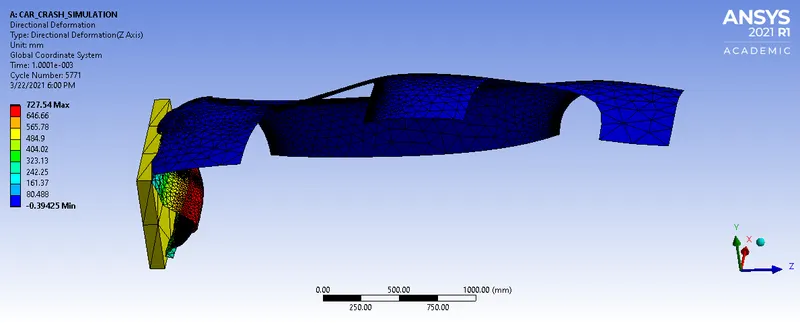
Directional Deformation
As we have set the input parameter we also have to set the respective output parameters to be calculated.On updating the design points we get all the values corresponding to each design points

CONCLUSION
• The car crash simulation was set up and all test cases ran successfully
• From the above results we can conclude that deformation is decreasing and stress is increasing to a small extend as an increase in the thickness of the Car Body.
•In case-3 as the thickness is 0.7mm the directional deformation and total deformation is less compared to the case-1 and case-2 but it is too small to consider for a design hence from the results obtained the 0.3 mm thickness car body design is safe for manufacturing.