Week 10 Thermal Management
Electric vehicles use large batteries to store energy. The energy flowing into the battery pack as it is charged either from regenerative braking or from the grid and discharged from the pack to power the vehicle and its accessories is measured by electrical current and voltage. The flow of current causes heating in the battery cells and their interconnection systems are proportional to the square of the current flowing multiplied by the internal resistance of the cells and the interconnect systems. The higher the current flow the more the heating effect will be. At AVID we design and manufacture lithium battery systems you can find out more about that here.
The performance of Lithium-Ion battery cells is greatly impacted by their temperature, they suffer from the Goldilocks effect, they do not perform well when too cold or too hot, which can lead to permanent and extreme damage of the cells or accelerated degradation. So in addition to cooling, heating of the cells may also be required at lower ambient temperatures to prevent damage during fast charging when the cells are too cold; this is because the internal resistance of the cells rises when they are cold. Most lithium battery cells cannot be fast-charged when they are less than 5oC and cannot be charged at all when they are below 0oC. Lithium cells also begin to degrade quickly when their temperature is above 45oC.
In the past, the largest battery packs did not necessarily need any special cooling as the physical size of the packs was sufficient and the relative flow of current was not large compared to the overall capacity of the pack. As ever faster battery charging rates are demanded with recharge power of over 200kW to deliver times of 30 minutes or less, higher performance electric vehicles with a requirement for consistent performance and adequate durability in global markets has meant that special thermal management methods for the battery pack are now required.
Active Air-Cooling
The active air-cooling strategy uses a fan with forced air passed over the batteries to remove heat. This strategy extends the lifetime of the battery pack compared to passive cooling as it keeps the batteries at a more consistent operating temperature. It is cheaper and lighter than liquid cooling and is more manageable to design because it does not have to interface with the other cooling networks in the vehicle. However, it can be challenging to develop battery packaging and mounting for airflow. Bracing and mounts can get in the way of airflow, and it can be challenging to distribute the airflow to maintain a uniform temperature. Using modeling techniques such as Computational Fluid Dynamics (CFD) or fluid nodal networks helps engineers solve these problems, but they can be tricky to overcome given the size and weight restrictions associated with designing a vehicle. Even though active air cooling is better than passive cooling at maintaining optimal operating temperatures, the most effective way to keep a uniform temperature within a pack and meet warranty requirements is liquid cooling.
Liquid Cooling
Liquid cooling is the most effective way to remove heat from the battery pack. It is also better than active air cooling at keeping the battery pack within optimal operating temperatures. Designing a system that cools all of the batteries uniformly leads to better battery performance and lifetime. Liquid cooling also allows the battery pack to be operated with higher peak power loads because it dissipates more heat than other cooling methods.
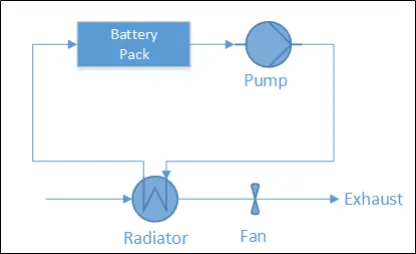
There are three main approaches to liquid cooling: serpentine ribbon-shaped cooling tubes, cooling plates with cooling channels inside them, and direct/immersive cooling. The cooling tube approach is the most effective at maintaining uniform cell temperatures but is more challenging to manufacture and can result in higher pressure drops. The cooling plate approach is reasonably simple to implement but can lead to large temperature gradients across individual batteries. The direct cooling approach may present the most effective means of heat removal but is relatively new and requires expensive dielectric coolants instead of conventional cooling fluids.
Thermo-electric Module
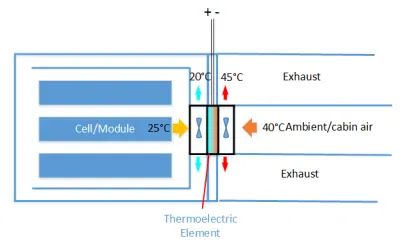
To improve the cooling/heating power of passive air systems, there are two possible upgrades. One is through thermo-electric modules, which will be introduced here. The thermoelectric module can convert the electric voltage to temperature difference and vice-versa. Here the former effect is adopted. That means it transfers heat through the module by consuming electricity directly. Two fans are installed to improve heat transfer by forced convection. To combine a passive air system with the thermoelectric module, the combined system is able to cool down the battery even lower than the intake air temperature, but the power is still limited to around some hundreds of watts and less than one kW. It’s easy to switch between cooling and heating operations. To achieve that, the poles of electrodes need to be reversed.
Heat Pipe
Besides thermo-electric modules, a heat pipe is another way to upgrade passive air systems. The flat copper envelope of the heat pipe was under partial vacuum. The capillary structure is made of sintered copper powder.
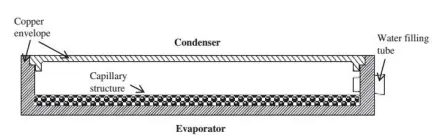
The heat pipe uses water as the working fluid. Water on the evaporator side will absorb heat and become vapour lower 100°C due to low pressure inside. Water on the condenser will dissipate heat to the surrounding and become liquid again. This cycle repeats again and again.
CONCLUSION
Batteries play an increasingly critical role in renewable energy usage and storage. As an example, the performance of EVs and HEVs are highly dependent on battery capacity. Battery thermal management systems (BTMS’) are developed to monitor and optimize the thermal status of batteries. The battery temperature is a critical factor for battery operating performance.
Thermal management of the battery pack is equally important as BMS. Here we got an overview about different types of thermal management techniques for the electric car battery pack.