Week 10 - Simulating Combustion of Natural Gas.
Aim: - To perform a combustion simulation on a combustion model and effect of addition of water in fuel on soot formation.
Objective: -
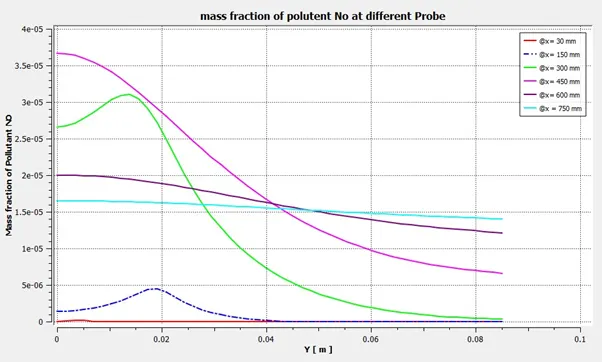
- To plot the variation of the mass fraction of the different species in the simulation at different location of the combustion model along with soot formation and NOx emission.
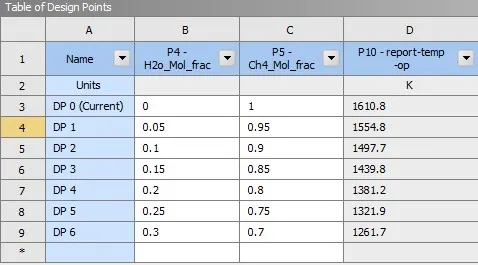
- To add water content in the fuel i.e., 0-30 % by mole and observe its effect on formation of soot and NOx pollutants emission.
Theory: -
Combustion –
It is a reaction in which a substance reacts with oxygen from the air. Combustion reactions happen at high temperatures, and transfer energy to the surroundings as light and heat.
One important combustion reaction is that of methane. Methane reacts with oxygen from the air and produces either a hot blue or an orange flame. The energy that the reaction produces can be used to heat water, cook food, generate electricity or even power vehicles.
The products of combustion reactions are compounds of oxygen, called oxides. Since methane is made up of atoms of carbon and hydrogen, the products of its combustion reaction are oxides of carbon and hydrogen. The names of these oxides are carbon dioxide and water.
Combustion of methane is a multiple step reaction summarized as follows:
CH4 + 2 O2 → CO2 + 2 H2O (ΔH = −891 kJ/mol, at standard conditions)
Peters four-step chemistry is a systematically reduced four-step chemistry that explains the burning of methane.
- CH4 + 2H + H2O --> CO + 4H2
- CO + H2O <--> CO2 + H2
- H + H + M --> H2 + M
- O2 + 3H2 <--> 2H + 2H2O
Chemical Reaction Models –
Chemical reaction models transform physical knowledge into a mathematical formulation that can be utilized in computational simulation of practical problems in chemical engineering. Modeling of a chemical reaction involves solving conservation equations describing convection, diffusion, and reaction source for each component species.
Species Transport Equation –
When you choose to solve conservation equations for chemical species, ANSYS FLUENT predicts the local mass fraction of each species, Yi, through the solution of a convection-diffusion equation for the ith species. This conservation equation takes the following general form:

where Ri is the net rate of production of species i by chemical reaction and Si is the rate of creation by addition from the dispersed phase plus any user-defined sources. An equation of this form will be solved for N-1 species where N is the total number of fluid phase chemical species present in the system. Since the mass fraction of the species must sum to unity, the Nth mass fraction is determined as one minus the sum of the N-1 solved mass fractions. To minimize numerical error, the Nth species should be selected as that species with the overall largest mass fraction, such as N2 when the oxidizer is air.
The reaction rates that appear as source terms are computed in ANSYS FLUENT, for turbulent flows, by one of three models:
- Laminar finite-rate model: The effect of turbulent fluctuations is ignored, and reaction rates are determined by Arrhenius kinetic expressions.
- Eddy-dissipation model: Reaction rates are assumed to be controlled by the turbulence, so expensive Arrhenius chemical kinetic calculations can be avoided. The model is computationally cheap, but, for realistic results, only one or two step heat-release mechanisms should be used.
- Eddy-dissipation-concept (EDC) model: Detailed Arrhenius chemical kinetics can be incorporated in turbulent flames. Note that detailed chemical kinetic calculations are computationally expensive.
The generalized finite-rate formulation is suitable for a wide range of applications including laminar or turbulent reaction systems, and combustion systems with premixed, non-premixed, or partially-premixed flames.
Case Setup: -
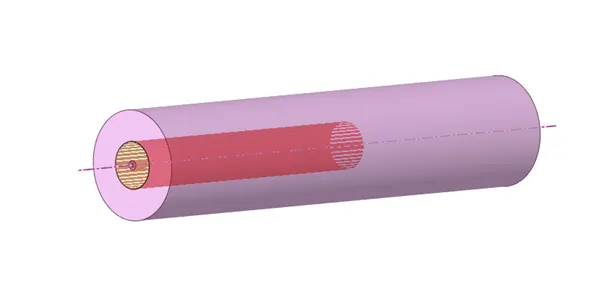
Model – Mid Section View
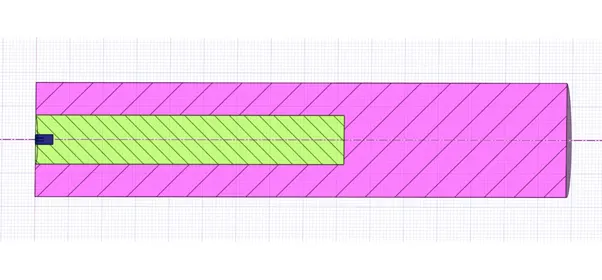
Quarter-section view
This is a 3D model of a Burner where fuel is injected in the middle of the air stream at the inlet.
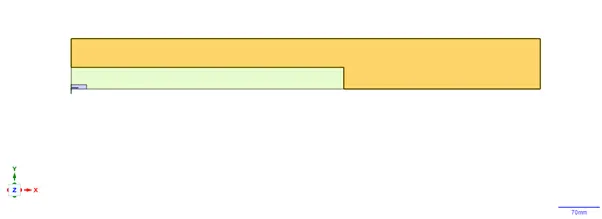
the simulation of above model requires high computational capacity, Hence to ease the calculation, Axis symmetry 2D plane model is created in XY plane where Z axis is radial distance.

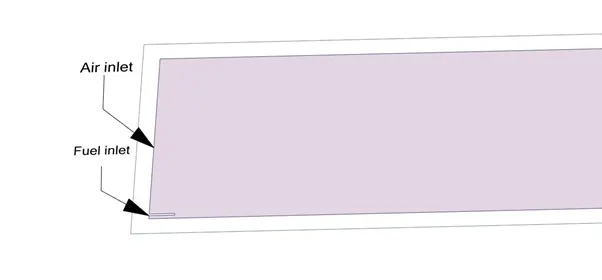
Above 2-D model is used for further calculation.
Meshing –
Element Size = 1 mm Capture Proximity ON
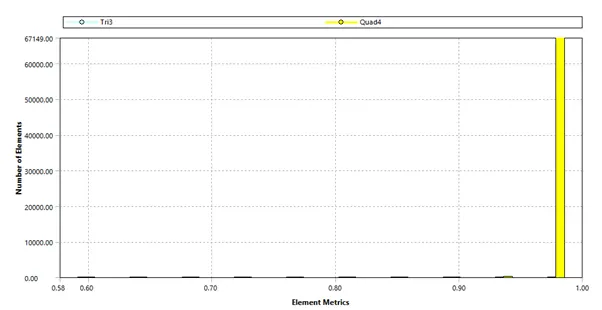
No. of Nodes = 68326 No. of Elements = 67422
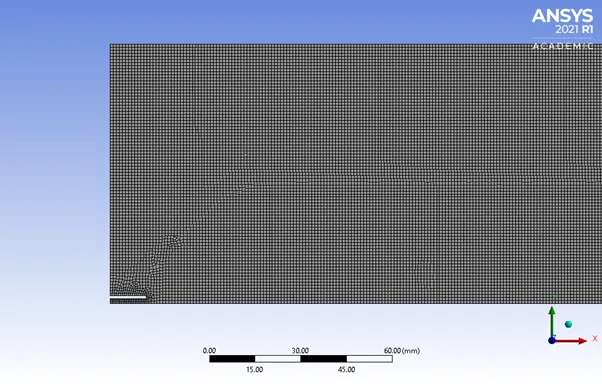
Element Quality –
Fluent Setup –
- Pressure based solver and Absolute velocity is used.
- Steady-state Calculation is performed.
- Axisymmetric is marked.
- Energy is checked to solve energy equation.
- Standard K-ɛ model is used.
- Species Transport Model is used to track mass fraction of species.
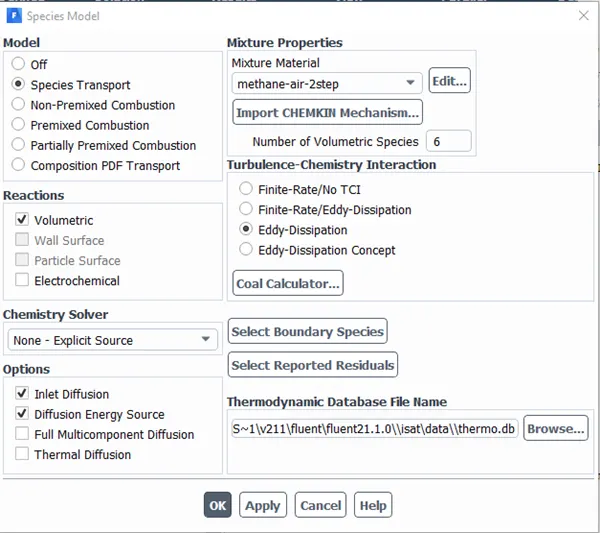
- Boundary Condition:
- Fuel inlet - velocity– 80m/s
Species mass fraction: Ch4 =1
Species mass fraction: H2O =0 - Air inlet - velocity – 0.5m/s
Species mass fraction: O2 =0.23
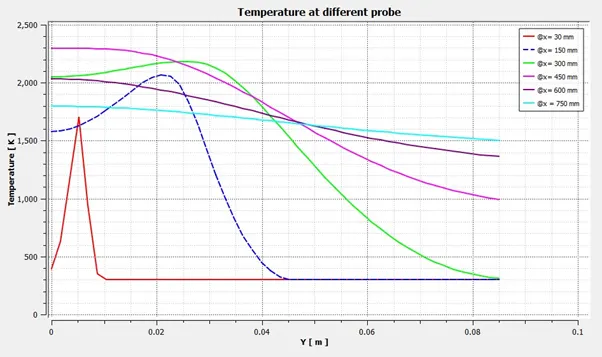
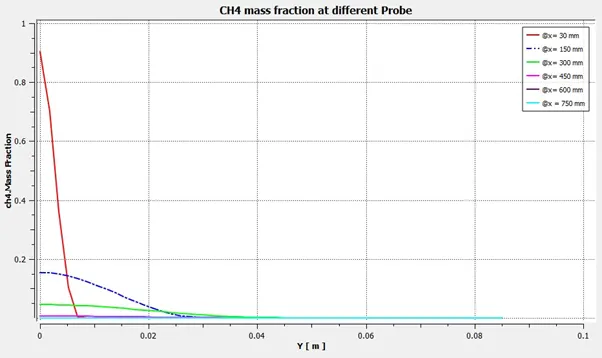
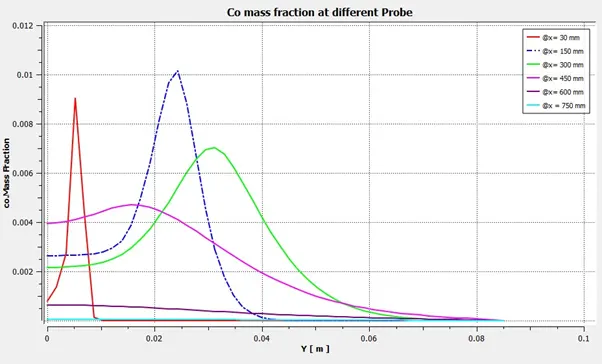
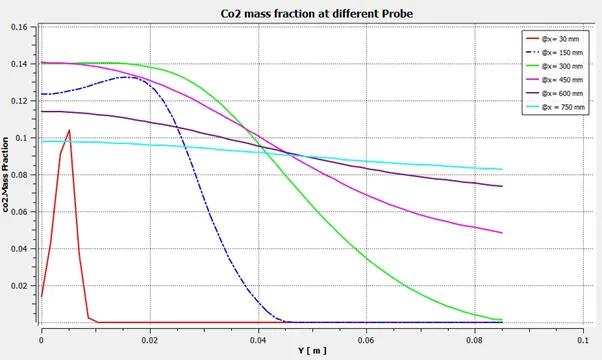
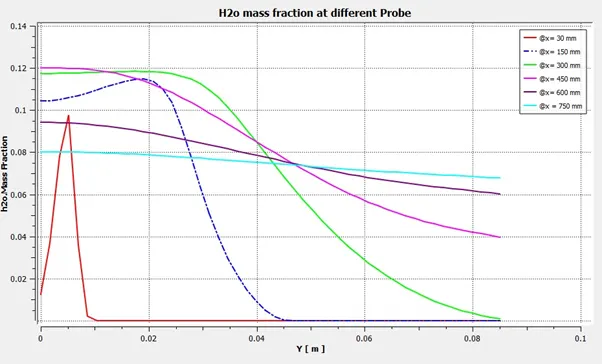
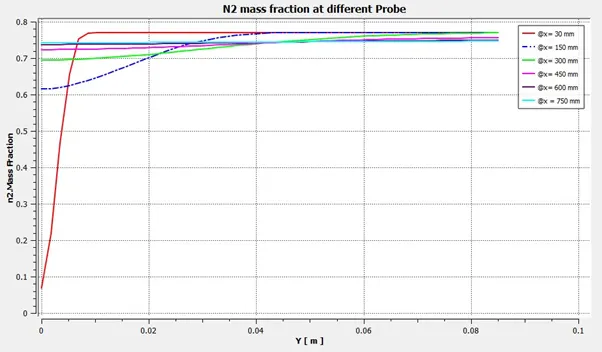
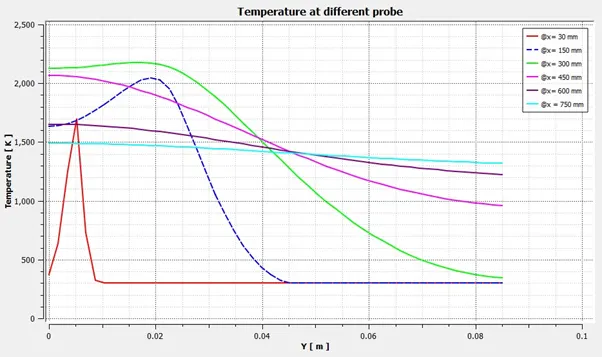
To get velocity and mass fraction plot at different location of combustion model line probes are creates at following positions

Results: -
1. Methane with no added water content
Residue –
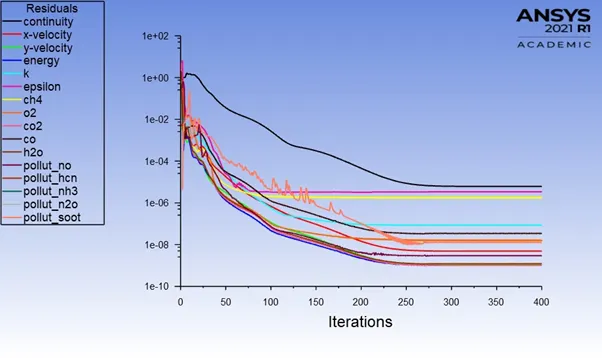
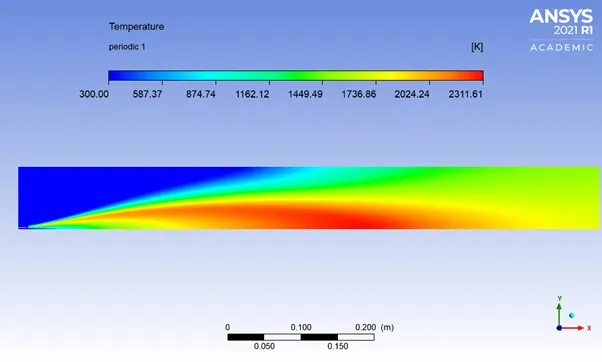
Temperature Contour and plots
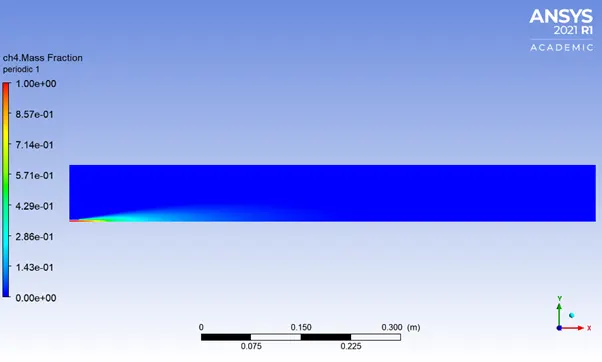
CH4 mass fraction
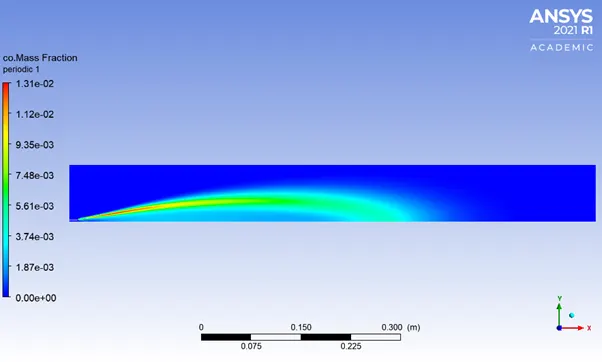
CO mass fraction
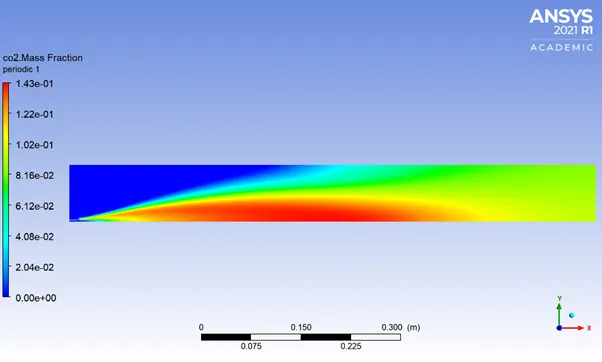
CO2 mass fraction
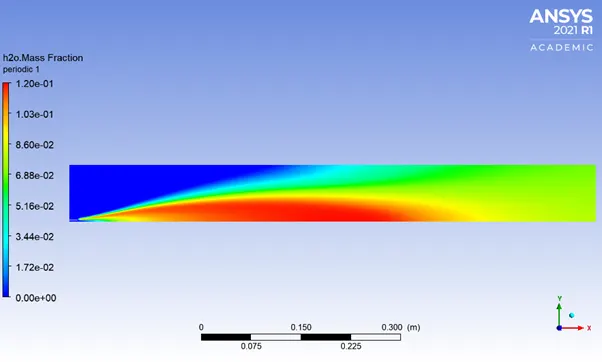
H2O mass fraction
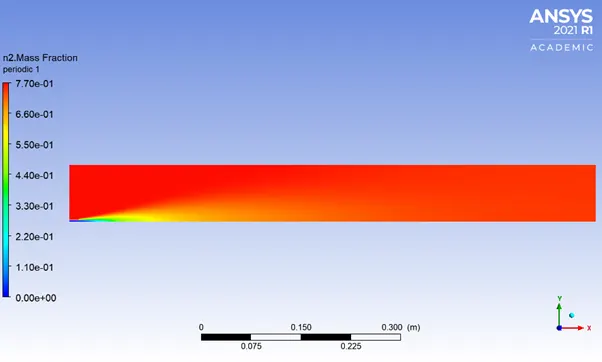
N2 mass fraction
O2 mass fraction
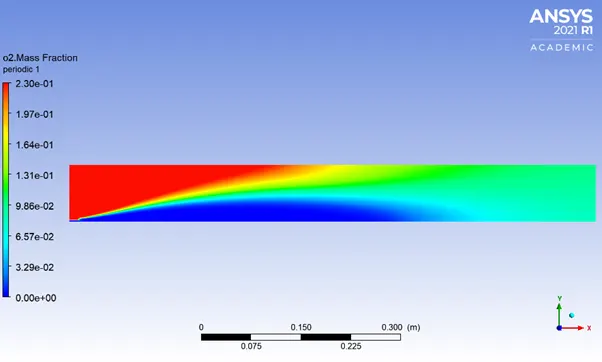
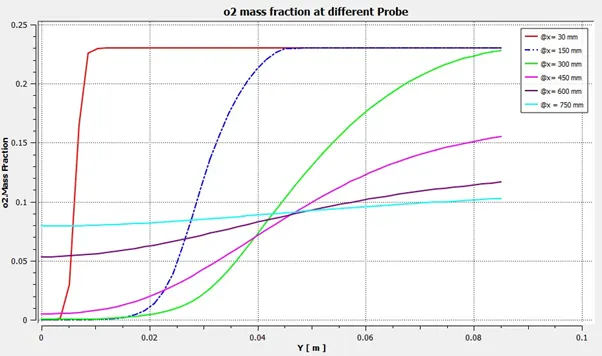
Pollutants Mass Fractions
Soot mass fraction
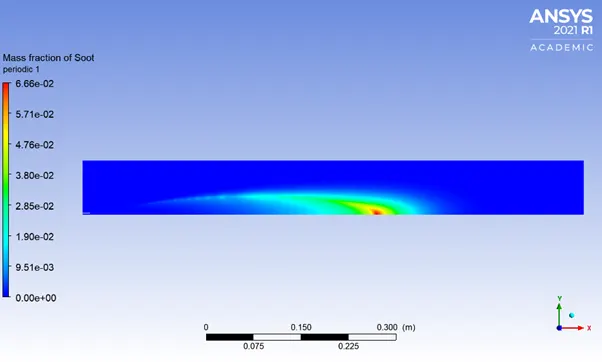
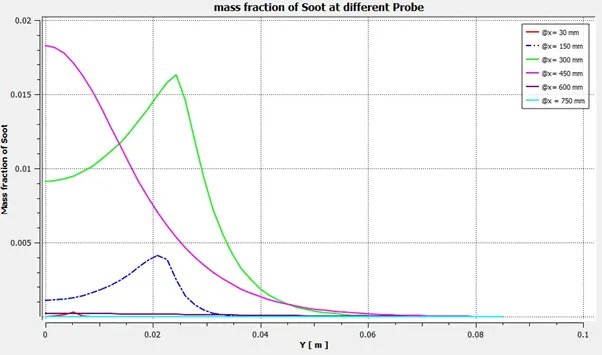
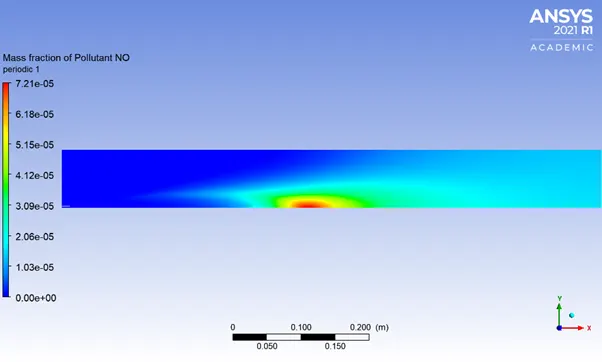
NOx mass fraction
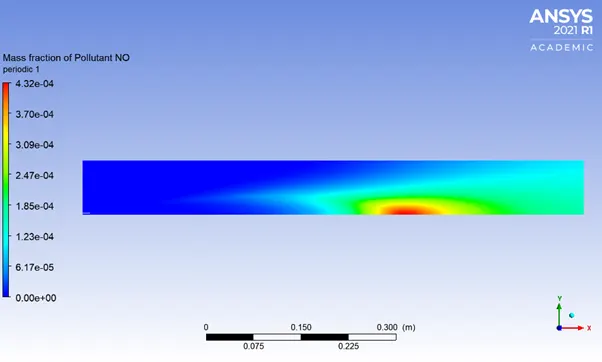
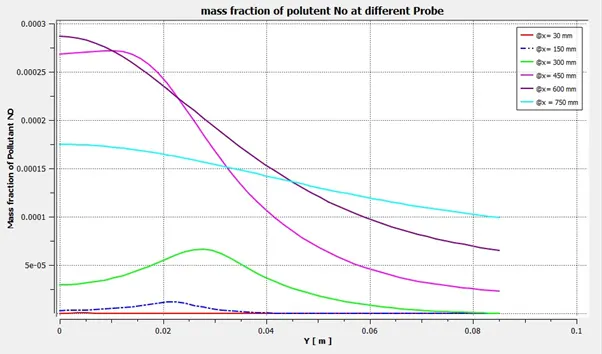
2. Methane with 10 %, 20 % and 30 % added water content by mole fraction respectively.
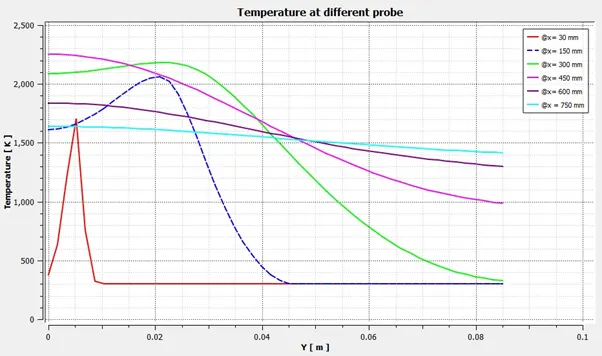
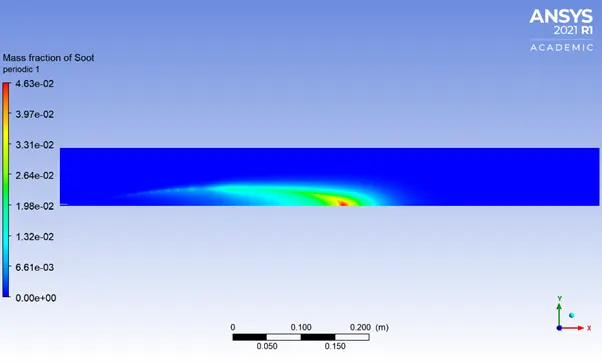
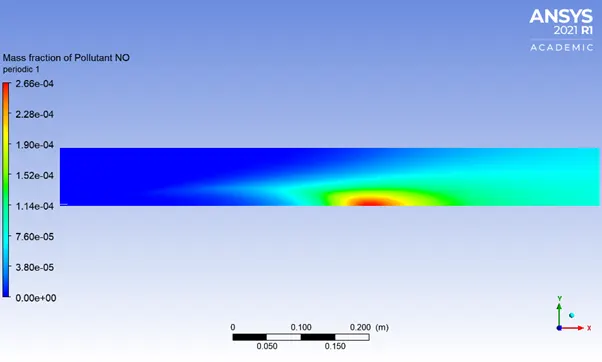
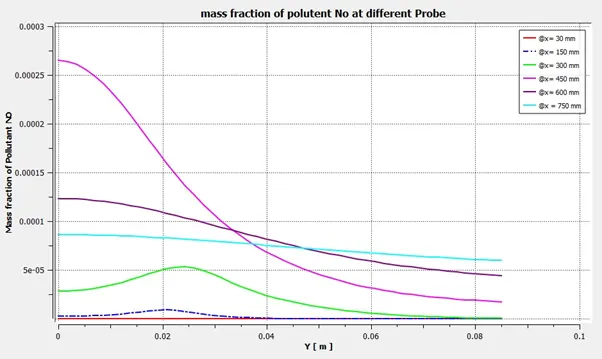
a) methane with 10 % added water by mole fraction
Residue –
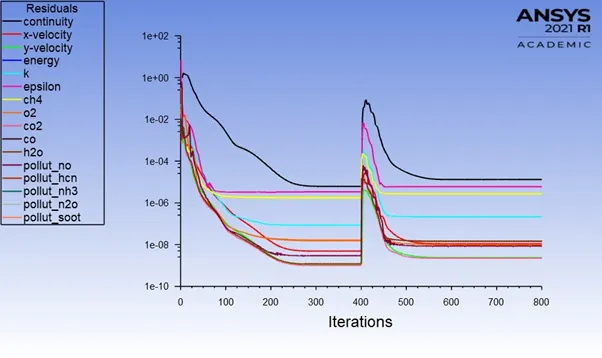
Temperature –
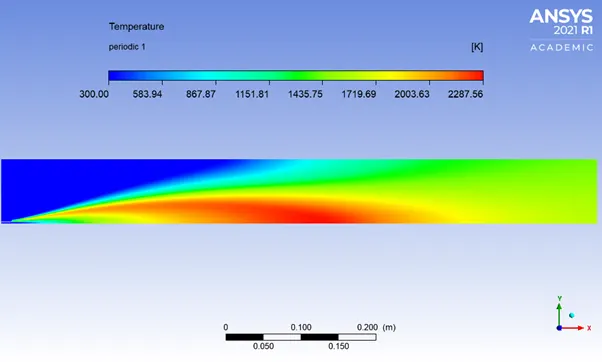
Mass fraction of Pollutants
Soot mass fraction –
NOx mass fraction –
b) methane with 20 % added water by mole fraction
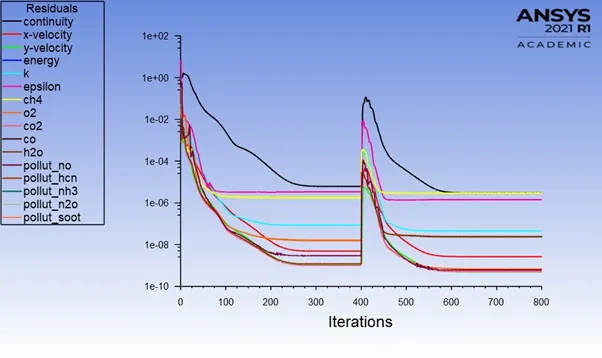
Residue –
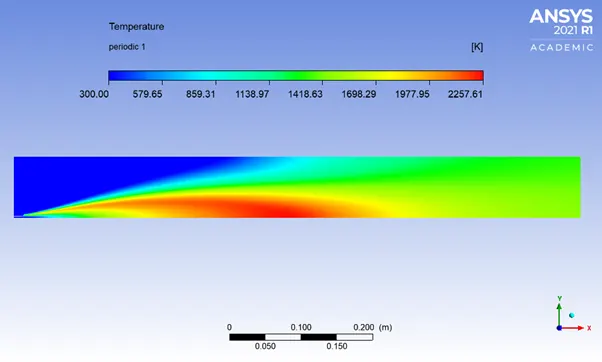
Temperature –
Mass fraction of Pollutants
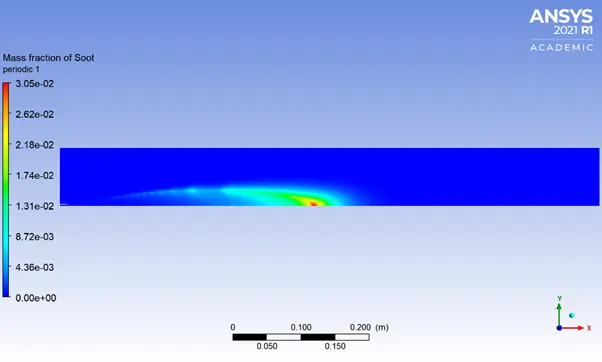
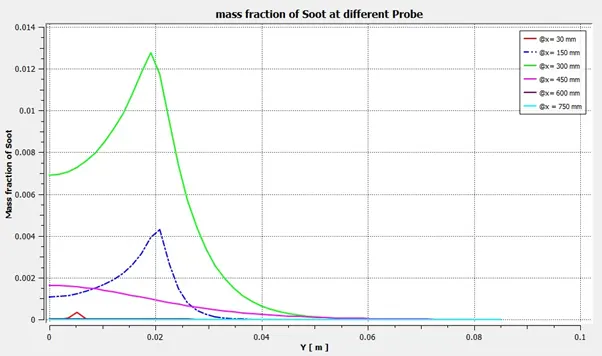
Soot mass fraction –
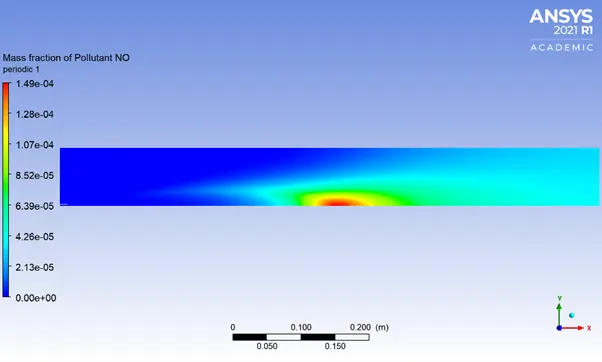
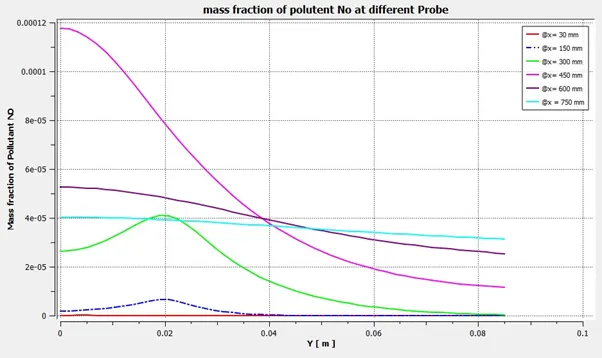
NOx mass fraction –
c) methane with 30 % added water by mole fraction
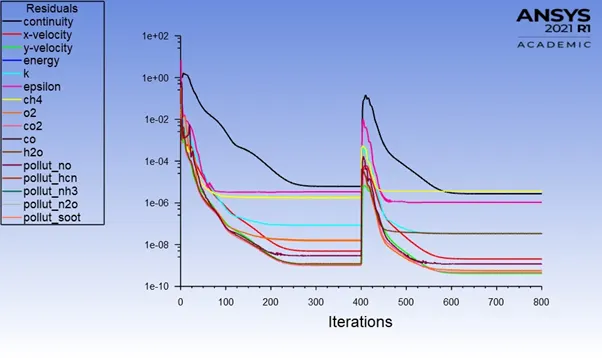
Residue –
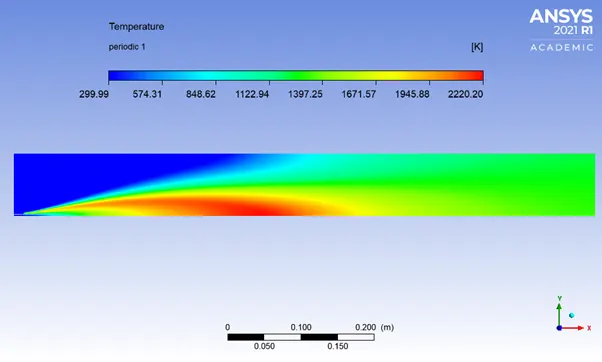
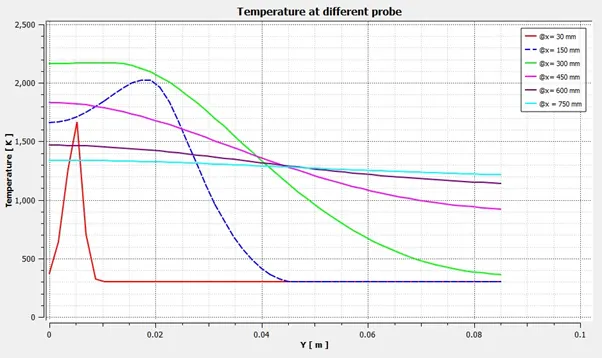
Temperature –
Mass fraction of Pollutants
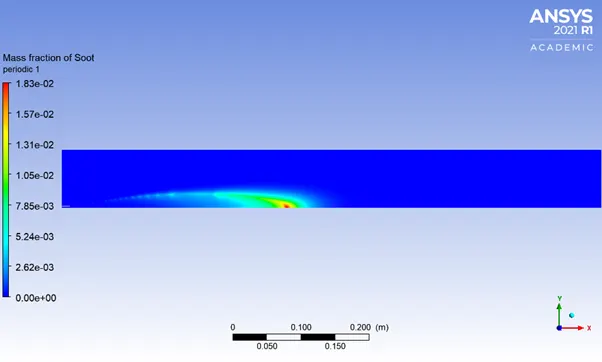
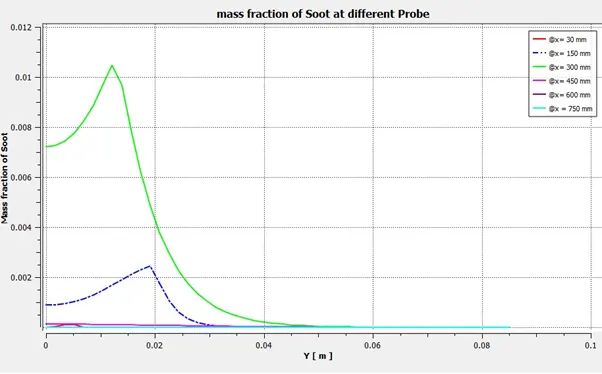
Soot mass fraction –
NOx mass fraction –
Variation in Area weightage Temperature at outlet with respect to addition of water -
Variation in Pollutants with respect to addition of water -
|
CH4 mole fraction |
H20 mole fraction |
NOx mass fraction |
Soot mass fraction |
|
1 |
0 |
4.32067e-4 |
0.0665776 |
|
0.95 |
0.05 |
3.40652e-4 |
0.0537152 |
|
0.90 |
0.10 |
2.66089e-4 |
0.0462824 |
|
0.85 |
0.15 |
2.02422e-4 |
0.0365815 |
|
0.80 |
0.20 |
1.49119e-4 |
0.0305255 |
|
0.75 |
0.25 |
1.05917e-4 |
0.0240572 |
|
0.70 |
0.30 |
7.2107e-5 |
0.0183278 |
Conclusion: -
- As mole fraction of water is increased NOx pollutant emission is significantly reduced.
- As mole fraction of water is increased Soot formation is significantly reduced.
- As water is added the temperature of exhaust gases decreases.
- It is advisable to add water to methane combustion as it brings down the pollutant emission at the expense of reduce efficiency due to incomplete combustion.