Week - 10 Hyperelastic Material Models
AIM OF THE PROJECT
- To calculate Mooney Rivlin and Ogden material constants and compare the both using stress-strain data from a Dogbone specimen tensile test with 100% strain
- The comparison should be shown from the d3hsp file and using simulation
IMPORTANT POINTS TO BE CONSIDERED
- The given data is the engineering stress-strain in MPa/(mm/mm)
- The system of unit used here is gm/mm/ms
INTRODUCTION TO HYPERELASTIC MATERIALS
Hyperelastic materials are regularly used to represent large deformation behaviour of materials in finite element analysis. They are commonly used to model mechanical behaviour of unfilled/filled elastomers. In addition to elastomers, hyperelastic material models are used to approximate the material behaviour of biological tissues, polymeric foams. Linear elastic materials are described by two material constants(Young's Modulus and Poisson's ratio). In contrast hyperelastic materials are described by strain energy per unit volume as a function of stretch as the material has to acoount for both non-linear and large deformations
Hyperelastic materials are the type of materials that are capable of accepting upto 500% strain and come back to its original state. Hyperelastic models account for both non-linear material behaviour and large shape changes. There are many type of models taht are being used. Here we discuss modelling of Mooney-Rivlin and Ogden material using the given stress-strain data.
Here, We have to calculate the co-efficients of different material models used for different order of polynomial and the comparision fro d3hsp file and material curve is to be done. The material card M_077 is being used through out the project and vary the values of n to calculate required co-efficients
Some of the key points to be remembered about hyperelastic materials
- They are ideal elastic material (No permanent deformation)
- They undergo large deformations
- The stress-strain relation is derived from strain energy density function
- It is a highly elastic material
There are many material models available for hyperelastic material which are defined by N state of constant
- N=0 for defining curve constant without defining the curve(C10, C01, C11, C20, C02 etc)
- N=1 for defining the curve with Mooney-Rivlin constant
- N=2 and N=3 for defining Ogden constants.
Mooney Rivlin Material
The strain energy density function for an incompressible Mooney-Rivlin material is defined as
W = ∑ Cij (I1 – 3)i (I2 – 3)j
Cij are empirically determined material constants. I1 and I2 are the first and second Invariants. W is the hydrostatic work term which will be included in strain energy functional. By varying the index values of i and j we can change the constitutive equations and use it appropriately for our component
Ogden Material
Ogden rubber model is obtained from an equation

mu and alpha are Ogden constants
PROCEDURE TO MODEL A HYPERELASTIC MATERIAL
- Importing of raw data
- Part definition and applying boundary conditions
- Tensile test for the verification of hyperelastic rubber with N=1, 2, 3
- Tensile test for the validation of hyperelastic rubber with N=1, 2, 3
- Tensile test for the verification of Ogden rubber with N=1, 2, 3
- Tensile test for the verification of Ogden rubber with N=1, 2, 3
- Results of hyperelastic material modelling
- Plots of material model verification(N=1, 2, 3)
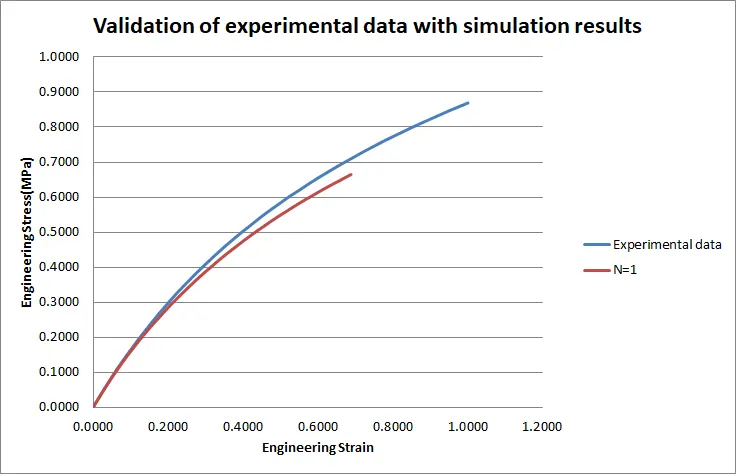
- Plots of material model validation(N=1)
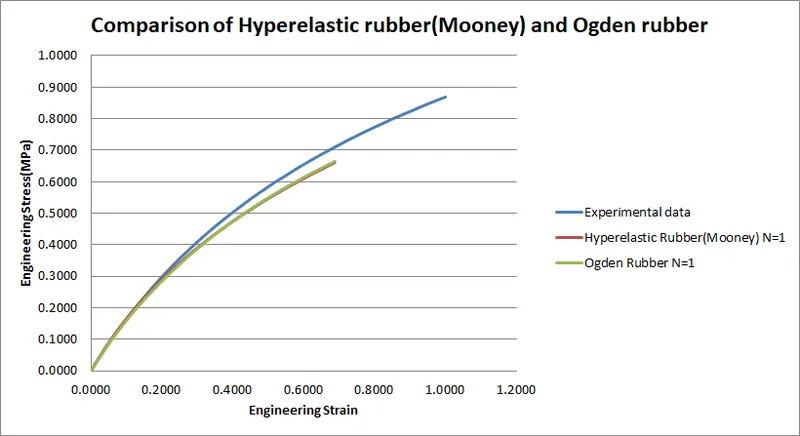
- Comparing the plots of Mooney Rivlin(Hyperelastic rubber) and Ogden rubber for N=1
- Final conclusion
1)Importing of raw data
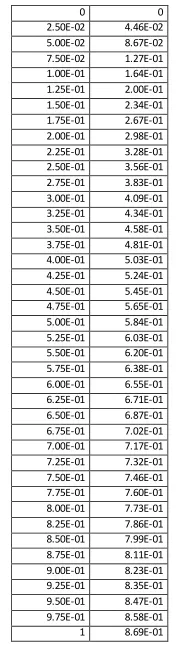
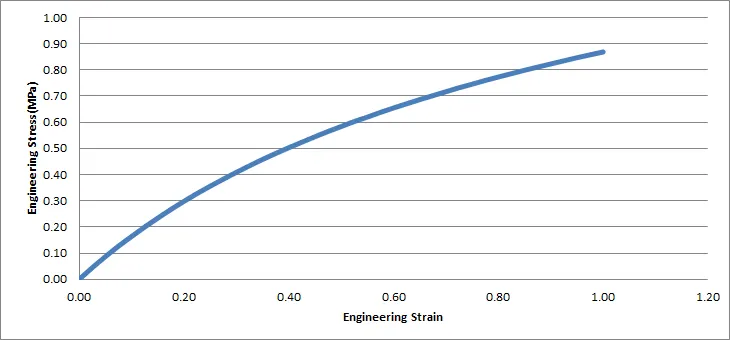
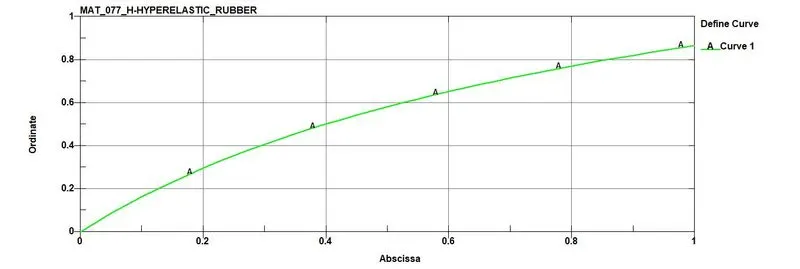
Experimental data plotted with Engineering Stress and Engineering Strain
2)Part definition and applying boundary conditions
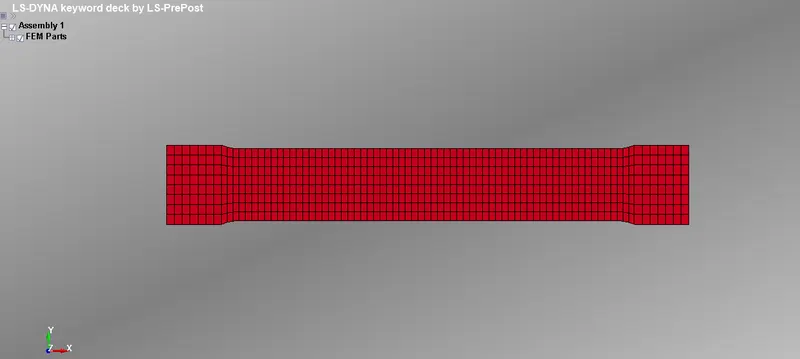
Step 1 - Importing the Dogbone specimen into LS-PrePost: The given keyword file is opened in LS-PrePost using the option, File > Open > LS-Dyna Keyword File.
Step 2 - Defining the experimental data in the material model: The stress/strain for the material is now in the form of engineering stress and engineering strain which can be directly implemented on MAT_077-H card without any conversion. The stress/strain values should be inserted in *DEFINE_CURVE card with a suitable LCID for further process
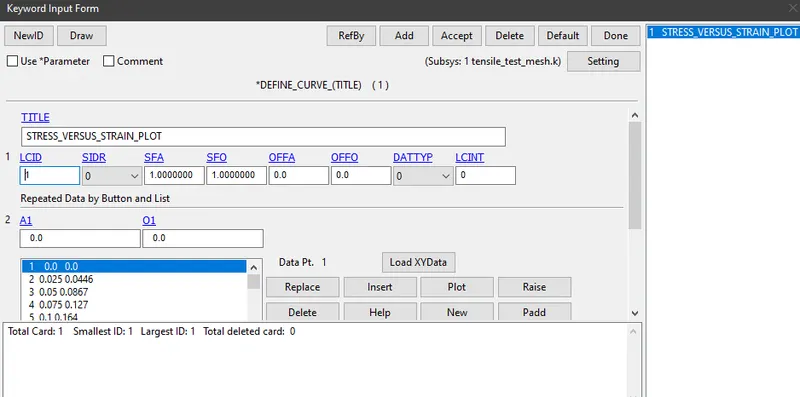
This is the graph of engineering stress and engineering strain which is generated by LS-PrePost when the values are inserted in *DEFINE_CURVE card
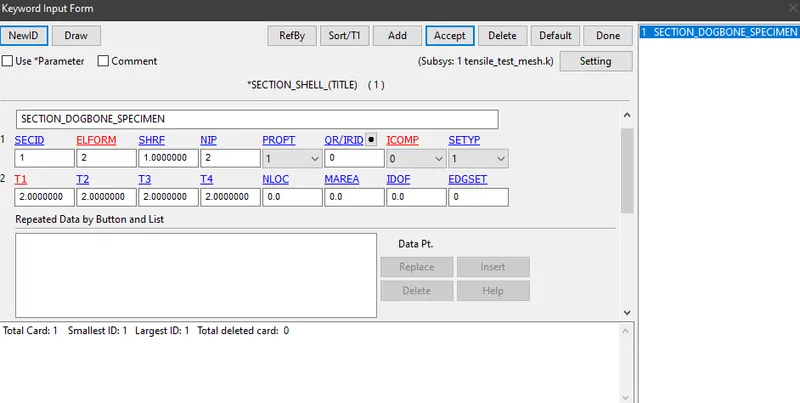
Step 3 - Creation of section: The section property for the Dogbone specimen is assigned as shell element with an element formulation of 2 and thickness 2 mm
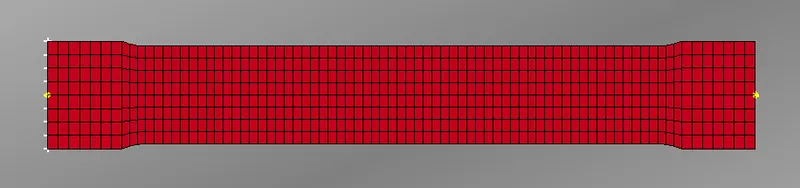
Step 4 - Applying boundary conditions: Since we are performing a tensile test where one end of the specimen is fixed and displacement is added to the other end, so two types of boundary conditions is used on the specimen
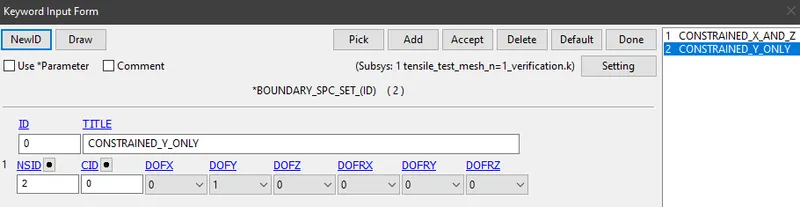
(a)Boundary SPC Set
(i) To fix one end of the specimen as test procedure, we will constrain all the degrees of freedom except Y-direction because specimen will elongate in X-direction and simultaneously contract in Y-direction for edge node on one end of the specimen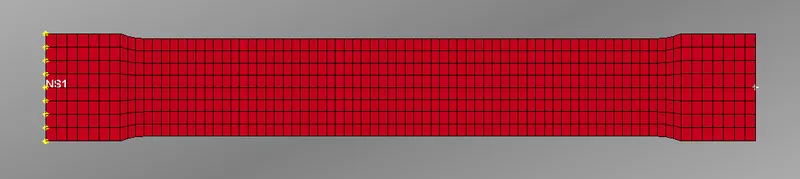
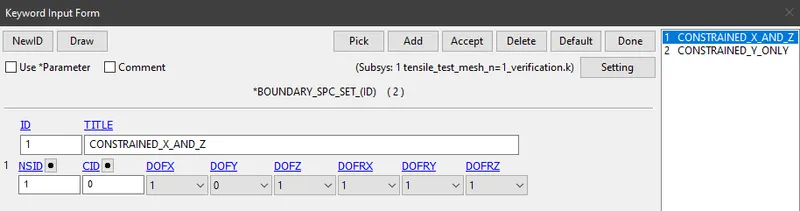
(ii) Here, midnodes on both edge of the specimen is selected. It is constrained in only Y-direction as the neutral axis passes through the middle of the specimen
(b)Prescribed Boundary Motion
A set of nodes is created on the right edge of the specimen where displacement is applied
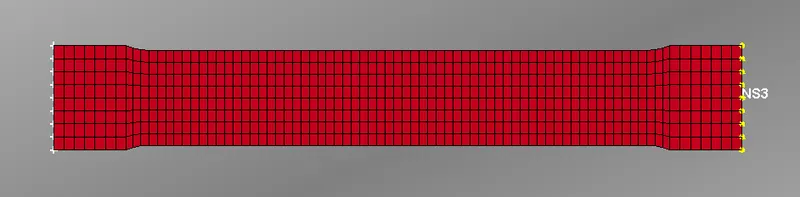
Degree Of Freedom is set to 1 which means displacement takes place in X-direction and VAD(Velocity/Acceleration/Displacement flag) is set to 2-displacement(rigid bodies and nodes).
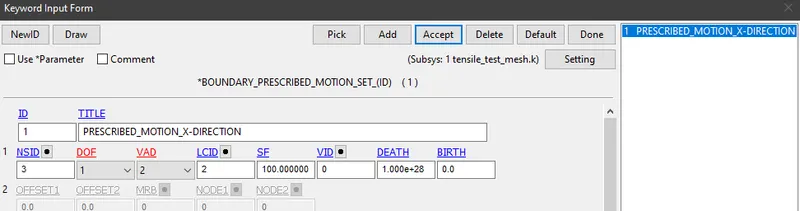
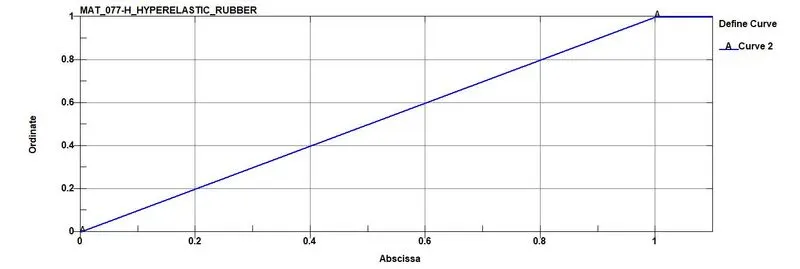
Displacement curve created using DEFINE_CURVE card withLCID 2 is inserted into *BOUNDAARY_PRESCRIBED_MOTION_SET card
Step 5 - Defining control cards
(i) *CONTROL_IMPLICIT_GENERAL: It activated implicit analysis and define associated control parameters. This keyword is required for all implicit analysis
- IMFLAG: Implicit/Explicit switching flag = 1
- DTO: Initial timestep for implicit analysis = 0.01
- IMFORM: Element formulation switching flag = 2(retains original element formulation)
(ii) *CONTROL_IMPLICIT_AUTO: It is defined to adjust the timestep size automatically
- IAUTO: Automatic time step control flag=1 (automatically adjust time step size)
- ITEOPT: It optimizes automatic count step = 11
- ITEWIN: Iteration window = 5
(iii)*CONTROL_IMPLICIT_SOLVER: It performs CPU intensive stiffness matrix
- LSOLVR: Linear equation solver method = 6(It solves the simulation with single precision which constantly saves runtime)
(iv)*CONTROL_TERMINATION: The end time of the simulation is specified as 1ms
Step 6 - Defining the cards for database
- *DATABASE_BINARY_D3PLOT: Time interval between the outputs is given as 0.01 ms
- *DATABASE_EXTENT_BINARY: Here, STRFLG is defined as 1 to compute the elastic strain in the model
3) TENSILE TEST FOR THE VERIFICATION OF HYPERELASTIC RUBBER(MOONEY RIVLIN) WITH N=1
(i) To find Mooney Rivlin material constants, the value of N is set to 1. For N>0, data from a uniaxial test are used
The value of SGL, SW and ST are set to unity which indiacates Specimen Gauge Length, Specimen Width and Specimen Thickness
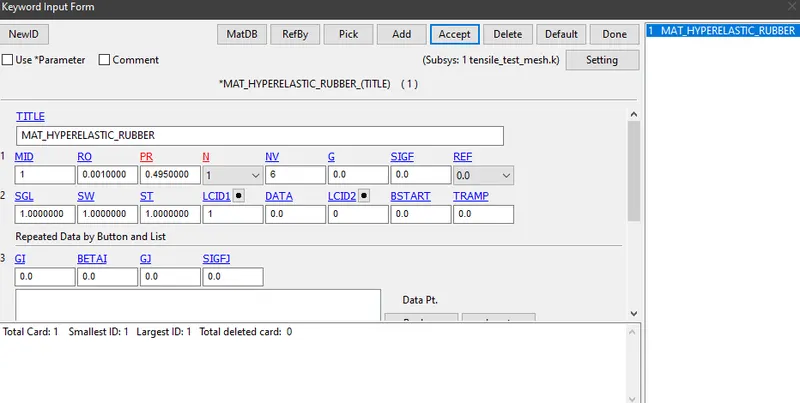
(ii) Save the file using .k extension and run the file using LS-Run
4) TENSILE TEST PROCEDURE FOR THE VALIDATION OF HYPERELASTIC RUBBER(MOONEY RIVLIN) WITH N=1
(i) The d3hsp file for Hyperelastic rubber(Mooney Rivlin) material model is opened with the help of notepad ++. The value of Mooney constants c1 and c2. Also the final fit data of extension(stretch) and true stress is obtained
c1 = 0.1768E+00
c2 = 0.1474E+00
(ii)For the material model validation, the value of N in material card is set to zero. The values of Mooney Rivlin constants are updated as well.
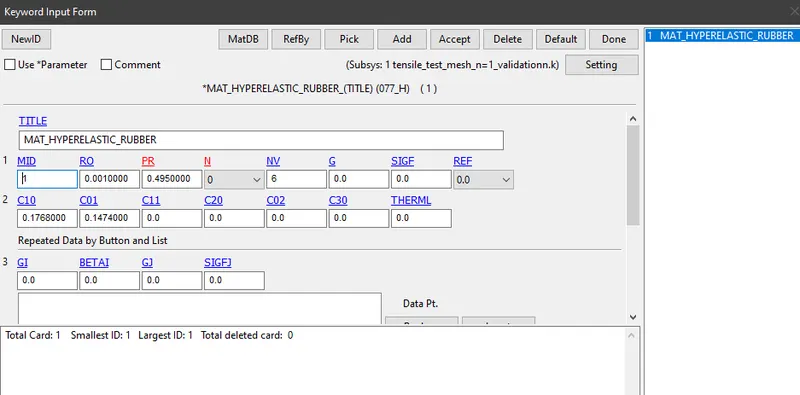
(iii)Save the file using .k extension and run the file using LS-Run
5) TENSILE TEST PROCEDURE FOR THE VERIFICATION OF HYPERELASTIC RUBBER(MOONEY RIVLIN) WITH N=2
(i) To find Mooney Rivlin material constants, the value of N is set to 2. For N>0, data from a uniaxial test are used
The value of SGL, SW and ST are set to unity which indiacates Specimen Gauge Length, Specimen Width and Specimen Thickness
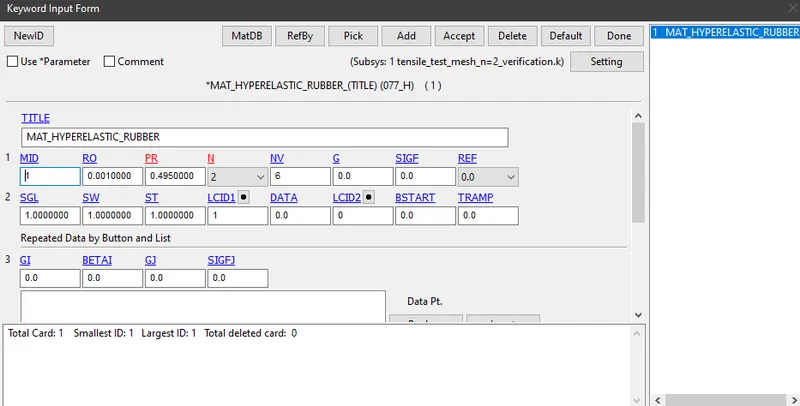
(ii) Save the file using .k extension and run the file using LS-Run
6) TENSILE TEST PROCEDURE FOR THE VALIDATION OF HYPERELASTIC RUBBER(MOONEY RIVLIN) N=2
(i) The d3hsp file for Hyperelastic rubber material model is opened with the help of notepad ++. The value of Mooney constants are C10, C01, C11, C20, C02. Also the final fit data of extension(stretch) and true stress is obtained
C10= 0.2595E+00
C01= 0.4594E-01
C11= -0.2092E-01
C20= 0.2914E-02
C02= 0.1016E-02
(ii)For the Hyperelastic material(Mooney Rivlin) model validation, the value of N in material card is set to zero. The values of Mooney Rivlin constants are updated as well.
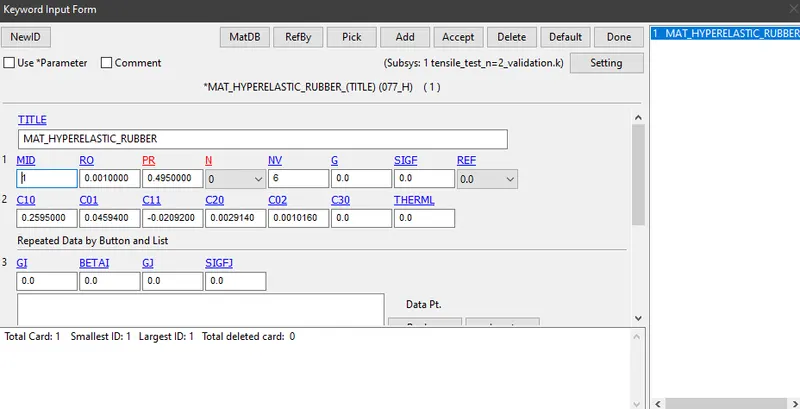
(iii) Save the file using .k extension and run the file using LS-Run
7) TENSILE TEST FOR THE VERIFICATION OF HYPERELASTIC RUBBER(MOONEY RIVLIN) WITH N=3
(i) To find Mooney Rivlin material constants, the value of N is set to 3. For N>0, data from a uniaxial test are used
The value of SGL, SW and ST are set to unity which indiacates Specimen Gauge Length, Specimen Width and Specimen Thickness
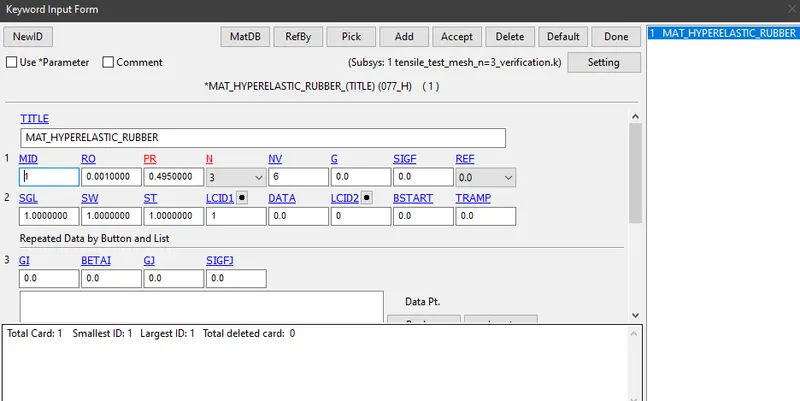
(ii) Save the file using .k extension and run the file using LS-Run
8) TENSILE TEST PROCEDURE FOR THE VALIDATION OF HYPERELASTIC RUBBER(MOONEY RIVLIN) WITH N=3
(i) The d3hsp file for Hyperelastic rubber(Mooney Rivlin) material model is opened with the help of notepad ++. The value of Mooney constants are C10, C01, C11, C20, C02. Also the final fit data of extension(stretch) and true stress is obtained
C10= 0.2595E+00
C01= 0.4594E-01
C11= -0.2092E-01
C20= 0.2914E-02
C02= 0.1016E-02
C30= 1.565E-04
(ii)For the material model validation, the value of N in material card is set to zero. The values of Mooney Rivlin constants are updated as well.
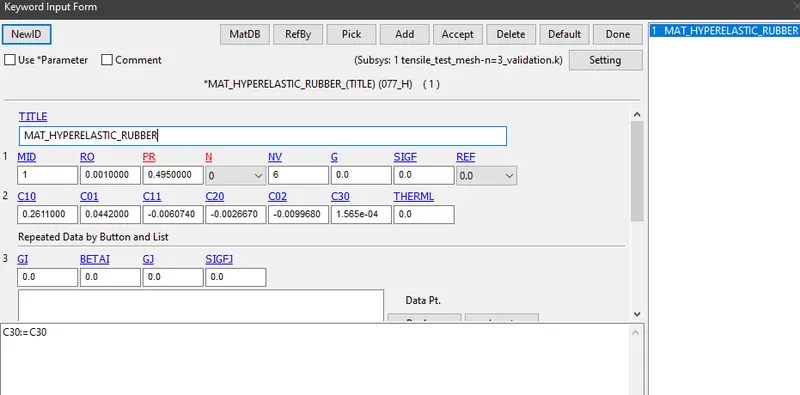
(iii) Save the file using .k extension and run the file using LS-Run
9) TENSILE TEST PROCEDURE FOR THE VERIFICATION OF OGDEN RUBBER WITH N=1
(i)To find Ogden material constants, the value of N is set to 1. For N>0, data from a uniaxial test are used
The value of SGL, SW and ST are set to unity which indiacates Specimen Gauge Length, Specimen Width and Specimen Thickness
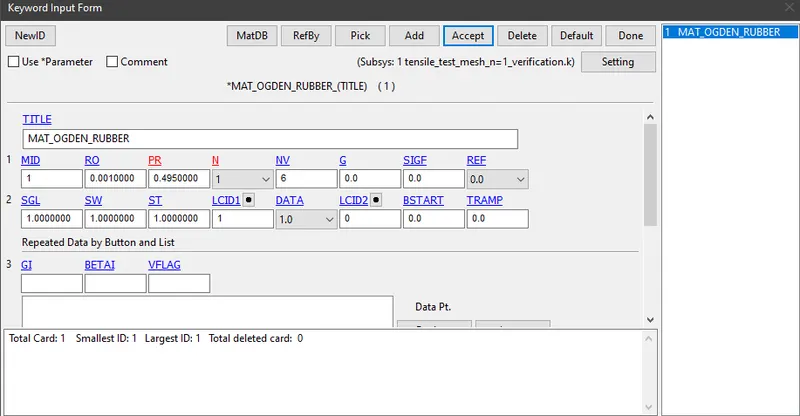
(ii) Save the file using .k extension and run the file using LS-Run
10) TENSILE TEST PROCEDURE FOR THE VALIDATION OF OGDEN RUBBER WITH N=1
(i) The d3hsp file for Ogden rubber material model is opened with the help of notepad ++. The value of Ogden constants are mu(1) and alpha(1). Also the final fit data of extension(stretch) and true stress is obtained
mu(1)= 9.1076024661337E-01
alpha(1)= 1.3427238801352E+00
(ii)For the material model validation, the value of N in material card is set to zero. The values of Ogden constants are updated as well.
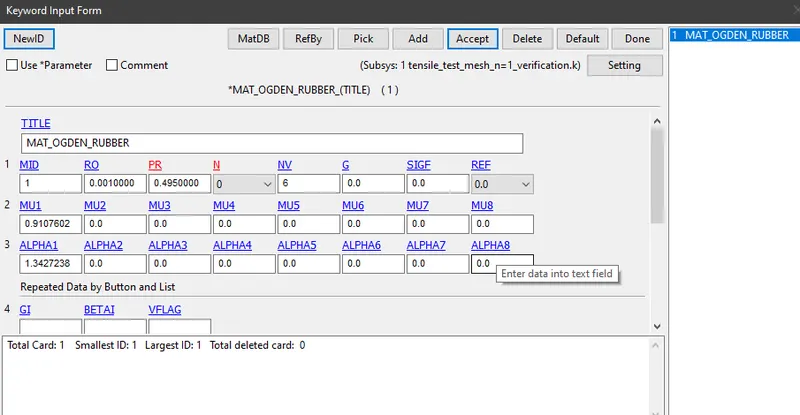
(iii) Save the file using .k extension and run the file using LS-Run
11) TENSILE TEST PROCEDURE FOR THE VERIFICATION OF OGDEN RUBBER WITH N=2
(i)To find Ogden material constants, the value of N is set to 2. For N>0, data from a uniaxial test are used
The value of SGL, SW and ST are set to unity which indiacates Specimen Gauge Length, Specimen Width and Specimen Thickness
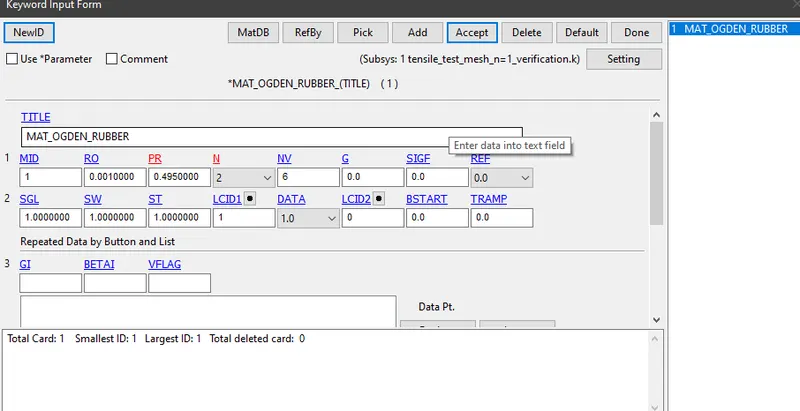
(ii) Save the file using .k extension and run the file using LS-Run
12) TENSILE TEST PROCEDURE FOR THE VALIDATION OF OGDEN RUBBER WITH N=2
(i) The d3hsp file for Ogden rubber material model is opened with the help of notepad ++. The value of Ogden constants are mu(1), mu(2), alpha(1) and alpha(2). Also the final fit data of extension(stretch) and true stress is obtained
mu(1)= 9.1564732574771E-01
mu(2)= 2.2259557307116E+00
alpha(1)= 1.3399091914039E+00
alpha(2)=-1.8434702588025E-03
(ii)For the material model validation, the value of N in material card is set to zero. The values of Ogden constants are updated as well.
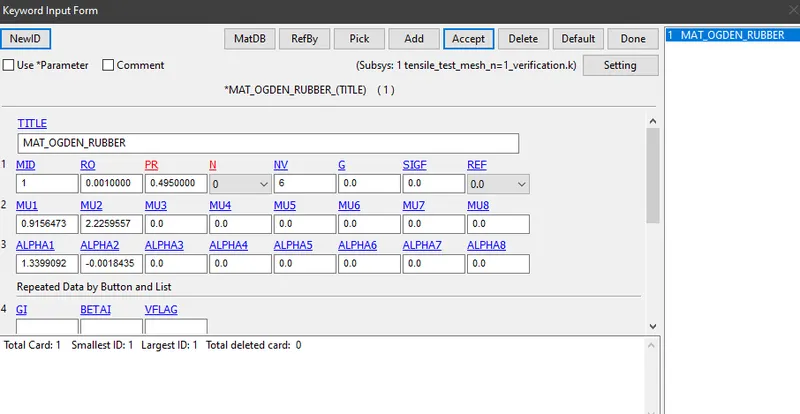
(iii) Save the file using .k extension and run the file using LS-Run
13) TENSILE TEST PROCEDURE FOR THE VERIFICATION OF OGDEN RUBBER WITH N=3
(i)To find Ogden material constants, the value of N is set to 1. For N>0, data from a uniaxial test are used
The value of SGL, SW and ST are set to unity which indiacates Specimen Gauge Length, Specimen Width and Specimen Thickness
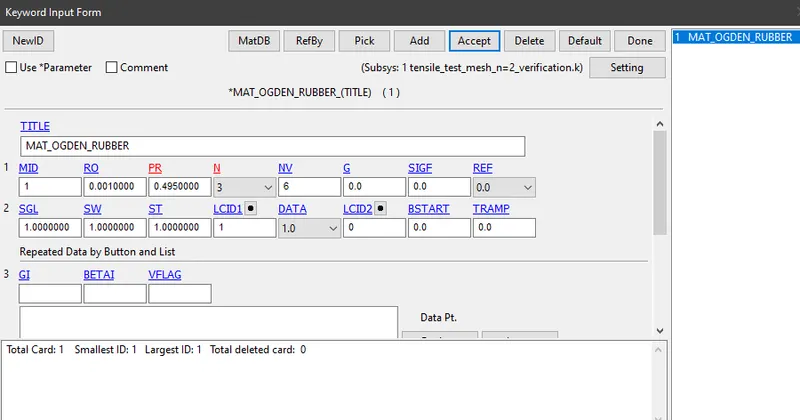
(ii) Save the file using .k extension and run the file using LS-Run
14) TENSILE TEST PROCEDURE FOR THE VALIDATION OF OGDEN RUBBER WITH N=3
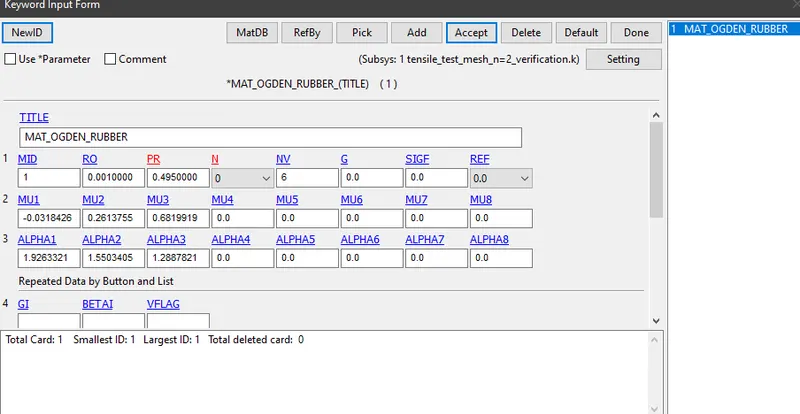
(i) The d3hsp file for Ogden rubber material model is opened with the help of notepad ++. The value of Ogden constants are mu(1), mu(2), mu(3), alpha(1), alpha(2) and alpha(3). Also the final fit data of extension(stretch) and true stress is obtained
mu(1) = -3.1842578663497E-02
mu(2) = 2.6137553188494E-01
mu(3) = 6.8199192354798E-01
alpha(1) = 1.9263321407459E+00
alpha(2) = 1.5503405391191E+00
alpha(3) = 1.2887820957813E+00
(ii)For the material model validation, the value of N in material card is set to zero. The values of Ogden constants are updated as well.
(iii) Save the file using .k extension and run the file using LS-Run
15) RESULTS OF HYPERELASTIC MATERIAL MODELLING
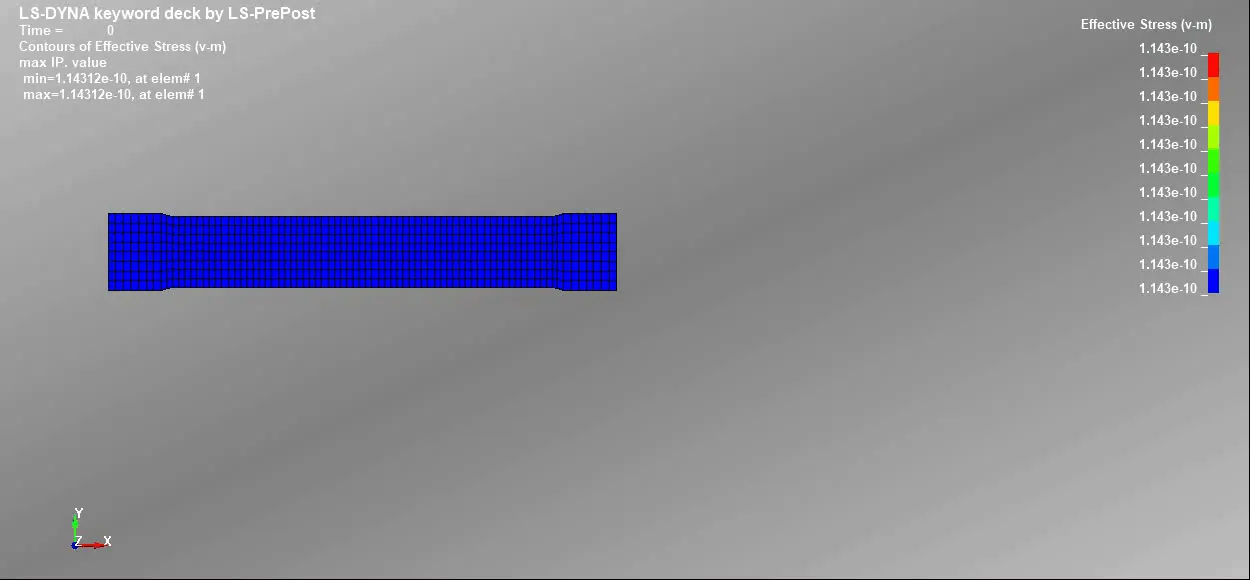
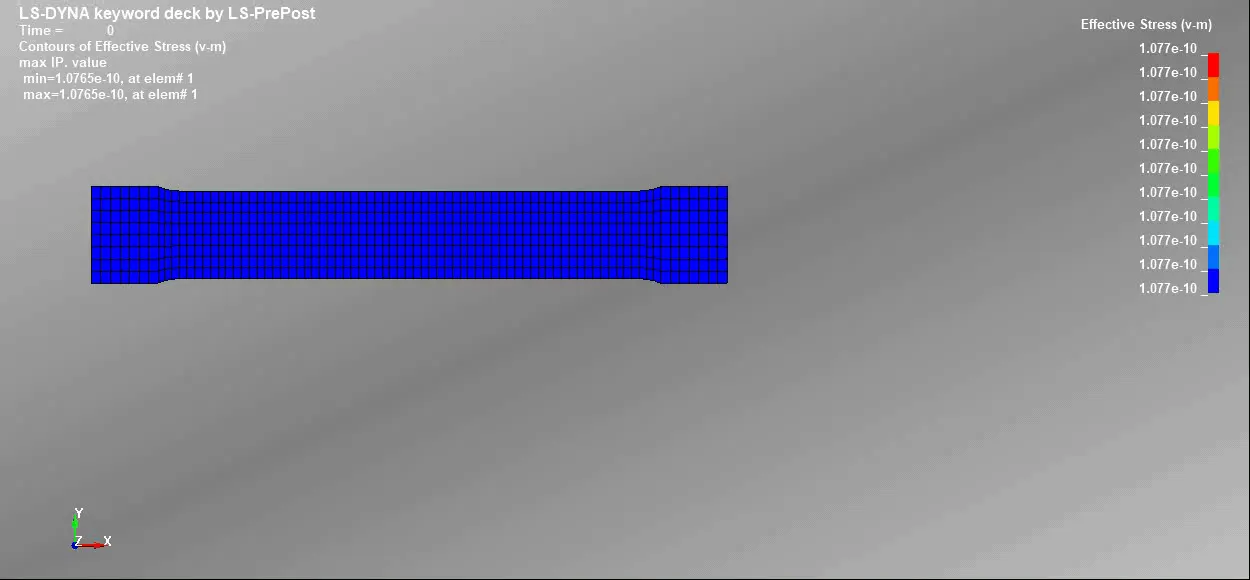
(i)Von-Mises Stress
(a)Hyperelastic rubber(Mooney Rivlin) with N=1
(b)Ogden rubber with N=1
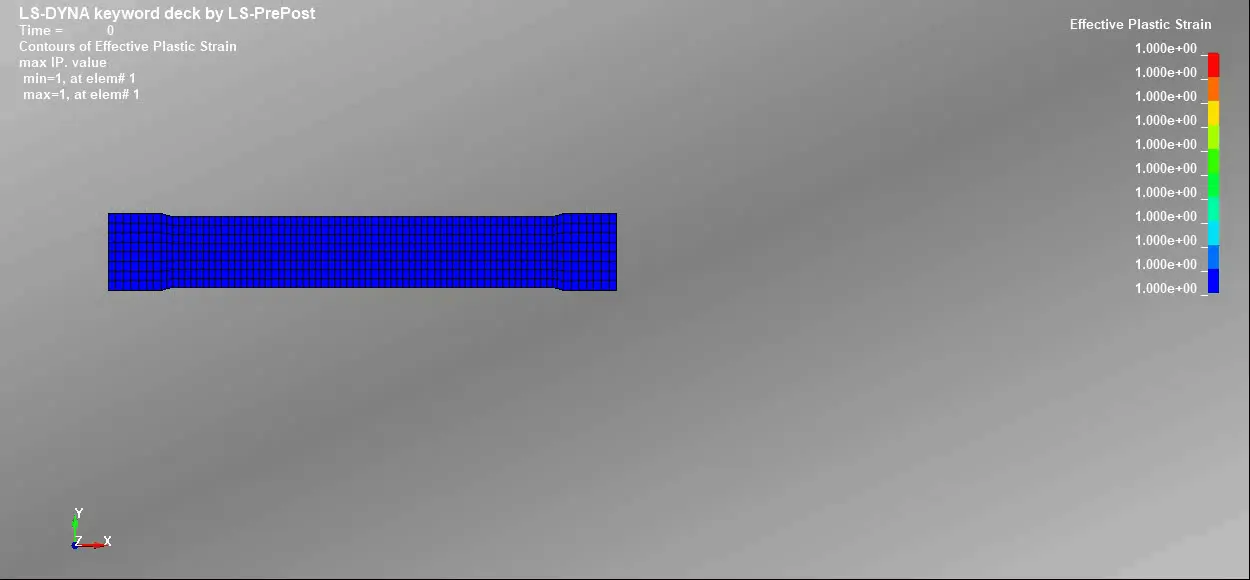
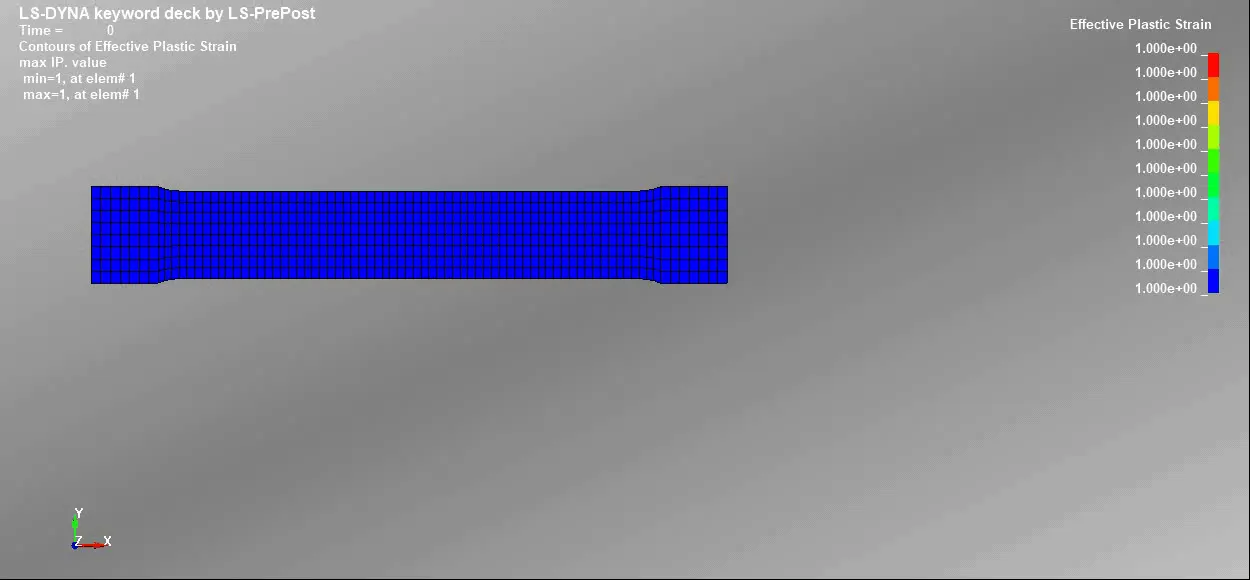
(ii)Effective Plastic Strain
(a)Hyperelastic rubber(Mooney Rivlin) with N=1
(b)Ogden rubber with N=1
16) PLOTS OF MATERIAL MODEL VERIFICATION
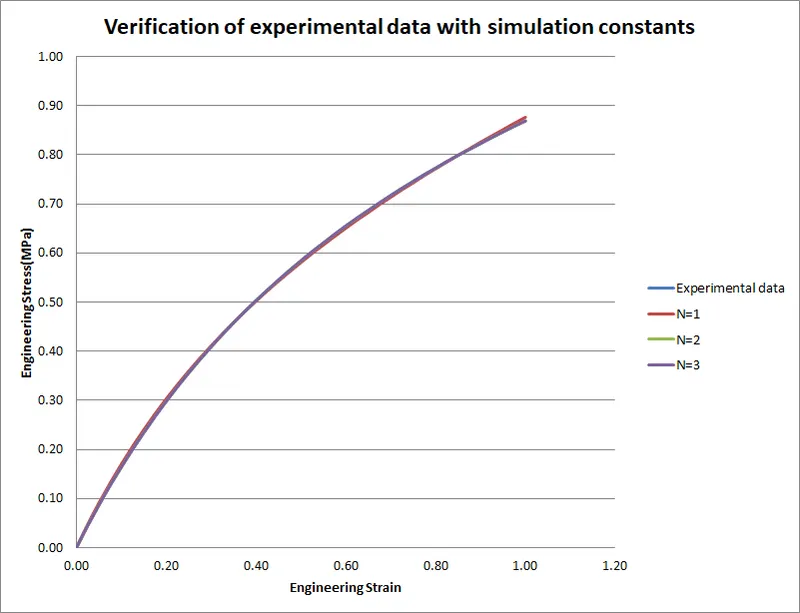
(i)Mooney-Rivlin material (Hyperelastic Rubber)
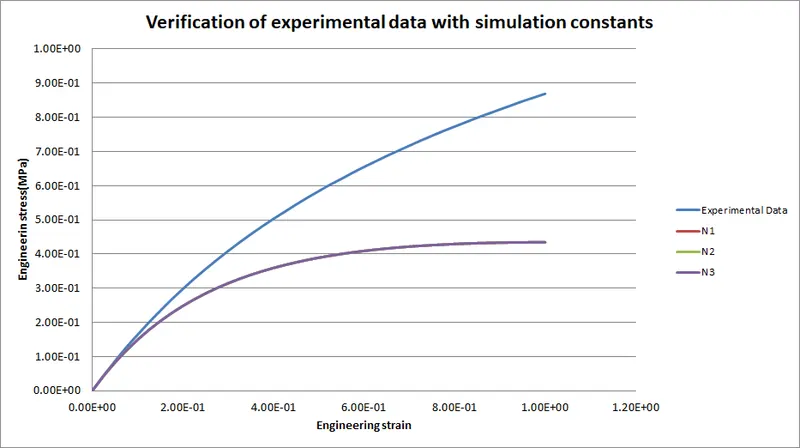
(ii)Ogden material
17) PLOTS OF MATERIAL MODEL VALIDATION
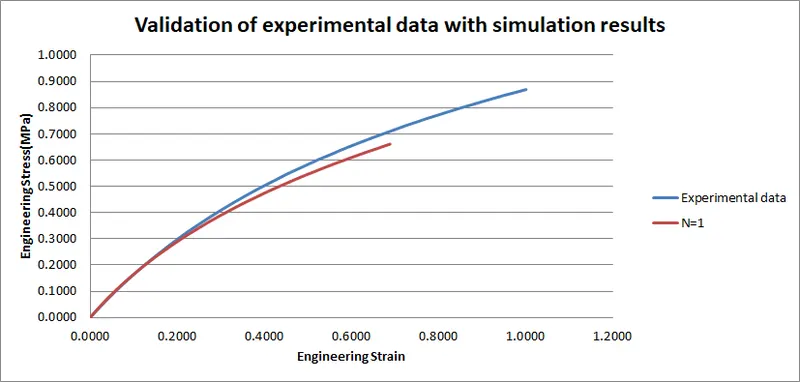
(i)Mooney-Rivlin material (Hyperelastic Rubber)
(ii)Ogden material
18) Plots of Mooney Rivlin(Hyperelastic rubber) and Ogden rubber for N=1
19) FINAL CONCLUSION
- Mooney Rivlin and Ogden material constants are obtained from d3hsp file by feeding N=1 as input.
- The stress-strain data extracted from d3hsp file in hyperelastic models were compared with the experimental data.
- The simulation results of tensile test for both the material models with experimental data showed a slight deviation due to high non-linearity of given hyperelastic material.
- From simulation results, both the hyperelastic models were found to be valid to describe the behaviour of given material data.
- Learned how to verify and validate the material models of Hyperelastic rubber(Mooney Rivlin) and Ogden material.