Week 10 Bullet penetrating a Bucket Challenge
OBJECTIVE:-
- To set up the Model for Bullet penetrating Bucket challenge with different materials and observing the change in the results
Steps:-
Import Materials:-
- In this challenge we will be using explicit dynamics analysis system
- As mentioned above let us import any three nonlinear materials from engineer data
- I am using Copper alloy NL, Aluminium Alloy NL and Magnesium Alloy NL ,these materials for bucket in each case
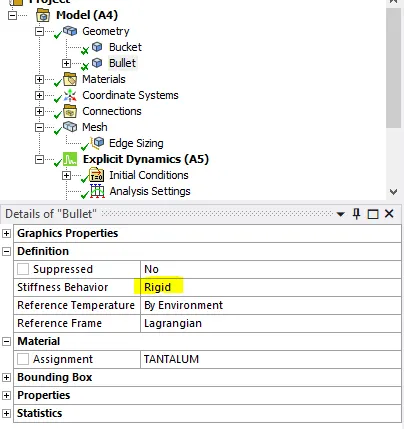
- Tantalum material from explicit material is used for Bullet
Mechanical Module:-
- Open the model in space claim and check for abnormalities in model
- Open it in mechanical module, rename the geometry for convinience
- Assign the materials to the geometry
- Stiffness behaviour of bullet should be rigid
- Delete the default contacts created between the models
Mesh:-
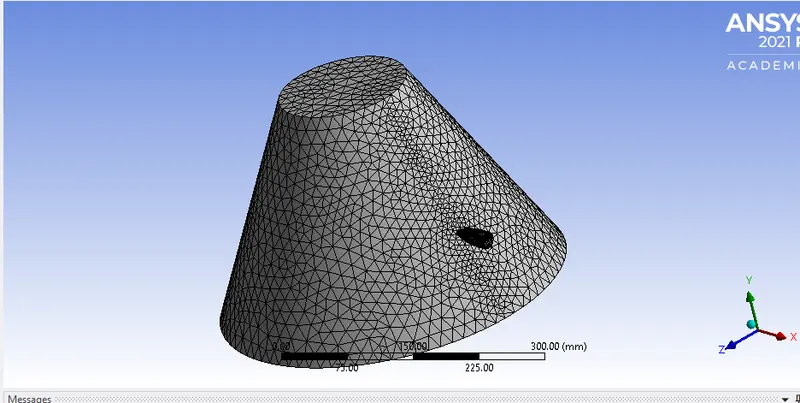
- Perform edge sizing on the both edges where bullet enters ans exits
- Let the element size be 6mm
Analysis system:-
- Set the end time for 0.01 sec
- Set the energy error to 5
- Let all the other setting be default
Define Load:-
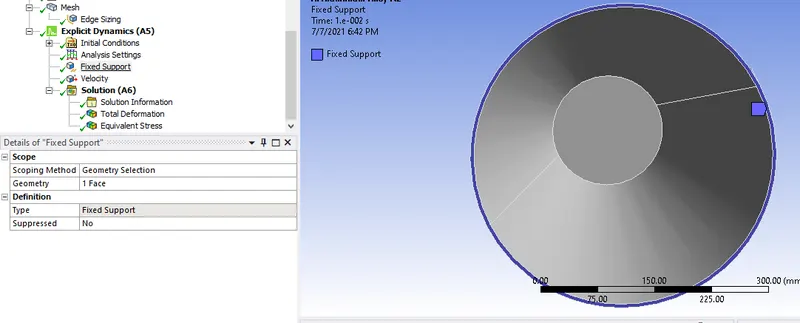
- Define fixed support for the botton face of bucket
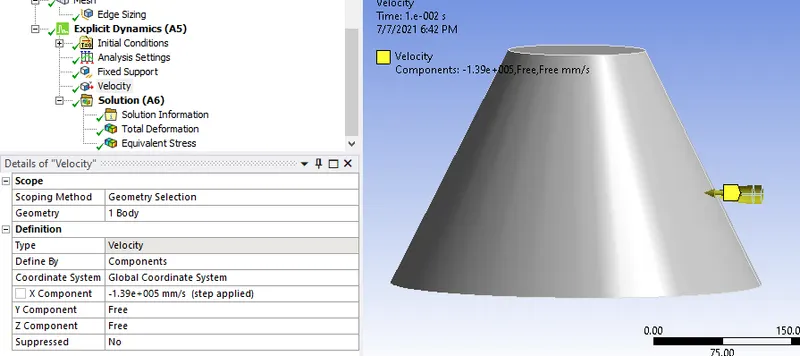
- Define velocity of 139000 mm/s in global negative X direction
Results and Conclusion:
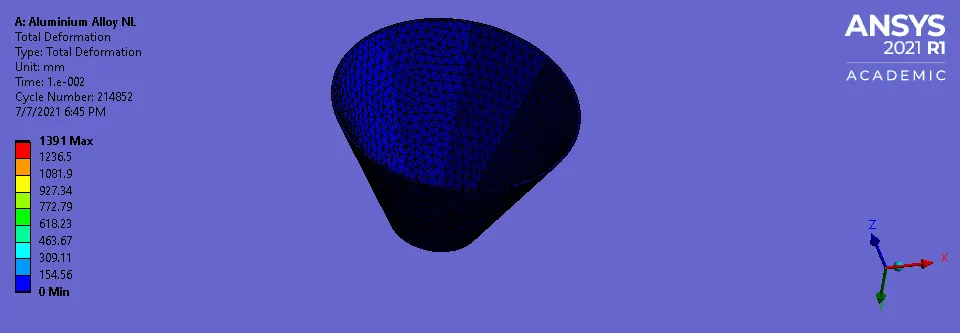
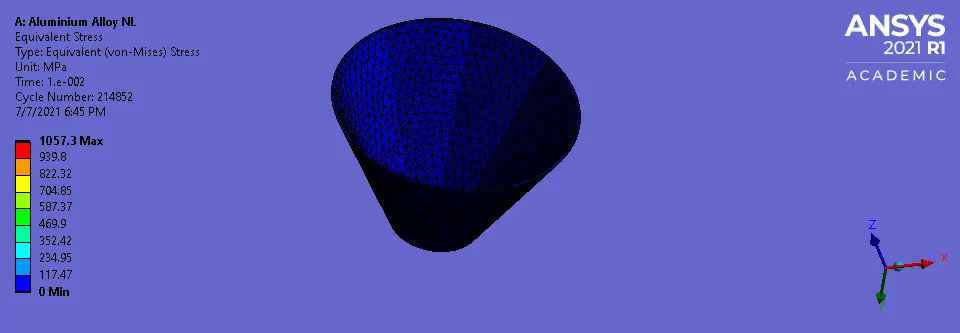
Case 1(Bucket material = Aluminium Alloy NL):-
- Total deformation
- Equivalen stress
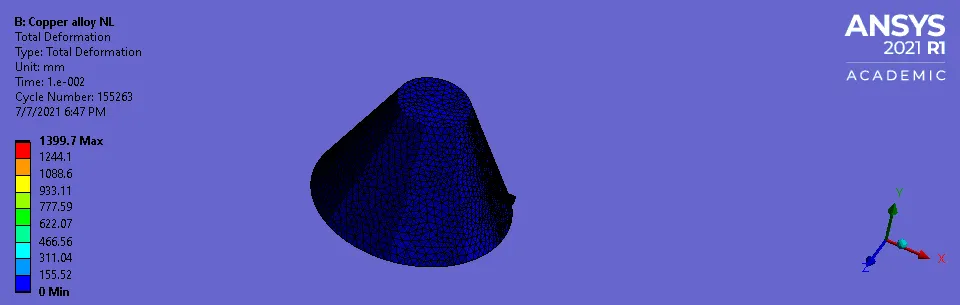
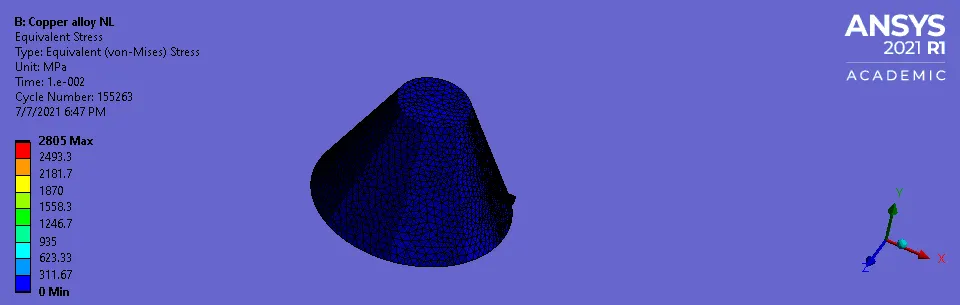
Case 2(Bucket material = Copper Alloy NL):-
- Total deformation
- Equivalen stress
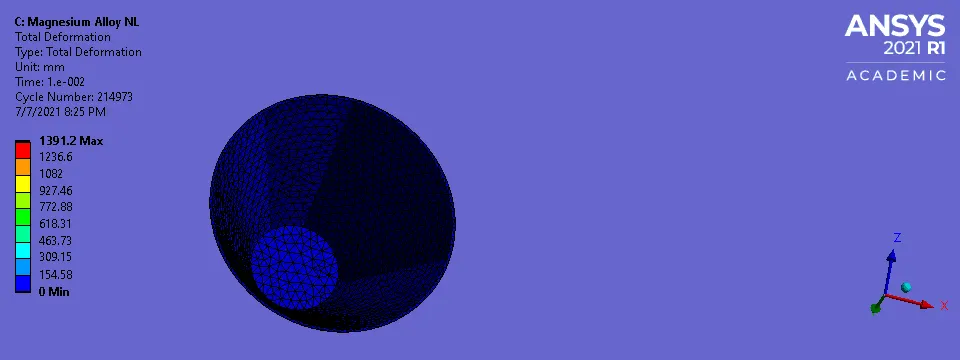
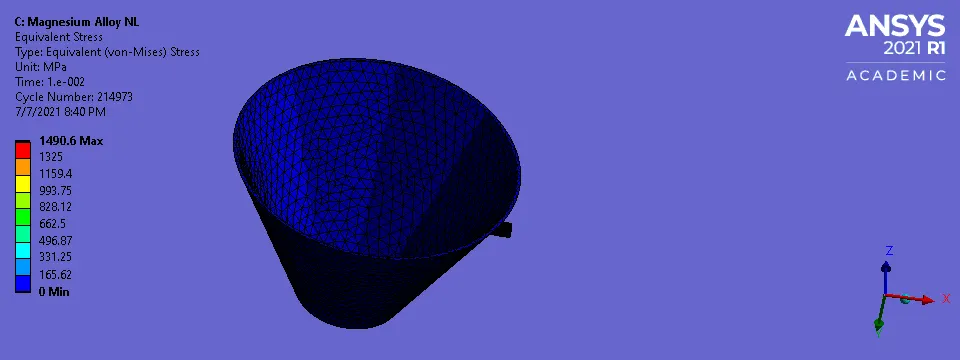
Case 3(Bucket material = Magnesium Alloy NL):-
- Total deformation
- Equivalen stress
-
Non-linear Material Total Deformation(mm) Eq Stress(Mpa) Aluminium alloy 1391 632.28 Copper Alloy 1399.7 1196.6 Magnesium Alloy 1391.2 557.63 - From the above tabular data we can see the equivalent stress is more in Copper alloy
- The derformation is more in copper alloy
- From the above three materials density of Copper>Aluminium>Magnesium
- So this concludes the material with higher density will experience higher stress