Week 10 Bullet penetrating a Bucket Challenge
Case Study of Bullet penetrating a bucket.
Objective:
For this challenge, you will have to simulate a bullet penetrating into a bucket. You will need to use 3 different non linear materials for the bucket and analyse their behaviour for the same velocity of bullet. Apply the conditions for bullet as mentioned in the video itself. Upload animation files to show the behaviour in the three cases.
Procedure:
Case1:
For Case 1, Static Structural Analysis is carried out on Workpiece. The material is Aluminum 1100 and the analysis is carried out on Ansys Workbench. The geometry of the model is imported on the Ansys Workbench for analysis. The Analysis system taken is Explicit Dynamic.
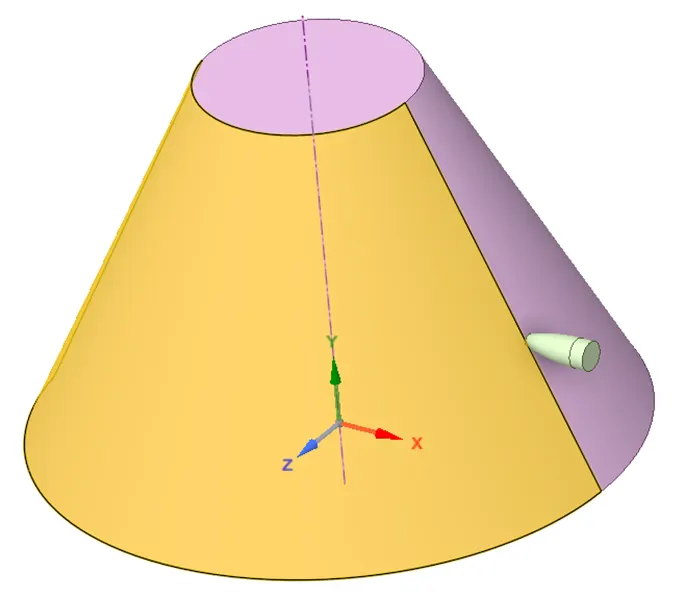
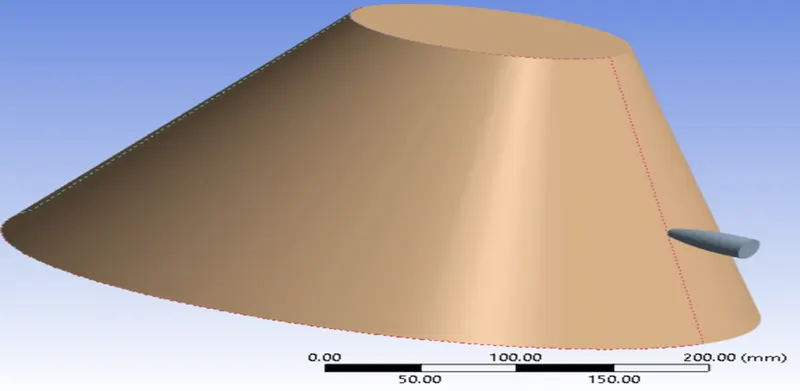
2D Geometry is extruded in the Space Claim to get the model to be imported to the ANSYS. The Extruded model is as shown in the image below:
The properties of the material is stated below:
|
Density |
|
Thermal
|
Specific Heat Constant Pressure |
|
Other
|
Gruneisen Coefficient |
|
||
|
Parameter C1 |
|
||
|
Parameter S1 |
|
||
|
Parameter Quadratic S2 |
|
||
|
Initial Yield Stress Y |
|
||
|
Maximum Yield Stress Ymax |
|
||
|
Hardening Constant B |
|
||
|
Hardening Exponent n |
|
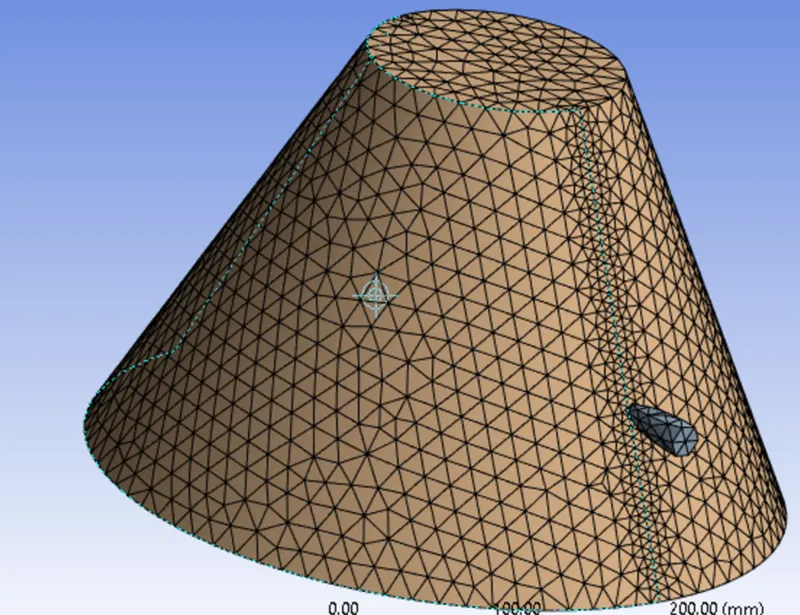
The model is meshed using Ansys Mesher with an element size of 10 mm, and a patch conforming method using tetrahedrons was employed. This is done to get the best refinement within the limitation of Ansys Academic License.
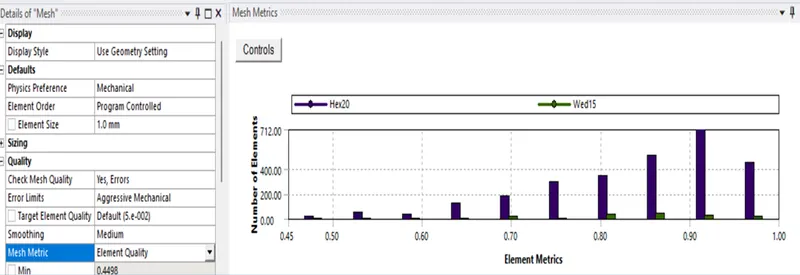
A mesh metric that identifies the elements according to their quality was employed and it can be seen that element of lowest quality are minimal. Most of the elements have very high quality in the range of 0.7-1. Hence, the mesh is of acceptable quality. The meshed model is shown in image below:
The bucket is fixed at the base and the bullet is made to move with a velocity of 139000 mm/s from the other end, simulation is then run with the setting and the results are then obtained.
Case 2:
The material of the bucket in case 2 is Stainless Steel NL.
The properties of the material is stated below:
|
Density |
|
Structural
|
Isotropic Elasticity |
|||
|
Derive from |
Young's Modulus and Poisson's Ratio |
||
|
Young's Modulus |
|
||
|
Poisson's Ratio |
|
||
|
Bulk Modulus |
|
||
|
Shear Modulus |
|
Case 3:
The material of the bucket in case 3 is Copper Alloy NL.
|
Density |
|
Structural
|
Isotropic Elasticity |
|||
|
Derive from |
Young's Modulus and Poisson's Ratio |
||
|
Young's Modulus |
|
||
|
Poisson's Ratio |
|
||
|
Bulk Modulus |
|
||
|
Shear Modulus |
|
Results:
Total deformation of the 3 cases are compared.
Time [s] Minimum [mm] Maximum [mm] Average [mm]
1.e-002 5.4644e-024 1390 21.506
1.e-002 7.044e-023 1390. 24.552
1.e-002 5.1e-022 1390. 14.39
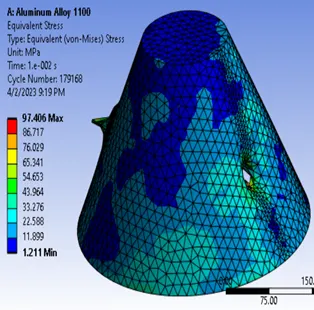
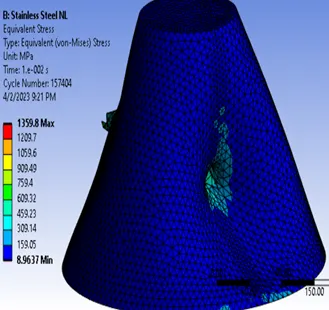
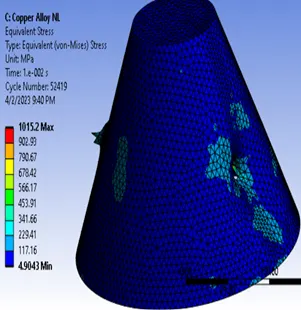
Equivalent Stress of the 2 cases are compared.
Time [s] Minimum [Mpa] Maximum [Mpa] Average [Mpa]
1.e-002 1.211 97.406 15.426
1.e-002 8.9637 1359.8 72.674
1.e-002 4.9043 1015.2 72.51
The total directinal deformation on the gear is as plotted and is shown on the plate below.
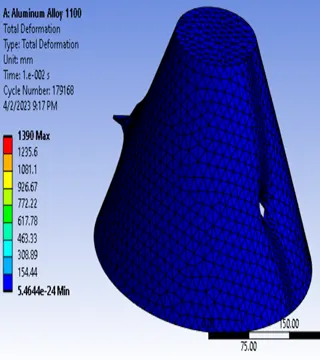
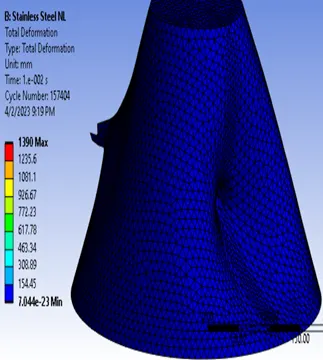
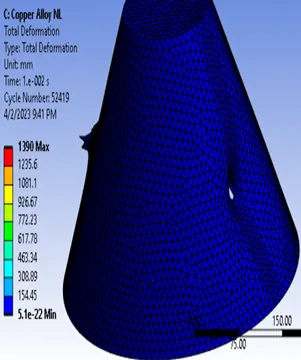
The Equivalent stress is plotted on the plate and is as shown below
Conclusion:
The average deformation and equivalent stress for case 3 (Copper NL) is less than that of Case 1 & Case 2, therefore Case 3 is preferrable from the analysis point of view.