Week 10 Bullet penetrating a Bucket Challenge
AIM: To perform Explicit Dynamic Analysis for bullet penetrating into a bucket.
OBJECTIVE:
- To perform the Analysis bullet penetrating into a bucket using three different non-linear materials for the bucket.
THEORY:
- Explicit Dynamic Analysis is a computational technique used to simulate the behaviour of structures and materials under dynamic loading conditions, such as impact or explosion. In the case of a bullet penetrating a bucket, explicit dynamic analysis can be used to model the interaction between the bullet and the bucket, and to predict the behaviour of the materials involved.
- To perform an explicit dynamic analysis, the geometry of the bullet and the bucket are modelled using finite element analysis (FEA) software. The material properties of the bullet and the bucket, such as density, elasticity, and strength, are also input into the model. The analysis is then run by applying an initial velocity to the bullet and simulating its penetration into the bucket over a period of time.
- During the analysis, the software calculates the stresses, strains, and deformations in both the bullet and the bucket, and predicts the extent of damage that will occur. This information can be used to optimize the design of the bucket to better withstand the impact of the bullet, or to choose a different material for the bullet to increase its penetrating power.
- Overall, explicit dynamic analysis is a powerful tool for predicting the behaviour of materials under dynamic loading conditions, and can be used to design more effective and resilient structures and materials.
The physics involved in a bullet penetrating into a bucket is primarily related to the mechanics of materials and the behaviour of solids under impact loading. Specifically, the following physical principles are important:
- Kinematics: The motion of the bullet as it penetrates the bucket is described by kinematic equations, which relate the position, velocity, and acceleration of the bullet as a function of time.
- Newton's laws of motion: The forces acting on the bullet as it penetrates the bucket are described by Newton's laws of motion. In particular, the second law, which states that the force acting on an object is proportional to its mass and acceleration (F=ma), is used to calculate the acceleration of the bullet as it interacts with the bucket.
- Impulse-momentum principle: The impulse-momentum principle relates the change in momentum of an object to the force applied to it. In the case of a bullet penetrating a bucket, the impulse-momentum principle can be used to calculate the force exerted by the bullet on the bucket as it slows down.
- Material properties: The material properties of the bullet and the bucket are important factors in determining the behaviour of the system. The elasticity, strength, and density of the materials determine the amount of deformation, stress, and strain that occur during the impact.
- Energy conservation: The energy of the system is conserved during the impact, with some of the kinetic energy of the bullet being transferred to the bucket and dissipated as heat and deformation. The total energy of the system remains constant before and after the impact.
- One of the key engineering equations used to model the behaviour of a bullet penetrating into a bucket is the stress-strain relationship for the material of the bucket. This relationship is described by Hooke's law, which states that the stress applied to a material is proportional to the strain it experiences:
σ = Eε
- where σ is the stress applied to the material, ε is the strain it experiences, and E is the modulus of elasticity of the material. The modulus of elasticity is a material property that describes how much the material will deform when a given amount of stress is applied.
- In the case of a bullet penetrating into a bucket, this equation can be used to calculate the stress and strain on the material of the bucket as the bullet penetrates it. The force exerted by the bullet is related to the stress applied to the material, while the deformation of the material is related to the strain it experiences. By modelling the behaviour of the material using this equation, engineers can design buckets that are better able to withstand the impact of bullets or other high-speed projectiles.
ANALYSIS SETUP
Here we will start our work Explicit Dynamic analysis for bullet penetration on a bucket with different Non-Linear material of bucket.
There are three different cases as per different Non-Linear material of Bucket as given below:
- CASE: 1 {Aluminium Alloy NL}
- CASE: 2 {Copper Alloy NL}
- CASE: 3 {Stainless Steel NL}
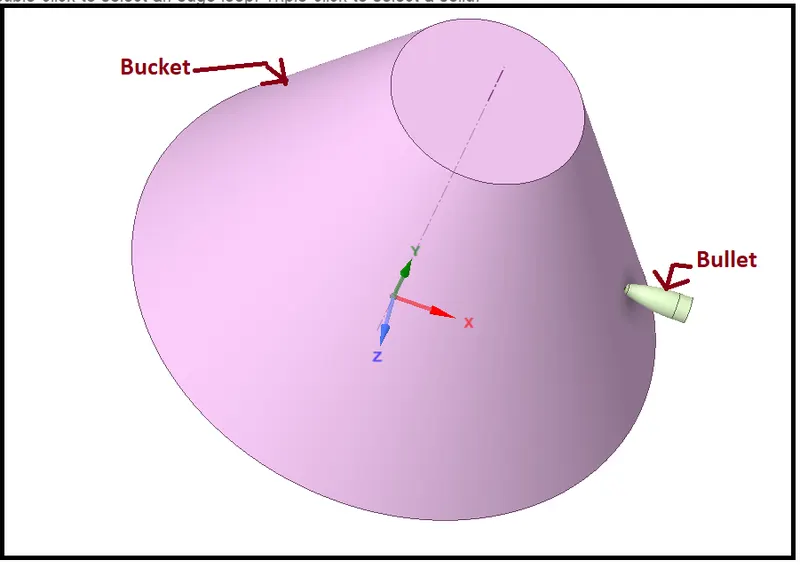
- Given Geometry
- Mesh
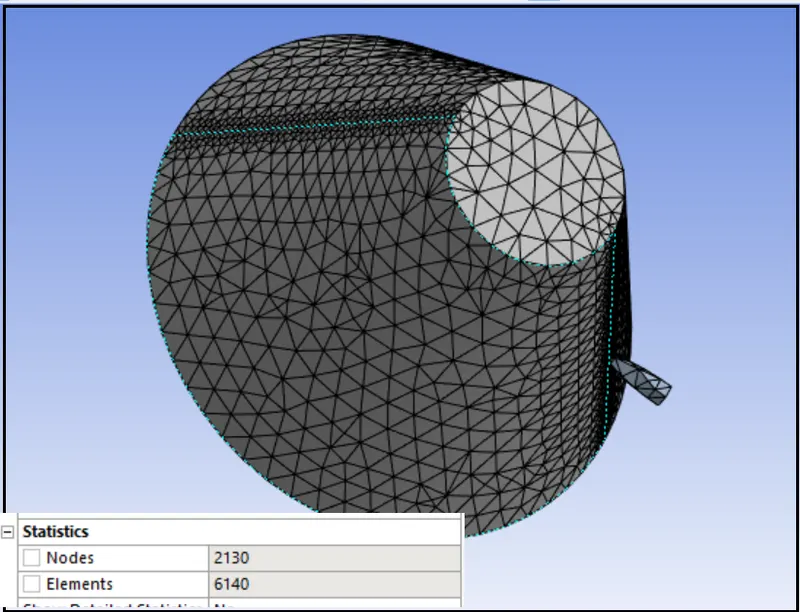
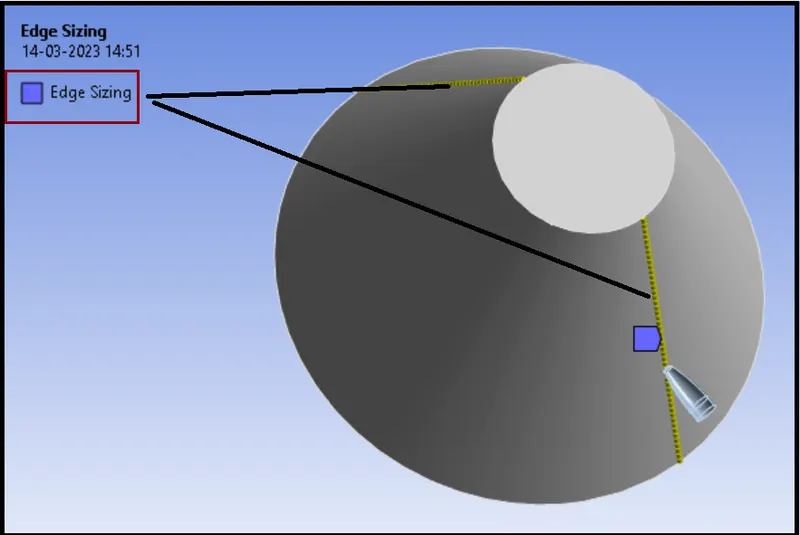
Meshing parameters are as given below:
Edge Sizing: 2 Spited Edges
Element Size: 6 mm.
Material for Bullet
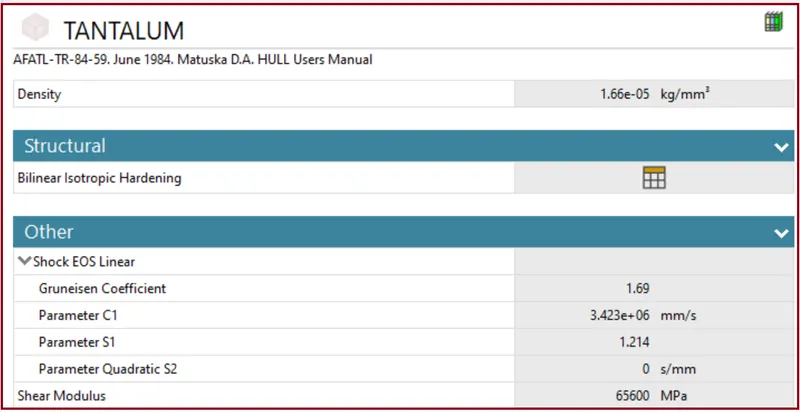
Here bullet material is same for all three cases.
Material for Bucket
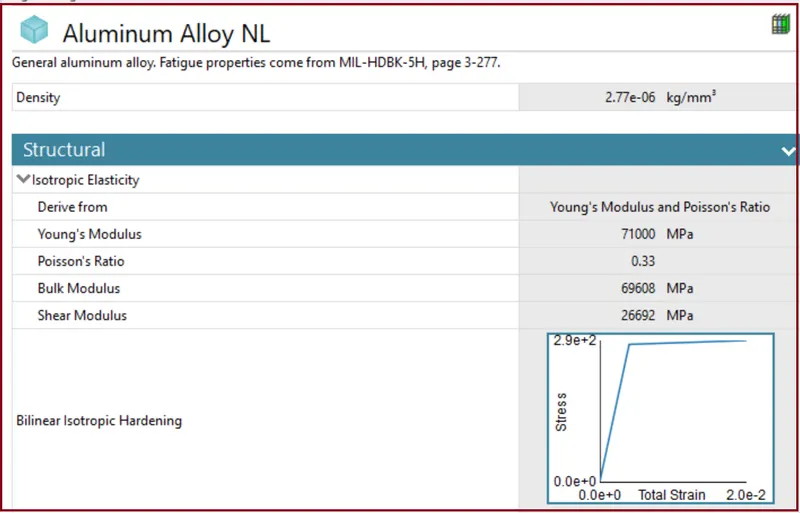
CASE:1 {Aluminium Alloy NL}
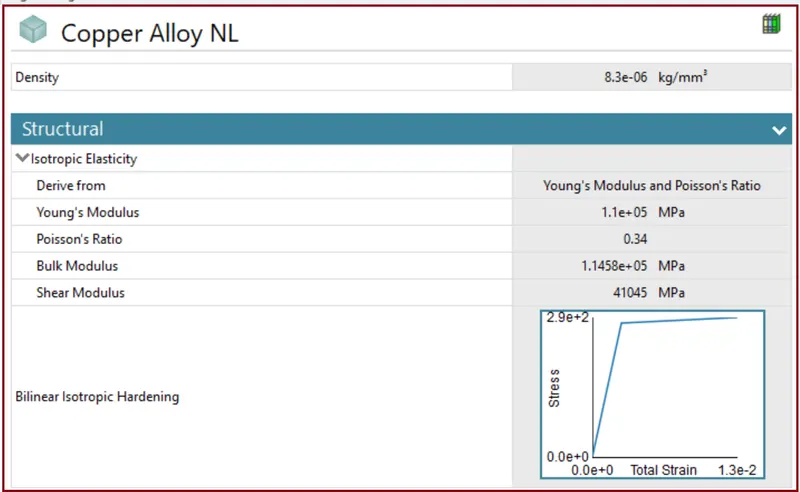
CASE:2 {Copper Alloy NL}
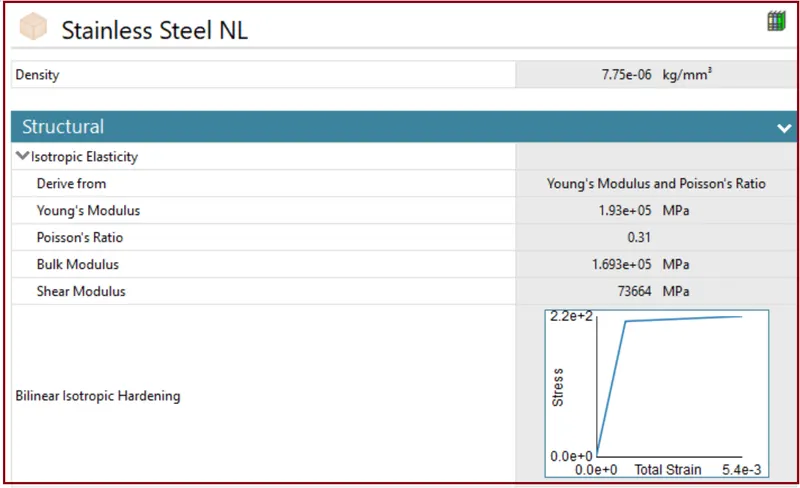
CASE:3 {Stainless Steel NL}
Initial steps
- Import model in Explicit Dynamics in Geometry section.
- Then go to Mechanical model section.
- Rename the Part of the setup as Bucket and Bullet.
- Boundary Conditions settings:
Our next step is creating Boundary Conditions:
Analysis Settings:
- No. of Steps: 1
- End Time: 0.01 s
- Maximum Number of Cycles:1e+07
- Maximum Energy Error: 5
- Initial Time Step: Program Controlled
- Minimum Time Step: Program Controlled
- Maximum Time Step: Program Controlled
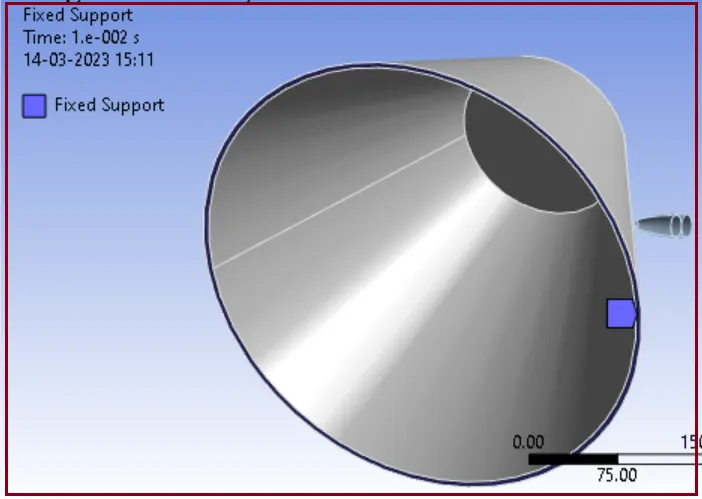
Fix Support {same for all three cases}
Here we need to Keep bottom face of the Bucket as a fixed to hold it while the bullet is penetrating.
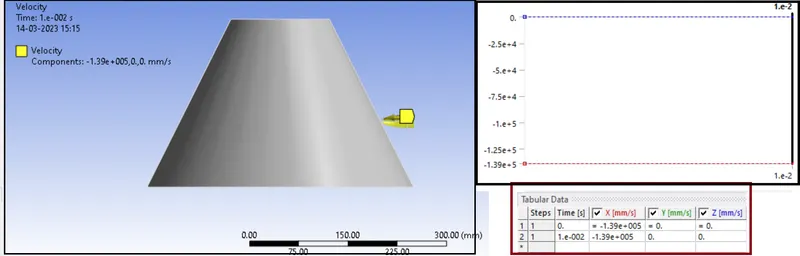
Velocity (same for all three CASES)
Apply The velocity to Bullet in the negative X-Direction.
SOLUTION
After giving proper boundary conditions, create desired solutions for output results.
- Equivalent Stress
- Total Deformation
CASE:1 {Aluminium Alloy NL}
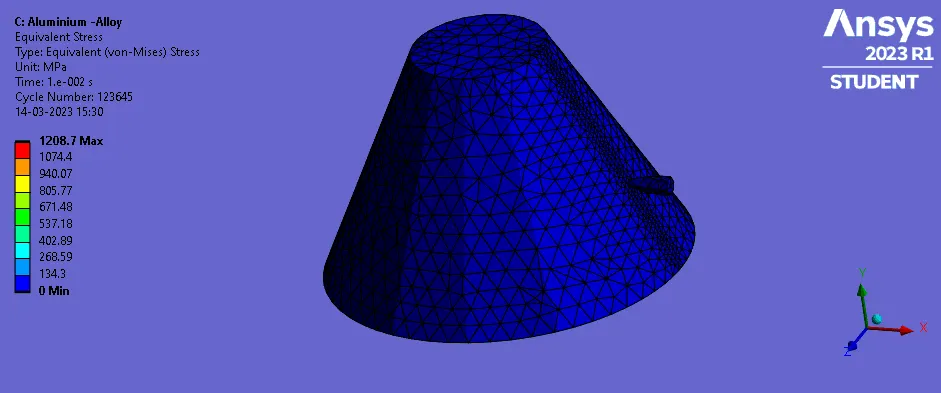
- Stress
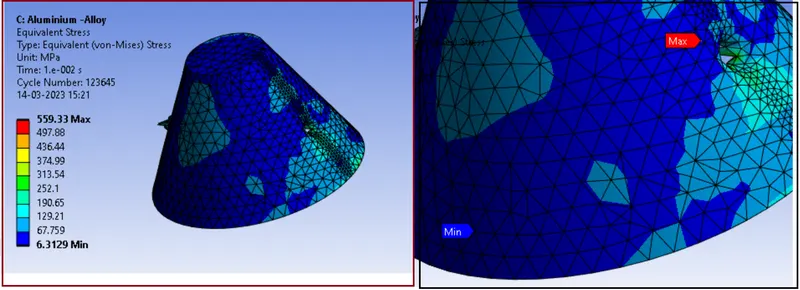
- Stress plot
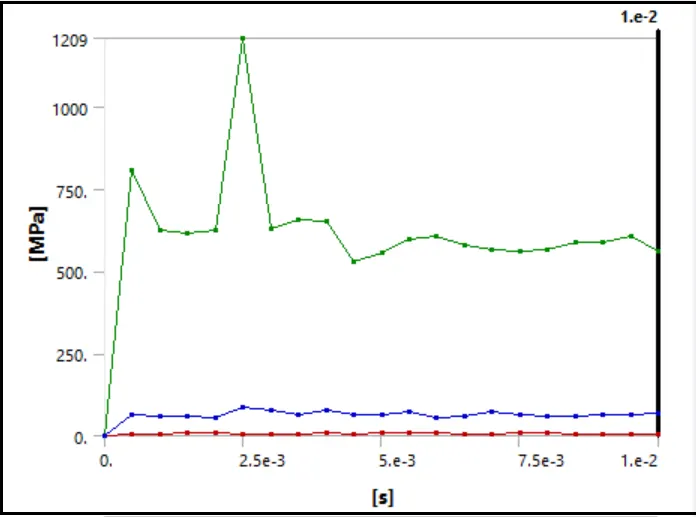
- Detailed Stress data
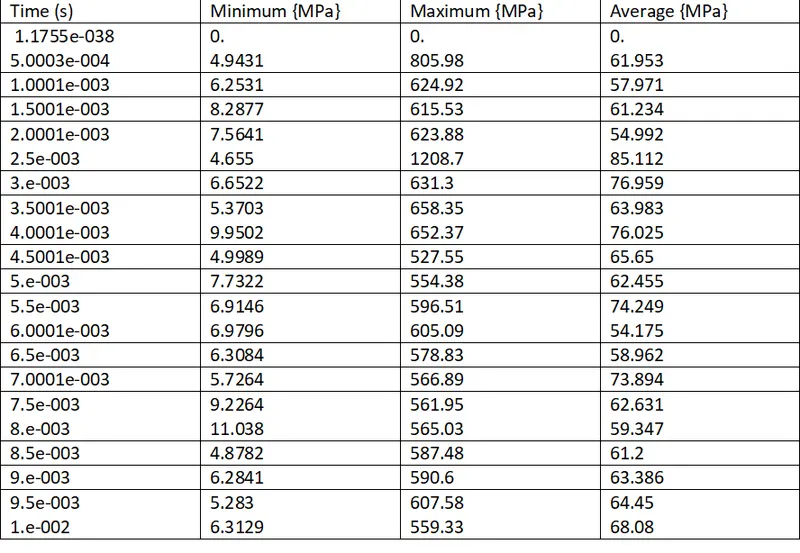
The maximum stress is 559.33 MPa.
when the bullet starts to penetrate, we Observe some spikes in plot.
Maximum stress is generating when the bullet impacts on the bucket.
ANNIMATION..
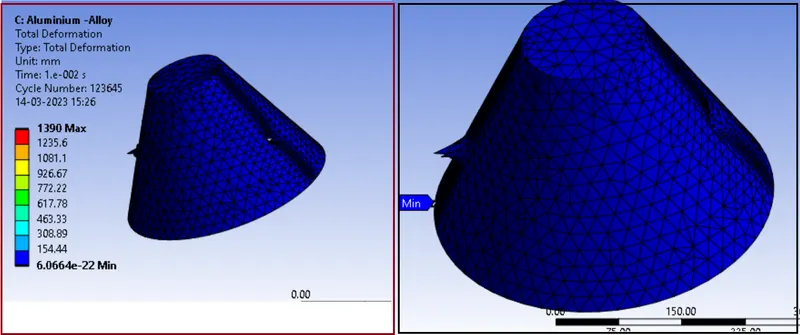
- Total Deformation
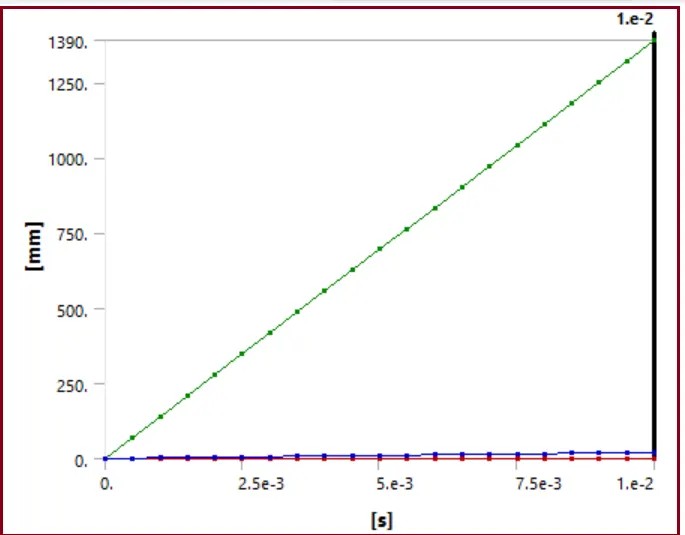
- Total Deformation Plot
- Detailed deformation data
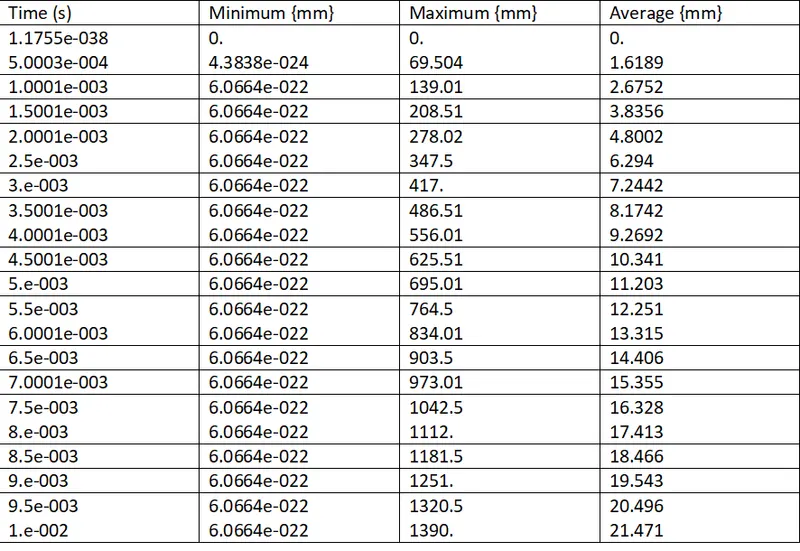
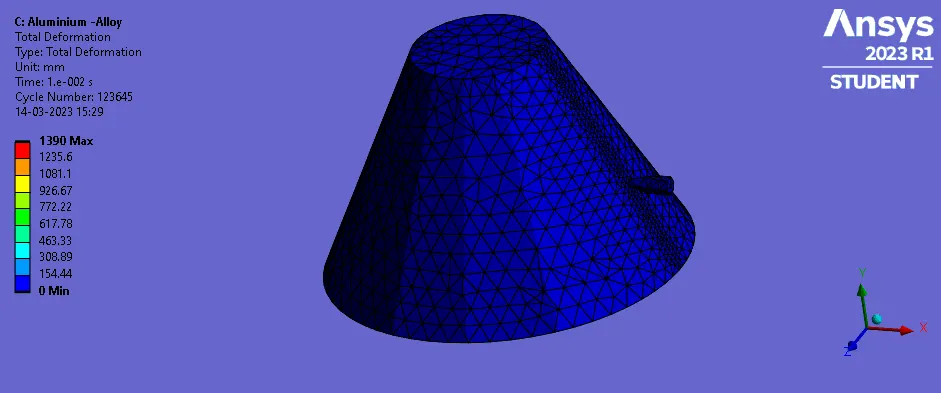
The deformation is the distance travelled by the bullet, which is maximum 1390 mm.
ANNIMATION..
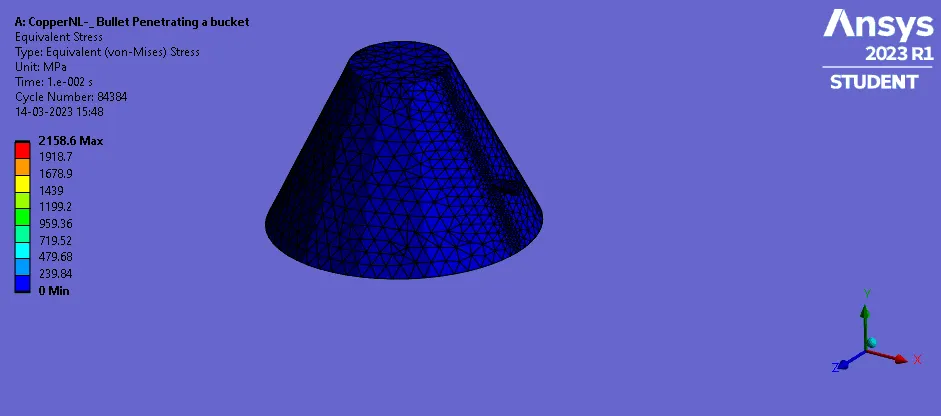
CASE:2 {Copper Alloy NL}
- Stress
- Stress plot
- Detailed Stress data
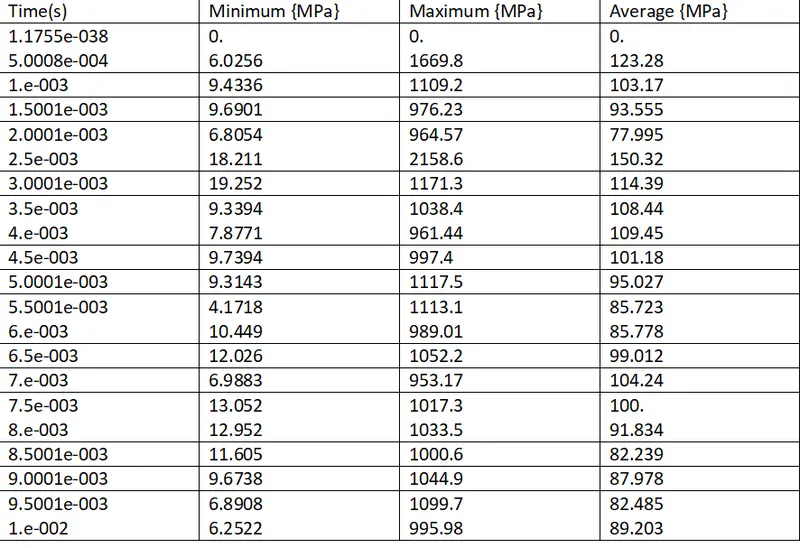
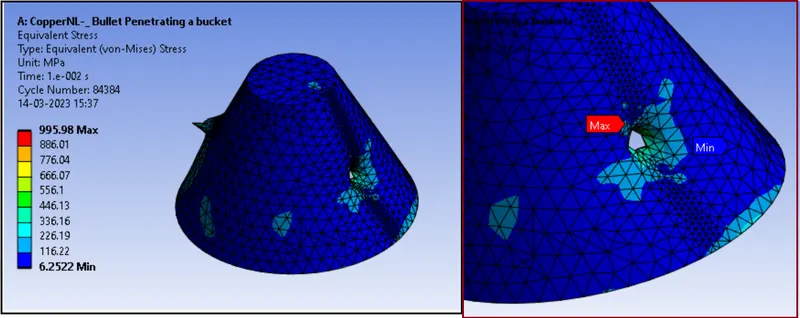
- The maximum stress is 995.98 MPa.
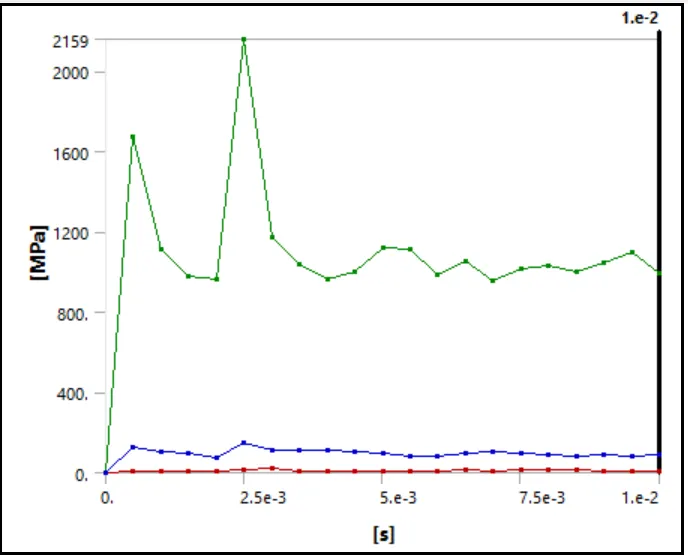
- when the bullet starts to penetrate, we can see some spikes in plot.
- Maximum stress is generating when the bullet impacts on the bucket.
- From the plot we can say that when bullet enters the bucket, stress is 1669.8 MPa at 5e-4 s.
- When bullet exits the bucket, stress is maximum up to 2158.60 MPa at 2.5e-3 s.
ANNIMATION..
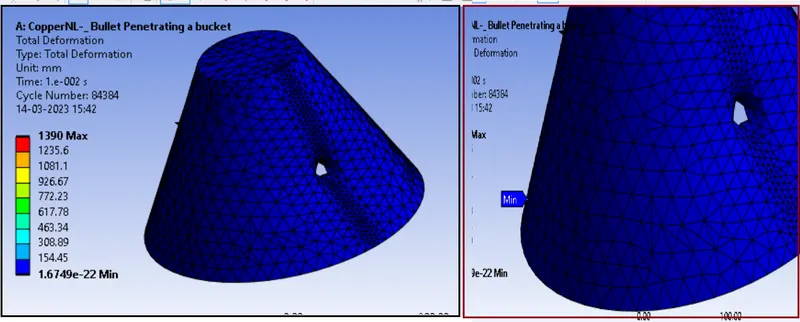
- Total Deformation
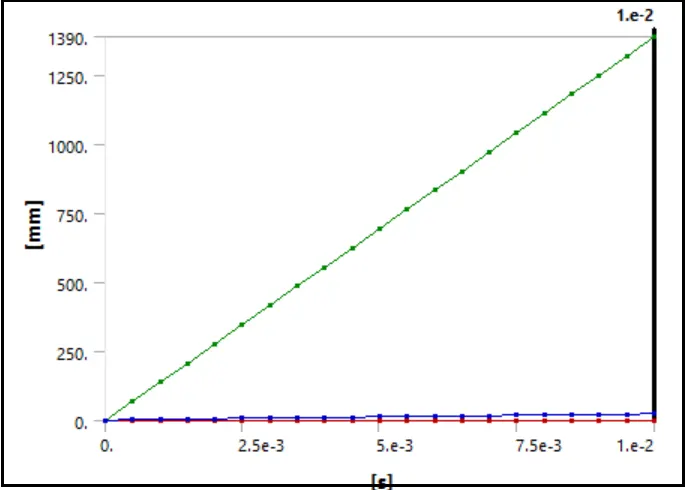
- Total Deformation Plot
- Detailed deformation data
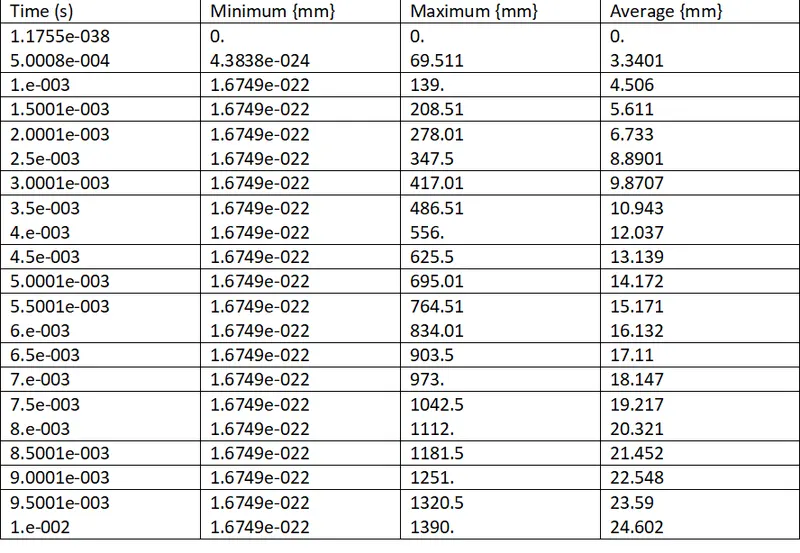
- The deformation is the distance travelled by the bullet, which is maximum 1390 mm.
ANNIMATION..
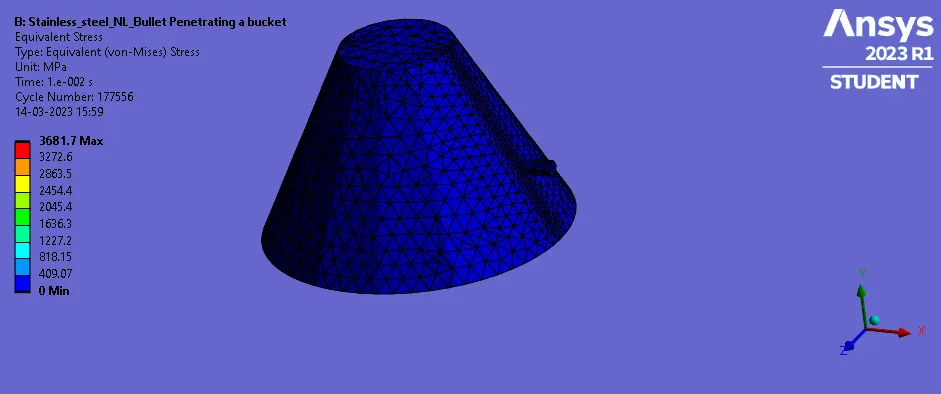
CASE:3 {Stainless Steel NL}
- Stress
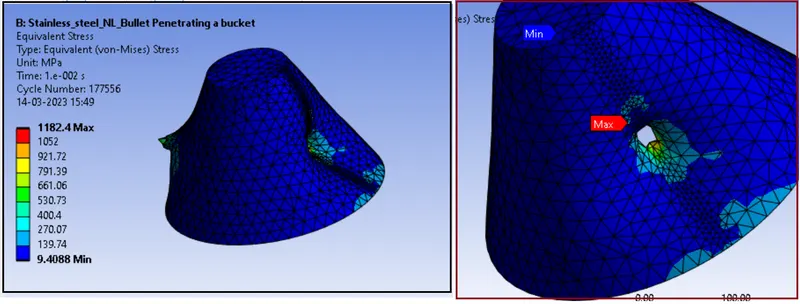
- Stress plot
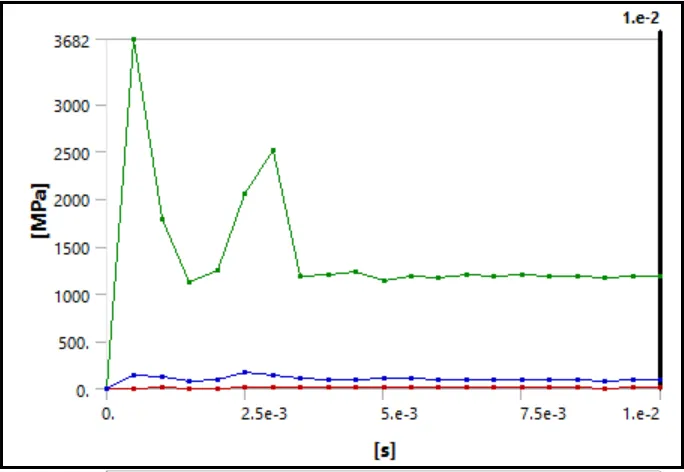
- Detailed Stress data
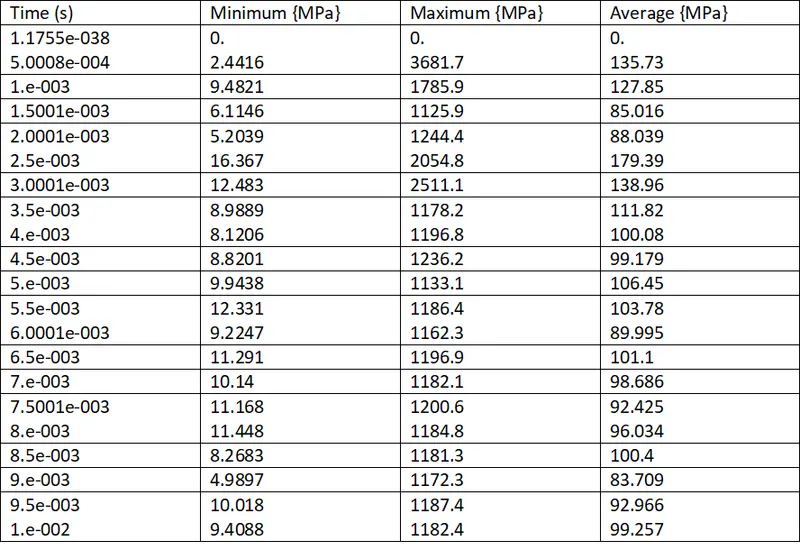
- The maximum stress is 1182.4 MPa.
- when the bullet starts to penetrate, we can see some spikes in plot.
- Maximum stress is generating when the bullet impacts on the bucket.
- From the plot we can say that when bullet enters the bucket, stress is 3681.7 MPa at 5.e-4 s.
- When bullet exits the bucket, stress is maximum up to 2511.1 MPa at 3.e-3 s.
ANNIMATION..
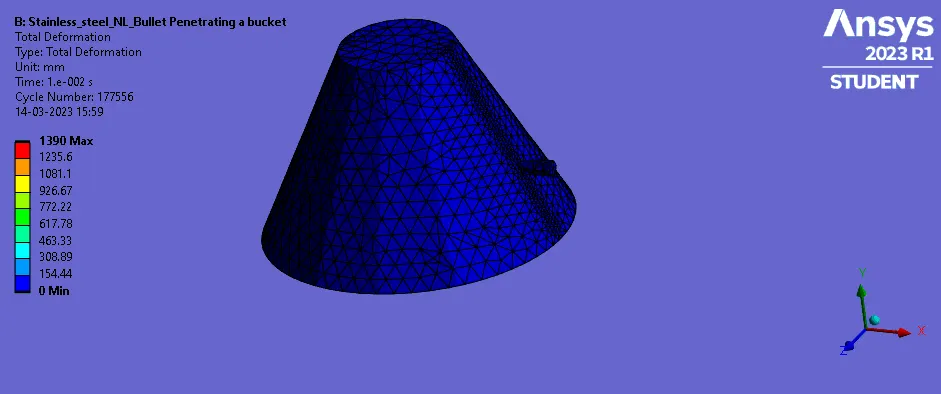
- Total Deformation
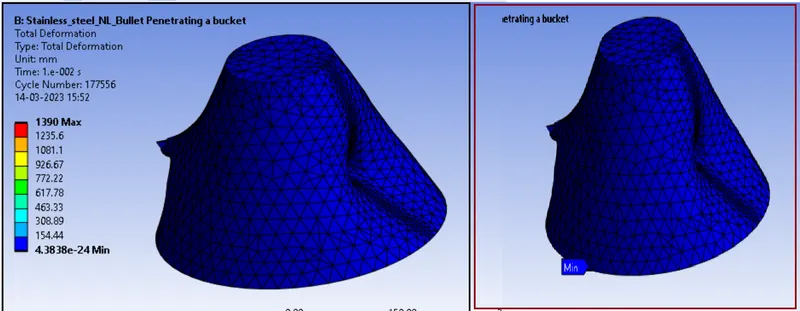
- Total Deformation Plot
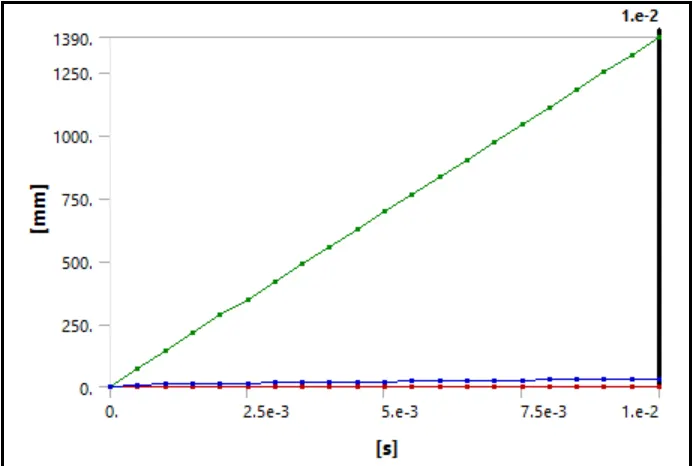
- Detailed deformation data
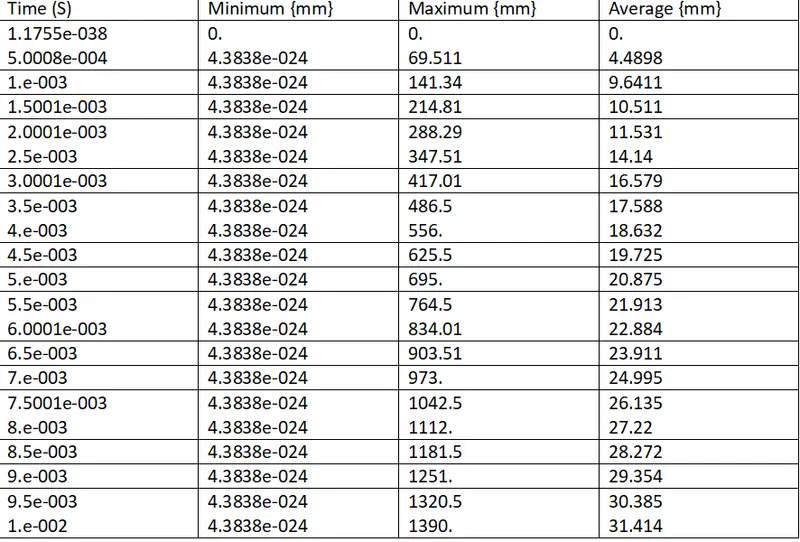
- The deformation is the distance travelled by the bullet, which is maximum 1390 mm.
ANNIMATION..
Result Summary:
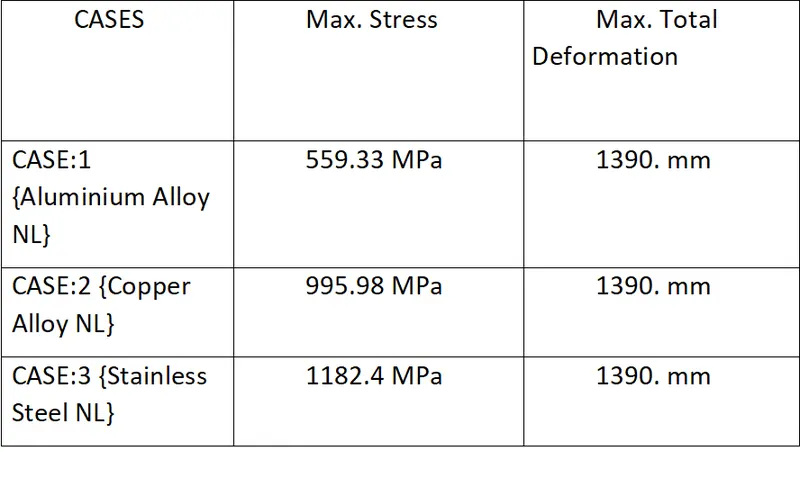
- Here if we comparing the stress results, we can see that Aluminium Alloy NL gives the minimum stress on bullet penetration in CASE: 1.
- In CASE: 2 Copper Alloy NL, stress is little higher compared to Aluminium Alloy NL.
- In CASE: 3, with Stainless Steel NL, stress generation is maximum.
- It means, Bullet cannot penetrate very easily to Stainless Steel NL.
CONCLUSION:
- we can conclude that Stainless Steel NL has the highest strength and higher young’s modulus, so the stress is also getting higher. So, it is capable to resist penetration.
- On the real time testing of the different material, we can also see the deviation of the bullet on penetration and in some cases, it may trap or captured by the material also.
- Generally, the materials like Kevlar are use as bullet proofing, which resist the bullet easily and also light in weight.
- The Effect of penetration depends on the thickness and the density of the material.
- Main objective of these type of analyses is to find the material for damage reduction and deviation.
- Damage reduction reduces the damage a bullet dots per inch of the material it passes through.
- Deviation determines how much the bullet changes the direction per inch of the material it passes through.
- So, high strength and density also decrease the penetration with increase in stress.
- In Stainless Steel NL case, stress is the higher, which means the plastic deformation of the material is large. So, the resistance to the penetration will also be higher.
- So, due to high strength and high density, it gives less penetration and it leads to less damage.
**********************************************************************************************************************************************************************************************************************************************************************END
Thanks & regards,
Devesh kashyap