ANSYS Project: Bullet Penetrating a Bucket
Aim:
To perform a Explicit Dynamics analysis of a bullet pentrating a bucket for three different materials of the bucket.
Theory:
Bullet penetration through various materials is a significant topic to consider while designing containers, pressure tanks, vehicles, armour, and other similar products, particularly barriers, to protect security troops. In various defence scenarios, the behaviour of the material supporting bullet impacts, for example, in continuous media, is investigated. Granular media, on the other hand, is another alternative for reducing the kinetic energy of a bullet over short distances, especially when used in the form of ballistic blocks.

Figure: Penetration of Bullet [link]
Projectiles can be hard or flexible. Nails, hard bullets, and low velocity fluid and soil penetration are examples of rigid projectiles. Bullets striking hard armour, warhead-launched fragments, and fragment simulating projectiles (FSP), which are usually used as surrogate long rods designed to penetrate heavy armour, and shaped charged jets (which are produced by explosive collapse of ductile metal cones), are all examples of deforming projectiles. The physical processes that occur in the projectiles are distinct from those that occur in the target, but they are controlled by the requirement that stress be continuous across the projectile-target border and displacements be compatible at the boundary. Rigid body penetration is well described by cavity expansion models. Let `sigma_c` be the stress required to open a cavity from zero radius. It can be easily shown that the force required to drive an indenter into a target is `F=pir^2sigma_c` regardless of the nose shape.
Target elements might be regarded thin or thick. A reasonably thick target is one in which the transitory effects of first impact and either projectile aerostation or breakout are minor in comparison to the steady state. In practise, thickness is frequently quantified in terms of projectile diameters, and steady state effects typically dominate in targets thicker than 5 diameters. In this context, thick target response means a projectile with a high L/D ratio; otherwise, the target will not be perforated. As a result, thick target theory is most applicable to long rod projectiles. The Poncelet equation is the most basic steady penetration equation:
`m (dV)/ (dt) = R + 1/2 C rho_tAV ^2`
Perforation occurs when a projectile enters a target without going through it, while penetration happens when the projectile completely passes through the target; however, the term penetration is widely used to apply to either. Penetration into a semi-infinite or gigantic target is penetration of targets so thick that the level of penetration is unaffected by the target's thickness. There is a transition period between semi-infinite penetration and perforation in which the target is not perforated but the bullet encounters less resistance and can penetrate a larger distance than it would in a semi-infinite target. This effect, also known as the back or rear surface, plate, or face effect, happens when perforation occurs.
A penetrating projectile may cause the target to shatter into many pieces, spewing at high velocity from both the front and back of the target. These fragments are referred to as spall. Even if a perforation is not achieved (the bullet fails to pass through the target), spall can be generated by the shock wave produced by the projectile's contact. Bunker busters are bombs designed for deep penetration into the earth or perforation of hardened objects.
Objectives:
- Getting ready with the Bullet Penetrating a Bucket 3D models developed in Solidworks and importing it into the Ansys Workbench for Explicit Dynamics analysis.
- Apply Boundary Conditions by setting up the contacts and joints. Also editing the analysis setting for the simulation to take place.
- Determine Total Deformation, Equivalent Stress, Equivalent Strain and User defined result to measure temperature for the performed simulation.
- Conducting the parametric study for each material of the Bucket.
- Analyzing the result and developing an inference for the trend shown with the change in Bucket material.
Analysis Setup:
A explicit dynamics analysis is to be conducted for a bullet penetrating a bucket mechanism for three different non-linear materials of the bucket: Aluminum Alloy NL, Magnesium Alloy NL and Structural Steel NL. The simulation is aimed at finding the Equivalent Stress, Total Deformation, Equivalent Strain and also User defined result to calculate the temperature of the body for the three cases.
- Geometry:
The 3D assembly model of the Bullet Penetrating Bucket model developed in SOLIDWORKS is shown in figure below: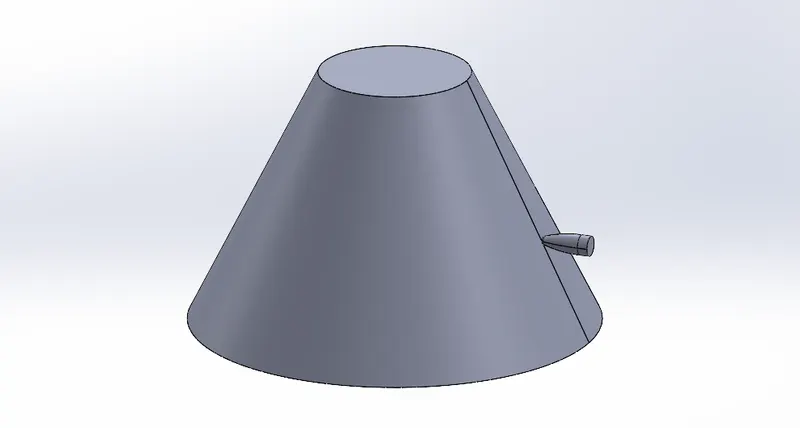
These model is then imported to Ansys Mechanical explicit dynamics Workbench for the analysis. - Material Properties:
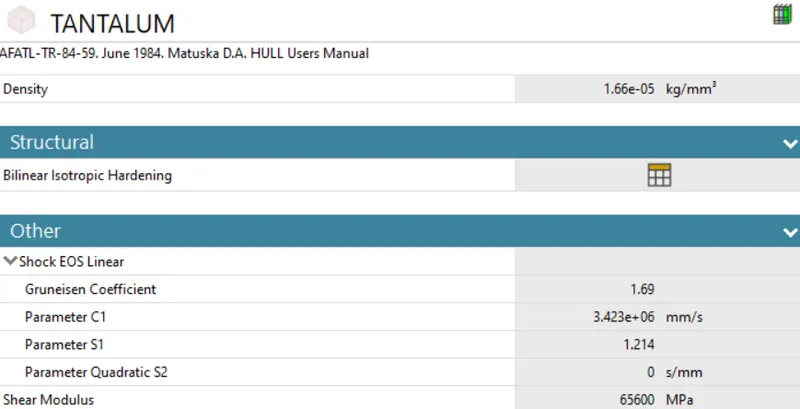
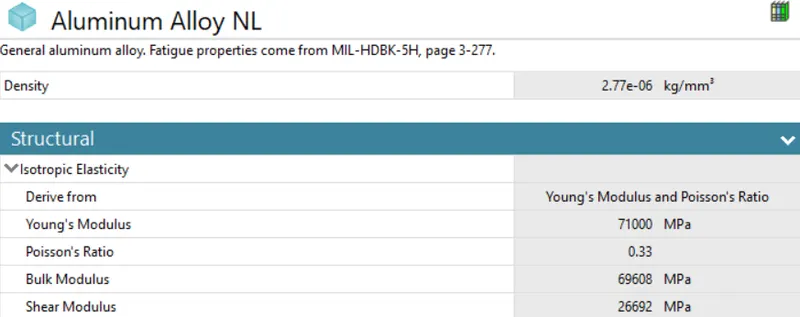
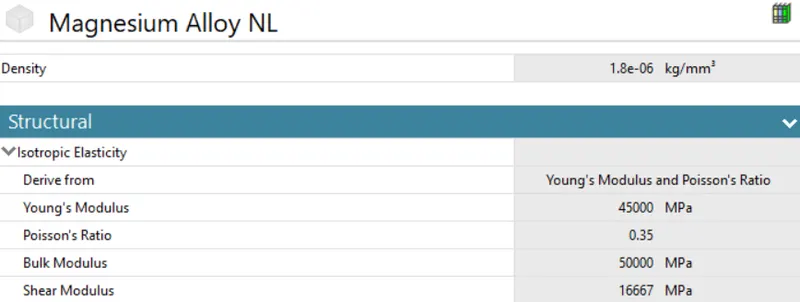
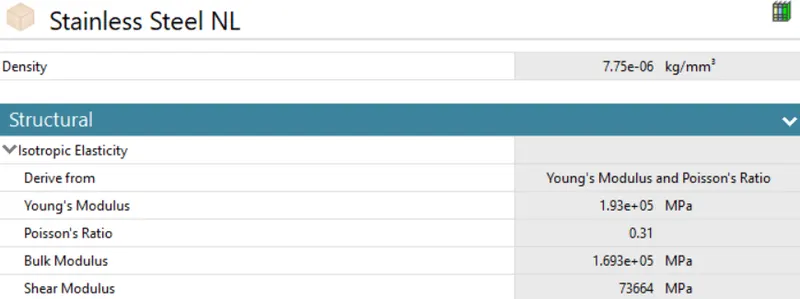
The material of the bullet is kept to be Tantalum for all the three cases. The material of the Bucket is changed for each case: Aluminum Alloy NL, Magnesium Alloy NL and Structural Steel NL. The material properties are given below:
- Tantalum:
- Aluminum Alloy NL:
- Magnesium Alloy NL:
- Structural Steel NL:
- Tantalum:
- Connection Details:
The default contact identified by the workbench is deleted as the interaction between the workpiece and the cutting tool is not a major concern for this study. Also, the body interactions is set to be frictionless. - Meshing:
Onto the default mesh size, an additional edge sizing is provided to the both side of the bucket where the bullet collides with the bucket to smoothen the simulation. The adaptive sizing is kept ON. The total number of nodes and elements generated are 5126 and 12538 respectively. The generated mesh can be seen below: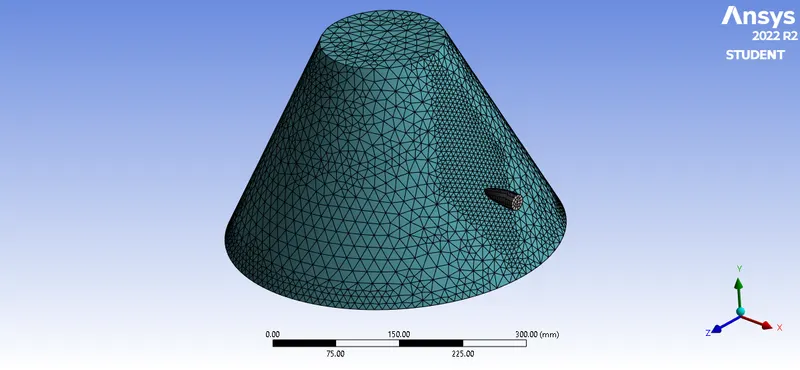

A mesh metric was used to identify elements based on their quality, and it can be observed that the elements of the lowest quality are minimum. The majority of the elements have very high quality values ranging from 0.18235 to 0.99559 with an average value of 0.55838. As a result, the mesh is of reasonable quality. - Boundary Conditions:
For analysis settings, the end time is given as 0.0053 s with the initial, maximum, and minimum time step be as program-controlled.
For this analysis the number of steps is set to 1 with maximum number of cycles is 1e+07 and end time is 0.0053 s and it is defined by time, hence initial, maximum and minimum time will be program controlled. The maximum energy error was set to be 5.
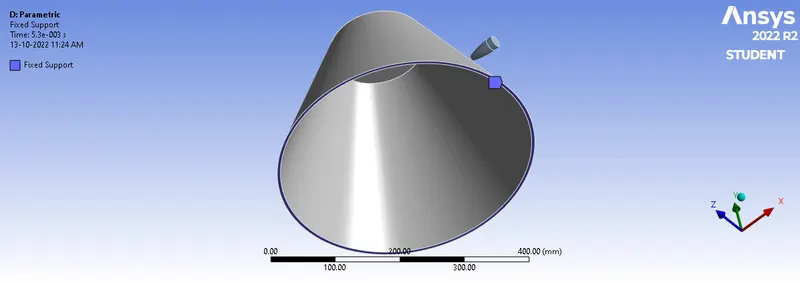
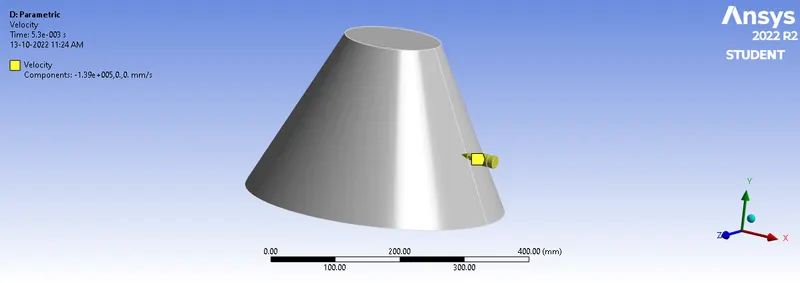
In order to simulate the motion of the model, the bucket was fixed on its bottom surface and the bullet was made to move along x-axis with a velocity of 139 m/s.
- Fixed Support to the Bucket:
- Velocity Condition for the Bullet:
- Fixed Support to the Bucket:
Results:
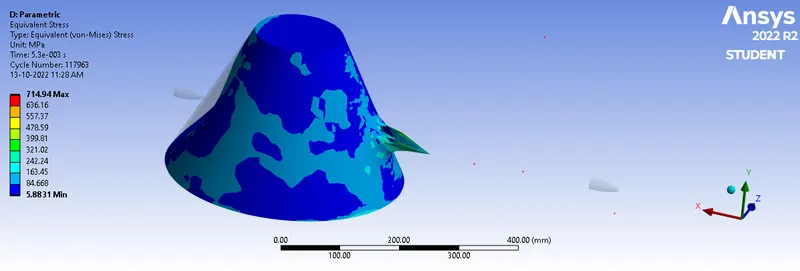
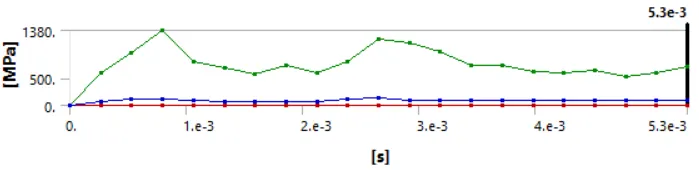
In order to accomodate the comparison of different cases with different bucket material, a parametric study was done which compares the maximum Total Deformation, Maximum Equivalent Stress, Maximum Equivalent Strain and Maximum Temperature.
Below provides the observation for the case 1 where the Bucket material is Aluminum Alloy NL.
- Equivalent Stress:
- Equivalent Strain:
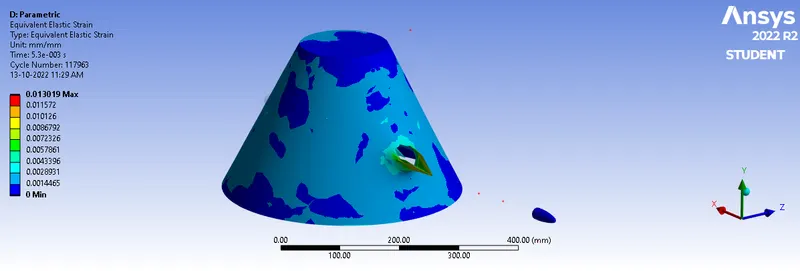
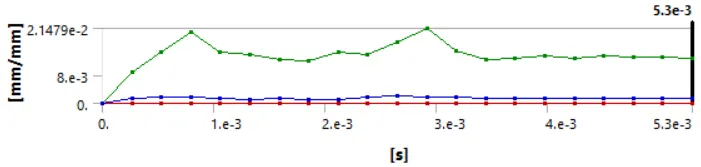
- Total Deformation:
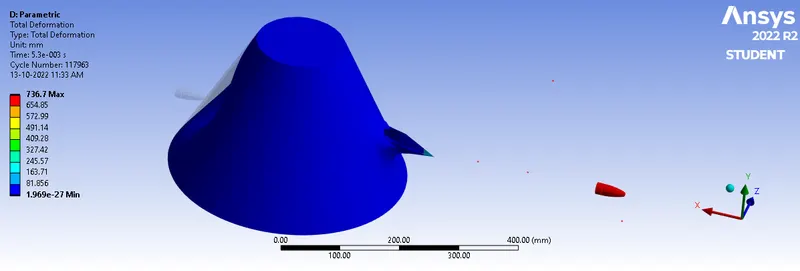
- Userdefined Result: Temperature
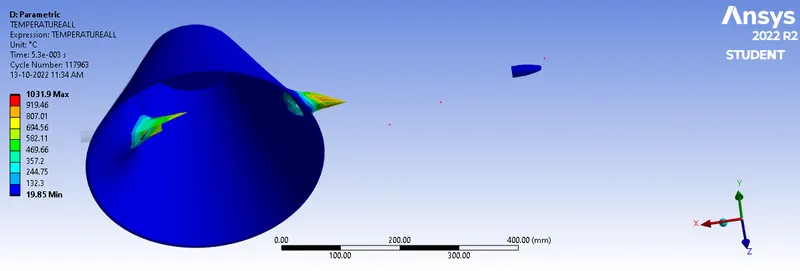
- Animations:
- Equivalent Stress:
- Equivalent Strain:
- Equivalent Stress:
- Comparison:
The observations from the parametric study are as below: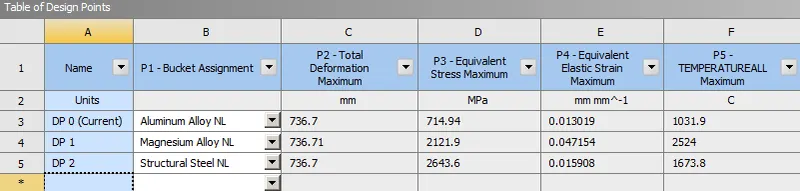
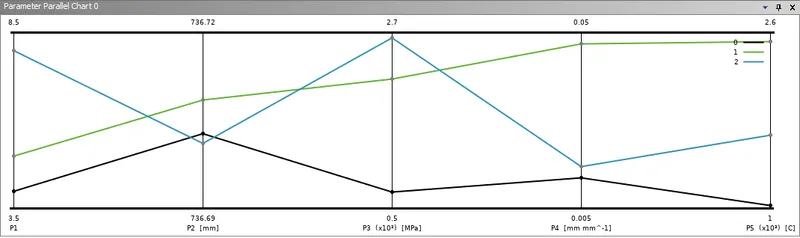
From the comparison table above, it can be identified that the maximum stress is seen on the materia Structural Steel NL, then followed by Magnesium Alloy NL and the lowest is Aliminum Alloy NL. This means that, it is harder for the buller to penetrate through Structural Steel NL and Magnesium Alloy NL compared to the Aluminum Alloy NL. Also, from the maximum deformation information in the above table, it can be seen that the value is same almost for every material. This maximum deformation gives the information about the distance travelled by the bullet. Since the values seems to almost equal, no conclusion can be made from these deformation values. The maximum strain is seen for Magnesium Alloy NL which is justified with the deformation value. The strain gives information on how the material of bucket displaces when the bullet hit on the bucket. The more the strain, the more will be the instantaneous displacement during the interaction of bullet with bucket. The bucket is able to produce the highest internal energy for the case where the stress formed is the lowest. As the stress is low even the temperature of the bucket is also lowest compared to the other two cases.
When bullet tries to penetrate into bucket or any object,the penetration purely depends on the bullet material,bucket material density and hardness. Both the density and hardness will resist penetration. Higher the density and hardness, lower will be the penetration.
Conclusion
With Ansys Workbench, a simulation of a mechanism of Bullet Penetrating a Bucket was conducted for different bucket material cases and are compared. According to the analysis, Structural Steel NL withstands slightly better compared to other two material because of its higher Young's Modulus value making it to have higher Ultimate Strength of the material. Because of this the temperature developed on it will be more compared to other material.