Week 10 Bullet penetrating a Bucket Challenge
Objective:
The aim of this challenge is to simulate the situation of a bullet penetrating a bucket. The challenge involves 3 cases - in each case the bucket is made of a different non-linear material. The equivalent stress and elastic and plastic strain are to be determined.
Case setup and execution:
First the explicit dynamics module was opened. The SpaceClaim was opened and the geometry was dragged and dropped in the SpaceClaim. But the geometry did not show the edge dividing the bucket surface into 2 parts.
Hence the model was imported in the SpaceClaim. This time the edge was showing. But when the materials were added to the library and the model was updated, the edge again disappeared.
Hence first the required materials were first added to the library. Then the model was imported into the module. This time the edge was showing.
The materials added to the library were Aluminium Alloy NL, Copper Alloy NL, Titanium Alloy NL and Tantalum.
Then the Ansys Mechanical was opened. The parts were renamed as Bucket and Bullet respectively. The Bullet was assigned the Tantalum material, while the bucket was assigned Aluminium alloy NL. The material of the bucket was parameterised.
The existing contacts were deleted since in the explicit analysis the collision of the objects is the main focus.
The body interaction was kept unchanged.
In the meshing, the bucket was provided the edge sizing of 6 mm by selecting the edges dividing the surface of the bucket. The model was then meshed.
In the analysis settings, the end time was provided as 0.01 seconds.
The bottom face ofthe bucket was provided a fixed support. The bullet was given the velocity of 1.35e+05 mm/sec in negative X direction.
The output was requested for equivalent stress as well as equivalent elastic and plastic strain.
The model was run. However after running for some time, it terminated with the error saying that the timestep is too small.
Hence the mesh was modified. The edge sizing for the bucket was increased from 6 mm to 10 mm.
Then the model was run. It ran smoothly.
Results:
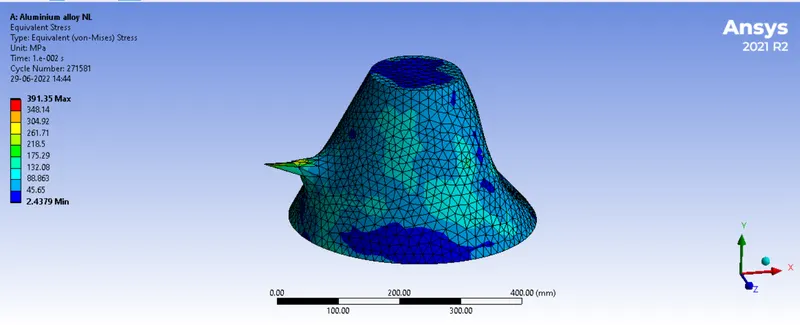
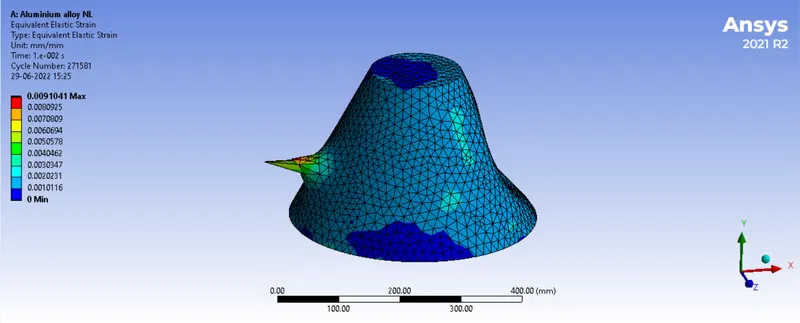
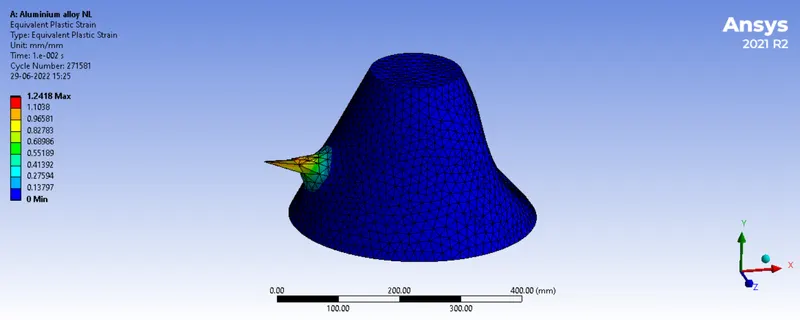
Case 1: Aluminum alloy NL
Animation
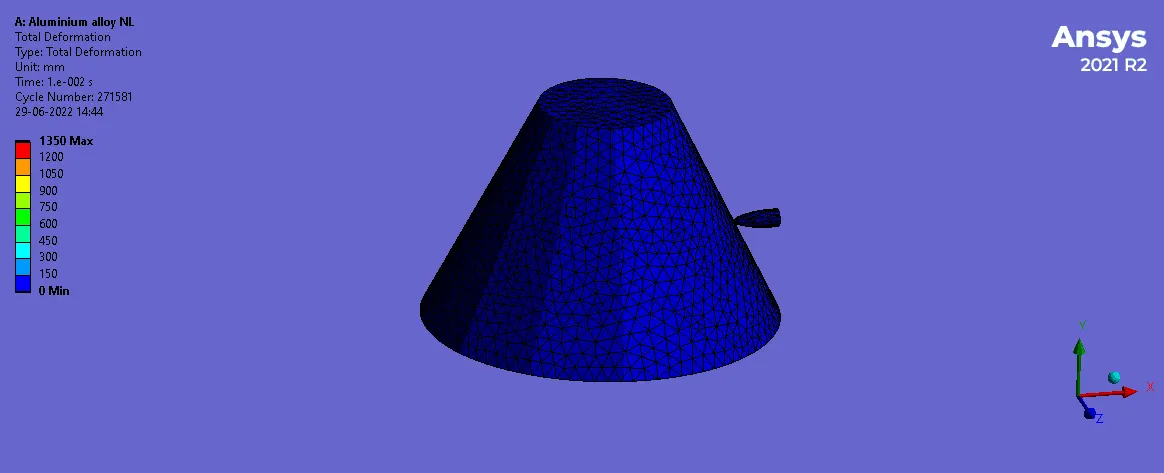
Equivalent stress
Equivalent elastic strain
Equivalent plastic strain
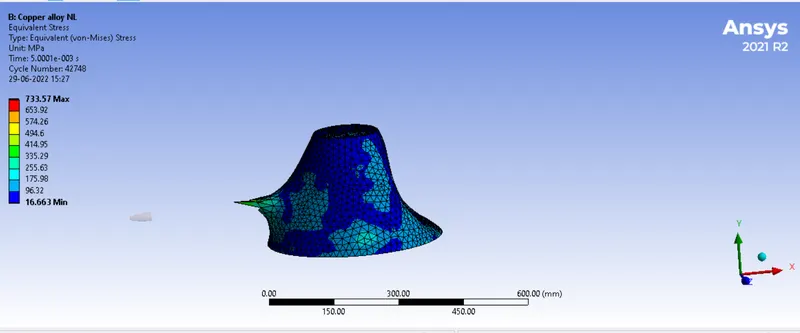
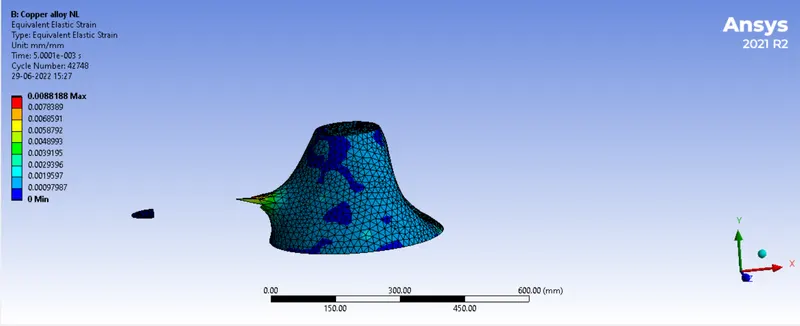
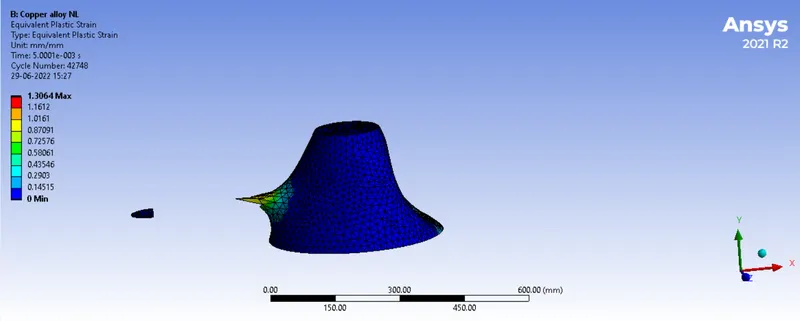
Case 2: Copper alloy NL
Equivalent stress
Equivalent elastic strain
Equivalent plastic strain
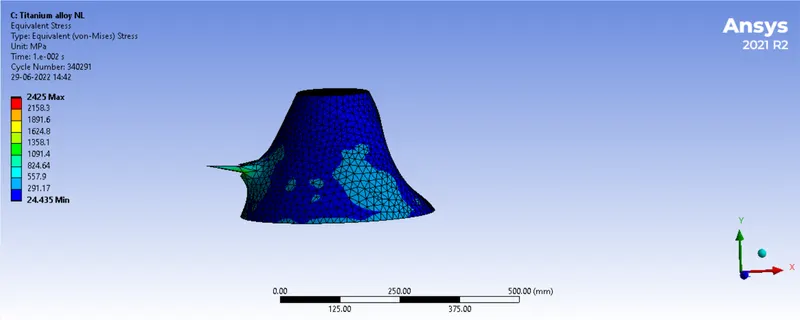
Case 3: Titanium alloy NL
Equivalent stress
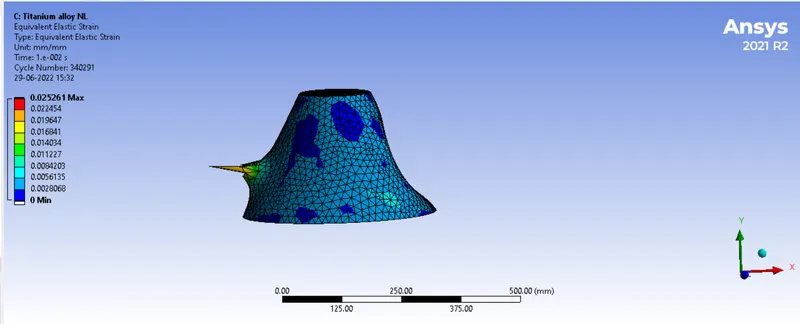
Equivalent elastic strain
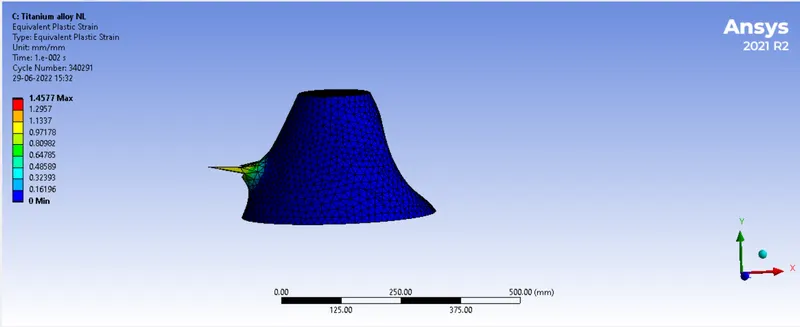
Equivalent plastic strain
| Aluminium Allloy NL | Copper Alloy NL | Titanium alloy NL | |
| Equivalent stress (GPa) | 0.39135 | 0.73357 | 2.425 |
| Eq. Elastic strain | 0.0091041 | 0.0088188 | 0.025261 |
| Eq. Plastic strain | 1.2418 | 1.3064 | 1.4577 |
Material properties
| Aluminium Allloy NL | Copper Alloy NL | Titanium alloy NL | |
| Young's modulus (GPa) | 71 | 110 | 96 |
| Yield strength (GPa) | 0.28 | 0.28 | 0.93 |
| Tangent Modulus (GPa) | 0.5 | 1.15 | 2.15 |
Conclusion:
Copper alloy NL has higher Young's modulus with same Yield strength as that of Aluminium alloy. As a result, it has lower elastic strain, with higher equivalent stress value than Aluminium alloy NL. As a result, it has higher plastic strain value. On the other hand, Titanium alloy NL has very high Yield strength, with Young's modulus lying between the earlier 2 cases. As a result, it has highest elastic and plastic strain values as well as highest equivalent stress. The simulation files are attached with the report.