Week 1 Understanding Different Battery Chemistry
INTRODUCTION OF LITHIUM ION BATTERY:
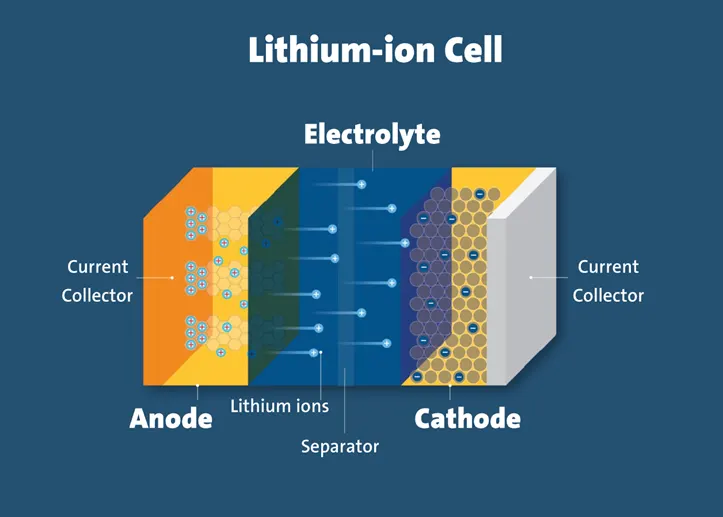
A lithium-ion battery is a type of rechargeable battery that uses lithium ions as the primary component of its electrolyte. During the discharge cycle, lithium atoms in the anode are ionized and separated from their electrons. The lithium ions move from the anode and pass through the electrolyte until they reach the cathode, where they recombine with their electrons and electrically neutralize.
TYPES OF LITHIUM ION BATTERIES THAT ARE MOST COMMON:
1. Lithium Cobalt Oxide (LCO)
2. Lithium Manganese Oxide (LMO)
3. Lithium Iron Phosphate (LFP)
4. Lithium Nickel Manganese Cobalt Oxide (NMC)
5. Lithium Nickel Cobalt Aluminium Oxide (NCA)
6. Lithium Titanate (LTO)
TERMS USED IN BATTERY TECHNOLOGY:
Actual Capacity or Available Capacity:
The total battery capacity, usually expressed in ampere-hours or milliampere-hours, available to perform work. The actual capacity of a particular battery is determined by a number of factors, including the cut-off voltage, discharge rate, temperature, method of charge and the age and life history of the battery.
Ampere or Amp (A):
An Ampere or an Amp is a unit of measurement for an electrical current. One amp is the amount of current produced by an electromotive force of one volt acting through the resistance of one ohm. Named for the French physicist Andre Marie Ampere. The abbreviation for Amp is A but its mathematical symbol is "I". Small currents are measured in milli-Amps or thousandths of an Amp.
Ampere-Hour (Amp-Hrs, Ah):
A unit of measure for a battery’s electrical storage capacity, obtained by multiplying the current in amperes by the time in hours of discharge. (Example: A battery that delivers 5 amperes for 20 hours delivers 5 amperes x 20 hours = 100 amp-hrs of capacity.)
Anode:
During discharge, the negative electrode of the cell is the anode. During charge, that reverses and the positive electrode of the cell is the anode. The anode gives up electrons to the load circuit and dissolves into the electrolyte.
Cathode:
Is an electrode that, in effect, oxidizes the anode or absorbs the electrons. During discharge, the positive electrode of a voltaic cell is the cathode. When charging, that reverses and the negative electrode of the cell is the cathode.
Separator:
The permeable membrane that allows the passage of ions, but prevents electrical contact between the anode and the cathode. Separators are made from numerous materials such as polyethylene, polyvinyl chloride, rubber, glass fiber and cellulose.
C-Rate (C):
Discharge or charge current, in amperes, expressed in multiples of the rated capacity. For example, C/10 discharge current for a battery rated at 1.5 Ah is: 1.5 AH/I 0 = 150 mA (A cell's capacity is not the same at all discharge rates and usually increases with decreasing rate.)
Capacity:
The capacity of a battery is a measure of the amount of energy that it can deliver in a single discharge. Battery capacity is normally listed as amp-hours (or milli amp-hours) or as watt-hours.
Battery:
An electrochemical device used to store energy. The term is usually applied to a group of two or more electric cells connected together electrically.
Cell:
An electrochemical device, composed of positive and negative plates and electrolyte, which is capable of storing electrical energy. It is the basic “building block” of a battery.
Cell Mismatch:
Cells within a battery pack that contain different capacity and voltage levels.
Charge:
The conversion of electric energy, provided in the form of a current, into chemical energy within the cell or battery.
Chemical cells:
The type of cells which convert energy obtained by chemical reactions into electrical current.
Circuit:
An electrical circuit is the path followed by a flow of electrons. A closed circuit is a complete path. An open circuit has a broken, or disconnected, path.
Watt:
A measurement of total power. It is amperes multiplied by volts. 120 volt @ 1 amp = 12 volts @ 10 amps
Watt Hours (Wh):
amount of electric energy that can be withdrawn from a battery or cell under specified conditions. This energy is measured in milli-Watt-hours (mWh). Product of the discharge voltage, discharge rate, and discharge time
Volumetric Energy Density:
ratio of a cell's energy to its total volume. Usually expressed in Watt-hours per liter (Wh/l). Also called "power density"
Volt:
The unit of measurement of electromotive force, or difference of potential, which will cause a current of one ampere to flow through a resistance of one ohm.
Thermal runaway:
A critical condition arising during constant voltage charging in which the current and the temperature of the battery produce a cumulative mutually-reinforcing effect which further increases them and can lead to the destruction of the battery.
Terminals:
The parts of a battery to which the external electric circuit is connected.
Temperature Cutoff (TCO):
A protective or safety device (e.g., thermostat, PTC, etc.) which senses temperature in a battery and opens or cuts off the electrical circuit if the specified temperature is exceeded, thus preventing a further rise in temperature due to the charge or discharge of a battery.
Specific Energy:
The ratio of the energy output of a cell or battery to its weight (Wh/kg). This term is used interchangeably with gravimetric energy density.
Specific Gravity (Sp. Gr. or SG):
Specific gravity is a measure of the electrolyte concentration in a battery. This measurement is based on the density of the electrolyte compared to the density of water and is typically determined by the use of a hydrometer (see Hydrometer). By definition, the specific gravity of water is 1.00 and the specific gravity of the sulfuric acid electrolyte in a typical fully charged battery is 1.265-1.285. Specific gravity measurements are typically used to determine if the battery is fully charged or if the battery has a bad cell.
Shelf Life:
The duration of storage under specified conditions at the end of which the battery still retains the ability to give a specified performance.
Self-Discharge:
Discharge that takes place while the battery is in an open-circuit condition.
Nominal capacity:
The standard capacity designated by a battery manufacturer to indentify a particular cell model.
Nominal Voltage:
The characteristic operating voltage or rated voltage of a battery.
Open Circuit:
Condition of a battery which is neither on charge nor on discharge (i.e., disconnected from a circuit).
Open-Circuit Voltage (OCV):
The difference in potential between the terminals of a cell when the circuit is open (i.e., a no-load condition). The voltage of a battery when it is not delivering or receiving power.
Operating voltage:
Voltage between the two terminals of the battery without any load.
ION:
An atom or a group of atoms charged either positively or negatively
Exothermic:
release of heat caused by a chemical reaction
Endothermic:
heat absorption caused by a chemical reaction
Energy - Output Capability:
expressed as capacity times voltage, or watt-hours.
Energy Density:
Ratio of cell energy to weight or volume (watt-hours per pound (Wh/L), or watt-hours per cubic inch(Wh/kg)).
Energy:
overall amount of power a battery or cell can deliver over time. Product of the battery's or cell's voltage, discharge rate, and discharge time. Usually expressed in milli-Watt hours (mWhr) or mWhr = V x mA x hrs
Specific Power (or gravimetric power density):
The amount of power a battery can deliver per unit mass, typically measured in W/kg
LITHIUM-ION BATTERY COMPARISON BASED ON PARAMETERS:
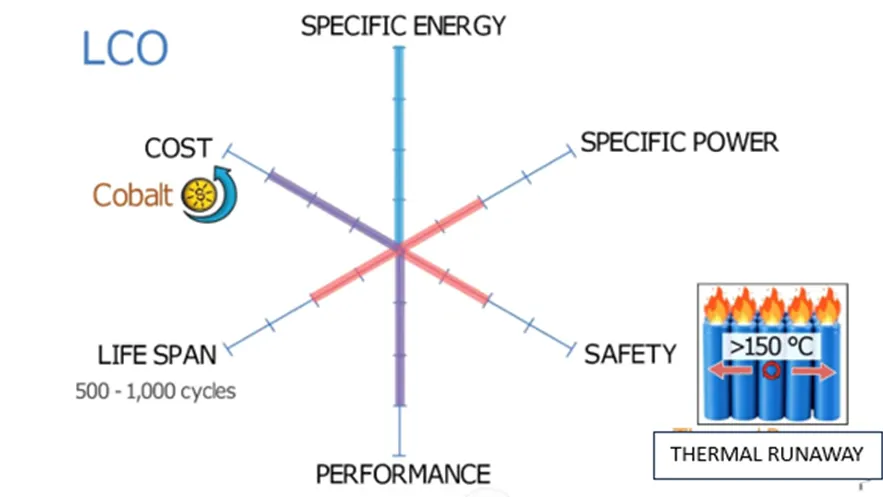
1. Lithium Cobalt Oxide (LCO)- It has a high specific Energy which allows it to deliver power for long period.
But relatively low specific power. In terms of safety, it's low because of thermal runaway occurs at 150° C. In terms of performance, it has optimum performance with relatively low life span of about 500- 1000 cycle. Since cobalt is costly it has optimum cost. It used in mobile phone applicable, laptop, camera.
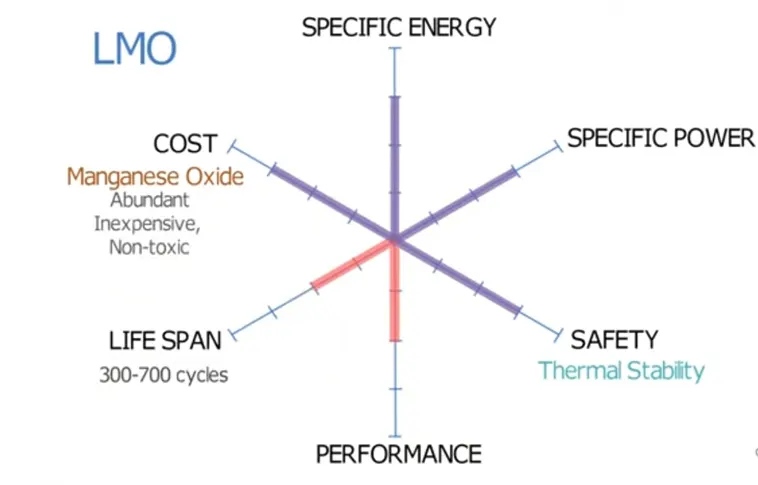
2. Lithium Manganese Oxide (LMO)- It uses lithium manganese oxide as cathode. It has optimum specific Energy as well as specific power. When it comes to safety it has good thermal stability. It has relatively low performance as well as low life span about 300 to 700 cycles. It has an optimum cost as manganese oxide is abundant, Inexpensive, Non- toxic. Used in medical device, power tool as well as e- bikes.
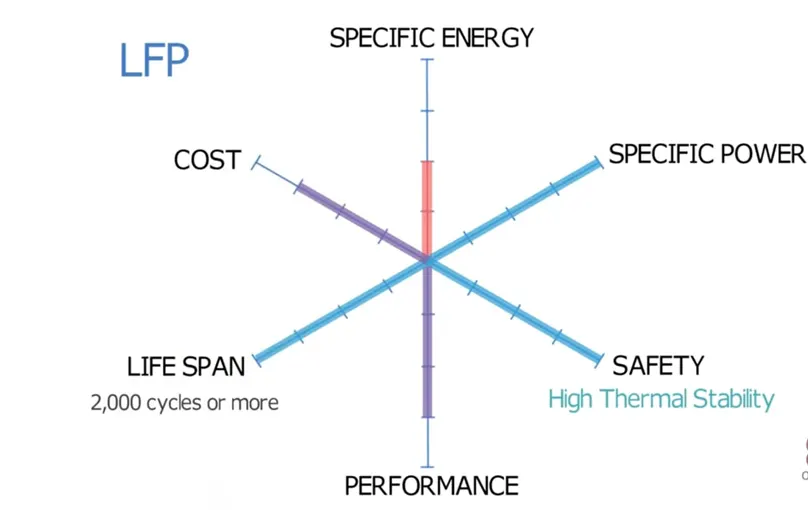
3. Lithium Iron Phosphate (LFP)- it is also known as lithium ferro phosphate. It uses phosphate as an active material in its cathode. It has relatively low specific Energy but very high specific power. When it comes to safety it has very high thermal stability with optimum performance. It has very long-life span of above 2000 cycles with an optimum cost. It is used in E- rickshaw and in electric Bike.
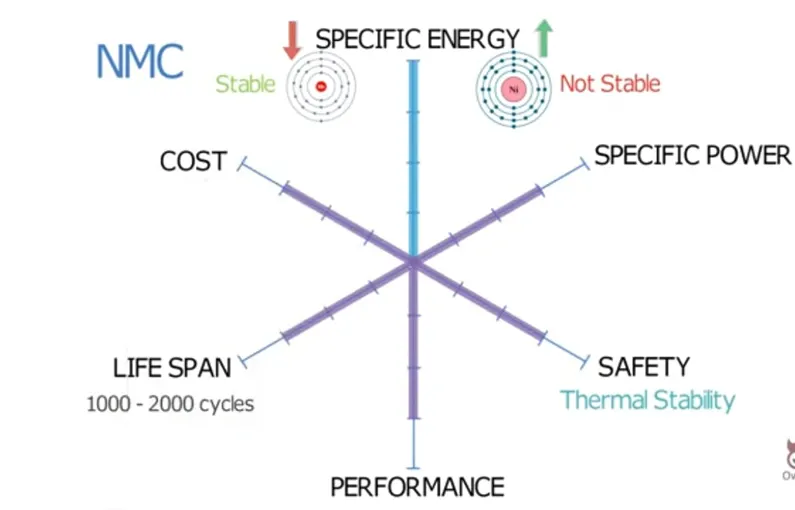
4. Lithium Nickel Manganese Cobalt Oxide (NMC)- It uses Combination of transition metals Nickel, manganese, cobalt in its cathode. Nickel has high specific Energy but it's not stable and manganese has low specific Energy but it's stable combining them result in high specific Energy with good stability. It has optimum specific power also good in performance. Life span is about 1000 to 2000. And optimum cost.
It uses in electric vehicle, E-Bike, Industrial application and in medical devices.
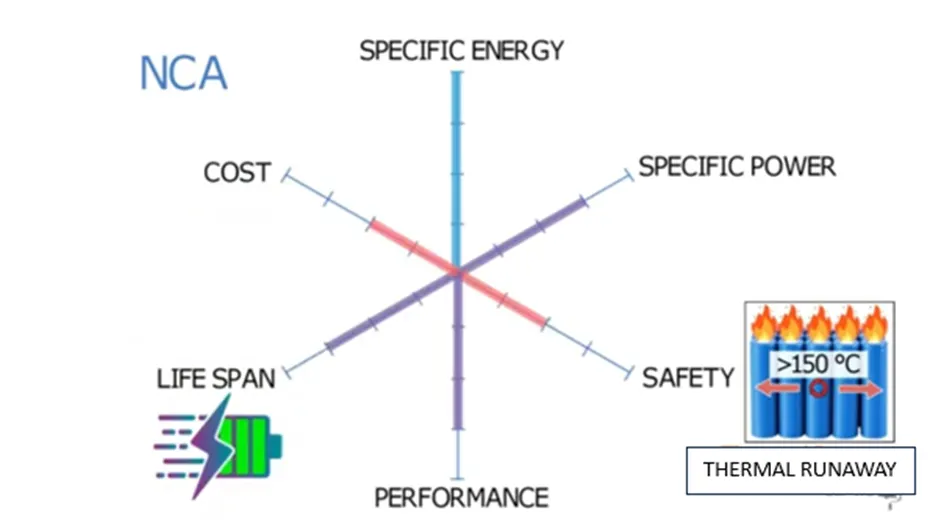
5. Lithium Nickel Cobalt Aluminium Oxide (NCA)- It has high voltage with high specific Energy and optimum specific power. Relatively low safety because of thermal runaway issue which occurs at temperature more than 150°C . It has optimum performance with fast charging Capability. Good Life span its cost is high.
Used in electrical vehicle such as tesla, medical devices, Industrial application.
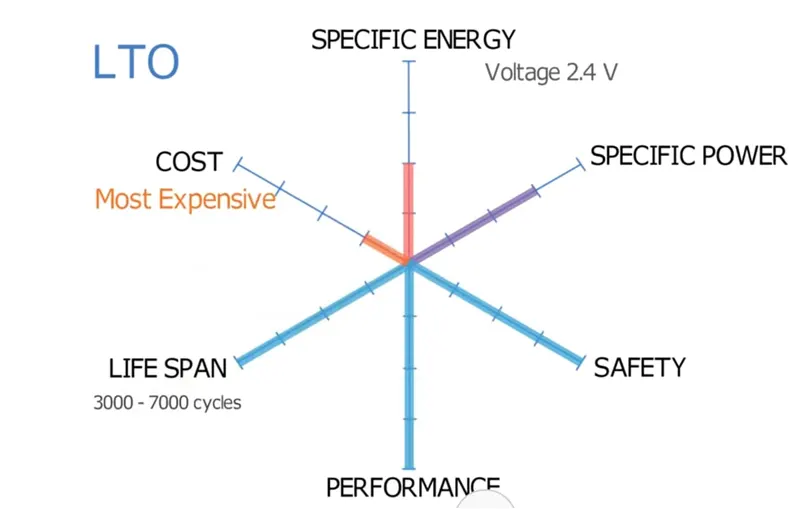
6. Lithium Titanate (LTO)- it is also known as lithium titanate. It is a modified battery that uses lithium titanate nano crystal instead of carbon on surface of anode. Large Surface area of lithium titanate allows larger quantity of electrons to enter and exit anode at faster rate. Making a very high rate of charging and discharging without compromising a safety. It has a low voltage of 2.4 V resulting in low specific Energy with an optimum specific power. It is one of the safest batteries with very high performance. Also, it has a very high life span of about 3000 to 7000 in terms of cost it is most expensive battery. Used in fast charging station, solar power street lights, electrical vehicle, wind and solar energy storage.