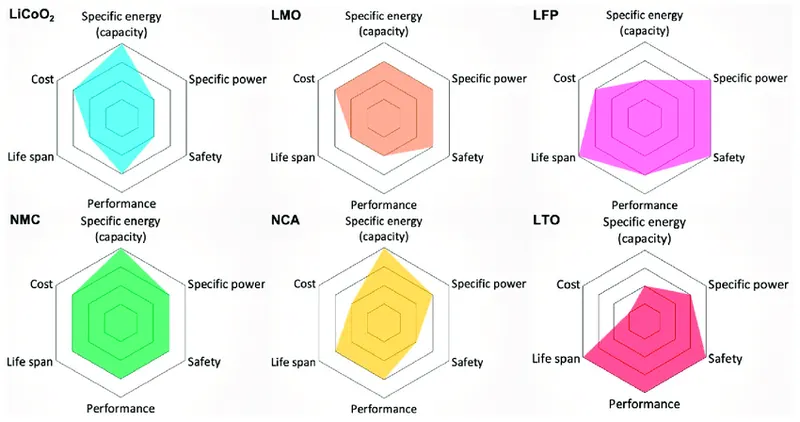
Week 1 Understanding Different Battery Chemistry
1.ANS:
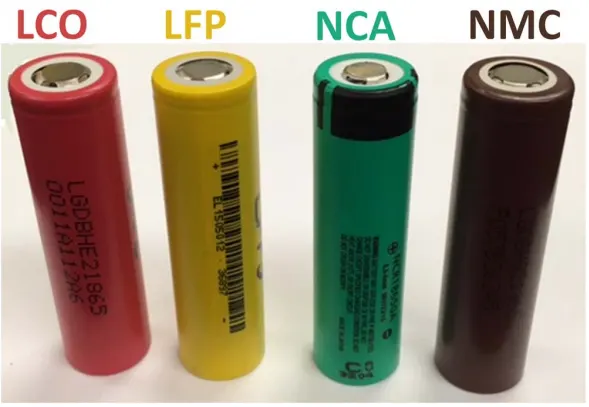
1) LCO – Lithium Cobalt Oxide (LiCoO2):
Cobalt acid lithium battery has high discharge platform, high specific capacity, stable product performance, and good cycle performance, but its safety performance is poor. The cost is very high, it is mainly used for medium and small type batteries, which is widely used in mobile phones, portable computers, cameras, camera, electric cars, solar energy storage, UPS power supply, medical equipment, space and other fields. The nominal voltage is 3.7V.
Materials used:
Lithium cobalt oxide, LiCoO2 (LCO), is an inorganic compound commonly used as a anode material for lithium ion batteries.
Chemical reactions occurring at the anode and cathode:
What happens when you charge it,
Anode: LiCoO2 = Li1-xCoO2+xLi++xe-
Cathode: 6C+xLi++xe- = LixC6
What happens when you discharge
Anode: Li1-xCoO2+xLi++xe-=LiCoO2
Cathode: LixC6=6C+xLi++xe-
2)LMO – Lithium Manganese Oxide (LiMnO2):
Lithium manganate oxide battery refers to the battery that uses lithium manganate oxide as an anode material. Its nominal voltage is 3.7V. It is the mainstream power battery at present. This kind of battery has ordinary energy density and cycling life. It has environmental protection and no patent limitation. But lithium manganate oxide is not very stable, easy to decompose gas, may lead to swell, and its high-temperature performance is poor.
Materials used:
Lithium manganate oxide battery is a lithium ion battery that uses lithium manganate oxide as anode, graphite as cathode, and electrolyte with LiPF6 organic solution.
Chemical reactions occurring at the anode and cathode:
Charging Process
When the battery is charged by the power source, the electron on the anode runs to the cathode from the external circuit. The lithium ion (Li+) goes into the electrolyte from the anode, passes through the small winding hole in the separator, reaches the cathode, and combines with the electrons that have already come over.
The reaction on the anode: LiMn2O4==Li1-xMn2O4+Xli++Xe(electron)
The reaction on the cathode: 6C+XLi+Xe==LixC6
Discharging Process
When the battery discharges, the electron on the cathode runs from the external circuit to the anode, and the lithium ion goes into the electrolyte from the cathode, passes through the small winding hole in the separator runs to the anode, and combines with the electrons that have already come over.
The reaction on the anode Li1-xMn2O4+xli++xe(electron)==LiMn2O4
The reaction on the cathode LixC6==6C+xLi+xe
3)NMC – Lithium Nickel Manganese Cobalt Oxide (LiNiMnCoO2) :
Nickel manganese cobalt (NMC) batteries contain a cathode made of a combination of nickel, manganese, and cobalt. NMC is one of the most successful cathode combinations in Li-ion systems. It can be tailored to serve as energy cells or power cells like Li-manganese. NMC batteries are used for power tools, e-bikes, and other electric powertrains.
Charging Process
The reaction on the anode:
| LixC6→xLi++xe-+C6 |
The reaction on the cathode:
| Li1-xNi0.8Mn0.1Co0.1O2+xLi++xe- |
→LiNi0.8Mn0.1Co0.1O2
Discharging Process
|
C6+LiNi0.8Mn0.1Co0.1O2↔LiC6+Ni0.8Mn0.1Co0.1O2 |
4)NCA – Lithium Nickel Cobalt Aluminum Oxide (LiNiCoAlO2) :
Lithium Nickel-Cobalt-Aluminum Oxide (NCA) is used as the cathode material for lithium ion batteries, and is mainly used in electric automobiles. Due to a high nickel content of the Lithium Nickel-Cobalt-Aluminum Oxide (NCA) manufactured by the company, the capacity of batteries can be increased, which contributes to a longer distance that can be covered with a single-time charging. The company’s strength lies in integrated production from the nickel raw material up to the battery material.

5)LFP – Lithium Iron Phosphate (LiFePO4):
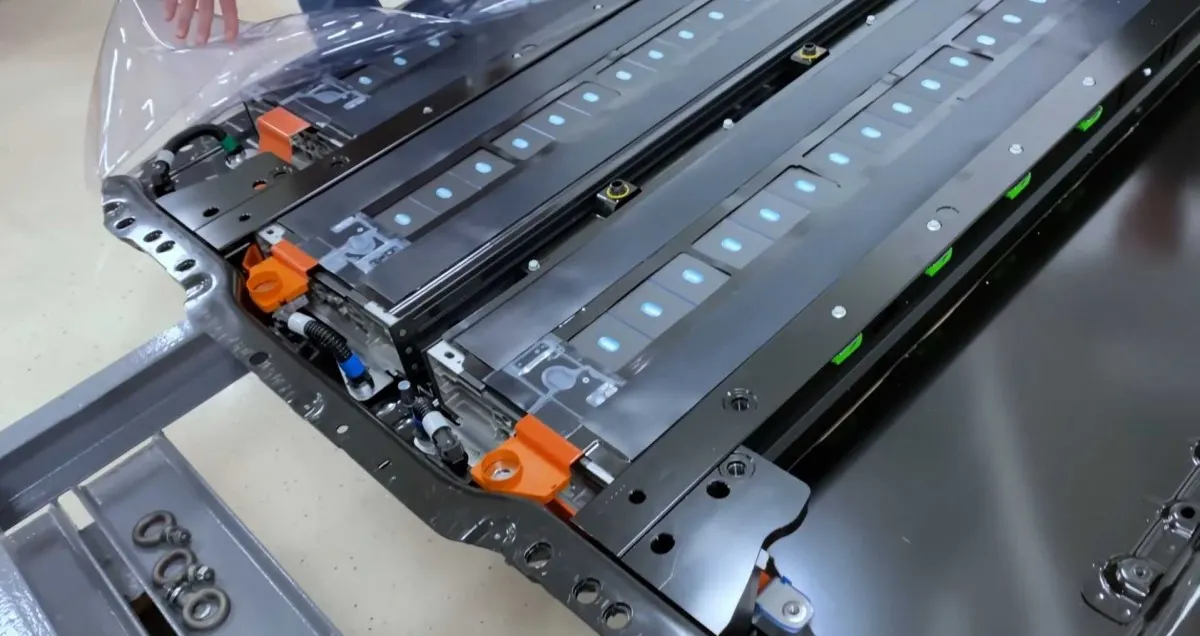
CATL manufactured LFP battery pack from Tesla Model 3
LiFePO4 is one of the most recent cathode materials to be introduced. As of 2017, LiFePO4 is a candidate for large-scale production of lithium-ion batteries, such as electric vehicle applications, due to its low cost, excellent safety, and high cycle durability. The energy density of an LFP battery is lower than that of other common lithium-ion battery types, such as Nickel Manganese Cobalt (NMC). Because of their lower cost, high safety, low toxicity, long cycle life, and other factors, LFP batteries are finding a number of roles in vehicle use, utility-scale stationary applications, and backup power. Working voltage = 3.0 ~ 3.3 V. Cycle life ranges from 2,700 to more than 10,000 cycles depending on conditions.
Chemical Reaction
LiFePO4+6xC --> Li1-xFePO4+LixC6.
6)LTO – Lithium-Titanium-Oxide (LiMnO2):
The lithium titanate battery (Referred to as LTO battery in the battery industry) is a type of rechargeable battery based on advanced nano-technology. which is a lithium ion battery that use negative electrode material – lithium titanate. Which can be combined with lithium manganate, ternary material or lithium iron phosphate and other positive electrode materials to form a 2.4V or 1.9V lithium ion secondary battery. In addition, lithium titanate batteries can also be used as positive electrodes to form 1.5V lithium secondary batteries with metal lithium or lithium alloy negative electrodes.
Chemical Reaction

2.ANS.
The differences between each type of Li+ion batteries based on their characteristics:
| Parameters | LCO | LMO | NCA | NMC | LFP | LTO |
| Nominal Voltage | 3.60V | 3.70V | 3.7V | 3.7V | 3.1V | 2.3V |
| Operating range | 3.0-4.2V | 3.0-4.2V | 3.6V-4.0V | 4.3V | 3.0-3.3V | 2.4-3.7V |
| Specific energy | 150-200wh /kg | 100-150Wh/kg | 150-325Wh/kg | 160-220Wh/kg | 120Wh/kg | 60-110Wh/kg |
| Charge rate | 0.7-1C, charge to 4.20V | 0.7-1C, maximum is 3C, charge to 4.20V | - | - | - | 5C |
| Charging time | 3 hours | - | - | 3hours | - | 20C |
| Discharge rate | 1Ccut-off voltage is 2.50V | 1C,2.50V cut-off | - | - | - | - |
| Cycling life | 500-1000 | 300-700 | 500-1500 | 1000-above | 2000-above | 3000-7000 |
| Applications | Mobile phones, instruments, etc.. | Power tools, medical equipment, electric powertrain | electric automobiles, for consumer products | - | - | S-Pen that comes with the Samsung Galaxy Note 20 Ultra 5G. |