Week 1 Understanding Different Battery Chemistry
1.Prepare a table which includes materials & chemical reactions occurring at the anode and cathode of LCO, LMO, NCA, NMC, LFP and LTO type of lithium ion cells.Give your detailed explanation on it
LITHIUM ION BATTERY
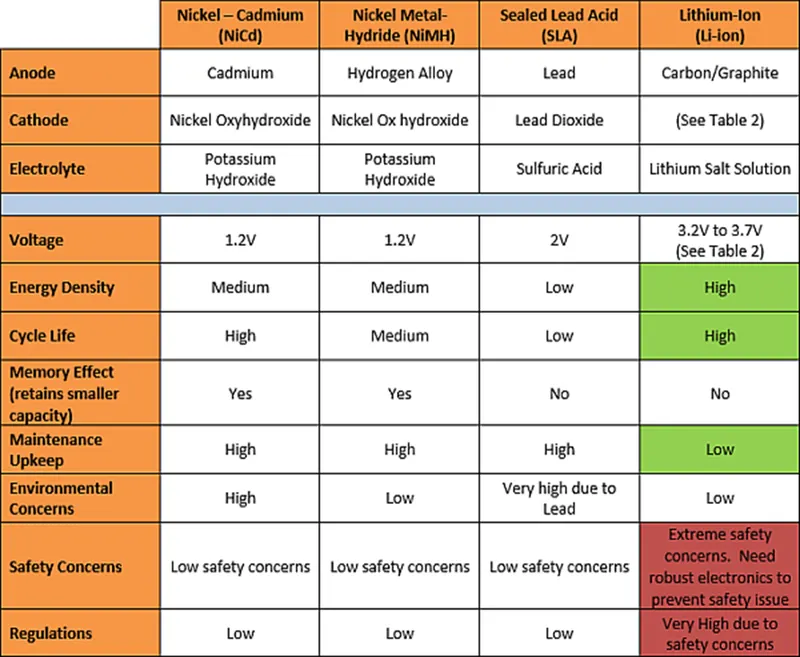
A lithium-ion battery, often known as a Li-ion battery, is a type of rechargeable battery that stores energy by the reversible reduction of lithium ions. It is the most common kind of battery used in electric cars and portable consumer gadgets. Additionally, grid-scale energy storage as well as military and aerospace applications make major use of it. Li-ion batteries outperform other rechargeable battery technologies in terms of energy density, self-discharge, and memory effect (although a small memory effect reported in LFP cells has been traced to poorly made cells).
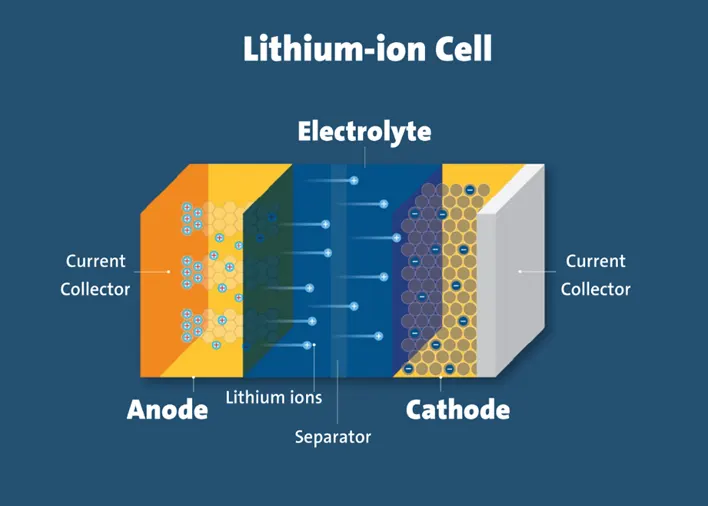
The many varieties of lithium-ion batteries have different chemistry, performance, cost, and safety properties. Most commercial Li-ion cells employ intercalation chemicals as the active components. Graphite typically serves as the anode or negative electrode, while silicon-carbon is now being utilised more frequently. It is possible to construct cells that emphasise power density or energy. With a high energy density, lithium polymer batteries (with polymer gel as the electrolyte), lithium cobalt oxide (LiCoO2) cathode material, and graphite anode are the main materials used in handheld electronics.
Lithium nickel manganese cobalt oxide (LiNiMnCoO2 or NMC), lithium iron phosphate (LiFePO4), and lithium manganese oxide (LiMn2O4 spinel, or Li2MnO3-based lithium rich layered materials, LMR-NMC) may all have longer lifetimes and improved rate capability. The electrification of transportation, one of the key technologies (in conjunction with renewable energy) for lowering greenhouse gas emissions from cars, makes extensive use of NMC and its derivatives.
Because the cells in lithium-ion batteries have volatile electrolytes and can explode or catch fire if broken or charged improperly, the batteries can pose a safety danger if not designed and manufactured appropriately. There has been significant advancement in the production of secure lithium-ion batteries.
Batteries that are poorly recycled can result in toxic waste, particularly from hazardous metals, and they are also at risk of catching fire. Additionally, lithium mining presents substantial challenges due to its water-intensive nature in frequently dry places and the fact that other important minerals needed in batteries, like cobalt, are frequently conflict minerals. Researchers have been prompted by both environmental concerns to increase the effectiveness of mineral and find substitutes like iron-air batteries.
TYPES OF LITHIUM BATTERIES
Different lithium battery designs use various active components and chemical processes to store energy. Each type of lithium battery has advantages and disadvantages as well as applications for which it is most suitable.
The names of the various varieties of lithium batteries are derived from their active components. Based on the molecular symbols for the active ingredients, the lithium iron phosphate battery, generally known as LiFePO4, is the first type we shall examine. However, many individuals abbreviate the term even more, using LFP.
Lithium Cobalt Oxide(LiCoO2) — LCO
Li-cobalt is a common choice for cell phones, computers, and digital cameras due to its high specific energy. A cobalt oxide cathode and a graphite carbon anode make up the battery. Lithium ions flow from the anode to the cathode during discharge due to the cathode's layered nature. On charging, the flow changes. Li-cobalt has a constrained range of load capacities, a short life duration, and poor thermal stability (specific power).
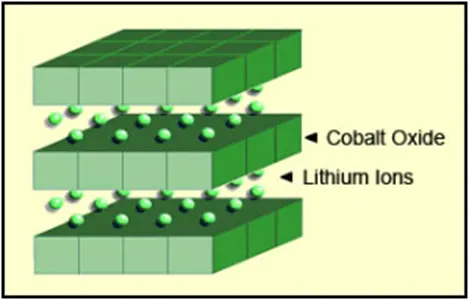
Li-cobalt structure.
The cathode has a layered structure. During discharge the lithium ions move from the anode to the cathode; on charge the flow is from cathode to anode.
Drawback of Li-cobalt
Li-cobalt has a constrained range of load capacities, a short life duration, and poor thermal stability (specific power). Li-cobalt batteries, like other cobalt-blended Li-ion batteries, have a graphite anode that reduces cycle life due to a changing solid electrolyte interface (SEI), thickening on the anode, and lithium plating with fast charging and charging at low temperature. Nickel, manganese, and/or aluminium are used in more recent systems to increase durability, loading capacity, and cost.
It is not recommended to charge and discharge lithium-cobalt batteries at currents greater than their C ratings. As a result, a 2,400mAh 18650 battery may only be charged and discharged at 2,400mA. Forced rapid charging and loads more than 2,400mA lead to overheating and unnecessary stress. The manufacturer advises a C-rate of 0.8C, or around 2,000mA, for the best quick charging. (See BU-402: Describe C-rate.) The necessary battery protection circuit restricts the Energy Cell's charge and discharge rates to a secure level of roughly 1C.
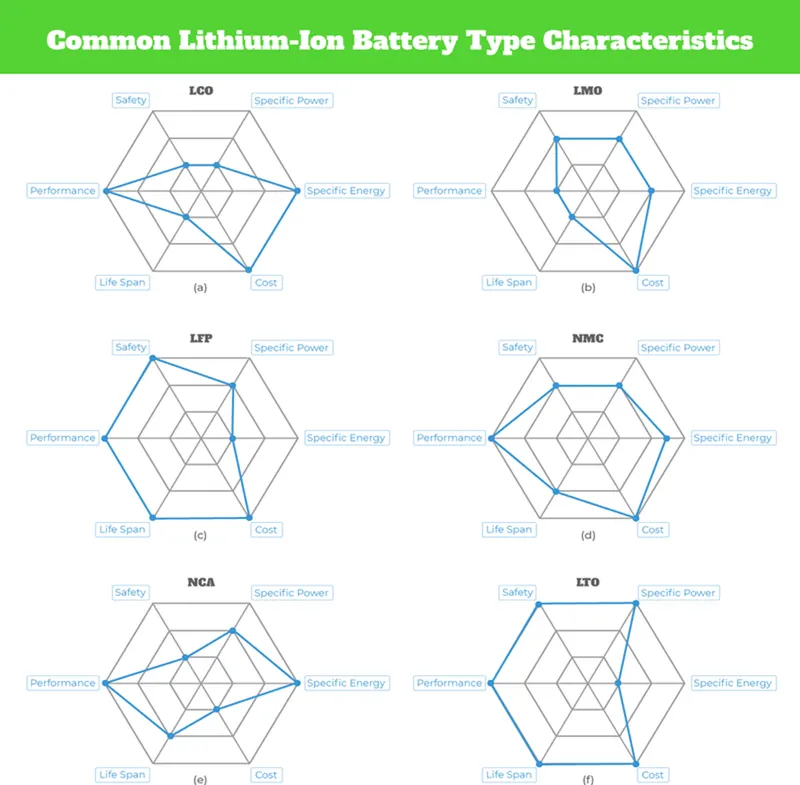
In terms of specific energy or capacity, which is related to runtime, specific power, or the capacity to deliver high current, safety, performance at hot and cold temperatures, life span, which reflects cycle life and longevity, and cost, Li-performance cobalt's is summarised by the hexagonal spider graphic. The spider webs do not exhibit any of the interesting features such as toxicity, quick charging, self-discharge, or shelf life. (Read more about what defines a battery in BU-104c: The Octagon Battery.)
Due to the expensive cost of cobalt and enhanced performance from mixing with other active cathode materials, Li-cobalt is losing ground to Li-manganese, notably NMC and NCA. (See below for an explanation of the NMC and NCA.)
Snapshot of an average Li-cobalt battery.
Li-cobalt excels on high specific energy but offers only moderate performance specific power, safety and life span.
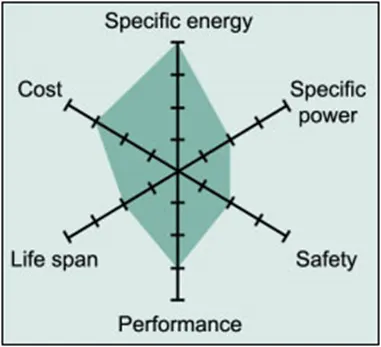
Summary Table
|
Lithium Cobalt Oxide: LiCoO2 cathode (~60% Co), graphite anode |
|
|
Voltages |
3.60V nominal; typical operating range 3.0–4.2V/cell |
|
Specific energy (capacity) |
150–200Wh/kg. Specialty cells provide up to 240Wh/kg. |
|
Charge (C-rate) |
0.7–1C, charges to 4.20V (most cells); 3h charge typical. Charge current above 1C shortens battery life. |
|
Discharge (C-rate) |
1C; 2.50V cut off. Discharge current above 1C shortens battery life. |
|
Cycle life |
500–1000, related to depth of discharge, load, temperature |
|
Thermal runaway |
150°C (302°F). Full charge promotes thermal runaway |
|
Applications |
Mobile phones, tablets, laptops, cameras |
|
Comments |
Very high specific energy limited specific power. Cobalt is expensive. Serves as Energy Cell. Market share has stabilized. |
LITHIUM MANGANESE OXIDE (LIMN2O4) — LMO
The Materials Research Bulletin initially reported on Li-ion with manganese spinel in 1983. Lithium manganese oxide used as the cathode material for the Li-ion cell that Moli Energy launched in 1996. The construction creates a three-dimensional spinel structure on the electrode to enhance ion flow, which lowers internal resistance and enhances current handling. High thermal stability and improved safety are further benefits of spinel, although its cycle and calendar lives are constrained.
Low internal cell resistance makes high-current discharging and quick charging possible. Li-manganese batteries in 18650 packages may discharge at currents of 20–30A with only little heat buildup. Additionally, one-second load pulses of up to 50A are practicable. a, a, an an an aster a s out of an an an an an as Power tools, medical equipment, as well as hybrid and electric cars, all employ lithium manganese.
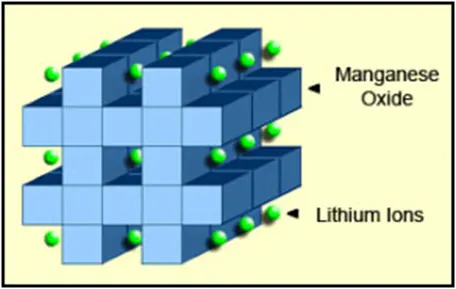
Li-manganese structure.
The cathode crystalline formation of lithium manganese oxide has a three-dimensional framework structure that appears after initial formation. Spinel provides low resistance but has a more moderate specific energy than cobalt.
The capacity of lithium manganese is around one-third less than that of lithium cobalt. Engineers can enhance the battery for best lifespan (life span), maximum load current (specific power), or high capacity thanks to design flexibility (specific energy). For instance, the high-capacity version of the 18650 cell is 1,500mAh whereas the long-life version has a moderate capacity of 1,100mAh.
The spider web of a typical Li-manganese battery is seen in the image. Although the features seem insignificant, more recent designs have enhanced particular power, safety, and lifespan. These days, pure Li-manganese batteries are uncommon and should only be utilised I specific circumstances.
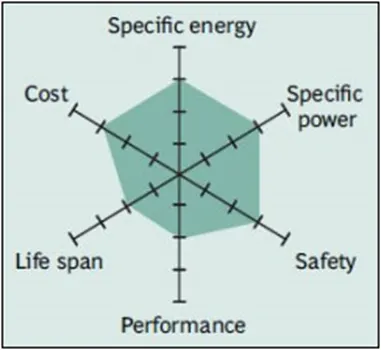
Li-manganese battery.
Although moderate in overall performance, newer designs of Li-manganese offer improvements in specific power, safety, and life span.
For improved specific energy and longer life, most Li-manganese batteries combine with lithium nickel manganese cobalt oxide (NMC). The LMO (NMC) is the system of choice for most electric vehicles, including the Nissan Leaf, Chevrolet Volt, and BMW i3. This combination brings out the best in each system. About 30% of the battery's capacity is made up of LMO, which may enhance current during acceleration and provide a long driving range.
Li-ion research has a strong inclination toward using Li-manganese as the active cathode material in combination with cobalt, nickel, manganese, and/or aluminium. A modest quantity of silicon may be added to the anode in some architectural designs. This increases capacity by 25%, but the gain is sometimes associated with a lower cycle life since silicon expands and contracts with charge and discharge, putting mechanical stress on the device.
It is simple to select one of these three active metals, along with silicon enhancement, to improve a specific energy (capacity), specific power (load capability), or life. Industrial applications call for battery systems with superior loading capacities, long life, and safe and trustworthy service, whereas consumer batteries prioritise large capacity.
Summary Table
|
Lithium Manganese Oxide: LiMn2O4 cathode. graphite anode |
|
|
Voltages |
3.70V (3.80V) nominal; typical operating range 3.0–4.2V/cell |
|
Specific energy (capacity) |
100–150Wh/kg |
|
Charge (C-rate) |
0.7–1C typical, 3C maximum, charges to 4.20V (most cells) |
|
Discharge (C-rate) |
1C; 10C possible with some cells, 30C pulse (5s), 2.50V cut-off |
|
Cycle life |
300–700 (related to depth of discharge, temperature) |
|
Thermal runaway |
250°C (482°F) typical. High charge promotes thermal runaway |
|
Applications |
Power tools, medical devices, electric powertrains |
|
Comments |
High power but less capacity; safer than Li-cobalt; commonly mixed with NMC to improve performance. |
Lithium Nickel Manganese Cobalt Oxide (LiNiMnCoO2) — NMC
An effective Li-ion system uses nickel, manganese, and cobalt as the cathode (NMC). These systems may be customised to function as Energy Cells or Power Cells, similar to Li-manganese. For instance, NMC in an 18650 cell optimised for specific power has a capacity of just around 2,000mAh but offers a continuous discharge current of 20A. NMC in the same cell designed for moderate load situation has a capacity of approximately 2,800mAh and may deliver 4A to 5A. The maximum capacity of a silicon-based anode is 4,000mAh, albeit with a decreased loading capability and a shorter cycle life. The disadvantage of silicon added to graphite is that the anode expands and contracts with charge and discharge, resulting in mechanical instability in the cell.
The mechanism of NMC lies in mixing nickel and manganese. An illustration of this is table salt, whose primary components, sodium and chloride, are harmful when consumed separately but act as a food preservative when combined. Manganese has the advantage of developing a spinel structure to create low internal resistance but delivers a low specific energy. Nickel is noted for its high specific energy but poor stability. The metals' combined strengths are increased.
Power tools, e-bikes, and other electric vehicles all use NMC batteries as their primary power source. The cathode combination, often known as 1-1-1, generally consists of one third nickel, one third manganese, and one third cobalt. Cobalt is pricey and hard to get by. Manufacturers of batteries are lowering the cobalt concentration while making certain performance sacrifices. NCM532, which contains 5 parts nickel, 3 parts cobalt, and 2 parts manganese, is an effective combination. NMC622 and NMC811 are more combinations. Nickel, a high energy active material, is stabilised by cobalt.
New electrolytes and additives enable charging to 4.4V/cell and higher to boost capacity. Figure 7 demonstrates the characteristics of the NMC.
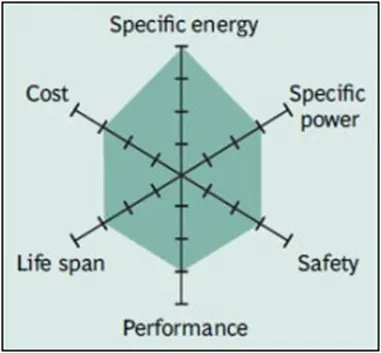
There is a shift toward NMC-blended Li-ion because the system may be constructed affordably and performs well. The three active components, nickel, manganese, and cobalt, may be conveniently combined to suit a variety of automotive and energy storage system (EES) applications that need frequent cycling. The variety of the NMC clan is expanding.
Summary Table
|
Lithium Nickel Manganese Cobalt Oxide: LiNiMnCoO2. cathode, graphite anode |
|
|
Voltages |
3.60V, 3.70V nominal; typical operating range 3.0–4.2V/cell, or higher |
|
Specific energy (capacity) |
150–220Wh/kg |
|
Charge (C-rate) |
0.7–1C, charges to 4.20V, some go to 4.30V; 3h charge typical. Charge current above 1C shortens battery life. |
|
Discharge (C-rate) |
1C; 2C possible on some cells; 2.50V cut-off |
|
Cycle life |
1000–2000 (related to depth of discharge, temperature) |
|
Thermal runaway |
210°C (410°F) typical. High charge promotes thermal runaway |
|
Cost |
~$420 per kWh[1] |
|
Applications |
E-bikes, medical devices, EVs, industrial |
|
Comments 2019 Update: |
Provides high capacity and high power. Serves as Hybrid Cell. Favorite chemistry for many uses; market share is increasing. |
LITHIUM IRON PHOSPHATE (LIFEPO4) — LFP
Li-phosphate has a low resistance and strong electrochemical performance. Phosphate cathode material on a nanoscale enables this. The main advantages are a high current rating, a long cycle life, strong thermal stability, increased safety, and abuse tolerance.
If sustained at high voltage for an extended period of time, lithium-phosphate is more resilient to full charge circumstances and experiences less stress than other lithium-ion systems. (See BU-808: Increasing the Life of Lithium-based Batteries.) In exchange, its lower nominal voltage of 3.2V/cell lowers the specific energy below that of lithium-ion with a cobalt mix. Li-phosphate batteries are not an exception; like other batteries, they perform worse in cold temperatures and last shorter at hotter storage temperatures. Li-phosphate batteries have a greater self-discharge than conventional Li-ion batteries, which over time might lead to balance problems. High-quality cell purchases and/or the use of advanced control electronics, both of which raise the price of the pack, can reduce this. For lifespan, production cleanliness is crucial. Moisture cannot be tolerated, lest the battery will only deliver 50 cycles.
Li-phosphate is often used to replace the lead acid starter battery. Four cells in series produce 12.80V, a similar voltage to six 2V lead acid cells in series. Vehicles charge lead acid to 14.40V (2.40V/cell) and maintain a topping charge. Topping charge is applied to maintain full charge level and prevent sulfation on lead acid batteries.
For starting batteries, lithium-phosphate is frequently used in place of lead acid. Similar to six 2V lead acid cells connected in series, four cells produce 12.80V when connected in series. Lead acid batteries are charged in vehicles to 14.40V (2.40V/cell) and kept at a topping charge. On lead acid batteries, topping charge is used to keep the charge level at 100% and avoid sulfation.
Each Li-phosphate cell peaks out at 3.60V when four of them are connected in series, which is the appropriate full-charge voltage. The charge should now be turned off, however it keeps topping off while you're driving. Li-phosphate can withstand some overcharging; but, holding the voltage at 14.40V for an extended period of time, as most cars do on lengthy drives, might put Li-phosphate under stress. The longevity of Li-Phosphate will be determined throughout time asa lead acid replacement with a regular vehicle charging system. Cold temperature also reduces performance of Li-ion and this could affect the cranking ability in extreme cases.
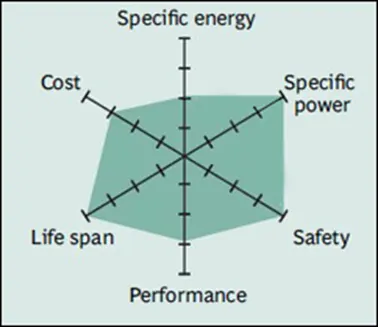
Li-phosphate battery.
Li-phosphate has excellent safety and long-life span but moderate specific energy and elevated self-discharge
Summary Table
|
Lithium Iron Phosphate: LiFePO4 cathode, graphite anode |
|
|
Voltages |
3.20, 3.30V nominal; typical operating range 2.5–3.65V/cell |
|
Specific energy (capacity) |
90–120Wh/kg |
|
Charge (C-rate) |
1C typical, charges to 3.65V; 3h charge time typical |
|
Discharge (C-rate) |
1C, 25C on some cells; 40A pulse (2s); 2.50V cut-off (lower that 2V causes damage) |
|
Cycle life |
2000 and higher (related to depth of discharge, temperature) |
|
Thermal runaway |
270°C (518°F) Very safe battery even if fully charged |
|
Cost |
~$580 per kWh[1] |
|
Applications |
Portable and stationary needing high load currents and endurance |
|
Comments |
Very flat voltage discharge curve but low capacity. One of safest Li-ions. |
LITHIUM NICKEL COBALT ALUMINUM OXIDE (LINICOALO2) — NCA
Lithium nickel cobalt aluminium oxide battery, or NCA, has been around since 1999 for special applications. It shares similarities with NMC by offering high specific energy, reasonably good specific power and a long-life span. Less flattering are safety and cost. NCA is a further development of lithium nickel oxide; adding aluminium gives the chemistry greater stability.
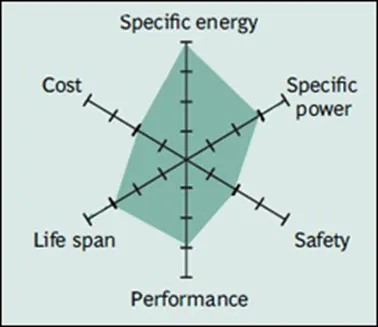
NCA.
High energy and power densities, as well as good life span, make NCA a candidate for EV powertrains. High cost and marginal safety are negatives.
|
Lithium Nickel Cobalt Aluminum Oxide: LiNiCoAlO2 cathode (~9% Co), graphite anode |
|
|
Voltages |
3.60V nominal; typical operating range 3.0–4.2V/cell |
|
Specific energy (capacity) |
200-260Wh/kg; 300Wh/kg predictable |
|
Charge (C-rate) |
0.7C, charges to 4.20V (most cells), 3h charge typical, fast charge possible with some cells |
|
Discharge (C-rate) |
1C typical; 3.00V cut-off; high discharge rate shortens battery life |
|
Cycle life |
500 (related to depth of discharge, temperature) |
|
Thermal runaway |
150°C (302°F) typical, High charge promotes thermal runaway |
|
Cost |
~$350 per kWh |
|
Applications |
Medical devices, industrial, electric powertrain (Tesla) |
|
Comments |
Shares similarities with Li-cobalt. Serves as Energy Cell. |
LITHIUM TITANATE (LI2TIO3) — LTO
Since the 1980s, lithium titanate anodes have been used in batteries. In the anode of a conventional lithium-ion battery, lithium titanate takes the role of graphite and crystallises into a spinel structure. Lithium manganese oxide or NMC can be used as the cathode. Li-titanate batteries provide a high discharge current of 10C, or 10 times the rated capacity, and have a nominal cell voltage of 2.40V. They can also be quickly charged. It is claimed that the cycle count is greater than that of a typical Li-ion. Li-titanate is secure, exhibits outstanding low-temperature discharge properties, and achieves an 80 percent capacity at -30°C (-22°F).
When rapid charging and charging at low temperatures, LTO (commonly known as Li4Ti5O12) has benefits over the traditional cobalt-blended Li-ion with graphite anode in that it achieves zero-strain property, prevents SEI film formation, and prevents lithium plating. The battery is pricey, but it also has higher thermal stability at high temperatures than conventional Li-ion systems. The specific energy is low, rivalling NiCd at just 65Wh/kg. Lithium-ion batteries charge to 2.80V/cell and discharge to 1.80V/cell. The features of the Li-titanate battery are depicted in Figure 13. Electric drivetrains, UPS systems, and solar-powered street lighting are typical applications.
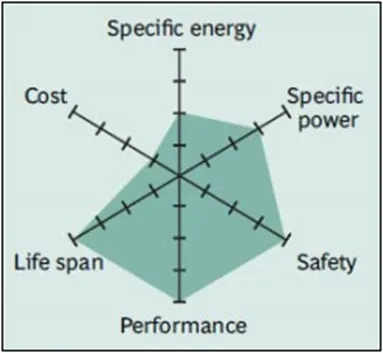
Li-titanate.
Li-titanate excels in safety, low-temperature performance, and life span. Efforts are being made to improve the specific energy and lower cost.
Summary Table
|
Lithium Titanate: Cathode can be lithium manganese oxide or NMC; Li2TiO3 (titanate) anode |
|
|
Voltages |
2.40V nominal; typical operating range 1.8–2.85V/cell |
|
Specific energy (capacity) |
50–80Wh/kg |
|
Charge (C-rate) |
1C typical; 5C maximum, charges to 2.85V |
|
Discharge (C-rate) |
10C possible, 30C 5s pulse; 1.80V cut-off on LCO/LTO |
|
Cycle life |
3,000–7,000 |
|
Thermal runaway |
One of safest Li-ion batteries |
|
Cost |
~$1,005 per kWh[1] |
|
Applications |
UPS, electric powertrain (Mitsubishi i-MiEV, Honda Fit EV), solar-powered street lighting |
|
Comments |
Long life, fast charge, wide temperature range but low specific energy and expensive. |
Table 14: Characteristics of Lithium Nickel Cobalt Aluminum Oxide
- Solid-state High specific energy but poor loading and safety for lithium-ion batteries.
- Lithium-sulfur batteries have a high specific energy but low cycle life and loading.
- Lithium-air has a high specific energy but poor loading; it also has a limited life and requires clean air to breathe.
2.Compare the differences between each type of Li+ion batteries based on their characteristics