Battery Technology Report: Understanding Different Battery Chemistry
Aim:
To understand the battery chemistry and compare different Li+ion batteries.
Theory:
A battery is a device that powers electrical devices by containing one or more electrochemical cells with external connections. When a battery is supplying electricity, the positive terminal is known as the cathode and the negative terminal is known as the anode. The negative terminal is the source of electrons that will flow to the positive terminal via an external electric circuit. When a battery is connected to an external electric load, a redox reaction occurs, converting high-energy reactants to lower-energy products and delivering the free-energy difference to the external circuit as electrical energy.
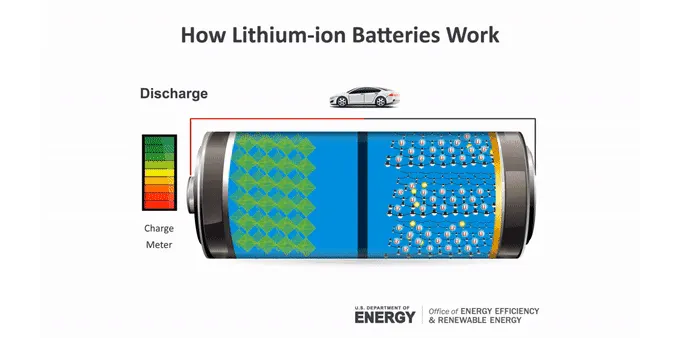
Figure: How Lithium-ion Batteries work [rebelbatteries, link]
Types of Batteries
There are two main types of battery cells:
- Primary cells - These are non-chargeable cells.
- Secondary cells - These are chargeable cells.
Primary cells are non-chargeable cells found in devices such as wrist watches, calculators, and radios. Li battery, dry cell. Secondary cells are chargeable cells that can convert electrical energy to chemical energy in a reversible chemical process.
Lead cell, Ni-cd cell, metal air, Ni metal Hydride, and Li ion battery cells are some examples. The use of Li ion batteries in many applications is due to their high energy density. The total amount of energy that can be stored per unit mass or volume is referred to as the energy density. This determines how long your device can operate before needing to be recharged.
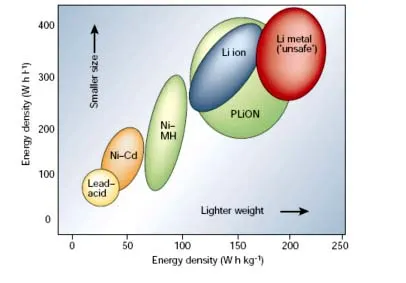
Battery cells are typically composed of three major components:
- The Electrode (Negative Electrode)
- The Cathode Ray Tube (Positive Electrode)
- Electrolytes
During the discharge process, The anode is a negative electrode that generates electrons for the battery's external circuit. When two batteries are connected, an electron buildup occurs at the anode, resulting in a potential difference between the two electrodes. The electrons will naturally try to redistribute themselves; however, the electrolyte will prevent this, so when an electrical circuit is connected, it provides a clear path for the electrons to move from the anode to the cathode, thereby powering the circuit to which it is connected.
Lithium atoms split at the anode (-ve) of a lithium-ion battery. This results in electrons and lithium ions (lithium atoms with a positive charge). An electrolyte transports lithium ions within the battery to the cathode (+ve). Electrons cannot generally pass through this material. As a result, the electrons travel to the cathode via an external circuit. This generates an electric current capable of powering a device. The electrons combine with the lithium ions at the cathode for another chemical reaction. This process is reversed when charging a battery. The ions and electrons return to the anode. The anode in a lithium-ion battery is typically graphite. The lithium ions are tucked between the graphite's atom-thin layers. The cathode can be made from a variety of lithium-containing materials.
Objectives:
- To prepare a table which includes materials and chemical reactions that occur at the anode and cathode of lithium ion cells of the LCO, LMO, NCA, NMC, LFP, and LTO types.
- To compare the difference between each type of Li+ion battery based on their characteriestics.
Table which includes materials & chemical reactions occurring at the anode and cathode of LCO, LMO, NCA, NMC, LFP, and LTO type of lithium-ion cells with detailed explanation.
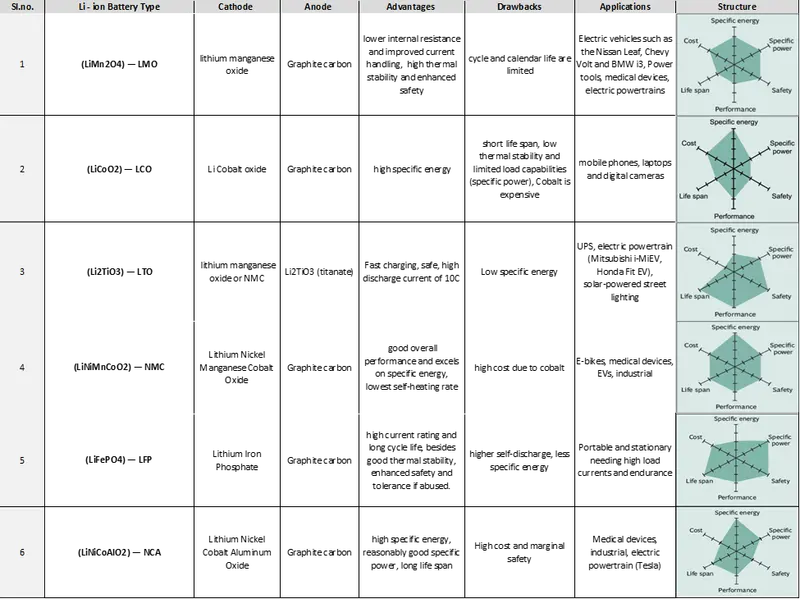
- Lithium Cobalt Oxide (LiCoO2) - LCO
It has a high specific energy but a low specific power, which means that charging and discharging with Current Rate (C) values above the rated values reduces battery life. It has a graphite anode and a cobalt oxide cathode. The cathode is multi-layered.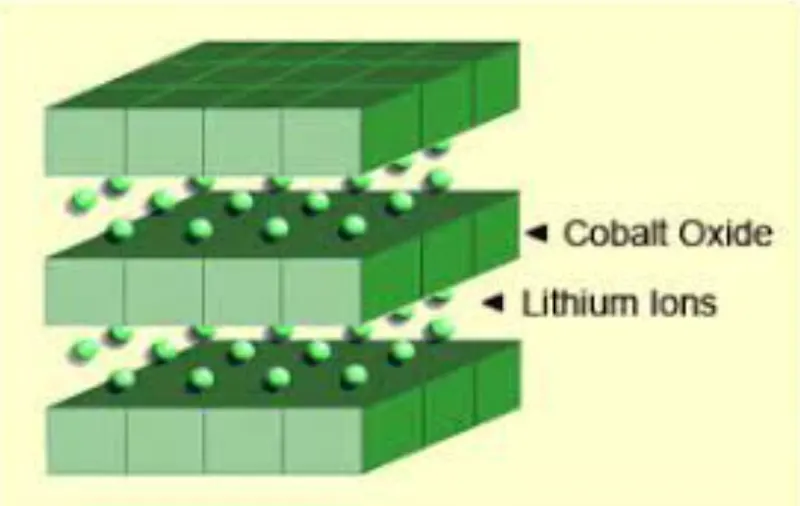
Li-ions move from anode to cathode during discharge. During charging, the flow is reversed. Because the graphite anode has a limited cycle life, it has a short life span. It is not thermally stable. Its primary applications include mobile phones, laptop computers, cameras, and so on. The lithium ions are absorbed by the lithium dioxide at the cathode, and the electrode is reduced as it receives electrons from the circuit.
Cathode Reaction: `LiCoO_2 harr Li_(1-x)CoO_2+xLi^++xe^-`
Anode Reaction: `6C+xe^(-)+xLi^+ harr Li_xC_6`
Overall Reaction: `LiCoO_2+6CharrLiC_6+CoO_2` - Lithium Manganese Oxide (LiMn2O4) — LMO
The Manganese Oxide forms a three-dimensional spinel structure, which improves ion flow on the electrode. As a result, internal resistance is reduced, allowing for faster charging and high-current discharging. In addition, the spinel structure provides additional thermal stability. Making it more secure than LCO. The cycle life of the LMO is shorter.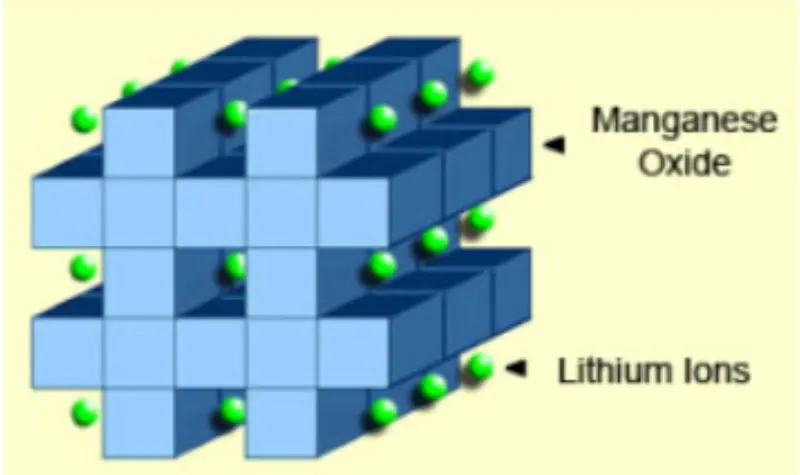
Most Li-manganese batteries combine with lithium nickel manganese cobalt oxide (NMC) to improve precision and battery life. Specific energy (capacity), specific power (load capability), and longevity can all be improved with these three active metals and silicon enhancement. Li-manganese has a high power but a low capacity. It is found in power tools, medical devices, and electric vehicle powertrains.
Cathode Reaction: `LiMnO_2harrLi_(1-x)Mn_2O_4+xLi^+xe^-`
Anode Reaction: `LiMnO_2harrLi_(1-x)Mn_2O_4+xLi^++xe^-`
Overall Reaction: `LiMnO_2harrLi_(1-x)Mn_2O_4+xLi^++xe^-` - Lithium Nickel Manganese Cobalt Oxide (LiNiMnCoO2) — NMC
Nickel Manganese Cobalt cathodic combination is successful because it can be tailored to be either Energy Cells or Power Cells. NMC performs well and excels in specific energy. This Lithium-ion battery has a continuous discharge current capability.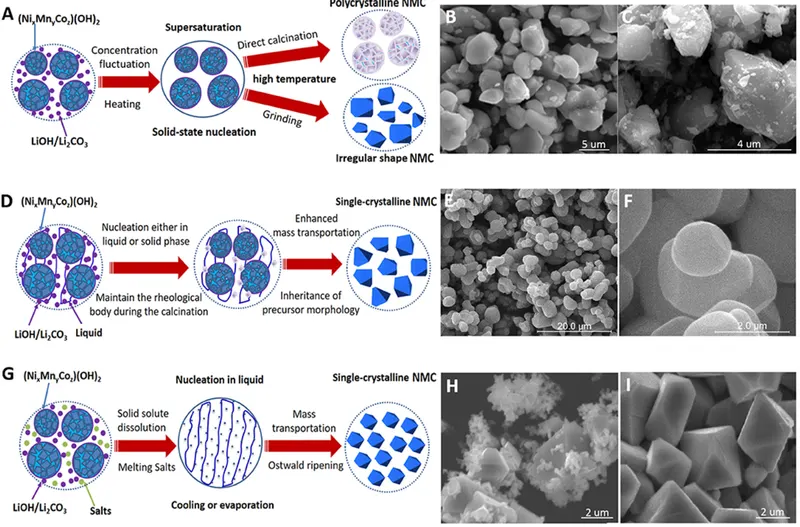
The benefit of nickel is its high specific energy, but it is unstable. Manganese, on the other hand, achieves low internal resistance by forming a spinal structure. Manganese, unlike Nickel, has a low specific energy. Their pairing improves each other's performances. New electrolytes have the potential to increase capacity. It has a low self-heating rate and a longer cycle life. This is the preferred battery for electric powertrains and industrial applications.
Cathode Reaction: `Li_(1-x)MO_2+xLi^++xe^-harrLiMO_2`
Anode Reaction: `Li_xC_nharrnC+xLi^++xe^-`
Overall Reaction: `Li_(1-x)MO_2+Li_xC_nharrLiMO_2+nC` - Lithium Iron Phosphate (LiFePO4) — LFP
Li- Phosphate is used as the cathode in this type because it has good electrochemical performance and low resistance. This is due to the use of nano-scale phosphate cathode material. Long lifecycle, good thermal stability, high current rating, enhanced safety, and abuse tolerance are some of the benefits of this Lithium-ion battery chemistry.
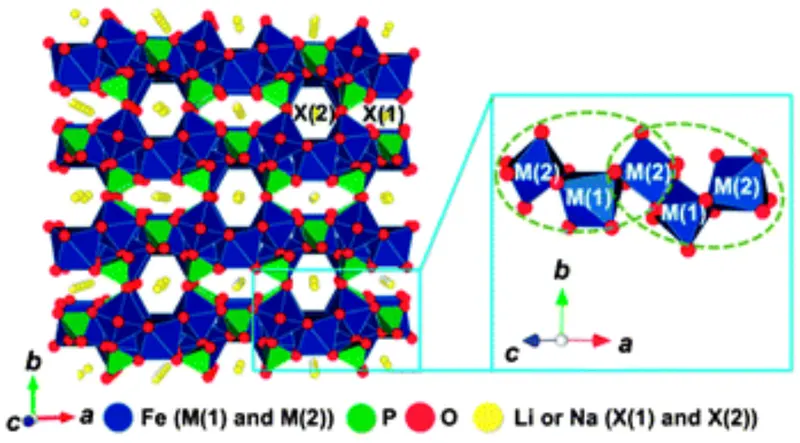
Li-Phosphate is frequently used to replace lead-acid batteries because it has a moderate specific energy and a very low tolerance for moisture, which drastically reduces its cycle life. Another feature is a very flat voltage discharge curve but a low capacity. LFP is one of the least dangerous Li-ions on the market. The lithium ions are absorbed by the lithium dioxide at the cathode, and the electrode is reduced as it receives electrons from the circuit.
Cathode Reaction: `LiFe(III)PO_4harrLI_(1-x)Fe(II)PO_4+xLi^++xe^-`
Anode Reaction: `xLi^++xe^-)+ 6CharrLi_xC_6`
Overall Reaction: `LiFePO_4+6Charr LiC_6+FePO_4` - Lithium Nickel Cobalt Aluminum Oxide (LiNiCoAlO2) — NCA
NCA batteries are becoming more popular in electric vehicles and grid storage. They are uncommon in the consumer industry, but they hold great promise for the automotive sector. Tesla, a US-based EV manufacturer, is researching and employing this Lithium-ion battery chemistry.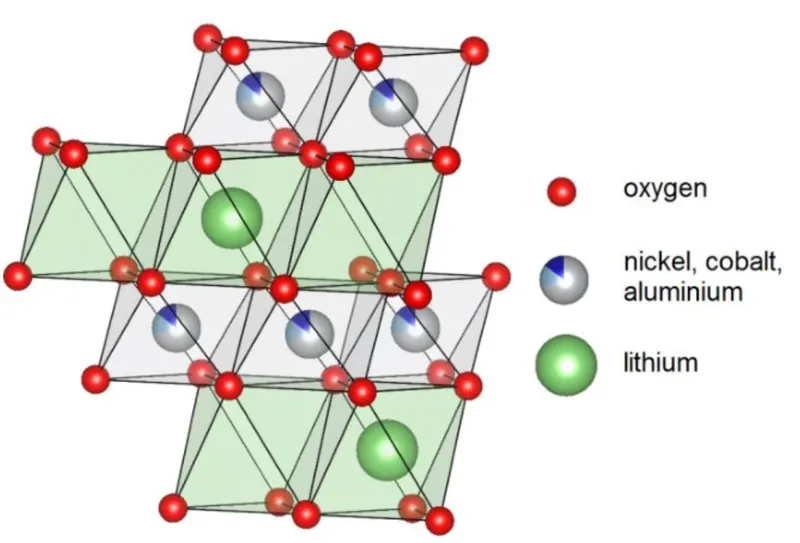
NCA has the highest Specific Energy, good Specific Power, and a long life span. High cost and marginal safety are the negatives.
Cathode Reaction: `LiNiCoAlO_2harrLi_(1-x)NiCoAlO_2+xLi^+ +xe^-`
Anode Reaction: `xLi^+xe^-)+6CharrLi_xC_6`
Overall Reaction: `6C+LiNiCoAlO_2harrLiC_6+NiCoAlO_2` - Lithium Titanate (Li2TiO3) — LTO
Li-titanate replaces graphite in the anode of a typical Lithium-ion battery in this technology, and the material forms a spinel structure. The cathode can be made of lithium manganese oxide (LMO) or NMC. Li-titanate can be fast-charged and has a discharge current that is 10 times the rated capacity. The cycle count is greater than that of standard Li-ion batteries.
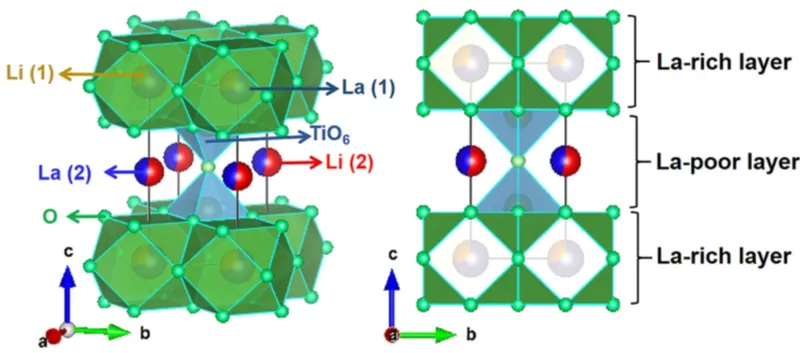
Li-titanate has excellent low-temperature discharge characteristics and a long life span. This lithium-ion battery chemistry power is used in electric powertrains, UPS, and solar-powered street lighting.
Cathode Reaction: `4LiMn_2O_4harr4Mn_2O_4+4Li^++4e^-`
Anode Reaction: `Ti_5O_12+4Li^++4e^-harrLi_4Ti_5O_12`
Overall Reaction: `Li_4Ti_5O_12+4Mn_2O_4harr4LiMn_2O_4+Ti_5O_12`
Comparison of the difference between each type of Li+ion Battery based on their Characteristics
The main differences between their characteristics are best discovered when selecting a battery type that is best suited for ones needs or does the job more efficiently than the others. In that context, there are a few factors that distinguish the six types from one another, which are listed below:
-
Nominal Voltage: The system voltage at which the device is designed to operate is referred to as the nominal voltage. To ensure the device's safety, the rated voltage is usually higher than the nominal voltage.
-
Cycle: A cycle is formed when the charge and discharge occur simultaneously. The greater the number of cycles that can occur, the greater the lifespan.
-
The current rate (C): It is used to determine a battery's fast charging and short-circuit discharge capabilities.
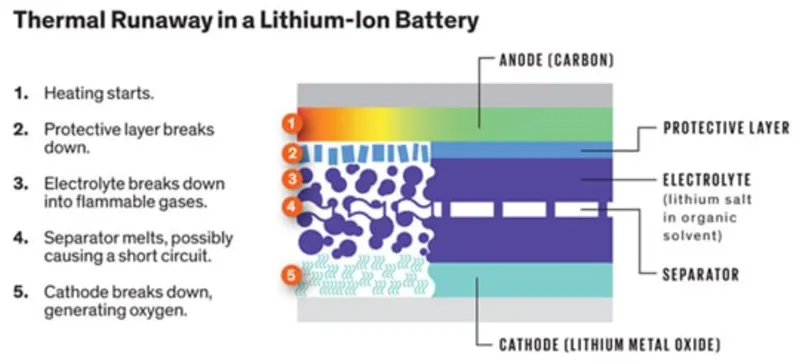
- Thermal Runaway: Thermal runaway occurs when the amount of heat generated within a battery exceeds the amount of heat dissipated to its surroundings. If the source of the excessive heat generation is not addressed, the situation will deteriorate. Internal battery temperature will continue to rise, increasing battery current and causing a domino effect. A single battery's temperature rise will begin to affect other batteries nearby, and the pattern will continue, hence the term "runaway."
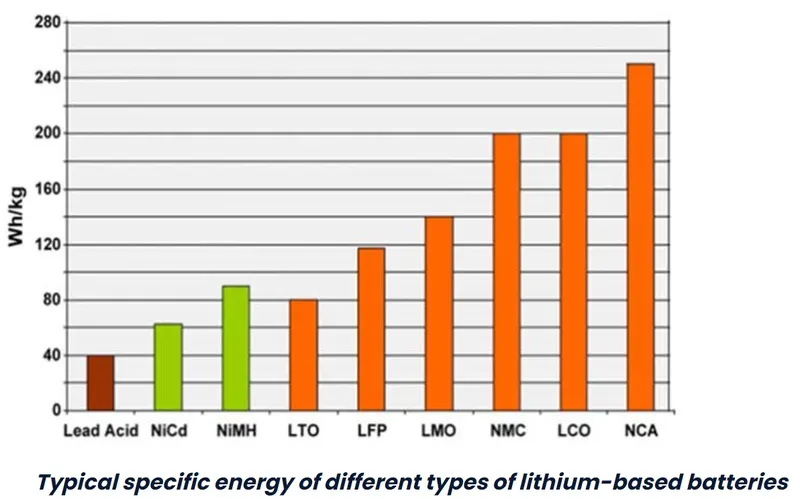
- Specific Energy (Wh/Kg): It is the amount of energy stored per unit mass. This is a critical deciding factor that determines how much energy or power we will get from different batteries of the same weight.
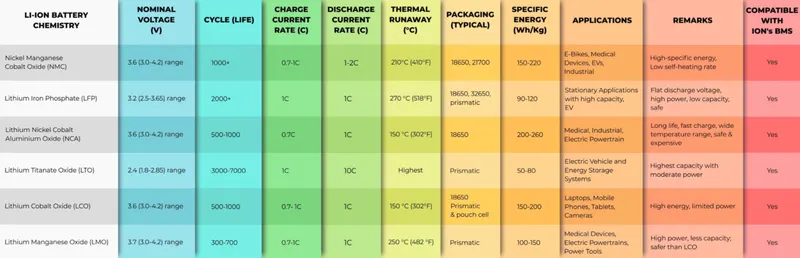
The main differences between the six types of Li+ ion batteries can be distinguished by their characteristics, and a snapshot of the same is provided in a tabular format:
-
Nominal Voltage: When it comes to nominal voltage, the majority of them are very close. In terms of volts, LMO(3.7) has the widest range and LTO(2.4) has the narrowest.
-
Cycle Life: They mostly differ significantly from one another. Because LTO batteries have the longest life cycle, they can last for a longer period of time, whereas LMO batteries are the polar opposite.
-
Charge Current Rate: The higher the charge current, the faster the battery will charge. LFP and LTO are the highest, while NCA comes close but falls short of its competitors.
-
Discharge Current Rate: In extreme cases, this can result in an internal short circuit and/or an explosion. The majority of consumer applications only require 1C from their batteries. If you require higher discharge rates and faster charging times, a high-rate battery is the way to go. LTO has a discharge rate that is ten times faster than others, making it one of the safest batteries available.
-
Thermal Runaway: As previously discussed, a thermal runaway occurs when an increase in temperature changes the conditions in such a way that another increase in temperature occurs, often with disastrous results. It's a form of uncontrollable positive feedback. We know that the higher the temperature at which the thermal runaway occurs, the more secure the battery. LTO has the highest temperature rating in this category, while NCA and LCO have the lowest.
-
Specific Energy: The specific energy density can be calculated by integrating the expression V(t)*I*A dt from 0 to t cutoff (time to reach the cut-off potential) and then dividing by (3600*Mw). This method yields the specific energy density in Wh kg-1. The highest energy densities are provided by lithium-ion batteries with cobalt cathodes (NCA-type batteries). Cell phones, laptop computers, and digital cameras are examples of common applications. The power density (W/kg) of a battery indicates how much power it can deliver on demand.
To make it easier for a layperson to choose a battery, the 6 key features are given a value between 0 and 5 for all 6 types of batteries, and then all of them are given the same parameters that are considered in the case of "5 Point Hexagonal Analysis" of the batteries. The six elements are as follows:
- Specific Energy
- Cost
- Life Span
- Specific Power
- Safety
- Performance
Conclusion:
All lithium-ion cells, their performance, reactions, and all other parameters were closely examined.