Week 1 Understanding Different Battery Chemistry
Understanding Different Battery Chemistry:
A Lithium-ion or Li-ion battery is a type of rechargable battery which uses the reversible reduction of Lithium ions to store energy. It is the predominant battery type used in portable consumer electronics and electric vehicles. It also sees significant use for grid scale energy storage and military and aerospace applications. Compared to other rechargeable battery technologies, Li-ion batteries have high energy densities, low self-discharge, and no memory effect.
Types of Li-ion batteries:
- Lithium Cobalt Oxide (LCO)
- Lithium Manganese Oxide (LMO)
- Lithium Iron Phosphate (LFP)
- Lithium Nickel Manganese Cobalt Oxide (NMC)
- Lithium Nickel Cobalt Aluminum Oxide (NCA)
- Lithium Titanate Oxide (LTO)
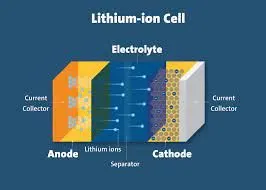
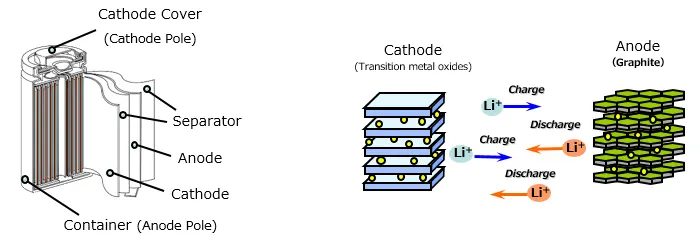
Below table shows the material and chemical reactions occuring at the anode and cathode of LCO, LMO, NCA, NMC, LFP and LTO type of lithium ion cells:
| Type of Batteries | Anode material | Cathode Material | Reaction at Anode | Reaction at Cathode |
| LCO | Graphite | Lithium cobalt oxide | LiC6→xLi++xe−+C6 | Li1−xCoO2+xLi++xe−→LiCoO2 |
| LMO | Graphite | Lithium manganese oxide | LiC6→Li++e−+C6 | MnO2+Li+ +e- →LiMnO2 |
| NCA | Graphite | Lithium Nickel Cobalt Aluminium | LiC6→Li++e−+C6 | NiCoAlO2 + Li+ +e- → LiNiCoAlO2 |
| NMC | Graphite | Lithium Nickel Manganese Cobalt | LiC6→Li++e−+C6 | FePO4+Li++e−→LiFePO4 |
| LFP | Graphite | Lithium Iron Phosphate | LiC6→Li++e−+C6 | FePO4 + Li+ +e- →LiFePO4 |
| LTO | Titanate | Lithium titanium dioxide | Li4Ti5O12 + 4Li+ + 4ei →4LiMn2O4 | 4Mn2PO4 + 4Li+ +4e- →4LiMn2O4 |
*Below table shows the comparison between each type of Li-ion batteries based on their characteristics:
| Li-ion Battery | NMC | LFP | NCA | LTO | LCO | LMO |
| Nominal voltage | 3.6 | 3.2 | 3.6 | 2.4 | 3.6 | 3.7 |
| Cycle life | 1000+ | 2000+ | 500-1000 | 3000-7000 | 500-1000 | 300-700 |
| Charge current rate (C) | 0.7-1 C | 1 C | 0.7 C | 1 C | 0.7-1 C | 0.7-1 C |
| Discharge current rate (C) | 1-2 C | 1 C | 1 C | 10 C | 1 C | 1 C |
| Thermal runaway (deg C) | 210 | 270 | 150 | Highest | 150 | 250 |
| Specific energy (Wh/Kg) | 150-220 | 90-120 | 200-260 | 50-80 | 150-200 | 100-150 |
| Application | E-bikes, Medical Devices, EVs | Stationary application with high capacity | Medical, Industrial, Electric Powertrain | Electric vehicle and enery storage systems | Laptops, Mobile phones, Tablets, Camera | Medical devices, Power tools |
| Remarks | High specific energy, Low self-heating rate | Flat discharge voltage, high power,safe | Long life, fast charge, wide temperature range, expensive | Highest capacity with moderate power | High energy ,limited power | High power, less capacity |