Hood design-Week 2
Hood design
Hood is located at the frontal portion of an automobile through which the engine compartment can be accessed, it is like a door that opens and closes by utilizing hinges located at the back end of the panel.
Objective: The aim of the project is to design hood of the car by considering functionality, manufacturing and safety aspects.
Introduction: Safety is the most important criteria in automobile designs which concentrates on both pedestrian and occupant safety. The pedestrians are the most vulnerable road users and are at high risk of traffic accidents. The major reason for the fatality of the pedestrian in traffic accident is due to the head injury resulting from the hard impact of the head against the stiffer hood or the ground. This leads to the necessity of good inner hood panel which is less stiff and pedestrian friendly.
The hood which is also referred as bonnet is a hinged cover over the engine of a car. This covers the engine and other components and acts as door for maintenance of the engine. It is made of same material as rest of body which includes steel, aluminum etc. Some custom hoods are also available in market made of carbon fiber to have a lighter hood and provide aesthetic look to the hood.
Hood mainly consists of 4 components; inner panel, outer panel, hinges and latch striker. Outer panel gives the aesthetic look whereas inner panel have some embossing on it according to the force distribution and safety requirements.
Design Consideration for the hood
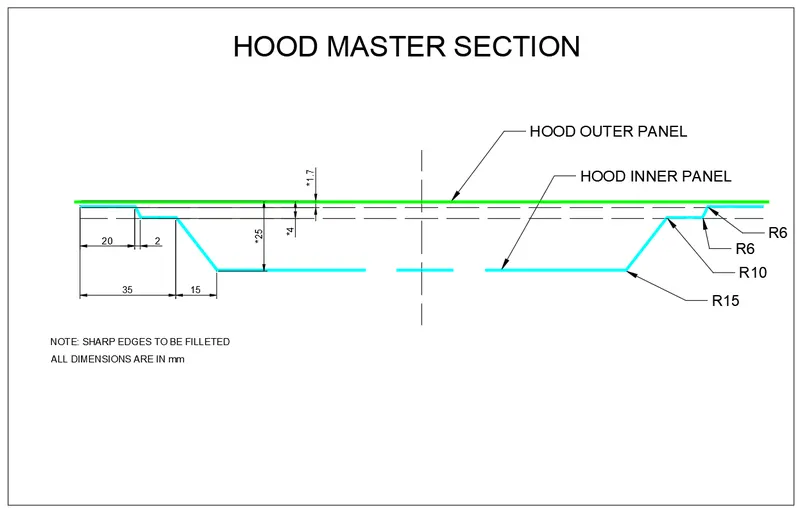
- The hood design should follow a master section that meets all the safety and structure requirements.
- The hood should be designed in such a way that in case of a crash it should dissipate the crash force towards the hinges away from the passenger compartment.
- The opening and closing of the hood should be seamless without any interruptions this can be achieved by placing the latch and striker mechanism at an optimum distance from the hinges.
- In case of a crash maximum amount of force should be absorbed as it is the frontal part of the car.
- The design should be in a manner that easy access and serviceability of the engine compartment are achieved.
- It should be aerodynamic and aesthetic to reduce drag force and looks appealing.
The following master section is used to design the hood in this project.
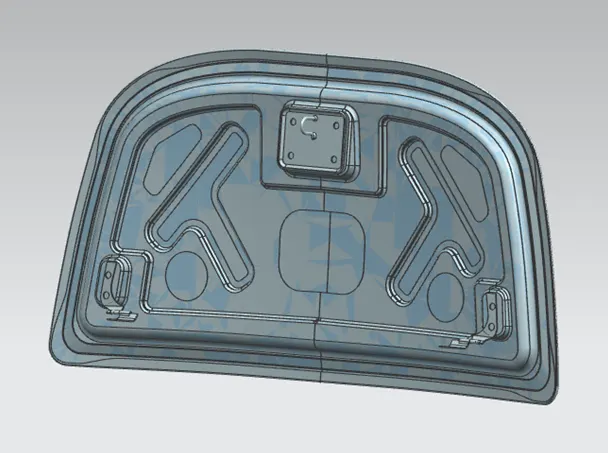
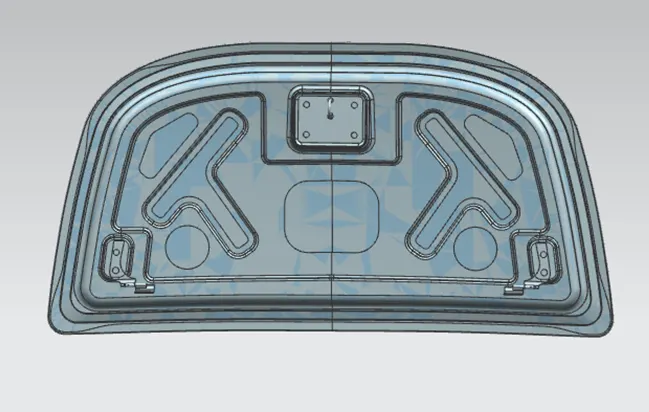
Following considerations are always taken into account while designing the hood.
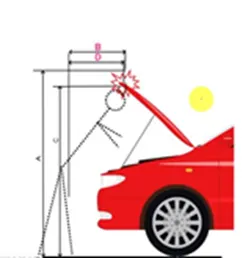
A] Hood opening angle:
It is one of the considerations in hood design. These opening angles vary from country to country which is decided by taking average height of person from that country.
B]Force distribution during collision:
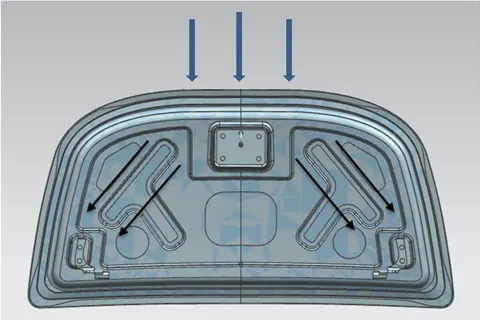
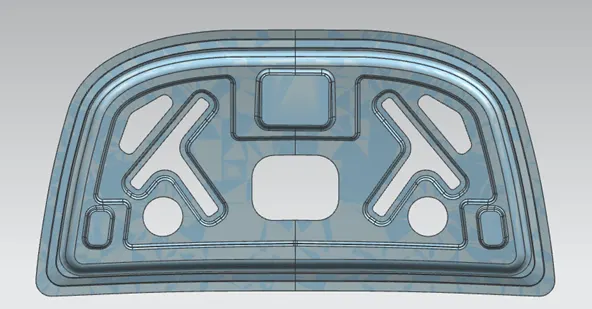
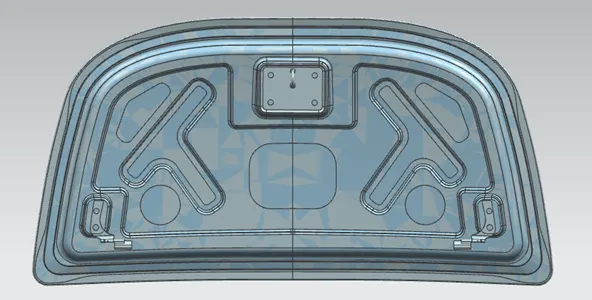
The inner panel of the hood is designed in such a way that the majority force produced during collision is distributed outwards to reduce damage to the passenger and driver. The design hood employs a V shape design which effectively dissipates the crash forces away from the passenger compartment and also satisfies the structural requirements.
C] Pedestrian safety:
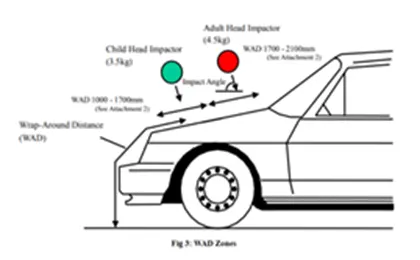
Pedestrian safety is important consideration while designing the hood. According to the wrap around distance and pedestrian head impact zone hood is designed. The area at the head impact zone is made softer to reduce the impact force during accident.
D] Noise, vibration and harness:
Noise, vibration, and harshness (NVH), also known as noise and vibration (N&V) are the study and modification of the noise and vibration characteristics of vehicles, particularly cars and trucks. While noise and vibration can be readily measured, harshness is a subjective quality, and is measured either via "jury" evaluations, or with analytical tools that can provide results reflecting human subjective impressions.
The hood panels are designed in NX CAD. Also, reinforcements are designed for latch striker and hinges.
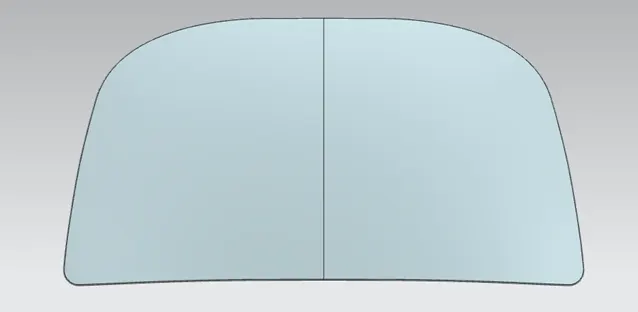
Outer panel:
Inner panel:
Inner and outer panel assembled:
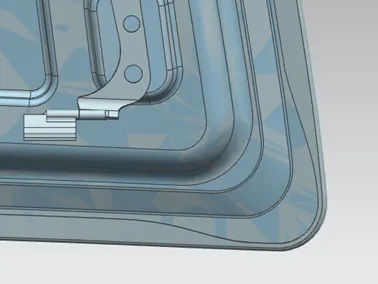
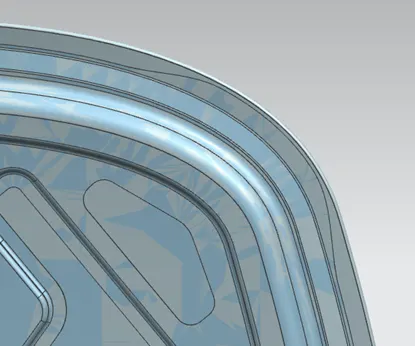
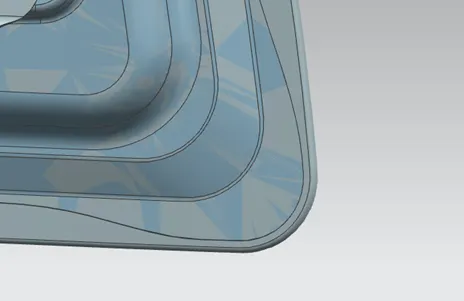
Corner reliefs:
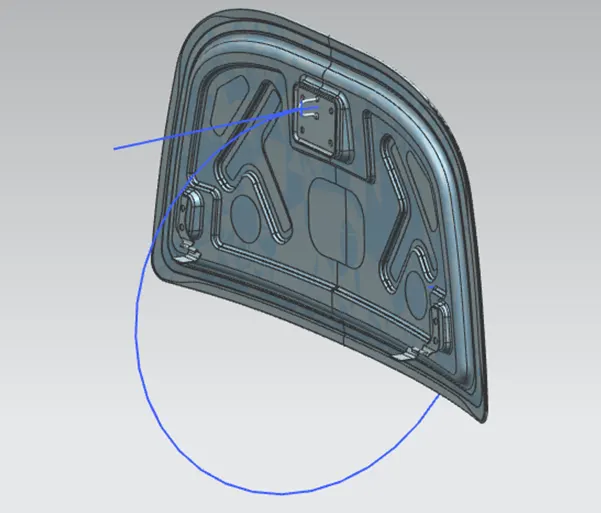
Latch trajectory:
For proper opening and closing of hood, the striker should be perpendicular to the trajectory of hood. To position the latch, a circle is drawn from the hinge axis center and latch is placed perpendicular to the circle path i.e., tangent to the path.
Mastic sealants:
The main purpose of the outer panel is for the athletic looks. Thus, we cannot use bolts for welding. This has to be done with the help of hemming and mastic sealants. Mastic sealants are elastic compound that behaves like the rubber. It is placed between the outer and inner panels. Initially it is in paste form but after the hot furnace bath it gets hardened thus joining the outer and inner panel. Mastic sealant has the tendency to increase the strength of the panel and has the influence of 80 mm diameter.
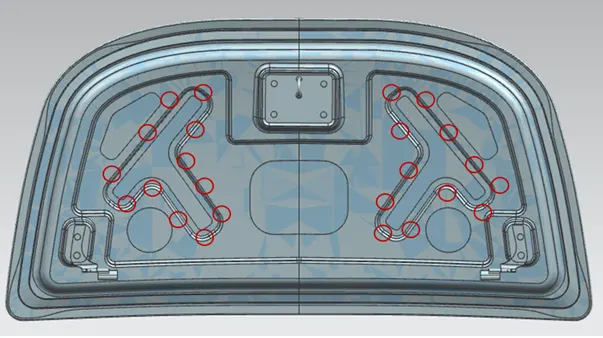
Various processes involved in manufacturing and assembly of complete hood are as follows:
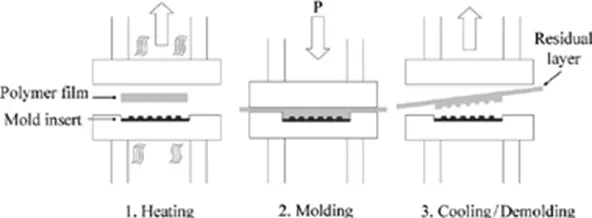
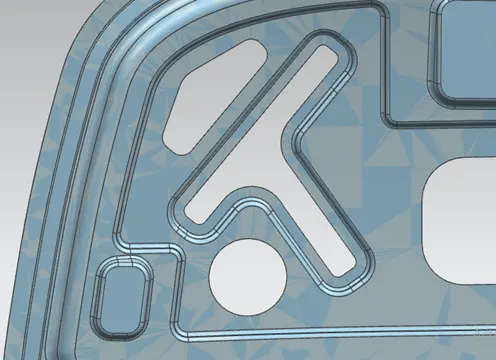
Embossing:
Sheet metal embossing is a stamping process for producing raised or sunken designs or relief in sheet metal. This process can be made by means of matched male and female roller dies, or by passing sheet or a strip of metal between rolls of the desired pattern.
Deep Drawing:
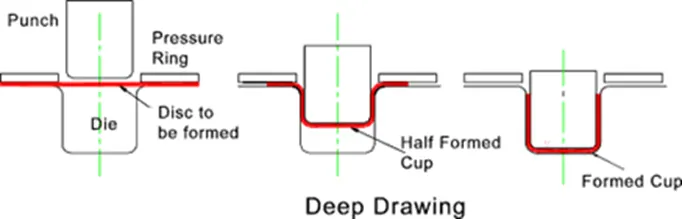
Deep drawing is a sheet metal forming process in which a sheet metal blank is radially drawn into a forming die by the mechanical action of a punch. It is thus a shape transformation process with material retention. The process is considered "deep" drawing when the depth of the drawn part exceeds its diameter. This is achieved by redrawing the part through a series of dies. The flange region (sheet metal in the die shoulder area) experiences a radial drawing stress and a tangential compressive stress due to the material retention property.
Hemming:
Hemming is a forming operation in which the edges of the sheet are folded or folded over another part in order to achieve a tight fit. Normally hemming operations are used to connect parts together, to improve the appearance of a part and to reinforce part edges.
In car part production, hemming is used in assembly as a secondary operation after deep drawing, trimming and flanging operations to join two sheet metal parts (outer and inner) together. Typical parts for this type of assembly are hoods, doors, trunk lids and fenders
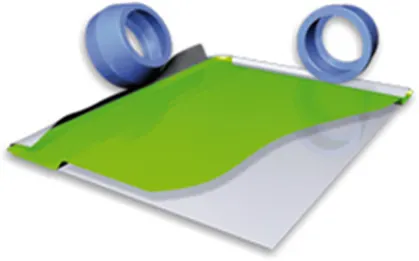
For hood, we use roll hemming to join inner and outer panel. Roll hemming is carried out incrementally with a hemming roller. An industrial robot guides the hemming roller and forms the flange. Roll hemming operation can also be divided into several pre-hemming and final hemming process steps. Roll hemming is very flexible to use and tool costs are significantly lower as compared to those of conventional die hemming.
Conclusion:
In this project complete hood assembly is designed by designing inner and outer panel which meets manufacturing requirements. Inner panel is designed with reference of master sketch. Hinge and latch striker reinforcements are designed and all components are assembled together.