Week 1 Understanding Different Battery Chemistry
Objective:-
To conduct research and gain an understanding of the electrochemistry of various kinds of lithium-ion batteries.
Questions:-
Create a table listing the components and chemical processes occurring at the anode and cathode of lithium-ion cells of the LCO, LMO, NCA, NMC, LFP, and LTO types.
Battery:
A battery is a component with external connections made up of one or more electrochemical cells used to electrical power appliances like flashlights, cell phones, and electric automobiles. A battery's positive terminal functions as the cathode and its negative terminal as the anode while it is providing electricity. The negative terminal is the origin of the electrons that will go from the positive terminal to an external electric circuit.
Redox reactions change high-energy reactants into lower-energy products when a battery is coupled to an external electric load, and the free energy difference is sent to the external circuit as electrical energy.
There are two different battery types:
Primary cell: These are single-use batteries that cannot be recharged for further use.
Secondary cell - These batteries have numerous uses and may be recharged.
Lithium-ion Battery:-
The secondary kind of batteries that may be recharged for further use are lithium-ion batteries.
There are four primary components in lithium-ion batteries.
Cathode is I
The anode
Electrolyte
The separator
Cathode:
They are the cell's positive electrodes.
Typically, the cathode electrode consists of,
Layered Transition Metal Oxides - High Capacity, but expensive and unsafe.
Spinels: While having a high power density, they are unstable and have poor conductivity.
Olivines - High in safety and longevity with limited capacity.
Anode:
They are the cell's negative electrodes.
Typically, the anode electrode consists of,
graphite. Hard Carbon; these anodes are less expensive and have high specific capacities and levels of stability.
Electrolyte:
An electrolyte is a material that, when dissolved in a polar solvent, forms an electrically conducting solution. The electrolyte that has been dissolved splits into cations and anions, which spread evenly throughout the solvent. Electrolytes of organic solvents including ethylene carbonate, dimethyl carbonate, propylene carbonate, and lithium salt are often used in lithium-ion batteries.
Separator:
Battery separators allow for the exchange of lithium ions from one side to the other while establishing a barrier between the anode (negative) and the cathode (positive). These substances are ion conductors, but they do not also conduct electrons. Polyolefin serves as a separator in Li-ion batteries. This substance is inexpensive and has strong chemical stability and great mechanical qualities.
Working of Lithium ion cell: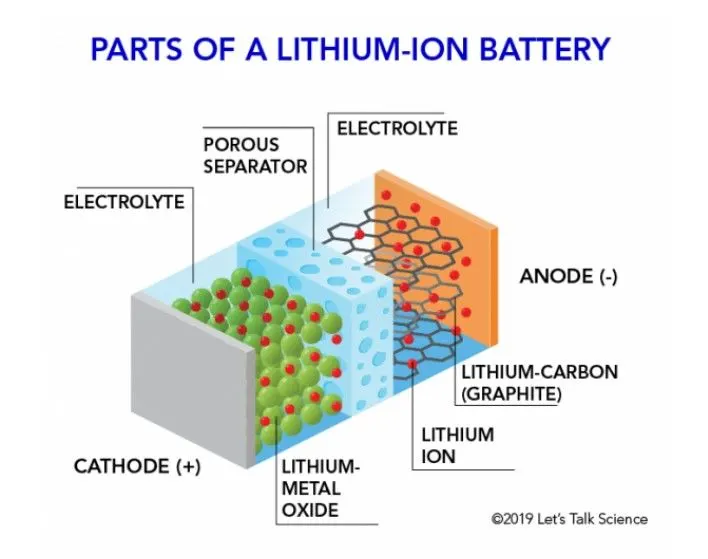
Lithium is stored in the anode and cathode of the battery, which also includes a separator, electrolyte, and two positive and negative current collectors. Positively charged lithium ions are transported through the separator by the electrolyte from the anode to the cathode and vice versa. A charge is produced at the positive current collector by the movement of the lithium ions, which releases free electrons in the anode. The electrical current then travels from the positive current collector to the negative current collector after passing via a powered device (such as a computer, electric motor, or mobile phone). The separator prevents electrons from moving freely within the battery. The anode transfers lithium ions to the cathode when the battery discharges and produces an electric current, which causes a flow of electrons from one side to the other. When recharging, the process is reversed, with the cathode releasing lithium ions while the anode absorbs them. A lithium-ion battery functions in this manner.
According to their chemical compositions, the following lithium ion cell types may be distinguished:
1. Lithium cobalt oxide (LiCoO2) (LCO):-
Lithium cobalt oxide batteries, sometimes referred to as lithium cobaltate or lithium-ion cobalt batteries, are created from lithium carbonate and cobalt. They have a cobalt oxide cathode and a graphite carbon anode; during discharge, lithium ions migrate from the anode to the cathode, and while the battery is charging, the flow is reversed. This kind of battery has various disadvantages, such as a restricted specific power and a relatively short battery life. Additionally, compared to other varieties, these batteries are less secure.
2. LiMn2O4, or lithium manganese oxide (LMO):-
In 1996, Moli Energy created the first commercial lithium-ion cells using lithium manganese oxide as the cathode material.
In addition to being safer than other kinds of lithium-ion batteries, lithium manganese oxide batteries are renowned for their great temperature stability. They may be found in power tools, electric motorcycles, and other items as well. Because of this, they are often utilised in medical equipment and gadgets. Lithium manganese oxide batteries may also be used to power electric automobiles and computers.
3. LiNiCoAlO2, or lithium nickel cobalt aluminium oxide (NCA):-
Lithium nickel cobalt aluminium oxide batteries, generally known as NCA batteries, are playing a bigger role in grid storage and electric drivetrains. Although NCA batteries are uncommon in the consumer sector, the automobile sector sees great potential in them. In comparison to other lithium-ion battery types, NCA batteries provide a high-energy choice with a long lifetime, but they are also rather expensive and less safe than they might be.
4. LiMnCoO2, or lithium nickel manganese cobalt oxide (NMC):-
Batteries with a cathode comprised of a mix of nickel, manganese, and cobalt are sometimes known as lithium manganese cobalt oxide batteries or NMC batteries. NMC batteries, like other types of lithium-ion batteries, may either have a high specific energy density or a high specific power. They are unable to possess both qualities, nevertheless. Power tools and car engines use this battery type the most often.
Typically, the cathode combination ratio is 60% nickel, 20% manganese, and 20% cobalt. Because cobalt may be relatively costly, the cost of raw materials is lower than it is for other lithium-ion battery choices. Future price reductions for these batteries may be possible since some battery manufacturers aim to change their battery chemistry to one that has a larger percentage of nickel in order to utilise less cobalt. This battery type's very low self-heating rate makes it a popular choice for electric cars.
5. LiFePo4, or lithium iron phosphate (LFP):-
Phosphate serves as the cathode in lithium iron phosphate batteries, sometimes referred to as li-phosphate batteries. Due to their low resistance characteristics, they are more secure and have better thermal stability. Durability and a long lifetime are further advantages; fully charged batteries may be kept with no effect on the battery's overall lifespan of charge. When the lengthy battery life of lithium-phosphate batteries is taken into account, they are often the most affordable alternative. However, compared to other lithium battery types, the li-phosphate battery has less energy due to its lower voltage. As a result, these batteries are often employed in applications that need a long lifetime and high levels of safety, such as electric bikes.
6. LiTiO2, or lithium titanium oxide (LTO):-
Last but not least, lithium titanate, often referred to as li-titanate, is a kind of battery that enables an expanding number of uses. The li-titanate battery's incredibly quick recharging time is its key benefit. Li-titanate batteries are being employed by producers of electric bikes and cars, and there is potential for this kind of battery to be used in electric buses for public transit. However, compared to other lithium-ion battery types, these batteries have a lower intrinsic voltage or lower energy density, which might pose problems with effectively supplying power to cars. However, lithium titanate batteries still have a greater density than other non-lithium-ion batteries, which is a benefit.
Comparision Table:-
|
Li - ion cell Type |
Cathode |
Anode |
Electrolyte |
Seperator |
Overall Reaction at Cathode & Anode |
Application |
|
LCO |
Graphite |
Lithium Cobalt Oxide |
Ethylene |
Polyolefin |
Li1-xCoO2(s) + x Li+ + x e- → LiCoO2(s) |
Mobile phones, laptops and digital cameras |
|
LMO |
lithium manganese oxide |
Graphite carbon |
Methyl carbonate + Li salt |
Polyolefin |
Mn2+ + 2 LiC6 → Mn + 2 Li++ graphite |
Power tools, medical devices, electric powertrains |
|
NCA |
Comprised of Nickel cobalt & Aluminium |
Graphite carbon |
Propylene carbonate + Li salt |
Polyolefin |
Li(1−x)NiO2 → (2 − x)Li(1−x)/(2−x)Ni1/(2−x)O + x/2O2 |
Medical devices, industrial, electric powertrain (Tesla) |
|
NMC |
Comprised of Nickel cobalt & Manganese |
Lithium metal Graphite |
Methyl carbonate + Li salt |
Polyolefin |
Li(x)MO2(s) → Li+(org) + Li(x-1)MO2(s) + e-. |
E-bikes, medical devices, EVs, industrial |
|
LFP |
Comprised of Lithium, Iron & Phosphate |
Graphite Carbon |
Propylene carbonate + Li salt |
Polyolefin |
Portable and stationary needing high load currents and endurance |
|
|
LTO |
Comprised of Nickel cobalt & Manganese |
Lithium–titanium oxide |
Propylene carbonate + Li salt |
Polyolefin |
Li4Ti5O12 + 3Li+ + 3e → 4 Li7Ti5O12 |
UPS, electric powertrain (Mitsubishi i-MiEV, Honda Fit EV), |