Week 1 Understanding Different Battery Chemistry
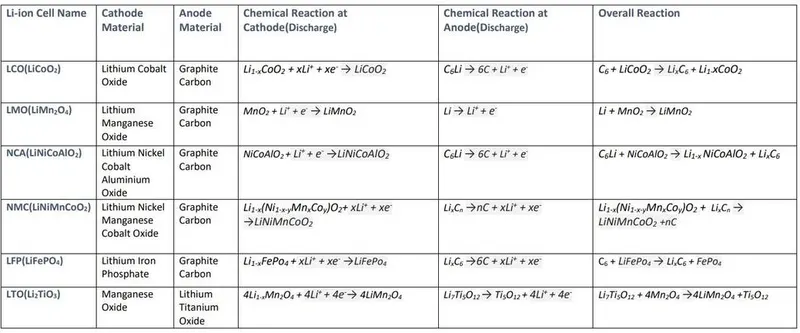
1.Prepare a table which includes materials & chemical reactions occurring at the anode and cathode of LCO, LMO, NCA, NMC, LFP and LTO type of lithium ion cells.Give your detailed explanation on it.
Lithium-ion Battery Working
The rechargeable Lithium-ion Battery is made of one or more power-generating compartments called cells. Each cell has essentially three components.- positive electrode, negative electrode and electrolyte.
A positive electrode connects to the battery's positive or + terminal. A negative electrode connects to the negative or − terminal. And a chemical called an electrolyte in between them.
The positive electrode is typically made from a chemical compound called lithium-cobalt oxide (LicoO2) or lithium iron phosphate (LiFePO4). The negative electrode is generally made from carbon (graphite). The electrolyte varies from one type of battery to another.
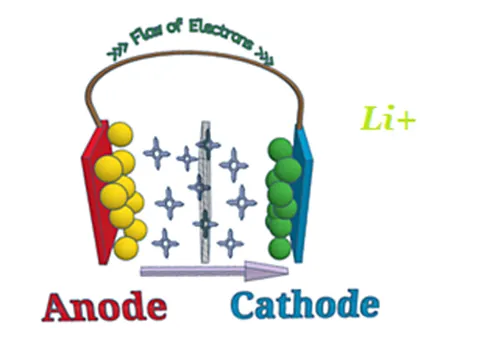
The electrolyte carries positively charged lithium ions from the anode to the cathode.The movement of the lithium ions creates free electrons in the anode which creates a charge at the positive current collector. The electrical current then flows from the current collector through a device being powered (cell phone, computer, etc.) to the negative current collector. The separator blocks the flow of electrons inside the battery.
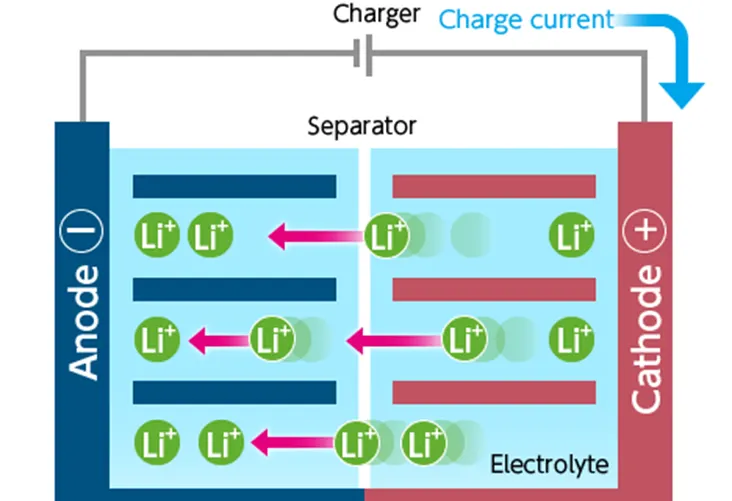
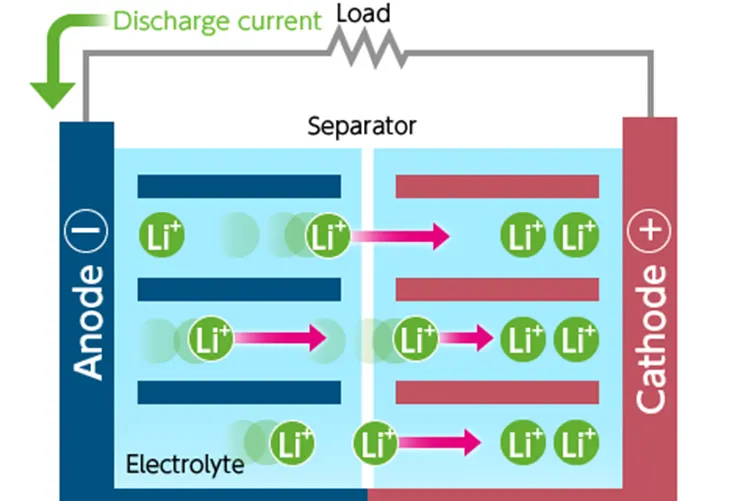
While the battery is discharging and providing an electric current, the anode releases lithium ions to the cathode, generating a flow of electrons from one side to the other. When plugging in the device, the opposite reaction happens, the cathode releases lithium ions and anode receives them. This is how the Lithium-ion battery works.
In this battery, the energy density and power density are most common things of the battery. Generally, the energy density measures in watt-hours per kilogram (wh/kg) and is the amount of energy the battery can store with respect to its mass. Power density measures in watts per kilogram (W/kg) and is the amount of power of battery with respect to its mass.
Advantages of Lithium-ion Battery
Now a days Lithium-ion batteries are popular because they have a number of important advantages over competing technologies:
- Generally, they are much lighter than other types of rechargeable batteries of the same size.
- They hold their charge. A lithium-ion battery pack loses only about 5 percent of its charge per month.
- High specific energy and high load capabilities with Power Cells
- Long cycle and extend shelf-life; maintenance-free. They can handle hundreds of charge/discharge cycles.
- High capacity, low internal resistance, good coulombic efficiency
- Simple charge algorithm and reasonably short charge times
- Low self-discharge (less than half that of NiCd and NiMH)
Limitations of Lithium-ion Battery
- Requires protection circuit to prevent thermal runaway if stressed
- Degrades at high temperature and when stored at high voltage
- No rapid charge possible at freezing temperatures (<0°C, <32°F)
- Transportation regulations required when shipping in larger quantities
- They are extremely sensitive to high temperatures. Heat causes lithium-ion battery packs to degrade much faster than they normally would.
Applications of Lithium-ion Battery
Lithium batteries have a long list of real-world applications beyond running the apps on your phone. From life-saving medical equipment to luxury yachts, lithium batteries keep both the essentials and the comforts of modern life running with safety and reliability.
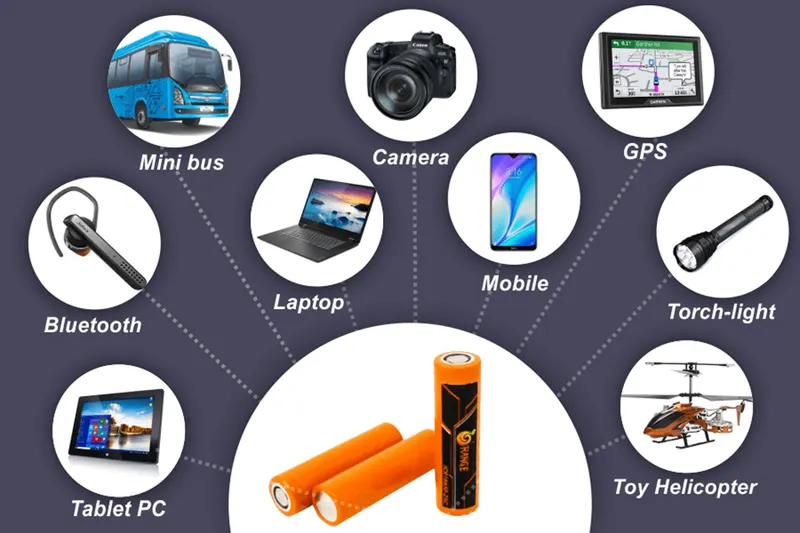
· UPS or Emergency Power Backup
It is different from a generator or other emergency power backup. It provides nearly instant power in order to run (or safely shut down) the equipment it is connected to.
·Reliable And Lightweight Marine Performance
Upgrading your boat with a long-lasting rechargeable lithium battery gives you years of reliable motor starts at a fraction of the weight of a traditional lead acid battery. Whether you need to power a small trolling motor, lithium batteries are capable and dependable.
· Dependable Electric And Power RV
Lithium- ion batteries offer reliable, stable, long-lasting power. The best solution for staying comfortable and safely exploring remote locations. Due to light weight and size, the lithium ion batteries power your Recreational Vehicle or electric vehicle with increased efficiency.
· Alarm Systems In Remote Locations
These batteries are ideal for remote monitoring systems due to long life, small size. Also, they are not losing power via self-discharge during the time that your system is inactive. Lithium batteries have a self-discharge rate that is 10 times lower than lead acid batteries
· Storage of Solar Power
Rechargeable lithium ion batteries are the best match for solar panels due to their fast charging. Solar panels produce low resistance charging, which is what lithium batteries require. In addition, lithium batteries charge quickly which allows to maximize the potential solar power storage from each day of sunlight.
· Personal Freedom With Mobility Equipment
From electric wheelchairs to stair lifts, numerous individuals depend on reliable mobility technology to live an independent life. Lithium-ion batteries are the ideal choice for mobility equipment, as they offer size customization, a longer life span, fast charging, a low self-discharge rate and extended run time.
· Used in Portable Power Packs
Rechargeable lithium batteries are well-known for powering our phones and the latest lightweight laptop computers. They also tolerate movement and temperature changes, as well as maintain their power delivery during use.
Types of lithium-ion batteries:
Lithium Cobalt Oxide Battery(LCO):
Lithium cobalt oxide batteries mainly consist of three parts anode, cathode and electrolyte. The cathode of lithium cobalt oxide battery is made up of lithium and cobalt elements and the anode is made up of graphite. The electrolyte of the battery is made up of lithium salts. The main work involved in the lithium cobalt oxide battery is the same as the lithium-ion battery. During discharging state the lithium oxide elements made up of cobalt will flow from anode to cathode.
During charging state the lithium oxide elements made up of cobalt will flow from the cathode to the anode. The electrolyte is a salt bridge that is used to make the electrolysis process a smoother way without any changes in the ions exchange between electrodes. This battery is mainly used in portable electronic gadgets such as cell phones, laptops and digital cameras as its energy density is comparatively less and self-discharge property is less. The battery is comparatively smaller in size.
DURING DISCHARGE
At the anode, lithium is oxidised. Lithium ions are released from the carbon, along with electrons:
LiC6→xLi++xe−+C6LiC6→xLi++xe−+C6
At the cathode, lithium-ions are absorbed by the lithium dioxide, and the electrode is reduced as it also receives the electrons from the circuit:
Li1−xCoO2+xLi++xe−→LiCoO2Li1−xCoO2+xLi++xe−→LiCoO2
The overall reaction is:
C6+LiCoO2⟷LixC6+Li1−xCoO2
Lithium Manganese Dioxide Battery:
Lithium Manganese dioxide batteries mainly consist of three parts anode, cathode and electrolyte. The cathode of lithium manganese dioxide battery is made up of lithium dioxide elements made up of Manganese and anode is made up of graphite. The electrolyte of the battery is made up of lithium salts. During discharging state the lithium oxide elements made up of Manganese will be flow from anode to cathode. During charging state the lithium dioxide elements made up of Manganese will flow from the cathode to the anode.
The electrolyte is a salt bridge that is used to make the electrolysis process the smoother way without any changes in the ions exchange between electrodes. This battery is mainly used in the microcontrollers and microcomputers power supply and it is mainly used for automatic cameras.
Lithium Iron Phosphate Battery(LFP):
The Lithium Iron Phosphate battery works on the main principle of electrochemical effect. The cathode is made up of a combination of lithium, iron and phosphate but the anode is made up of graphite. The major application of the LFP battery are it is used in passenger cars, logistic vehicles and low speed electric vehicles.
DURING DISCHARGE
At the anode, lithium is oxidised. Lithium ions are released from the carbon, along with electrons:
LiC6→Li++e−+C6LiC6→Li++e−+C6
At the cathode, lithium ions are absorbed by the lithium dioxide, and the electrode is reduced as it also receives the electrons from the circuit:
LiFe(III)PO4+xLi++xe−→LiFe(II)PO4LiFe(III)PO4+xLi++xe−→LiFe(II)PO4
FePO4+Li++e−→LiFePO4FePO4+Li++e−→LiFePO4
The overall reaction is:
LiFePO4+6C→LiC6+FePO4LiFePO4+6C→LiC6+FePO4
Lithium Nickel Cobalt Aluminium Oxide Battery(NCA):
Lithium Nickel Cobalt aluminium oxide battery consists of a cathode made up of Nickel, cobalt and aluminium (NCL) and the negative electrode is made up of carbon graphite. This is one of the trending batteries in the world as it is mostly used in electrical automobiles. This is also used in portable electronic devices.
Lithium Nickel Manganese Cobalt Oxide Battery(NMC):
Lithium Nickel Manganese Cobalt oxide battery consists of a cathode made up of Nickel, Manganese and cobalt (NMC) and the negative electrode is made up of carbon graphite. This is one of the trending batteries in the world as it is mostly used in medium speed electrical automobiles.
Adding nickel and cobalt back into the mix changes things slightly again. Nickel provides a high specific energy and, when added to the stable structure of the manganese spinel, also results in a battery with the benefits of the manganese spinel structure (low internal resistance, high charging rate, good stability and safety).
These batteries are generally made with a cathode with one-third nickel, one-third manganese and one-third cobalt, but the ratio can vary according to manufacturers’ secret formulas. These batteries are used in power tools, electric vehicles and medical devices.
Lithium manganese batteries are often coupled with a lithium nickel manganese cobalt oxide battery, producing a combination that is used in many electric vehicles. High bursts of energy (for rapid acceleration) are provided by the lithium-manganese component, and a long driving range is provided by the lithium nickel manganese cobalt oxide component.
Lithium Titanate Battery(LTO):
The lithium titanate battery is the fastest rechargeable battery. The cathode is made up of lithium oxide elements made up of titan element and the anode element is made up of carbon graphite. This is the fastest charging battery and slow rate while discharging, this property made it used in many applications. This batteries can be used for small unit operations and they are also used for electrical bikes as large units. This is mostly used in small voltage applications.
The below table shows chemical reactions of the Lithium ion batteries.
2.Compare the differences between each type of Li+ion batteries based on their characteristics.
The below image shows the characteristics of the lithium ion batteries.
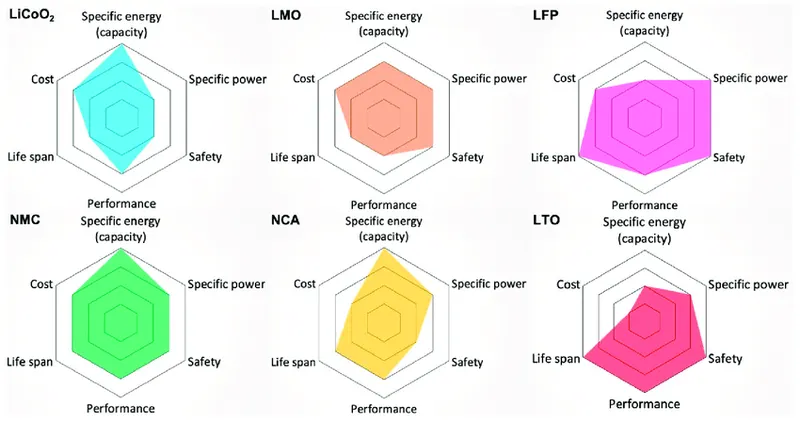
Specific energy: This defines the battery capacity in weight (Wh/kg). The capacity relates to the runtime. Products requiring long runtimes at moderate load are optimized for high specific energy.
Specific power: It's the ability to deliver a high current and indicates loading capability. Batteries for power tools are made for high specific power and come with a reduced specific energy.
A high specific power usually comes with reduced specific energy and vice versa. The pouring of bottled water into a glass is a perfect analogy of the relationship between specific power and specific energy. The water in the bottle can be thought of as specific energy. Pouring the water at a slow rate doesn’t provide enough force (low specific power), but the water lasts longer in the bottle (high specific energy). On the other hand, if we pour the water out at a faster rate, it provides a greater impact (high specific power). However, the water wouldn’t last very long in the bottle ( low specific energy).
Performance: This measures how well the battery works over a wide range of temperatures. Most batteries are sensitive to heat and cold and require climate control. Heat reduces life, and cold lowers performance temporarily.
Lifespan: This reflects cycle life and longevity and is related to factors such as temperature, depth of discharge, and load. Hot climates accelerate capacity loss. Cobalt blended lithium-ion batteries also usually have a graphite anode that limits the cycle life.
Safety: This relates to factors such as the thermal stability of the materials used in the batteries. The materials should have the ability to sustain high temperatures before becoming unstable. Instability can lead to thermal runaway in which flaming gases are vented. Fully charging the battery and keeping it beyond the designated age reduces safety.
Cost: Demand for electric vehicles has generally been lower than anticipated, mainly due to the cost of lithium-ion batteries. Hence cost is a huge factor when selecting the type of lithium-ion battery.
|
Lithium-ion battery Types |
Specific power |
Specific energy |
Safety |
Lifespan |
Cost |
Performance |
|
Lithium Cobalt Oxide |
Low |
High |
Low |
Low |
Low |
Moderate |
|
Lithium Manganese Oxide |
Moderate |
Moderate |
Moderate |
Low |
Low |
Low |
|
Lithium Nickel Manganese Cobalt Oxide |
Moderate |
High |
Moderate |
Moderate |
Low |
Moderate |
|
Lithium Iron Phosphate |
High |
Low |
High |
High |
Low |
Moderate |
|
Lithium Nickel Cobalt Aluminum Oxide |
Moderate |
High |
Low |
Moderate |
Moderate |
Moderate |
|
Lithium Titanate |
Moderate |
Low |
High |
High |
High |
High |
Lithium Cobalt Oxide has high specific energy compared to the other batteries, making it the preferred choice for laptops and mobile phones. It also has a low cost and a moderate performance. However, it is highly unfavorable in all the other aspects when compared to the other lithium-ion batteries. It has low specific power, low safety, and a low lifespan.
Lithium Manganese Oxide has moderate specific power, moderate specific energy, and a moderate level of safety when compared to the other types of lithium-ion batteries. It has the added advantage of a low cost. The downsides are its low performance and low lifespan. It is usually used in medical devices and power tools.
Lithium Nickel Manganese Cobalt Oxide has two major advantages as compared to the other batteries. The first one is its high specific energy, which makes it desirable in electric powertrains, electric vehicles, and electric bikes. The other is its low cost. It is moderate in terms of specific power, safety, lifespan, and performance when compared to the other lithium-ion batteries. It can be optimized to either have high specific power or high specific energy.
Lithium Iron Phosphate only has one major disadvantage when compared to other types of lithium-ion batteries, and that is its low specific energy. Other than that, it has moderate to high ratings in all the other characteristics. It has high specific power, offers a high level of safety, has a high lifespan, and comes at a low cost. The performance of this battery is also moderate. It is often employed in electric motorcycles and other applications that require a long lifespan and a high level of safety.
Lithium Nickel Cobalt Aluminum Oxide offers one strong advantage compared to the five other batteries: high specific energy. It is pretty moderate in the rest of the characteristics like performance, cost, specific power, and lifespan. The only downside to this battery type is its low level of safety. Its high specific energy and moderate lifespan make it a good candidate for electric powertrains.
Lithium Titanate offers high safety, high performance, and a high lifespan which are very important features every battery should have. Its specific energy is low compared to the five other lithium-ion batteries, but it compensates for this with moderate specific power. The only major disadvantage of lithium titanate as compared to the other lithium-ion batteries is its extremely high cost. Another important feature of this battery worthy of mention is its remarkably fast recharge time. It can be used for storing solar energy and creating smart grids.