Week 1 Understanding Different Battery Chemistry
Aim:-Prepare a table which includes materials & chemical reactions occurring at the anode and cathode of LCO, LMO, NCA, NMC, LFP and LTO type of lithium ion cells.Give your detailed explanation on it.
Solution:-
Lithium ion battery chemistry :-
A lithium-ion battery or Li-ion battery is a type of rechargeable battery composed of cells in which lithium ions move from the negative electrode through an electrolyte to the positive electrode during discharge and back when charging. Li-ion cells use an intercalated lithium compound as the material at the positive electrode and typically graphite at the negative electrode. Li-ion batteries have a high energy density, no memory effect (other than LFP cells) and low self-discharge. Cells can be manufactured to prioritize either energy or power density. They can however be a safety hazard since they contain flammable electrolytes and if damaged or incorrectly charged can lead to explosions and fires.
M. Stanley Whittingham discovered the concept of intercalation electrodes in the 1970s, and invented the first rechargeable lithium-ion battery, which was based on a titanium disulfide cathode and a lithium-aluminum anode, patented in 1977, and assigned to Exxon. John Goodenough expanded on this work in 1980 by using lithium cobalt oxide as a cathode. A prototype Li-ion battery was developed by Akira Yoshino in 1985, based on the earlier research by John Goodenough, M. Stanley Whittingham, Rachid Yazami and Koichi Mizushima during the 1970s–1980s, and then a commercial Li-ion battery was developed by a Sony and Asahi Kasei team led by Yoshio Nishi in 1991. Lithium-ion batteries are commonly used for portable electronics and electric vehicles and are growing in popularity for military and aerospace applications.
Chemistry, performance, cost and safety characteristics vary across types of lithium-ion batteries. Handheld electronics mostly use lithium polymer batteries (with a polymer gel as electrolyte), a lithium cobalt oxide (LiCoO
2) cathode material, and a graphite anode, which together offer a high energy density. Lithium iron phosphate (LiFePO
4), lithium manganese oxide (LiMn2O4 spinel, or Li2MnO3-based lithium rich layered materials, LMR-NMC), and lithium nickel manganese cobalt oxide (LiNiMnCoO2 or NMC) may offer longer lives and may have better rate capability. Such batteries are widely used for electric tools, medical equipment, and other roles.
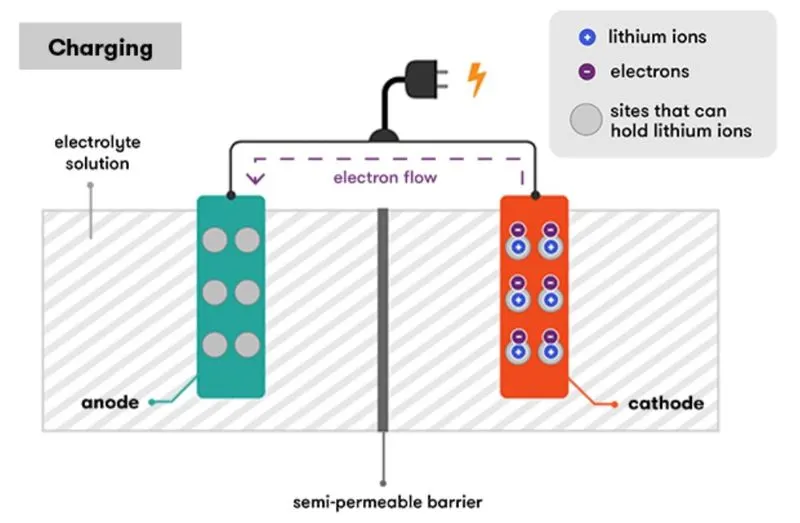
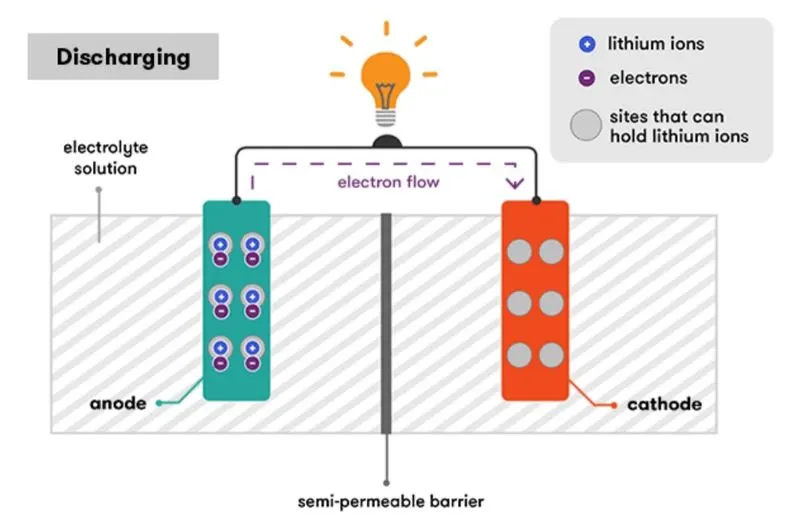
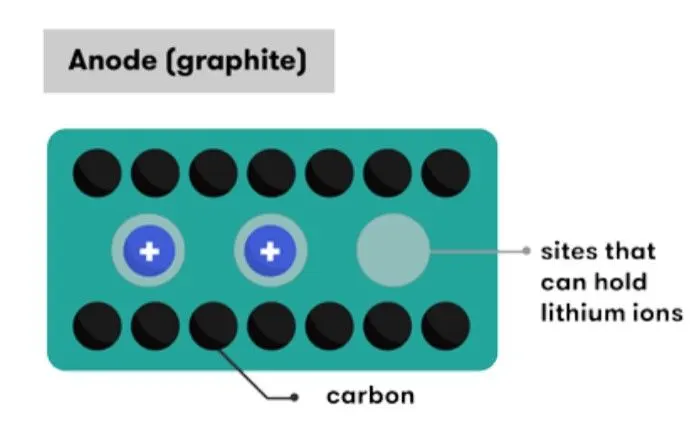
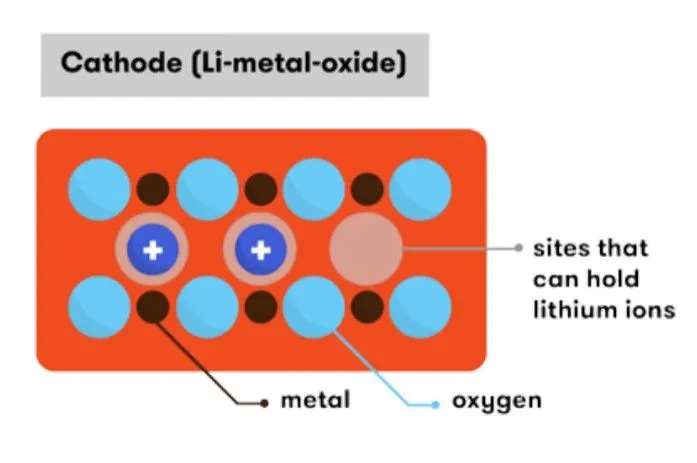
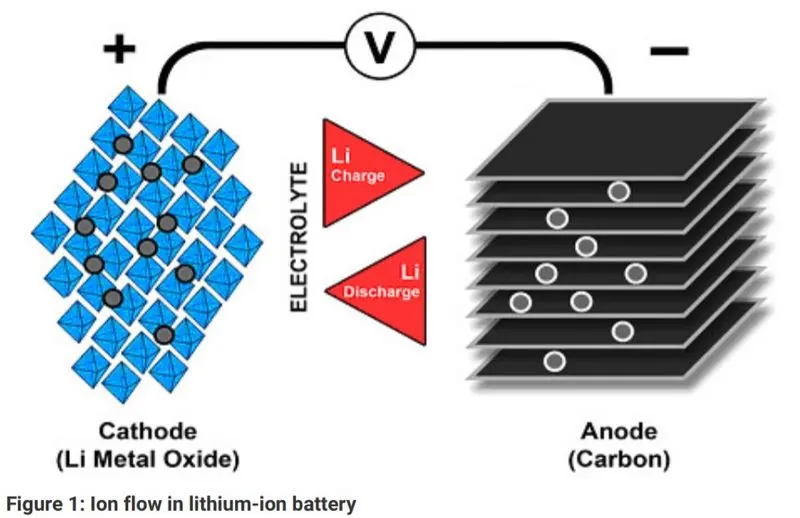
Types of lithium-ions battery
1. Lithium Cobalt Oxides(LicoO2)-LCO:-
Its high specific energy makes Li-cobalt the popular choice for mobile phones, laptops and digital cameras. The battery consists of a cobalt oxide cathode and a graphite carbon anode. The cathode has a layered structure and during discharge, lithium ions move from the anode to the cathode. The flow reverses on charge. The drawback of Li-cobalt is a relatively short life span, low thermal stability and limited load capabilities (specific power). Figure 1 illustrates the structure
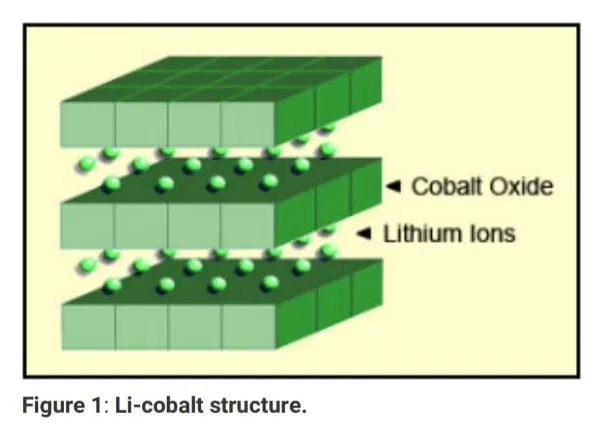
The cathode has a layered structure. During discharge the lithium ions move from the anode to the cathode; on charge the flow is from cathode to anode.
Reaction of LITHIUM COBALT OXIDE BATTERIES :
During Discharge
At the anode, lithium is oxidised.Lithium ions are released from the carbon, along with electrons:
LiC6 → Li+ + e- + C6
At the cathode, lithium-ions are absorbed by the lithium dioxide, and the electrode is reduced as it also receives the electrons from the circuit:
CoO2 + Li+ + e- → LiCO2
The overall reaction is :
LiC6 + CoO2 → C6 + LiCoO2
2. Lithium manganese oxide(Limn2o4)-LMO:-
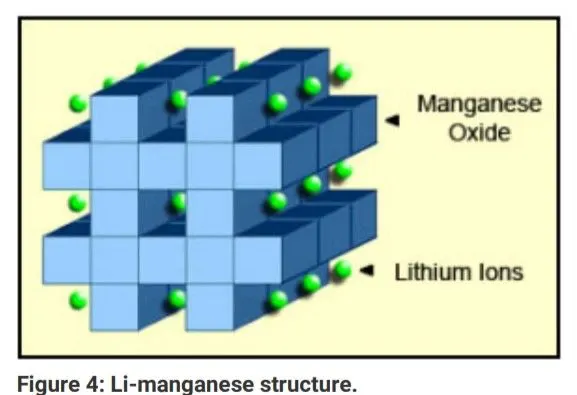
Reaction of Lithium Manganese Oxide BATTERIES :
During Discharge
At the anode, lithium is oxidised.Lithium ions are released from the carbon, along with electrons:
LiC6 → Li+ + e- + C6
At the cathode, lithium-ions are absorbed by the lithium dioxide, and the electrode is reduced as it also receives the electrons from the circuit:
Mn2O4 + Li+ + e- → LiMn2O4
The overall reaction is :
LiC6 + Mn2O4 → C6 + LiMn2O4
3. Lithium Nickel cobalt aluminium(LiNiCoAlO2)-NCA:-
Reaction of Lithium Nickel Cobalt Aluminum Oxide BATTERIES :
During Discharge
At the anode, lithium is oxidised.Lithium ions are released from the carbon, along with electrons:
LiC6 → Li+ + e- + C6
At the cathode, lithium-ions are absorbed by the lithium dioxide, and the electrode is reduced as it also receives the electrons from the circuit:
NiCoAlO2 + Li+ + e- → LiNiCoAlO2
The overall reaction is :
LiC6 + NiCoAlO2 → C6 + LiNiCoAlO2
4. Lithium Nickel manganese cobalt oxide(LiNiMnCoO2)-NMC:-
Reaction of Lithium Manganese Cobalt Oxide BATTERIES :
During Discharge
At the anode, lithium is oxidised.Lithium ions are released from the carbon, along with electrons:
LiC6 → Li+ + e- + C6
At the cathode, lithium-ions are absorbed by the lithium dioxide, and the electrode is reduced as it also receives the electrons from the circuit:
NiMnCoO2 + Li+ + e- → LiNiMnCoO2
The overall reaction is :
LiC6 + NiMnCoO2 → C6 + LiNiMnCoO2
5. Lithium Iron Phosphate(LiFePO4) — LFP:-
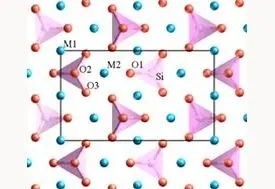
Reaction of Lithium Iron Phosphate BATTERIES :
During Discharge
At the anode, lithium is oxidised.Lithium ions are released from the carbon, along with electrons:
LiC6 → Li+ + e- + C6
At the cathode, lithium-ions are absorbed by the lithium dioxide, and the electrode is reduced as it also receives the electrons from the circuit:
FePO4 + Li+ + e- → LiFePO4
The overall reaction is :
FePO4 + Li+ + e- → LiFePO4
6. Lithium Titanate (Li2TiO3) — LTO:-
Reaction of Lithium Titanate BATTERIES :
During Discharge
At the anode, lithium is oxidised.Lithium ions are released from the carbon, along with electrons:
Li2TiO3 → TiO3 + 2Li+ + 2e-
At the cathode, lithium-ions are absorbed by the lithium dioxide, and the electrode is reduced as it also receives the electrons from the circuit:
Mn2O4 + 2Li+ + 2e- → LiMn2O4
The overall reaction is :
Li2TiO3 + 2Mn2O4 → 2LiMn2O4 + TiO3
Table:-
| Sr.No. | Battery Type | Electrode material | Chemical Reactions |
| 1 | Lithium cobalt oxide-LCO | Cathode: Lithium Cobalt Oxide (LiCoO2) Anode: Graphite |
At anode: LiC6 → Li+ + e- + C6 At cathode: CoO2 + Li+ + e- → LiCO2 Complete: LiC6 + CoO2 → C6 + LiCoO2 |
| 2 |
Lithium Magnese spinel/oxide LMO |
Cathode:Lithium manganese oxide(LiMn2O4) Anode: Graphite |
At anode: LiC6 → Li+ + e- + C6 At cathode: Mn2O4 + Li+ + e- → LiMn2O4 Complete: LiC6 + Mn2O4 → C6 + LiMn2O4 |
| 3 |
Lithium Nickel Cobalt Aluminium NCA |
Cathode:Lithium Nickel Cobalt Aluminum Oxide (LiNiCoAlO2) Anode: Graphite |
At anode: LiC6 → Li+ + e- + C6 At cathode: NiCoAlO2 + Li+ + e- → LiNiCoAlO2 Complete: LiC6 + NiCoAlO2 → C6 + LiNiCoAlO2 |
| 4 |
Lithium Nickel Magnese Cobalt NMC |
Cathode: Lithium Nickel Manganese Cobalt Oxide (LiNiMnCoO2) Anode: Graphite |
At anode: LiC6 → Li+ + e- + C6 At cathode: NiMnCoO2 + Li+ + e- → LiNiMnCoO2 Complete: LiC6 + NiMnCoO2 → C6 + LiNiMnCoO2 |
| 5 |
Lithium Iron phosphate LFP |
Cathode: Lithium Iron Phosphate(LiFePO4) Anode: Graphite |
At anode: LiC6 → Li+ + e- + C6 At cathode: FePO4 + Li+ + e- → LiFePO4 Complete: LiC6 + FePO4 → C6 + LiFePO4 |
| 6 |
Lithium Titanium Oxide LTO |
Cathode: Lithium Manganese oxide (LiMn2O4) Anode: Lithium Titanate (Li2TiO3) |
At anode: Li2TiO3 → TiO3 + 2Li+ + 2e-
At cathode: Mn2O4 + 2Li+ + 2e- → LiMn2O4 Complete: Li2TiO3 + 2Mn2O4 → 2LiMn2O4 + TiO3 |
Li-ion batteries consist of largely four main components: cathode, anode, electrolyte, and separator.
Every single component of a Li-ion battery is essential as it cannot function when one of the components is missing.
“Cathode” determines the capacity and voltage of a Li-ion battery
A Lithium-ion battery generates electricity through chemical reactions of lithium. This is why, of course, lithium is inserted into the battery and that space for lithium is called “cathode”. However, since lithium is unstable in the element form, the combination of lithium and oxygen, lithium oxide is used for cathode. The material that intervenes the electrode reaction of the actual battery just like lithium oxide is called” active material”. In other words, in the cathode of a Li-ion battery, lithium oxide is used as an active material.
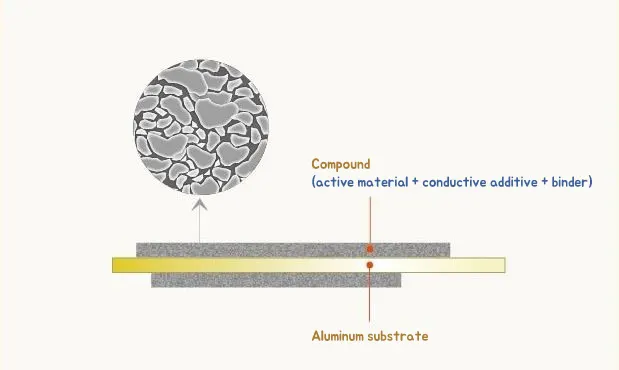
If you take a closer look at the cathode, you will find a thin aluminium foil used to hold the frame of the cathode coated with a compound made up of active material, conductive additive and binder. The active material contains lithium ions, the conductive additive is added to increase conductivity; and the binder acts as an adhesive which helps the active material and the conductive additive to settle well on the aluminium substrate. Cathode plays an important role in determining the characteristics of the battery as the battery’s capacity and voltage are determined by active material type used for cathode. The higher amount of lithium, bigger the capacity; and the bigger potential difference between cathode and anode, higher the voltage. The potential difference is small for anode depending on their type but for cathode, the potential difference is relatively high in general.
As such, the cathode plays a significant role in determining the voltage of the battery.
” Anode” sends electrons through a wire
Just like the cathode, the anode substrate is also coated with active material. The anode’s active material performs the role of enabling electric current to flow through the external circuit while allowing reversible absorption/emission of lithium ions released from the cathode. When the battery is being charged, lithium ions are stored in the anode and not the cathode. At this point, when the conducting wire connects the cathode to the anode (discharge state), lithium ions naturally flow back to the cathode through the electrolyte, and the electrons (e-) separated from lithium ions move along the wire generating electricity. For anode graphite which has a stable structure is used, and the anode substrate is coated with active material, conductive additive and a binder.
Thanks to graphite’s optimal qualities such as structural stability, low electrochemical reactivity, conditions for storing much lithium ions and price, the material is considered suitable to be used for anode.
“Electrolyte” allows the movement of ions only
- Electrolyte is an ionic conductor that porovides the medium for internal ionic cgharge is transfer between the electrodes.
- Liquid solvent containing dissolved chemicals.
- Aqueous electrolyte ,where solvent is water and ionic charge transfer is through either an acid, a base or a salt.
- Lithium ions cells uses non aqueous electrolytes.
”Separator”, the absolute barrier between cathode and anode
- Physically isolated the positive and negative electrodes.
- An ionic conductor but an electronic insulator.
- Prevent internal short circuiting between the two electrodes.
Commercialized separators we have today are synthetic resin such as polyethylene (PE) and polypropylene (PP).
Aim:-Compare the differences between each type of Li+ion batteries based on their characteristics.
| Battery Type | Voltage | Specific energy | C-rate(charge | C-rate(discharge) | Cycle | Thermal runaway |
| LCO | 3.60V nominal; typical operating range 3.0–4.2V/cell | 150–200Wh/kg. Specialty cells provide up to 240Wh/kg | 0.7–1C, charges to 4.20V (most cells); 3h charge typical. Charge current above 1C shortens battery life | 1C; 2.50V cut off. Discharge current above 1C shortens battery life. | 500–1000, related to depth of discharge, load, temperature | 150°C (302°F). Full charge promotes thermal runaway |
| LMO | 3.70V (3.80V) nominal; typical operating range 3.0–4.2V/cell | 100–150Wh/kg | 0.7–1C typical, 3C maximum, charges to 4.20V (most cells) | 1C; 10C possible with some cells, 30C pulse (5s), 2.50V cut-off | 300–700 (related to depth of discharge, temperature) | 250°C (482°F) typical. High charge promotes thermal runaway |
| NCA | 3.60V nominal; typical operating range 3.0–4.2V/cell | 200-260Wh/kg; 300Wh/kg predictable | 0.7C, charges to 4.20V (most cells), 3h charge typical, fast charge possible with some cells | 1C typical; 3.00V cut-off; high discharge rate shortens battery life | 500 (related to depth of discharge, temperature) | 150°C (302°F) typical, High charge promotes thermal runaway |
| NMC | 3.60V, 3.70V nominal; typical operating range 3.0–4.2V/cell, or higher | 150–220Wh/kg | 0.7–1C, charges to 4.20V, some go to 4.30V; 3h charge typical. Charge current above 1C shortens battery life | 1C; 2C possible on some cells; 2.50V cut-off | 1000–2000 (related to depth of discharge, temperature) | 210°C (410°F) typical. High charge promotes thermal runaway |
| LFP | 3.20, 3.30V nominal; typical operating range 2.5–3.65V/cell | 90–120Wh/kg | 1C typical, charges to 3.65V; 3h charge time typical | 1C, 25C on some cells; 40A pulse (2s); 2.50V cut-off (lower that 2V causes damage) | 2000 and higher (related to depth of discharge, temperature) | 270°C (518°F) Very safe battery even if fully charged |
| LTO | 2.40V nominal; typical operating range 1.8–2.85V/cell | 50–80Wh/kg | 1C typical; 5C maximum, charges to 2.85V | 10C possible, 30C 5s pulse; 1.80V cut-off on LCO/LTO | 3,000–7,000 | One of safest Li-ion batteries |