Week 1 Understanding Different Battery Chemistry
UNDERSTANDING DIFFERENT BATTERY CHEMISTRY
OBJECTIVE:
1.Prepare a table which includes materials & chemical reactions occurring at the anode and cathode of LCO, LMO, NCA, NMC, LFP and LTO type of lithium ion cells.Give your detailed explanation on it
2.Compare the differences between each type of Li+ion batteries based on their characteristics
SOLUTION:
Li-ion Cell:
Lithium-ion cells are rechargeable cells, they use lithium as one of the key components in the construction of the cell. The development of Li-ion cells started in the early 70s, and their advancement and potential to catapult the energy storage systems making the adoption of EV’s a reality caused its inventors to win a Nobel Prize in Chemistry in 2019. These are rechargeable cells commonly used in portable electronics to something as large as Discoms for storing energy produced from renewable energy. There is a tremendous amount of research going on in the Li-ion batteries which cause the capacity of battery to increase drastically in the coming future. In the past 3 decades, the cost of battery has decreased by 97% and since the last decade, it has fallen by 88%.
Components of Li-ion Cell
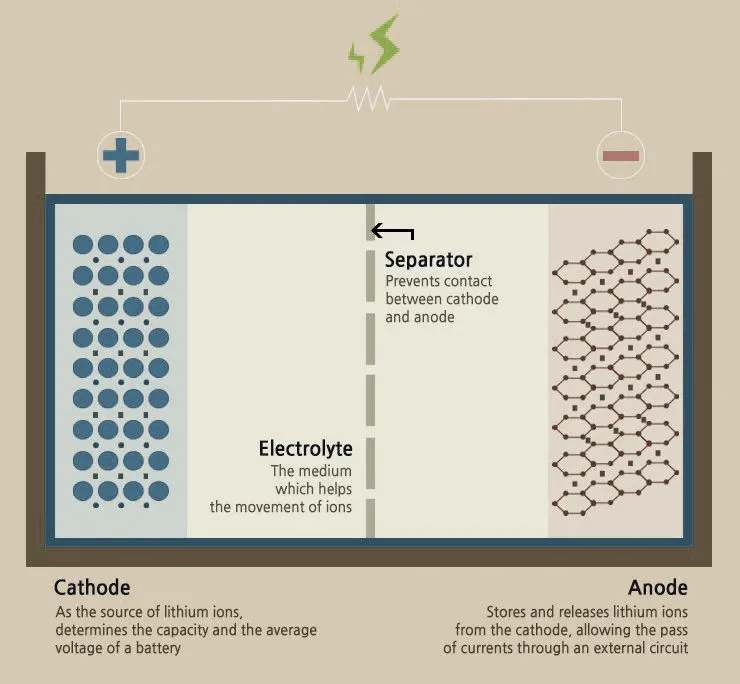
Like any other cell, Li-ion cells are also made up of different components. These internal components help in shaping the features and other characteristics of a Li-ion cell. The Li-ion cell has 4 main components that are Cathode, Anode, Electrolyte, and Separator.
1.Prepare a table which includes materials & chemical reactions occurring at the anode and cathode of LCO, LMO, NCA, NMC, LFP and LTO type of lithium ion cells.Give your detailed explanation on it
| BATTERY CHEMISTRY | ANODE MATERIAL | CATHODE MATERIAL | ELECTROLYTE | ANODE REACTION | CATHODE REACTION | REDOX REACTION |
| LCO Lithium Cobalt Oxide LiCoO2 | graphite anode | Lithium Cobalt Oxide LiCoO2 | LiPF6 in Ethylene Carbonate | LixC6→xLi++xe-+C6 | Li1-xCoO2+xLi++xe-→LiCoO2 | C6+LiCoO2↔LiC6+CoO2 |
| Lithium Manganese Oxide (LiMn2O4) — LMO | graphite anode | LiMn2O4 cathode | LiPF6 in Ethylene Carbonate | LixC6→xLi++xe-+C6 | Li1-xMn2O4+xLi++xe-→LiMn2O4 | C6+LiMn2O4↔LiC6+Mn2O4 |
| Lithium Nickel Manganese Cobalt Oxide (LiNiMnCoO2) — NMC | graphite anode | LiNiMnCoO2. cathode | LiPF6 in Ethylene Carbonate | LixC6→xLi++xe-+C6 | Li1-xNi0.8Mn0.1Co0.1O2+xLi++xe-→LiNi0.8Mn0.1Co0.1O2 | C6+LiNi0.8Mn0.1Co0.1O2↔LiC6+Ni0.8Mn0.1Co0.1O2 |
| Lithium Iron Phosphate(LiFePO4) — LFP | graphite anode | LiFePO4 cathode | LiPF6 in Ethylene Carbonate | LixC6→xLi++xe-+C6 | Li1-xFePO4+xLi++xe-→LiFePO4 | C6+LiFePO4↔LiC6+FePO4 |
| Lithium Nickel Cobalt Aluminum Oxide (LiNiCoAlO2) — NCA | graphite anode | LiNiCoAlO2 cathode (~9% Co) | LiPF6 in Ethylene Carbonate | LixC6→xLi++xe-+C6 | Li1-xNiCoAlO2+xLi++xe-→LiNiCoAlO2 | C6+LiNiCoAlO2↔LiC6+NiCoAlO2 |
| Lithium Titanate (Li2TiO3) — LTO | Li4Ti5O12 (titanate) anode | Cathode can be lithium manganese oxide or NMC | LiPF6 in Ethylene Carbonate | Li4Ti5O12→Ti5O12+4Li++4e- | 4Li1-xMn2O4+4Li++4e-→4LiMn2O4 | Li4Ti5O12+4Mn2O4↔4LiMn2O4+Ti5O12 |
2.Compare the differences between each type of Li+ion batteries based on their characteristics
| BATTERY COMPARISION | |||||||||
| BATTERY CHEMISTRY | ANODE MATERIAL | CATHODE MATERIAL | VOLTAGES | SPECIFIC ENERGY CAPACITY | CHARGE(C-RATE) | DISCHAGE(C-RATE) | CYCLE LIFE | THERMAL RUNAWAY | APPLICATIONS |
| LCO Lithium Cobalt Oxide LiCoO2 | graphite anode | cathode (~60% Co) | 3.60V nominal; typical operating range 3.0–4.2V/cell | 150–200Wh/kg. Specialty cells provide up to 240Wh/kg. | 0.7–1C, charges to 4.20V (most cells); 3h charge typical. Charge current above 1C shortens battery life. | 1C; 2.50V cut off. Discharge current above 1C shortens battery life. | 500–1000, related to depth of discharge, load, temperature | 150°C (302°F). Full charge promotes thermal runaway | Mobile phones, tablets, laptops, cameras |
| Lithium Manganese Oxide (LiMn2O4) — LMO | graphite anode | LiMn2O4 cathode | 3.70V (3.80V) nominal; typical operating range 3.0–4.2V/cell | 100–150Wh/kg | 0.7–1C typical, 3C maximum, charges to 4.20V (most cells) | 1C; 10C possible with some cells, 30C pulse (5s), 2.50V cut-off | 300–700 (related to depth of discharge, temperature) | 250°C (482°F) typical. High charge promotes thermal runaway | Power tools, medical devices, electric powertrains |
| Lithium Nickel Manganese Cobalt Oxide (LiNiMnCoO2) — NMC | graphite anode | LiNiMnCoO2. cathode | 3.60V, 3.70V nominal; typical operating range 3.0–4.2V/cell, or higher | 150–220Wh/kg | 0.7–1C, charges to 4.20V, some go to 4.30V; 3h charge typical. Charge current above 1C shortens battery life. | 1C; 2C possible on some cells; 2.50V cut-off | 1000–2000 (related to depth of discharge, temperature) | 210°C (410°F) typical. High charge promotes thermal runaway | E-bikes, medical devices, EVs, industrial |
| Lithium Iron Phosphate(LiFePO4) — LFP | graphite anode | LiFePO4 cathode | 3.20, 3.30V nominal; typical operating range 2.5–3.65V/cell | 90–120Wh/kg | 1C typical, charges to 3.65V; 3h charge time typical | 1C, 25C on some cells; 40A pulse (2s); 2.50V cut-off (lower that 2V causes damage) | 2000 and higher (related to depth of discharge, temperature) | 270°C (518°F) Very safe battery even if fully charged | Portable and stationary needing high load currents and endurance |
| Lithium Nickel Cobalt Aluminum Oxide (LiNiCoAlO2) — NCA | graphite anode | LiNiCoAlO2 cathode (~9% Co), | 3.60V nominal; typical operating range 3.0–4.2V/cell | 200-260Wh/kg; 300Wh/kg predictable | 0.7C, charges to 4.20V (most cells), 3h charge typical, fast charge possible with some cells | 1C typical; 3.00V cut-off; high discharge rate shortens battery life | 500 (related to depth of discharge, temperature) | 150°C (302°F) typical, High charge promotes thermal runaway | Medical devices, industrial, electric powertrain (Tesla) |
| Lithium Titanate (Li2TiO3) — LTO | Li2TiO3 (titanate) anode | Cathode can be lithium manganese oxide or NMC | 2.40V nominal; typical operating range 1.8–2.85V/cell | 50–80Wh/kg | 1C typical; 5C maximum, charges to 2.85V | 10C possible, 30C 5s pulse; 1.80V cut-off on LCO/LTO | 3,000–7,000 | 200°C + (One of safest Li-ion batteries) | UPS, electric powertrain (Mitsubishi i-MiEV, Honda Fit EV), solar-powered street lighting |
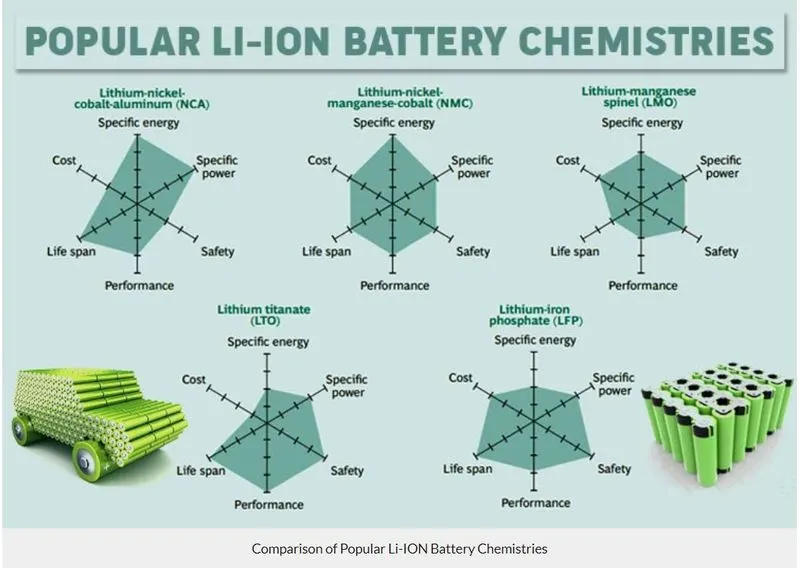
COMPARISION OF DIFFERENT LI ION CHEMISTRIES:
CONCLUSION:
Different types of Li ion batteries and their characteristics are studied and tabulated.