Week 1 Understanding Different Battery Chemistry
Aim : To Study the basis of battery and to understand electrochemistry of different types of Lithium ion cells.
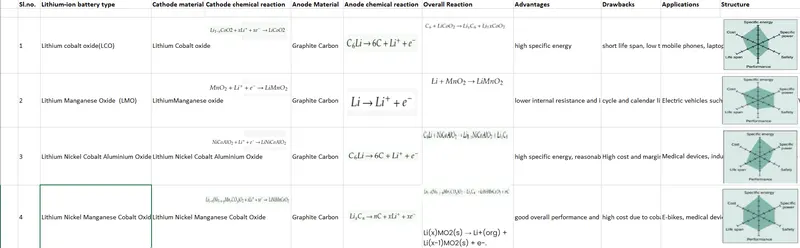
1.Prepare a table which includes materials & chemical reactions occurring at the anode and cathode of LCO, LMO, NCA, NMC, LFP and LTO type of lithium ion cells.Give your detailed explanation on it
2.Compare the differences between each type of Li+ion batteries based on their characteristics.
Soln:
Battery :
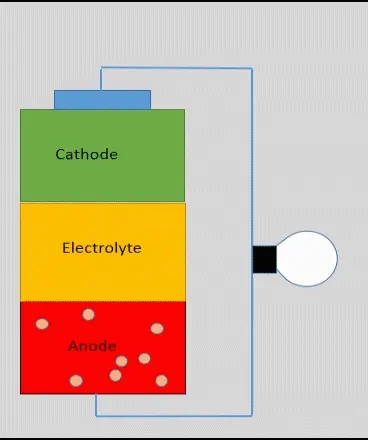
A battery is a device that stores chemical energy and converts it to electrical energy.
It consists of one or more electrochemical cells with external connections for powering electrical devices such as flashlights, mobile phones and electrical cars.
The chemical reactions in a battery involve the flow of electrons from one material(electrode) to another, through an external circuit. The flow of electrons provides an electric current that can be used to do work.
When a battery is connected to an External electric load, a redox reaction convert high-energy reactants to low energy products, and the free energy difference is delivered to external circuit as electrical energy.
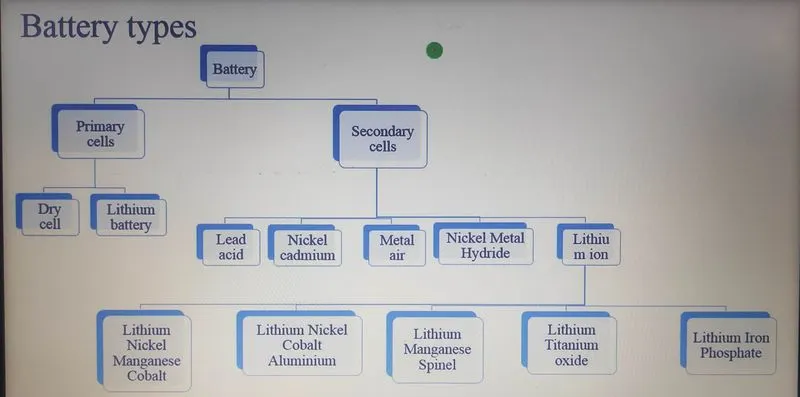
There are 2 types of batteries,
1) Primary cell - This batteries are one time use batteries and they cannot be reached for further usage.Non charageable cells. Ex : dry cell,calculator etc.
2) Secondary cell - This batteries can be recharged and can be used for multiple times. Chargeable cells. Ex : lead cell, Ni-cd cell retc.
Lithium ion cell :
The lithium ion batteries or secondary types of batteries which can be recharged for further usage.
The Lithium ion cells have four main components in it and they are,
(i) Cathode
(ii) Anode
(iii) Electrolyte
(iv) Seperator
(i) Cathode : They are the positive electrodes of the cell. The cathode electrode is made up of,
- Layered Transition metal oxides - Has high capacity but high in cost and poor in safety.
- Spinels - High Power density but poor in conductivity and stabiltiy.
- Olivines - Less capacity but has long life and are high in safety.
(ii) Anode : They are the negative electrodes of the cell. The anode electrode is usually made up of,
- Graphite
- Hard Carbon - These anodes are less in cost and high in stability and specific capacity.
(iii) Electrolyte : An electrolyte is a substance that produces an electrically conduction solution when dissolved in a polar solvent.
The dissolved electrolyte seperates into cations and anions, which disperse uniformly through the solvent.
Generally Lithium ion cells have electrolyte of organic solvents such as, Elthylene carbonate, dimethyl carbonate, propylene carbonate and lithium salt as solute.
(iv) Seperator :
Battery separators provide a barrier between the anode (negative) and the cathode (positive), while enabling the exchange of lithium ions from one side to the other.
They are materials that conducts ions but they do not conduct the electrons through them.
Li-ion cells use polyolefin as a separator. This material has excellent mechanical properties, good chemical stability and is low-cost as well.
Working of Lithiun-ion batteries.
- A battery is made up of an anode, cathode, separator, electrolyte, and two current collectors (positive and negative).
- The anode and cathode store the lithium.
- The electrolyte carries positively charged lithium ions from the anode to the cathode and vice versa through the separator.
- The movement of the lithium ions creates free electrons in the anode which creates a charge at the positive current collector.
- The electrical current then flows from the current collector through a device being powered (cell phone, computer, etc.) to the negative current collector.
- The separator blocks the flow of electrons inside the battery.
Charging and Discharging
- When the cell charges and discharges, ions shuttle between cathode and anode.
- On discharge, the anode undergoes oxidation, or loss of electrons, and the cathode sees a reduction, or a gain of electrons. Charge reverses the movement.
- During discharge, the Lithium ions are de-intercalated from the anode and travel back through the electrolyte to the cathode.
- This also releases the electrons that were tying them to the anode, and these flow through an external wire, providing the electric current that we used to do work.
- It's the connection of the external wire that enables the reaction to proceed- when the electrons are free to travel, so are the positively Lithium ions that wil balance the movement of their negative charge.
- When the cathode becomes full of Lithium ions, the reaction stops, and the battery is flat. Then we recharge our Lithium-ion batteries again, and the external electric charge that we apply pushes the Lithium ions back into the anode from the cathode.
Types of Lithium ion battery :

1) Lithium cobalt oxide - LiCoO2(LCO)
Also known as lithium cobaltate or lithium-ion batteries, Lithium cobalt oxide batteries are made from lithium carbonate and cobalt.
Lithium ion batteries commonly use graphite carbon as their anode material and cobalt oxide as cathode as additional electrode materials.
Lithium ion batteries work by using the transfer of lithium ions and electrons from the
anode to the cathode.
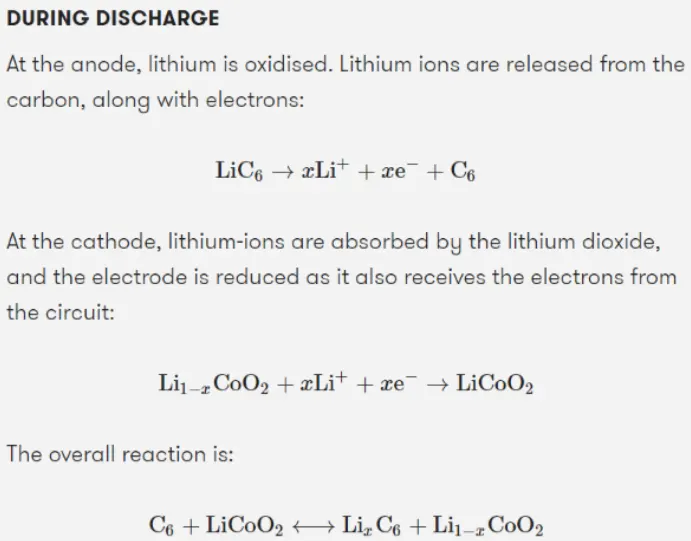
At the anode, neutral Lithium is oxidized and converted to Li+.
These Li+ ions then migrate to the cathode, where they are incorporated into LiCoO2.
This results in the reduction of Co(IV) to Co(III) when the electrons from the anode reaction are received at the cathode. Because lithium is involved in the reactions at both electrodes, the battery can be recharged by running the reactions in reverse.
Chemical reaction :
2) Lithium Manganese Oxide - LiMn2O4 (LMO)
A lithium ion manganese oxide battery (LMO) is a lithium-ion cell that uses manganese dioxide,MnO2, as the cathode material. They function through the same intercalation/de-intercalation mechanism as other commercialized secondary battery technologies, such as LiCoO2. Cathodes based on manganese-oxide components are earth-abundant, inexpensive, non-toxic, and provide better thermal stability.
Spinel LiMn2O4 and Li2Mn2O4
Mn2O4, LiMn2O4, and Li2Mn2O4 have a structure of the spinel type with cubic symmetry. The Li2Mn2O4 structure tends to change easily into the atacamite structure. The spinel structure resembles a three-dimensional system of tube-like voids made from the lattice of manganese and oxygen atoms.
Here lithium is not only easily built into but also transported from one void to the other. So far with respect to the ionic conductivity the manganese structure exceeds the layered structures of the cobalt and nickel oxides. The cathodic discharge reaction (and, by reversal, charge reaction) roughly resembles the following equations:
Chemical reaction :
Mn2O4 + Li → LiMn2O4
and
LixMn2O4 + (1-x)Li → LiMn2O4
LiMn2O4 + Li → Li2Mn2O4
3) Lithium Nickel Cobalt Aluminium Oxide - LiNiCoAlO2 (NCA)
They are composed of lattices of cations of the Lithium, Nickel, Cobalt and Aluminium, where the most important representatives as of this date have the general formula LiNixCoyAlzO2 with x + y + z = 1.
On the positive pole, NCAs are utilized as an active material. When the battery is discharged, the cathode is the positive pole. Cation of the chemical elements like aluminum, cobalt, nickel, and lithium make up NCAs.
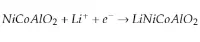
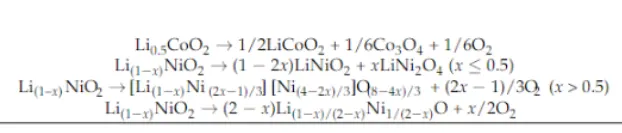
Chemical reactions.
4) Lithium Nickel Manganese Cobalt Oxide - LiMnCoO2 (NMC)
NMC are mixed metal oxides of Lithium, Nickel, Manganese and Cobalt . They have the general formula LiNixMnyCozO2. The most important representatives have a composition with x + y + z that is near 1, with a small amount of lithium on the transition metal site.
Structurally materials in this group are closely related to Lithium Cobalt(III) oxide (LiCoO2) and have a layered structure but possess an ideal charge distribution of Mn(IV), Co(III), and Ni(II) at the 1:1:1 stoichiometry.
The ratio between the three metals is indicated by three numbers. For example, LiNi 0.333Mn0.333Co 0.333O2 is abbreviated to NMC111 or NMC333, LiNi0.5Mn0.3Co0.2O2 to NMC532 (or NCM523), LiNi0.6Mn0.2Co0.2O2 to NMC622 and LiNi0.8Mn0.1Co0.1O2 to NMC811. In view of potential issues with cobalt sourcing, there is interest in increasing the level of nickel, even though this lowers thermal stability.
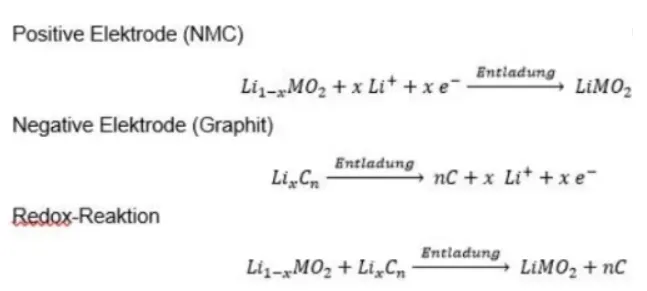
Chemical reaction :

5) Lithium Iron Phosphate - LiFePo4 (LFP)
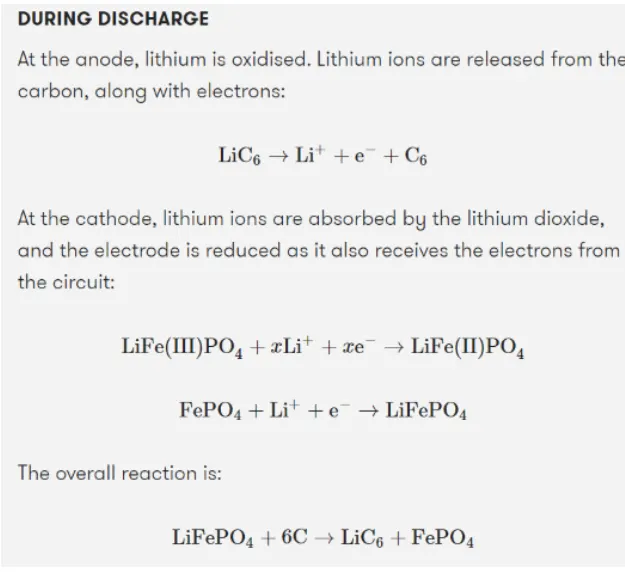
LFP battery (lithium ferrophosphate) is a type of lithium ion battery using lithium iron phosphate (LiFePO4) as the cathode material, and a graphitic carbon electrode with a metallic backing as the anode. The energy density of an LFP battery is lower than that of other common lithium ion battery types such as Nickel Manganese Cobalt (NMC) and Nickel Cobalt Aluminum (NCA), and also has a lower operating voltage.
6) Lithium Titanium Oxide - LiTiO2 (LTO)
Lithium titanates are chemical compunds of lithium, titanium and oxygen. They are mixed oxides and belong to the titanates.
The lithium-titanate or lithium-titanium-oxide (LTO) battery is a type of rechargeable battery which has the advantage of being faster to charge than other lithium-ion batteries but the disadvantage of having a much lower energy density.
A lithium-titanate battery is a modified lithium-ion battery that uses lithium-titanate nanocrystals, instead of carbon, on the surface of its anode.
This gives the anode a surface area of about 100 square meters per gram, compared with 3 square meters per gram for carbon, allowing electrons to enter and leave the anode quickly.
Also, the redox potential of Li+ intercalation into titanium oxides is more positive than that of Li+ intercalation into graphite.
This leads to fast charging (higher charging current) being much safer in the case of the titanate, than in the case of carbon, since lithium dendrites are less likely to form in the former case.
Lithium-titanate cells last for 3000 to 7000 charge cycles. a life cycle of ~1000 cycles before reaching 80% capacity is possible when charged and discharged at 55 °C (131 °F), rather than the standard 25 °C (77 °F).
Chemical reactions :



Conclusion : Study on Lithium-ion cell battery and table on different types of Li-ions and chemical reactions is done sucessfully.