Week 1 Understanding Different Battery Chemistry
Q1.Chemical reactions ocurring at the anode and cathode of differnt types of lithium ion cells
Batteries Defination:
Two or more eletrochemical cells,electrically interconnected,each of ehich contains two electrodes and an electrolyte.The redox(oxidation-reduction) reaction that ocurrs at these converts electrochemical energy into electrical energy.
In 1800,Alessandro volta invented the first modern battery.
Working of Li-ion batteries.
The traditional batteries are based on galvanic action but lithium ion secondary depends on an intercalation mechanism
This involves the insertion of lithium ions the crystalline lattice of the host electrode without charging its crystal structure.
These electrodes have two key properties.one is the open crystal structure which alloes the insertion or ettraction of lithium ions and second is the ability to accept compensating electrons at the same time .such electrode arre called intercalation hosts
The chemical reaction takes places inside the battery as follow

Basically,batteries can be clasified as two types ,primary and secondary batteries.
Primary Batteries:
In parimary batteries ,the electrochemical is not reversible During discharge the chemical compounds are permentally changed and electriacal energy is released untill the orginal compounds are completely exhausted .Thus the cells can be used only once.
Secondary Batteries:
In secondary batteries,the electrochemical reaction is reversible and the orginal chemical compounds can be reconsititued by the application of an electrical potential such cells can be discharged and recharged many times.
Types of lithium based batteries
Therre are two types oflithium based batteries available
1.Lithium batteries
2.Lithium-ion batteries
In lithium batteries a pure lithium metallic element is used as anode these batteries are not rechargeable.
In lithium-ion batteries ,lithium compounds are usedas anode.These batteries are know as re-chargeable batteries.Therfore lithium ion batteries are considered as best than pure lithium based batteries
Lithium cobalt oxide(LiCoO2)-LCO:
Lithium is the third element in the periodic table is a soft,silvery-white alkali metal.
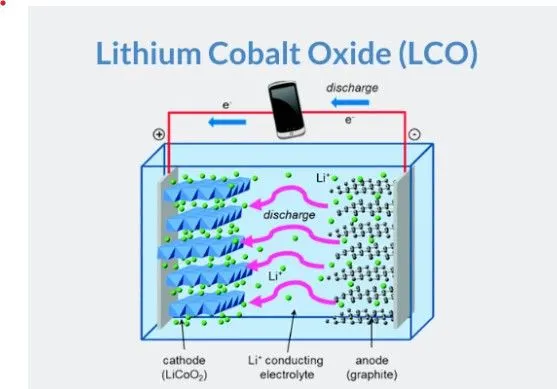
Cobalt oxide based battery further referred as LCO,is mature battery techonology characterizied by long life cyclelifetime and high energy density.Moreover,LCO is the most populr battery techonology used in protable electronic device due its excellent charging/dischaege rate aand high energy density.LCO consists of a cobalt of a cobalt oxide postive electrodes as cathode and graphite carbon as negative electrode as an anode.A typically LCO battery cell raiseat 3.7 V.
However due to concerns with safety and high price of cobalt,LCO batteries are not suitable for automative applications.Another Disadvantage of LCO based batteries is represented by their poor thermal sability.
Lithium Manganese oxide(LiMn2o4)-LMO
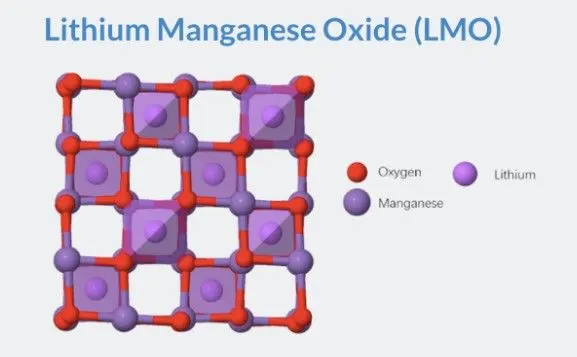
Manganese Oxide(LiMn2O4) based battery ,further referred to as LMO has higher nominal voltage thaan LCO-based batteries,rated between 3.8-4V. On other hands,the energy density of LMO batteries is approxmately 20% less than the ones of LCO batteries.Other important attributies of LMO battery cells are high thermal stability,lower cost and improved safety.However,due to its relatively short cycle life and high capacity losess,the LMO battery cell are not sutaible for electrical vechicles,plug-in electric vechicle nor hybrid plug-in electric vechicle applications.LMO batteries do not have good power nor energy density.
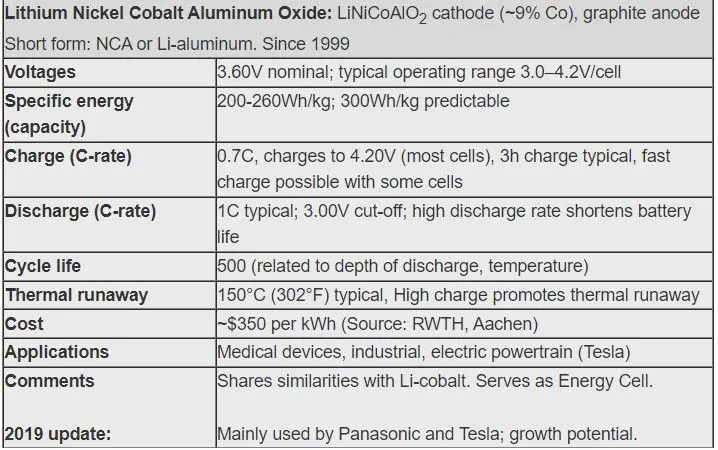
Lithium nickel cobalt aluminum oxide (LiNiCoAlo2)-NCA
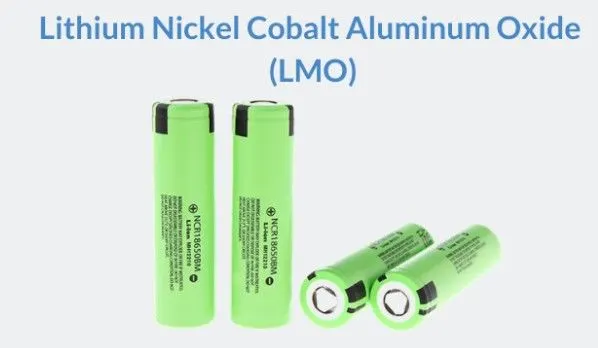
Nickel cobalt alunimum oxide based battery,further referred as NCA has a lower voltage and better safety characteristic,compared with LCO based battery.Futhermore NCA -based batteries perform well in terms of powder density,energyand lifetime.The main drawback of this Li-ion battery chemistry are coming from their reduced safety and high cost.
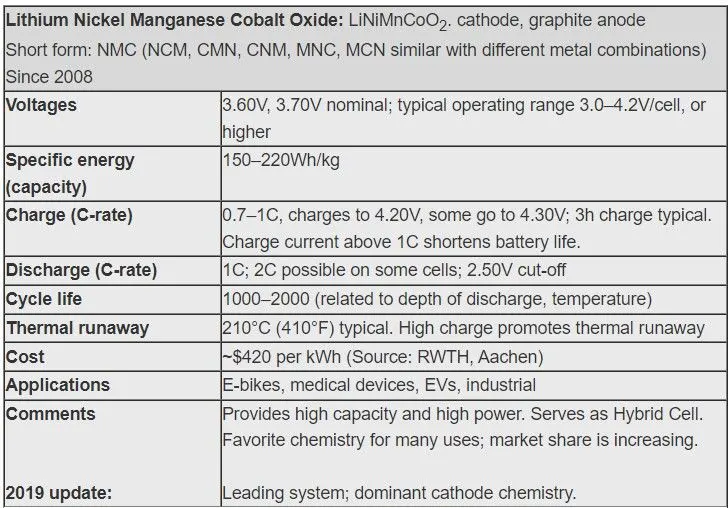
Lithium nickel manganese cobalt Oxide(LiNiMnCoO2)-NMC
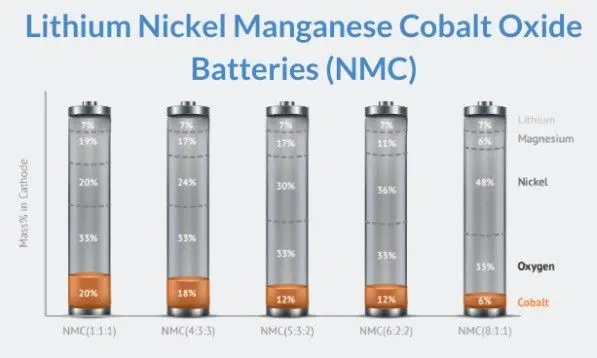
The cathode of lithuim nickel manganese cobalt oxide(NMC) is composed of cobalt,nickeland manganese.The most commonly used NMC composition contains equal ammount of all three transition metels.NMC-based battery cells have a high capacity,good rate capability and can operate at high voltages.
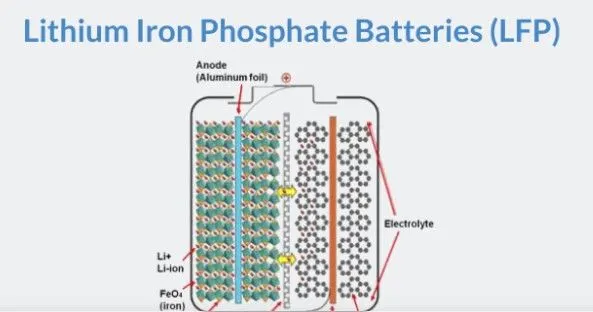
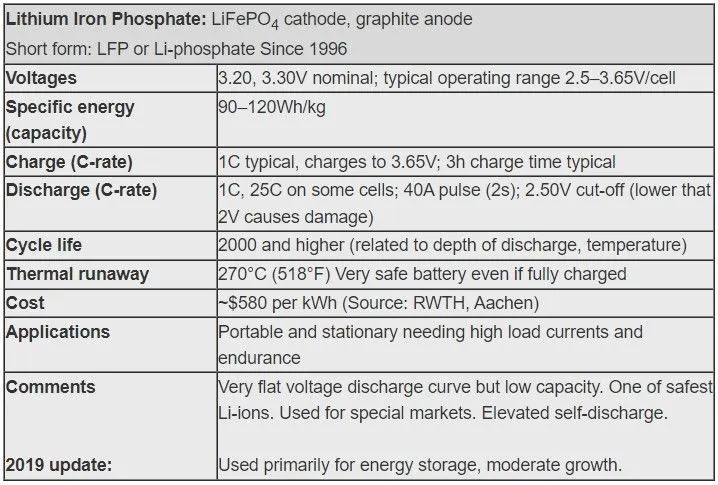
Lithium iron phosphate(LifePo4)-LEP
Iron Phosphate (LiFePo4) based battery, Futher referred to as LEP,repreents extermely attractive battery chemistry,because of its charateristics Such as high capacity ,low cost(Lower than LCO batteries),flat voltage profile,and low enviromental impact.LEP batteries are operating similaar to NCA batteries are considered suitable for being used in statiionary,automative and back-up power applications because their characteristics(ie. high safety,good thermal stability,long lifetime,and low self-discharge rate) are matching the demands of these applications.
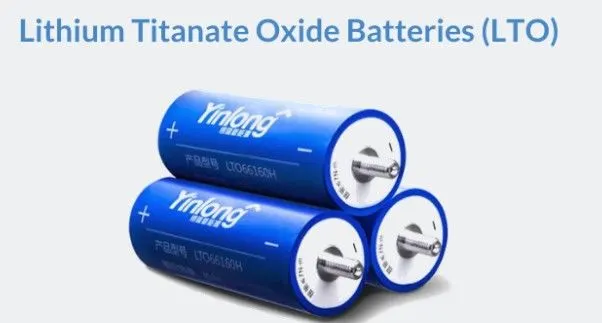
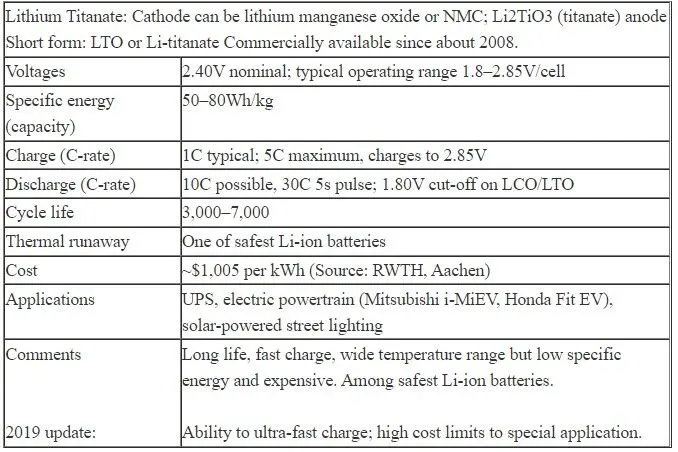
Lithium Titanate (Li2Tio3)-LTO:
Titanate oxide(Li4Ti5O12) based battery,Futher referred as LTO is using lithium titanate nanocrystls on the anode surface,instead of carbon.This fact represents an advantage o LTO battery cell because they can release ions repeatedly for recharging and rapidly high current.LTO has spinel-framework structure and is characterized by a two -phase electochemical process evolving with a relatevely flat voltage stability,but they have a lower voltage level than the other li-ion battery chemistries.However this lower operating Voltage bringa advantage in terms of safety.
The characteristics of LTO include high cycling stability,no electolyte decompostion,and thus no soild electrolyte interface formation,high rate/discharge capability.and high thermal stability in both charge and discharge state.Moreover LTO based batteries can opertate at low tempertures.These characteristice make LTO a promising candidate for their use in stationary and back up power applications
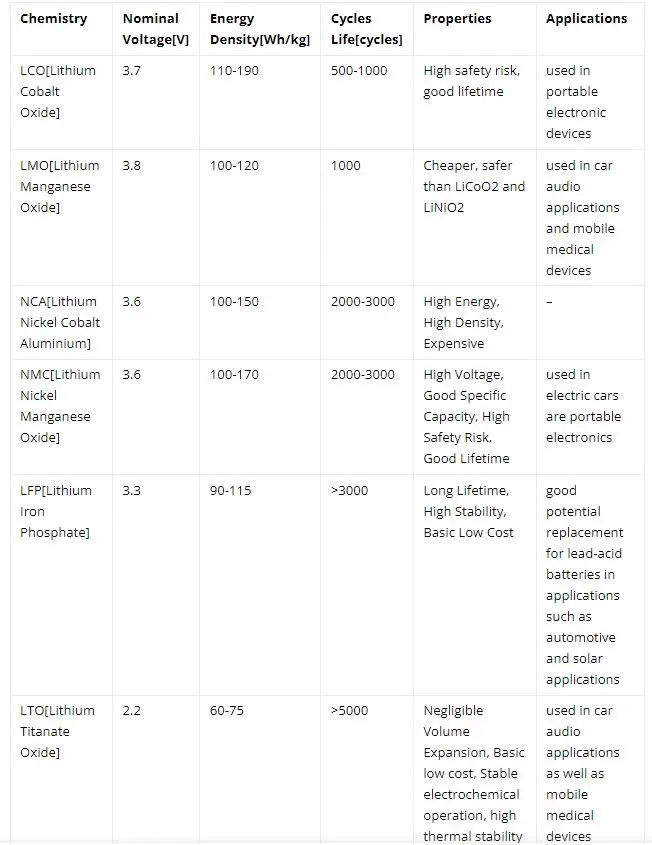
Summary of different Chemistries
Q2. Different types of lithinum-ion battery based on characteristices
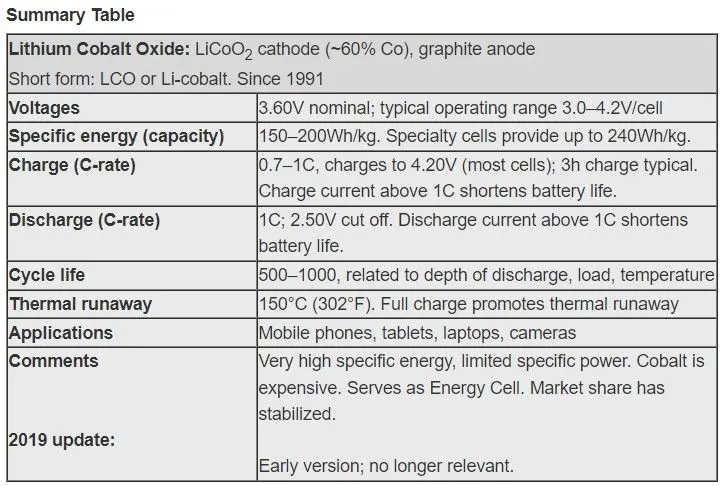
Lithium Cobalt Oxide(LiCoO2)-LCO
Its high Specific energy makes Li-cobalt the popular choice for mobile phone,laptops and digital cameras. The battery consists of a cobalt and a graphite carbon anode. The cathodes are layered structure and during discharge,lithinum ions move from anode to the cathode.This flow reverse on charge .The drawback of Li-cobalt is relatively short life span,low thermal stability and limited load capabilities.
The drawback was Li-cobalt was relatively very short life span,low themal stability and limited capibilities. Like other cobalt-blended Li-ion,Li-cobalt has a graphite anode that limits the cycle life by a changing soild electrolyte inerface(SEI),thickening on the anode and lithium plating while fast charging and charging at loe temperture.Newer systems include nickle,manganese and alunimum to improve lonhevity,loading capabilities and cost.
Li-cobalt should not be charged and discahrged at current higher then its C- rating.This means that an 18650 cell with 24400mAh can be charged and dischargred at 2400mAh.Forcing a fast chargeor applying a loas higher than2400mAh causes overheating and under stress.The mandatory battery protection circuits limits the charger and discharge rate to safe level 1C for the energy cell.
The hexagonal spider garaphic summarizes the performance of Li-cobalt in terms of specific energy or capacity that relates to runtime.Specific power or the ability to deliver high current:safety: performance at hot and cold tempertures:life span reflecting cycle life and longevity and cost
The Li-cobalt is losing favor to Li-manganese but especially NMC and NCA because of high cost of cobalt and improved performance by blending with other cathode materials.
Lithinum Manganese Oxide(LiMn2O4)-LMO
Li-ion with manganese spinel was first published in the material reseach Bulletuin. In 1983 moll Energy commercialized a Li-ion cell with lithium manganese oxide as cathode material.The architecture from a three dimensional spinal structure that improves ion flow on the electrode.which result in lower internal resistance and improved current handling.A futher advantage of spinel is high thermal stability and enhanced safety,but the cycle.
Low internal cell resistance enables fast charging and high-current discharging.it discharged at currents 20-30A with moderate heat buildup.It is also possible to apply one-second pulses of up to 50A.A managenes is a low power tool,medical instruments,as well as hybrid and electrical vechicles.
Most Li-manganese batteries blend with lithinum nickel managanese cobalt oxide(NMC) to improve the specific energy and proiong the life span. This combination brings out the best in each system,and the LMO(NMC) is choose for most electrical vechicles,such as nissan leaf,chevy volt and BMW 13.The LMO part of the battery,which can about 30percent provides high current boost an acceleartion the NMC part gives the long driving range.
These three active materials,as well as the sillicion enhancement can conveniently be choose to enhance the specificy energy,specific power or longetivity.While consumers batteries go for high capacity,industrial applications require battery system that have good loading capabilities,deliver a long and provide safe and dependable sevice.
Lithium Nickel Cobalt alunimum Oxide(LiNiCoAIO2)-NCA
Lithium nickel cobalt alunimum oxide battery or NCA has been around since 1999 for since application.It share similiarites with NMC by offering high Specific energy,resonably good specific power and long life span.Less falttering are safety and cost.NCA is futher development of lithinum nickel oxide;adding alunimum gives the chemistry grater stabitity.
Lithinum Iron Phosphate (LiFePO4)-LFP
In 1996 ,the university of Texas( and other Contributors) discorverd phosphate as cathode material for rechargeable lithinum batteries.Li-phosphate offers goog electrochemical performance with low resistance.This made possible with nano-scale phosphate cathode material.THe key benefits are high current rating and long cyclelife,besides good thermal sability enhanced safety and tolerance if abused.
Li-phosphate is more tolerate to full charge conditions and is less stressed other lithium-ion systems if kept at high voltage for a prolonged time.As a trade off, its lower nominal voltage of 3.2v/cell reduces the specific energy below that of cobalt blended lithinum-ion with most batteries cold temperture redues performances and elevated storage temperture shorttens the services life and Li-phosphate is no expections.Li-phosphate has a higher self discharge than otherLi-ion batteries,which can causes balancing,bothof which increases the cost of the pack.cleanliness in manfacturing is most important for longectivity.There is no tolerance for moisture,lest the battery will only delivery 50 cycles.
With four Li-phosphate cells in series,each tops at 3.65V,which is the correct full-charge voltage.At this point,the charge should be disconnectedb but the toppping charge continues while driving.Li-phosphate is tolerat to some overcharge.However keeping the voltage at 14.40V for a prolonged time,as most vechicles do on a long trip,could stress Li-phosphate.Time will tell how durable Li-Phosphate will be lead and replacement with a regular vechicle charging system.Cold temperture redues performance of Li-ion and this could affect the canking ability in extreme cases.
Lithium Titanate(Li2TiO3)-LTO
Batteries with lithinum titanate anodes have been know since the 1980s.Li-titanate replaces the graphate in the anode of a typical lithium-ion battery and the material forms into a spinel structure.The cathode can be lithinum manganese oxide or NMC .Li-titanate has a nomial cell voltage of 2.40V can be fast charged and delivers a high discharge current of 10C ot 10 times the rated capacity.The cycle count is said to be higher than that of regular Li-ion,Li-titanate is safe,has excellent low temperture discharge characteristics and obtains a capacity of 80 percent at -30 degee celecius.
LTO(commonly Li4Ti5O12) has advantage over conventional cobalt-blended Li-ion with graphite anode by attaininng Zero strain property,no SEI film formation and no lithinum plating when fast charging and charging at low temperture.Thermal stability under high temperture is also better than other Li-ionsystems;Typical uses are electric poertrains UPS and solar poweres streets lighting.
Future Batteries:
Solid-state Li-ion:High specific energy but poor loading and safety.
Lithium-Sulfur: HIgh specific energy but poor cycle life and poor loading.
Lithinum-air: High specific energy but poor loading needs clean air to breath and has short life
Summary
Li-aluminum(NCA) is the clear winner by storing more capacity than systems,this only applies to specific energy.In terms of specific power and thermal stability,Li-manganese(LMO)and Li-phosphate(LFP) are superior.LI-titanate (LTO) may have low capacity but this chemistry outlives most other batteries in term of life spanand also has the best cold temperture performance.Moving towards the electric power train safety and cycle life will again dominance over capacity.