Week 4.1 - Genetic Algorithm
code for genetic algorthim for gobel max :
clear all
close all
clc
x = linspace(0,0.6,150);
y = linspace(0,0.6,150);
numcase = 50;
% creating the stalagmite
[xx yy] = meshgrid(x,y);
for i = 1:length(x)
for j = 1:length(y)
inputvector(1) = xx(i,j );
inputvector(2) = yy(i,j);
f(i,j) = stagalmite(inputvector);
end
end
% study 1
tic
for i = 1:numspace
[res ,fopt(i)] = ga(@stagalmite,2);
xopt(i) = res(1);
yoptc(i) = res(2);
end
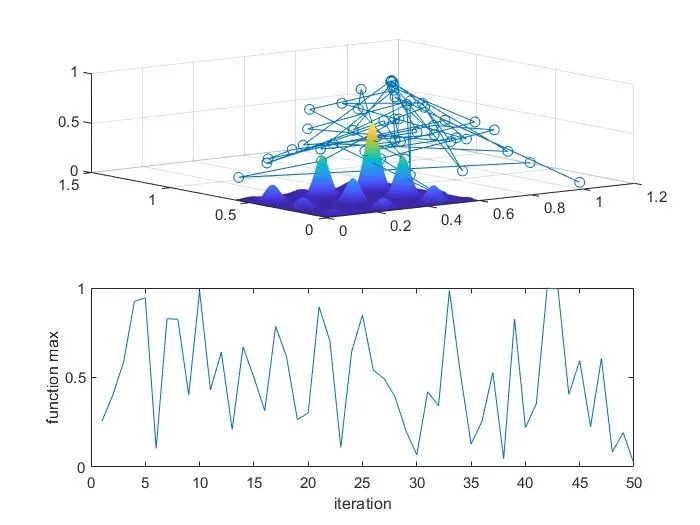
% plot 1
study1time = toc ;
figure(1)
subplot(2,1,1)
surf(xx,yy,-f)
shading interp
hold on
plot3(xopt,yopt,-fopt,marker,'o')
subplot(2,1,2)
xlabel('intertion')
ylabel('functiom max')
% study 2
for i = 1:numspace
[res,fotp(i)] = ga(@stalagmite,2,[],[],[],[],[0.6;0.6]);
xopt(i) = res(1);
yopt(i) = res(2);
end
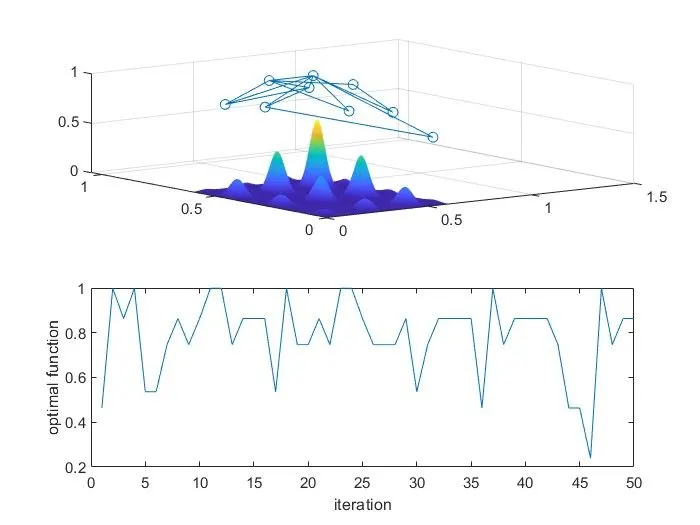
%plot 2
study2time = toc
figure(2)
subplot(2,1,1);
surf(x,y,-f)
shading interp
plot3(xopt,yopt,-fopt,'marker,'0')
subplot(2,1,2)
plot(-fopt)
xlabel('iteration')
ylabel('optimal solution')
% study 3
tic
options = optimoptions('ga')
ooptions = optimoptions(options,'populationsize',250);
tic
for i = 1:numcase
[res,fopt(i)] = ga(@stalagmite,2,[],[],[],[],[0.6;0.6],[],[],,options);
xopt = res(1);
yopt = res(2);
end
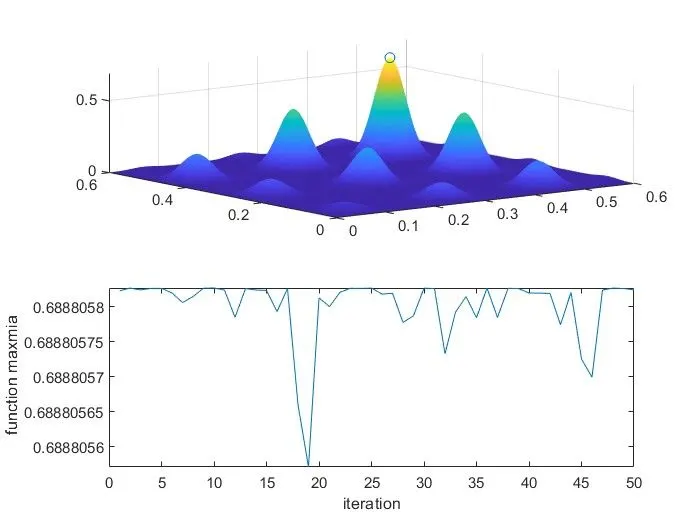
% plot 3
study3time = toc
figure (3)
subplot(2,1,1)
surf(x,y,-f)
shading interp
hold on
plot3(xopt,yopt,-fopt'marker','0',)
subplot(2,1,2)
plot(-fopt)
xlabel('interations')
ylabel('function maxmia')
stalagmite function code:
function A = staglamite(inputvector)
x = inputvector(1);
y = inputvector(2);
f1 =(sin(5.1*pi*x+0.5)).06;
f2 = exp(-4*log(2)*((x-0.667).^2))/0.64);
f3 = (sin(5.1*pi*y+0.5)).^6;
f4 = exp((-4*log(2))*((y-0.667).^2)/0.64);
A= -(f1*f2*f3*f4);
end
Explantation of the code
The genetic algorthim (GA) is a method for solving both constraine and unconstrained optimization problems based on a natural selection process that mimics bilogical evolution.The algorthim repeatdly modifies a population of individual solutions.At each step,the genetic algrothim randomly selectes individuals from the current population and uses them as parents to produces the children for the next generation
The genetic algorthim differs from a classical ,derivative-based,opyimazition algorthim in two ways
a. Classical algorthim
Generates a single point at each iteration the sequenc of points approaches an aoptimal solution.selects the next point in the sequence by a deterministic computation.
b.Genetic algrothim
Generates a population of points at each iteration. the best point in population apporaches an optimal solution. selects the nest population by computation which users random number generators
Outline of the algorthim
The following outline summeries how genetic algorthim works.
1.The algorthim begins by creting a random intial population
2. the algrothim then creates a sequence of new populations.At each steps,the algorthim uses the individuals in the current next population. To crate the new populatiion,the algorthim performs the following steps
a. scales the raw fittness scores to convert them into a more range of valves.
b. selects members,called parents ,based on their expections
c. some of the individuals in the current population that have lower fittness are choose as elite. hese eloite .these elite induluals are passed to the next population.
d.produces childern from the parents .childernare proceduces eithe by makingrandom chages to single parent-mutation-or by cobining the vaectorentries of a pair of parents-crossover.
e.Replaces the curent population with the childern to fromthe next generation.
3. the algorthim stops when one of the stopping ccriteriais met.
4.Thealgorthim takes modified steps for linear and inter constraints.
5.The algorthim is futher modified for non linear constraints.