Project 2 - Rankine cycle Simulator
Explanation of the code:
- satring with clear all and close all and clc commande earse all the previous data.
- After that giving the inputs as mensioned the queation i.e p1,t1and p2
- Ater that extracting the XSteam data file for water properties and temperture and sat vapour condition.
- Withe these inputs inlet and Xsteam data calculate the all points sates if the rankine cycle.
- sf,sg ,hf and hg where f and g stands saturated liquid and satureted vapours.
- The net work and work done by turbine and work done by the pump are calulated using the thermodynamic relations.
- Efficiency and specific steam consuption are calculated.
- T,S and H are extracted at vapour and liquid line for plot.
- saturation curve is plottedfor saturated liquis and saturated gas.
- plot T vs S and h vs s is created from all the points obtained from the program.
- The plots changes are the user inputs changed for the above menstioned inputs.
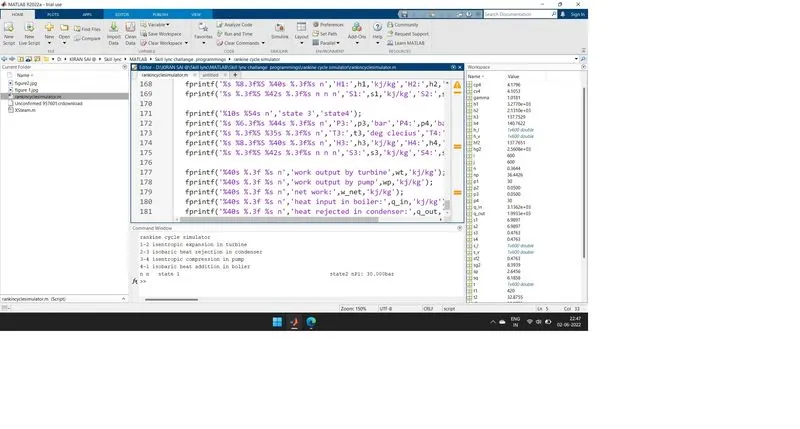
- Results are displayed in the command window
code for the rankine cycle cimulator
clear all
close all
clc
disp('rankine cycl simulator');
disp('1-2 isentropic expansion in turbine');
disp('2-3 isobaric heat rejection in turbine');
disp('3-4 isentropic compression in pump');
disp(('4-1 isobraic heat addition in boiler');
% inputs
% turbine inlet pressure in bar
p1 = 30;
%turbine inlet temperture in degree
t1 = 420;
% condenser pressure in bar
p2 = 0.05;
% inputs of the turbine
s1 = XSteam('s_pT',p1,t1);
h1 = xSteam('h_pT',p1,t1);
% inputs of the condenser
s2 = s1;
t2 = XSteam('Tsat_p',p1);
sf2 = XSteam('sL_pT',p1,t1);
sg2 = XSteam('sV_p',p2);
hf2 = XSteam('hL_p',p2);
hg2 = XSteam('hV_p',p2);
x2 = ((s2-sf2)/(sg2-sf2));
h2 = hf2+(x2*(hg2-hf2));
% exit of the condenser
p3 = p2;
t3 = t2;
s3 = XSteam('sL_T',t3);
h3 = XSteam(h_ps',p3,s3);
% inputs to the boiler
p4 = p1;
s4 = s3;
h4 = XSteam('h_ps',p4,s4);
cp4 =XSteam('cpL_p',p3);
cv4 = XSteam('cvL_p',p3);
gamma = (cp4/cv4);
% to calculate t4
% p4^(1-gamma)*t4^gamma = p3^(1-gamma)*t3^gamma
t4 = (t3*(p3/p4)^((1-gamma)/gamma)));
% calculation
% work done by turbine
wt = h1 - h2;
% work done by the pump
wp = h4 - h3;
% net work done
W_net = wt - wp;
% heat injected in the boiler
q_in = h1 - h4;
% heat rejected in condenser
q_ out = h2 - h3;
% thermal effiency
n = w_net /q_in;
np = n*100;
% plot for liquid and vapour saturation curve
t = linspace (0,550,600);
for i 1: length(t)
s_l(i) = XSteam(sL_T',t(i));
end
for i = 1: length(t)
s_v(i) = xSteam ('sV_T',t(i));
end
plot(s_l,t,'--','color','b')
hold on
plot(s_v,t,'--','color','b')
grid on
% plot for work done y turbine
plot([s1,s2],[t1,t2],'color','r')
hold on
title ('T-S digram is ideal rankine cycle')
xlabel('entropy')
ylabel('temp')
% plot for work done by turbine
plot([s3,s4],[t2,t3],'color','b')
hold on
% plot for heat rejected in condenser
tp =XSteam (Tsat_p',p4);
sp = XSteam('sL_T',tp);
plot([s4,sp],[t4,tp],'color','M')
hold on
tq = tp;
sq = XSteam('sV_T',tq);
plot([sp,sq],[tp,tq],'color','M')
hold on
plot([sq,sp],[tq,t1],'color','M')
hold on
% indicates states with numbers
text(s1,t1,'1');
text(s2,t2,'1');
text(s3,t3,'1');
text(s4,t4,'1');
% plot for enthalpy
figure (2)
plot([s1,s2],[h1,h2],'color','b')
grid on
title('H-S digram is ideal rankine cycle')
xlabel('entropthy')
ylabel('enthalpy')
hold on
plot([s2,s3],[h2,h3],'color','b')
hold on
plot([s3,s4],[h3,h4],'color','g')
hold on
plot([s4,s1],[h4,h1],'color','m')
hold on
% plot for liquid and vapour saturation
t = linspace(0,550,600);
for j = 1: length(t)
h_l(j) = XSteam (hV_T'),t(j));
end
for j = 1: length(t)
h_v(j) = XSteam('hV_t',t(j));
end
plot (s_l,h_l,'--','color','b')
hold on
plot(s_v,h_v,'--','color','b')
text(s1,h1,'1');
text(s2,h2,'1');
text(s3,h3,'1');
text(s4,h4,'1');
% results ouputs
fprintf('n n%10s %54s n','state1','state2');
fprintf('%s %6.3f%s %44s %.3f%s n','P1:',p1,'bar','P2:','p2','bar');
fprintf('%s %.3f%s %35s %.3f%s n','T1:',t1,'deg celecius','T2:',t2,'deg celcuis');
fprint('%s %8.3f%s %40s %.3f%s n','H1:',h1,'kj/kg','H2:',h2,'kj/kg');
fprint ('%s %.3f%s %42s %.3f%s n n n','S1:',s1,'kj/kg','s2:',s2,'kj/kg')
fprintf('%10s %54s n','state3','state4');
fprintf('%s %6.3f%s %44s %.3f%s n','P3:',p3,'bar','P4:','p4','bar');
fprintf('%s %.3f%s %35s %.3f%s n','T3:',t3,'deg celecius','T4:',t4,'deg celcuis');
fprint('%s %8.3f%s %40s %.3f%s n','H3:',h3,'kj/kg','H4:',h4,'kj/kg');
fprint ('%s %.3f%s %42s %.3f%s n n n','S3:',s3,'kj/kg','S4:',s4,'kj/kg')
fprintf('%40s %.3f %s n','work output by turbine',wt,'kj/kg');
fprintf('%40s %.3f %s n','work output by pump',wp,'kj/kg');
fprintf('%40s %.3f %s n','net work:',w_net,'kj/kg);
fprint('%40s %.3f %s n','heat input in bolier:'q_in,'kj/kg');
fprint ('%40s %.3f %s n','heat rejected in condenser:',q_out,'kj/kg');
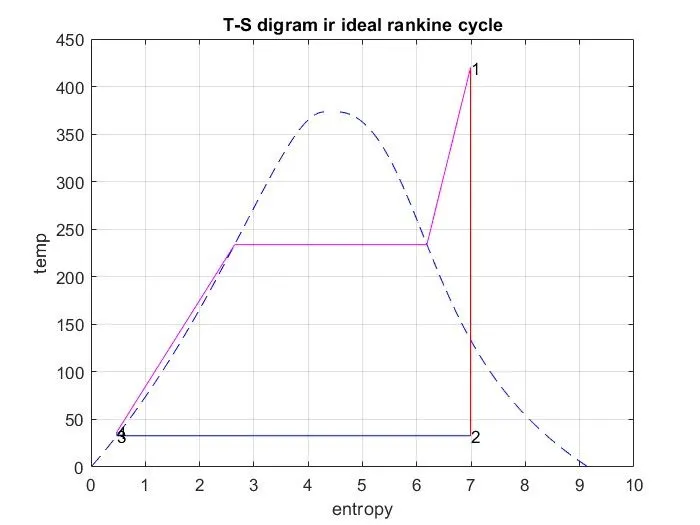
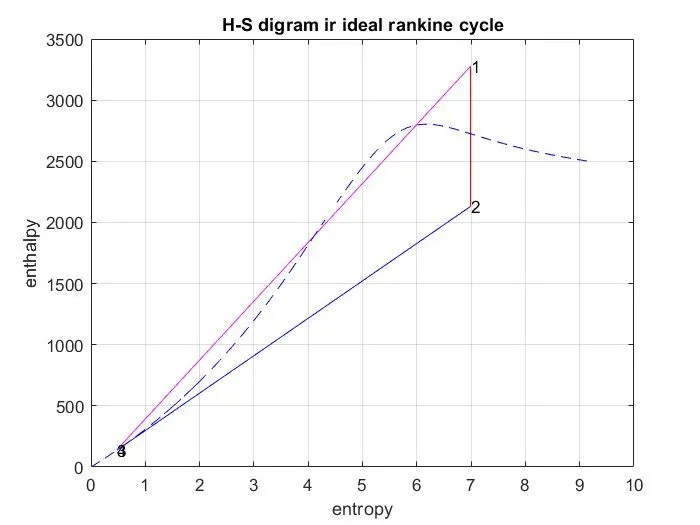
Explanation for working of the rankine cycle:
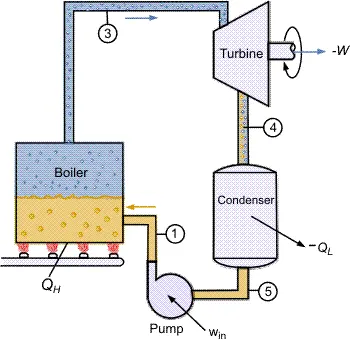
The rankine cycle or rankine vapour cycle is the fundamental operating cycle of all the power palnts where an operating fluids is continuosly evaporated and condensed. The selection of operating fluids depends mainly on the availble temperture ranges
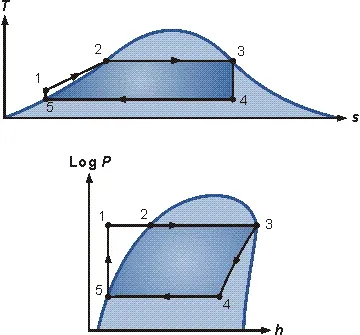
The pressure- enthalpy (p-H) and tenperture and entropy(T-S) diagrams
The rankine cycle operates in the folllowing steps
1-2-3 isobaric transfer : high pressure liquids enters in the bolier from the feed pump and heated to the saturation temperture .The addition of energy cacus evaportion of the liquid until it is fully converted into saturated steam.
3-4 isentropic expansion : The vapour is expand in the turbine ,thus producing work which may be converted to electricity. The expansion is limited by the temperture of the cooling medium and by the erosion of the turbine blades by the liquid entres in the vapour streamas move further into the phases region.
4-5 isobaric heat rejection: The vapour liquid mixture leaving the turbine is condensed at low pressure in the surface condensser using the cooling water and maintened condenser.The pressure of the vapouris well the atmospheric pressure,approching the saturation pressure of the opertaing fluid at the cooling water temperture.
5-1 isentropic compression : The pressure of the condensate is rasied in the feed pump. because of low specific volume of liquid, the pump work iss relectively small often neglected in thernodynamic
Error
some typo errors obtained corrected by checking the spelling corrected all the errors and no errore aobtained
Result of the code