Understanding Different Battery Chemistry
OBJECTIVE-1:
To Prepare a table that includes materials & chemical reactions occurring at the anode and cathode of LCO, LMO, NCA, NMC, LFP, and LTO type of lithium-ion cells.
LITHIUM-ION BATTERY:
Lithium-ion batteries are batteries that function based on the transfer of lithium ions between a cathode and an anode.
Lithium-ion batteries work by using the transfer of lithium ions and electrons from the anode to the cathode. At the anode, neutral lithium is oxidized and converted to Li +. These Li+ ions then migrate to the cathode, where they are incorporated into LiCoO2. This results in the reduction of Co(IV) to Co(III) when the electrons from the anode reaction are received at the cathode. Because lithium is involved in the reactions at both electrodes, the battery can be recharged by running the reactions in reverse
There are two types of lithium-ion cell: primary(single use), secondary(rechargeable)
Types of secondary lithium-ion cells
Lithium cobalt oxide(LCO)
The Lithium cobalt oxide batteries have the chemical compound formula of LiCoO2.These batteries have higher specific energy but cannot be drawn high current than the C rating. It is a little costly because of the availability of cobalt. It has a lower life span.
Lithium manganese oxide(LMO)
These batteries have the chemical formula of LiMn2O4.These LMO batteries have thermal stability and enhanced safety, also support fast charging but the life cycle is limited. Manganese can be combined with nickel for improving the higher specific energy. Some EVs like the Nissan Leaf, Chevy Volt, and BMW i3 uses LMO batteries
Lithium iron phosphate(LFP)
These batteries have the chemical formula of LiFePO4.These batteries have the higher specific power and safety, also Li-phosphate is tolerance to some overcharge
Lithium nickel manganese cobalt oxide(NMC)
These batteries have the chemical formula of LiNiMnCoO2. Nickel is known for its high specific energy but poor stability; manganese has low internal resistance but offers low specific energy. Combining the metals enhances each better specific charge and specific power. Nickel-based systems have a higher energy density, lower cost, and longer cycle life
Lithium nickel cobalt aluminum oxide(NCA)
These batteries have the chemical formula of LiNiCoAlO2. NCA by offering high specific energy, reasonably good specific power, and a long life span but High cost and marginal safety are negatives.
Lithium titanate(LTO)
These batteries have the chemical formula of Li2TiO3. Here Li-titanate replaces the graphite in the anode of a typical lithium-ion battery. The LTO can be fast-charged and delivers a high discharge current of 10C or 10 times the rated capacity. Thermal stability under high temperature is also better than other Li-ion systems
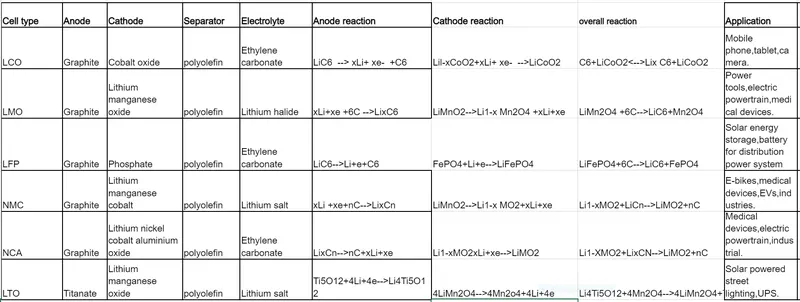
https://drive.google.com/file/d/18rfWrnbciEqkR0-z2-pPGH5CvAFwgISH/view?usp=sharing