Week 1 Understanding Different Battery Chemistry
1. Lithium Ion
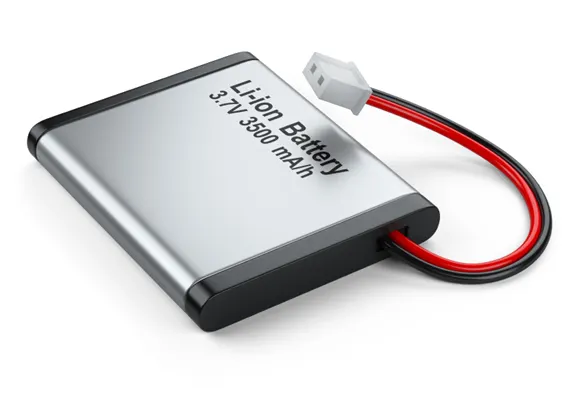
A lithium-ion battery or Li-ion battery is a type of rechargeable battery composed of cells in which lithium ions move from the negative electrode through an electrolyte to the positive electrode during discharge and back when charging. Li-ion cells use an intercalated lithium compound as the material at the positive electrode and normally graphite at the negative electrode. Li-ion batteries have a high energy density, no memory effect (other than LFP cells) and low self-discharge. Cells can be manufactured to prioritize either energy or power density. Lithium ion battery is commonly used for portable electronics and electric vehicles & is growing in popularity for military and aerospace applications.
Design:
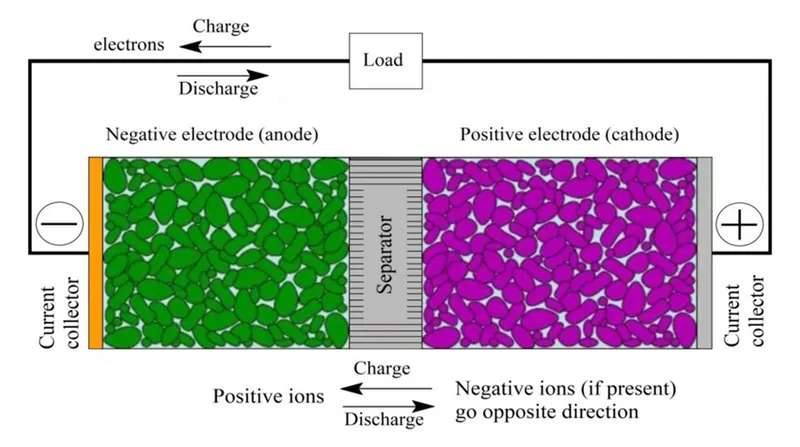
Generally, the negative electrode of a conventional lithium-ion cell is made from carbon. The positive electrode is typically a metal oxide. The electrolyte is a lithium salt in an organic solvent. The electrochemical roles of the electrodes reverse between anode and cathode, depending on the direction of current flow through the cell.
The most common commercially used anode (negative electrode) is graphite, which in its fully lithiated state of LiC6 correlates to a maximal capacity of 1339 C/g (372 mAh/g).
The positive electrode is generally one of three materials: a layered oxide (such as lithium cobalt oxide), a polyanion (such as lithium iron phosphate) or a spinel (such as lithium managanese oxide). More experimental materials include graphene -containing electrodes, although these remain far from commercially viable due to their high cost.
Depending on materials choices, the voltage, energy, density life, and safety of a lithium-ion cell can change dramatically. Current effort has been exploring the use of novel architectures using nanotechnology to improve performance. Areas of interest include nano-scale electrode materials and alternative electrode structures.
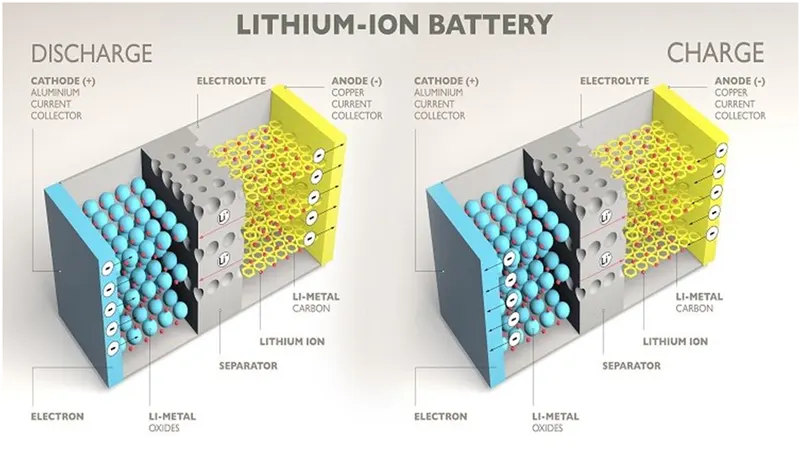
Charging and Discharging:
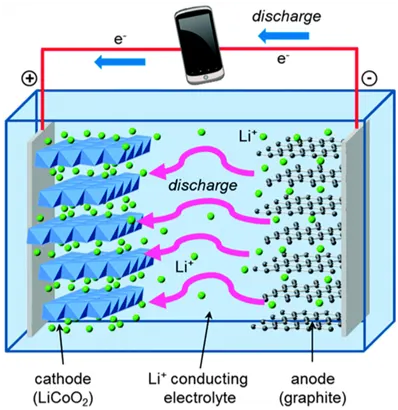
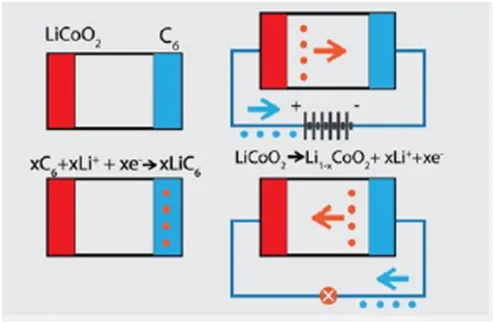
During discharge, lithium ions (Li+) carry the current within the battery cell from the negative to the positive electrode, through the non-aqueous electrolyte and separator diaphragm.
During charging, an external electrical power source (the charging circuit) applies an over-voltage (a higher voltage than the battery produces, of the same polarity), forcing a charging current to flow within each cell from the positive to the negative electrode, i.e., in the reverse direction of a discharge current under normal conditions. The lithium ions then migrate from the positive to the negative electrode, where they become embedded in the porous electrode material in a process known as intercalation.
Energy losses arising from electrical contact resistance at interfaces between electrode layers and at contacts with current collectors can be as high as 20% of the entire energy flow of batteries under typical operating conditions.
The charging procedures for single Li-ion cells, and complete Li-ion batteries, are slightly different.
A single Li-ion cell is charged in two stages:
- Constant current (CC)
- Constant Voltage (CV)
A Li-ion battery (a set of Li-ion cells in series) is charged in three stages:
1.Constant current (CC)
During the constant current phase, the charger applies a constant current to the battery at a steadily increasing voltage, until the voltage limit per cell is reached.
2.Balance (not required once a battery is balanced)
During the balance phase, the charger reduces the charging current (or cycles the charging on and off to reduce the average current) while the state of charge of individual cells is brought to the same level by a balancing circuit, until the battery is balanced. Some fast chargers skip this stage. Some chargers accomplish the balance by charging each cell independently.
3.Constant Voltage (CV)
During the constant voltage phase, the charger applies a voltage equal to the maximum cell voltage times the number of cells in series to the battery, as the current gradually declines towards 0, until the current is below a set threshold of about 3% of initial constant charge current.
Charging temperature limits for Li-ion are stricter than the operating limits. Lithium-ion chemistry performs well at elevated temperatures but prolonged exposure to heat reduces battery life. Li‑ion batteries offer good charging performance at cooler temperatures and may even allow 'fast-charging' within a temperature range of 5 to 45 °C (41 to 113 °F).
Internal Construction:
Electrolyte Cathode & Anode (Positive & Negative)
Positive: Oxide or Sulfide or other compound.
Negative: Metal or Alloys
Cathode:
Cathode materials are generally constructed from LiCoO2 or LiMn2O4. The cobalt-based material develops a pseudo tetrahedral structure that allows for two-dimensional lithium-ion diffusion. The cobalt-based cathodes are ideal due to their high theoretical specific heat capacity, high volumetric capacity, low self-discharge, high discharge voltage, and good cycling performance. Limitations include the high cost of the material, and low thermal stability. The manganese-based materials adopt a cubic crystal lattice system, which allows for three-dimensional lithium-ion diffusion. Manganese cathodes are attractive because manganese is cheaper and because it could theoretically be used to make a more efficient, longer-lasting battery if its limitations could be overcome. Limitations include the tendency for manganese to dissolve into the electrolyte during cycling leading to poor cycling stability for the cathode.
Anode:
Cathode:
Cathode materials are generally constructed from LiCoO2 or LiMn2O4. The cobalt-based material develops a pseudo tetrahedral structure that allows for two-dimensional lithium-ion diffusion. The cobalt-based cathodes are ideal due to their high theoretical specific heat capacity, high volumetric capacity, low self-discharge, high discharge voltage, and good cycling performance. Limitations include the high cost of the material, and low thermal stability. The manganese-based materials adopt a cubic crystal lattice system, which allows for three-dimensional lithium-ion diffusion. Manganese cathodes are attractive because manganese is cheaper and because it could theoretically be used to make a more efficient, longer-lasting battery if its limitations could be overcome. Limitations include the tendency for manganese to dissolve into the electrolyte during cycling leading to poor cycling stability for the cathode.
Anode:
Negative electrode materials are traditionally constructed from graphite and other carbon materials, although newer silicon-based materials are being increasingly used. These materials are used because they are abundant and are electrically conducting and can intercalate lithium ions to store electrical charge with modest volume expression.Graphite is the dominant material because of its low voltage and excellent performance. Various materials have been introduced, but their higher voltage reduces low energy density.
Electrolyte:
Medium that permits ionic conduction between electrodes. Non conductors of electrons. The ions in the electrolyte diffuse because there are small changes in the electrolyte concentration.
Separator:
Insulating layer between electrodes permeable to ions of electrolyte.
Types of Li-ion Batteries:
Lithium Cobalt Oxide (LCO)
Sometimes called lithium cobaltate is a chemical compound with formula LiCoO2. Lithium cobalt oxide is a dark blue or bluish-gray crystalline solid, and is commonly used in the positive electrodes of lithium-ion batteries. Cobalt is the core active material that defines the character of the battery. They are widely used for powering mobile phones, laptops, video cameras, and other modern day electronic gadgets.
Lithium magnesium oxide (LMO)
A lithium ion manganese oxide battery (LMO) is a lithium-ion cell that uses manganese dioxide, MnO2 as the cathode material & Its anode material is LiaC6. Cathodes based on manganese-oxide components are earth-abundant, inexpensive, non-toxic, and provide better thermal stability. These batteries were invented in the year 1996. LMO batteries have the ability to deliver a lot of energy in a short period of time, which makes them extremely useful for use in power tools like drills.
Compounds:
1. Spinel LiMn2O4: Manganese oxide-based cathodes is LiMn2O4 a cation ordered member of the spinel structural family. In addition to containing inexpensive materials, the three-dimensional structure of LiMn2O4 lends itself to high rate capability by providing a well connected framework for the insertion and de-insertion of Li+ ions during discharge and charge of the battery.
2. Layered Li2MnO3: Li2MnO3 is a Lithium rich layered rock salt structure that is made of alternating layers of lithium ions and lithium and manganese ions in a 1:2 ratio, similar to the layered structure of LiCoO2.
3. Layered LiMnO2: The layered manganese oxide LiMnO2 is constructed from corrugated layers of manganese/oxide octahedral and is electrochemically unstable.
4. Layered Li2MnO2: The layered manganese oxide Li2MnO2 is structurally related to Li2MnO3 and LiCoO2 with similar transition metal oxide layers separated by a layer containing two lithium cations occupying the available two tetrahedral sites in the lattice rather the one octahedral site. The material is typically made by low voltage lithiation of the parent compound, direct lithiation using liquid ammonia, or via use of an organic lithiating reagent.
Lithium nickel cobalt aluminum oxide (NCA)
The lithium nickel cobalt aluminum oxides (NCAs) are a group of mixed metal oxides. Some of them are important due to their application in lithium ion batteries. NCAs are used as active material on the positive pole (which is the cathode when the battery is discharged). Its anode material is LiaC6, the cathode material is LibNi0.8Co0.15Al0.05O2 and the carrier is Li+. It is used in different applications like power grid applications, medical devices, and electric cars. NCA batteries can store the same amount of energy as NMC. NCA batteries are not widely common in the consumer industry but are quite promising in the electric car industry.
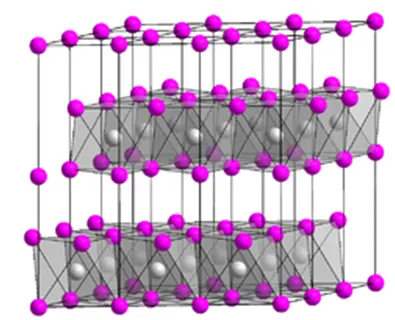
fig : Lithium nickel cobalt aluminum oxide
Nickel Manganese Cobalt Oxide (NMC)
Lithium nickel manganese cobalt oxides (abbreviated Li-NMC, LNMC, NMC or NCM) are mixed metal oxides of lithium, nickel, manganese and cobalt. They have the general formula LiNixMnyCozO2. The NMC systems can serve as a Power Cell or an Energy Cell. NMCs are among the most important storage materials for lithium ions in lithium ion batteries. They are used on the positive side, which acts as the cathode during discharge. NMC batteries are found in most electric cars. NMC batteries were installed in the BMW ActiveE in 2011/2011, and from 2013 in the BMW i8. Electric cars with NMC batteries include, as of 2020: Audi e-tron GE, BAIC EU5 R550, BMW i3, BYD Yuan EV535, Chevrolet Bolt, Hyundai Kona Electric, Jaguar I-Pace, Jiangling Motors JMC E200L, NIO ES6, Nissan Leaf S Plus, Renault ZOE, Roewe Ei5, VW e-Golf and VW ID.3. There are only a few electric car manufacturers that do not use NMC in their traction batteries. The most important exception is Telsa, as Telsa uses NCA batteries for its vehicles.
Lithium iron phosphate (LFP)
Lithium iron phosphate (or) Lithium ferrophosphate (LiFePO4) is a type of Lithium iron battery using Lithium iron phosphate (LiFePO4) as the cathode material, and a graphitic carbon electrode with a metallic backing as the anode. The energy density of an LFP battery is lower than that of other common lithium ion battery types such as Nickel Manganese Cobalt (NMC) and Nickel Cobalt Aluminum (NCA), and also has a lower operating voltage. The LFP battery uses a lithium-ion-derived chemistry and shares some advantages
More abundant constituents with lower human and environmental impact LFP contain neither nickel nor cobalt both of which are supply-constrained and expensive. As with lithium, human rights and environmental concerns have been raised concerning the use of cobalt. Environmental concerns have also been raised regarding the extraction of nickel. LFP are safety, LFP have lower energy density,LFP are viable alternative to lead acid batteries,LFP are Home energy storages.
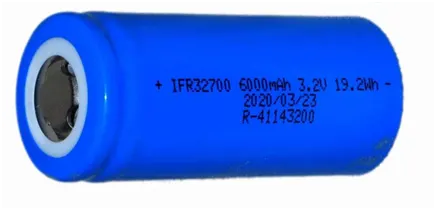
fig: LFP battery
Lithium titanate Oxide (LTO)
The lithium-titanate or lithium-titanium-oxide (LTO) battery is a type of rechargeable battery which has the advantage of being faster to charge than other lithium ion batteries but the disadvantage of having a much lower energy density. Titanate batteries are used in certain Japanese-only versions of Mitsubishi’s i-MiEV electric vehicles as well as Honda’s EV-neo electric bike and Fit EV. They are also used in the Tosa concept electric bus. Lithium-titanate cells last for 3000 to 7000 charge cycles, a life cycle of ~1000 cycles before reaching 80% capacity is possible when charged and discharged at 55 °C (131 °F), rather than the standard 25 °C (77 °F). As Lithium Titanate batteries are entirely free of carbon, they avoid thermal runaway or overheating which is a main cause of fires in traditional energy storage systems. Without the risk of fires or explosions, Lithium Titanate technology allows for safe, user-friendly and low risk energy storage in any applications. Because of the battery's high level of safety and recharge capabilities, LTO batteries are used in car audio applications as well as mobile medical devices.
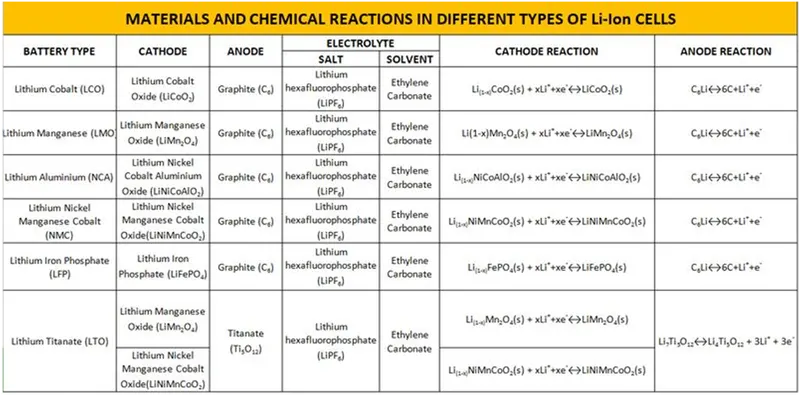
2.Materials & chemical reactions occur at the anode and cathode of LCO, LMO, NCA, NMC, LFP, and LTO type of lithium-ion cells:
Six types of lithium ion batteries are compared relative to one another:
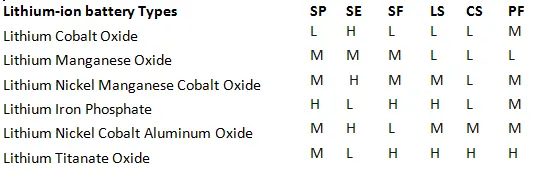
Where, L = Low, M = Moderate, H = High,SP = Specific power, SE = Specific energy, SF = Safety, LS = Lifespan, CS = cost, PF = Performance