Week 1 Understanding Different Battery Chemistry
(1). Student Of EV Online BAtch 16
Construction And Working of Li-ion battery:
>A li-ion battery is said to be a collection of several li-ion cells in series and parellel connection.
>The anode of the battery has the negative terminal, while cathode carrys positive terminal.
>Seprator plates are used in between the anode and cathode terminals to avoid the physical contact between the anode and the cathode.
>Electrolyte solution is a medium that permits ionic conduction between electrodes.
>When there is current flow between the electrodes, the lithium ions are released by the cathode and recieved by anode.
>This shows that the elctron flow is from anode to cathode.
>This process is happens at every cell of the battery pack and have the phenomenon of charging and discharging.
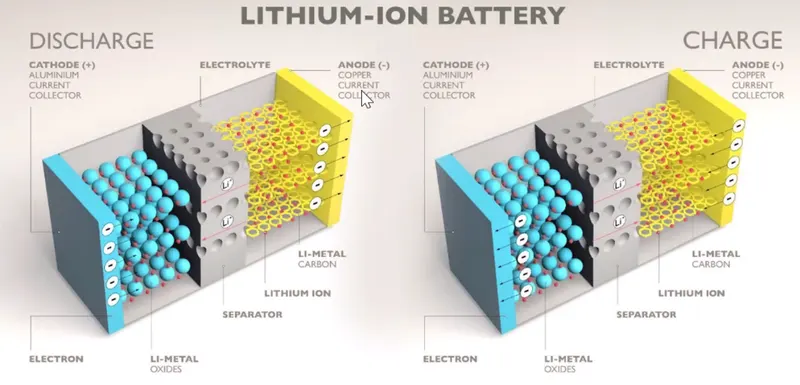
>The lithium ion battery have different types of compostion, their chemical reactions at anode and cathode are as follows:
Lithium Cobalt Oxide (LCO):LicoO2
Anode:
LiC6 > C6 + (Li^+) + (e^-)
Cathode:
CoO2 + (Li^) + (e^-) > LicoO2
Full Reaction:
LicoO2 + C6 > LiC6 + CoO2
Lithium Manganese Oxide (LMO): LiMn2O4
Anode:
LiC6 > C6 + (Li^+) + (e^-)
Cathode:
MnO2 + (Li^+) + (e^-) > LiMnO2
Full Reaction:
LiMnO2 + C6 > LiC6 +MnO2
Lithium NIckel Cobalt Aluminium Oxide (NCA): LiNiCoAlO2)
Anode:
LIC6 > C6 + (Li^+) +(e^-)
Cathode:
NiCoAlO2 + (Li^+) +(e^-) > LiNiCoAlO2
Full Reaction:
C6Li + NiCoAlO2 > LiCoAlO2 + C6
Lithium Nickel Manganese Cobalt Oxide (NMC): LiNiMnCoO2
Anode:
LiC6 > C6 + (Li^+) + (e^-)
Cathode:
NiMnCoO2 + (Li^+) +(e^-) > LiNiMnCoO2
Full Reation:
LiC6 + NiMnCoO2 > LiNiMnCoO2 +C6
Lithium Iron Phosphate (LFP): LiFePO4
Anode:
LiC6 > C6 + (Li^+) + (e^-)
Cathode:
FePo4 + (Li^+) + (e^-) > LiFePO4
Full Reacton:
LiC6 + FePO4 > LiFePO4 +C6
Lithium Titanium Oxide (LTO): LiTiO3
Anode:
Li2TiO3 > TiO2 + (Li^+) + (e^-)
Cathode:
Mn2O4 + Li + (e^-) > LiMn2O4
Full Reaction:
Li2TiO3 + 2Mn2O4 > 2LiMn2O4 + TiO3
Table For all Types Of Lithium Ion Battery:
| Reaction Type | LCO | LMO | NCA | NMC | LFP | LTO |
| Anode | Graphite | Graphite | Graphite | Graphite | Graphite |
Mangenese Oxide |
| Cathode | Lithium Cobalt Oxide | Lithium Mangenese Oxide | Lithium NIckel Cobalt Oxide | Lithium Nickel Manganese CObalt Oxide | Lithium Iron Phospate | Lithium Titanium Oxide |
| Electrolyte | Ethylene Carbonate + Li Salt | Methyle Carbonate + Li Salt | Propylene Carbonate + Li Salt | Methyle Carbonate + Li Salt | Propylene Carbonate + Li Salt | Propylene Carbonate + Li Salt |
| Seperators | Polyolefin | Polyolefin | Polyolefin | Polyolefin | Polyolefin | Polyolefin |
| Nominal Voltage | 3.6V | 3.7V | 3.6V | 3.6 to 3.7V | 3.2 to 3.3 V | 2.4BV |
| Applications | Mobiles, Laptops, Cameras | Power Tools Mechanical Devices, Power train | Electrical powertrains, medical devices, industrial useage | E-bikes, Electric Vehicles, medical devices, industrial useage | High Load current and endurance requirements |
ELectric Powers, UPS, Solar power, Street light, Industrial lights. |
(2) The difference between each type of Lithium Ion Battery based on thier cahrchterstics:
| Bttery Type | Cost | Life Span | Safety | Voltage | Cell Performance | Specific Enegy | Specific Power |
| LCO | low | low | low | 3.6 to 4.2V | high | high | low |
| LMO | low | low | reasonable | 3.0 to 4,2V | low | reasonable | reasonable |
| NMC | low | high | good | 3.0 to 4,3V or Higher | good | high | good |
| LFP | low | high | high | 2.5 to 3.65V | good | low | high |
| NCA | high | good | low | 3.0 to 4.2V | good | high | good |
| LTO | high | high | high | 1.8 to 2.85V | high | low | good |
>Thus this table shows the variations in different charcterstics in each of the Lithium Ion Battry.