Week 1 Understanding Different Battery Chemistry
1. Basic information about battery and its composition:
- A battery is composed of large number of cells either connected in series or parallel.
- And a cell is made up of four major components: Electrodes (Anode and Cathode), Current collector, Electrolyte and Separator.
- A battery is used to stored electrical energy in form of chemical energy, the energy conversion is bidirectional, when any external circuit is connected to battery chemical energy is converted into electrical energy and while charging the reverse process is occuring.
- Anode is considered as negative electrode and Cathode is positive electrode, electrons can not enter into them they only flow in external circuit.
- Battery is filled up with an aquous electrolyte or solid state electrolyte, and ions are taking part in current flow.
- In lithium ion cell . copper foils is used with anode as an negative electrode current collector and aluminium foils is used as positive electrode current collector.
- When battery discharges, Negative electrode release electrons and get oxidized and while charging negative electrode accept electrons and get reduced, this reaction combiningly known as Redox reaction.
Table for materials used in all Lithium ion cells like anode , cathode with their corresponding chemical reactions and electrolyte is Shown below.
| S.No. | Battery_Name | Anode(Negative) | Cathode(positive) | Electrolyte | Chemical Reaction(Bidirectional) |
| 1 | LCO |
Graphite LiC6 ⇋ C6+Li(+) +e- |
LiCoO2 CaO2+Li(+)+e- ⇋ LiCaO2 |
Lithium Salt | LiC6+CoO2 ⇋ C6+LiCoO2 |
| 2 | LMO |
Graphite LiC6 ⇋ C6+Li(+) +e- |
LiMn2O4(Spinel) 2MnO2+Li(+)+e- ⇋ LiMn2O4 |
Poly(vinylidene fluoride-co-hexafluoropropylene) with 1000 mole/m3 LiPF6 in 1:2 EC: DMC |
Li(n)C6+Li(m-n)Mn2O4 ⇋ Li0C6+Li(m)Mn2O4 |
| 3 | NCA |
Graphite LiC6 ⇋ C6+Li(+) +e- |
LiNiCoAlO2 NiCoAlO2+Li(+)+e- ⇋ LiNiCoAlO2 |
1 M liPF6 Ec/DMC |
Li(n)C6+Li(m-n)Ni(x)Co(y)Al(z)O2 ⇋ Li0C6+Li(m)Ni(x)Co(y)Al(z)O2 |
| 4 | NMC |
Graphite LiC6 ⇋ C6+Li(+) +e- |
LiNiMnCoO2 NiMnCoO2+Li(+)+e- ⇋ LiNiMnCoO2 |
Lithium Salt |
Li(n)C6+Li(m-n)Ni(x)Mn(y)Co(z)O2 ⇋ Li0C6+Li(m)Ni(x)Mn(y)Co(z)O2 |
| 5 | LFP |
Graphite LiC6 ⇋ C6+Li(+) +e- |
LiFePO4 FePO4+Li(+)+e- ⇋ LiFePO4
|
Lithium Salt | LiC6+FePO4 ⇋ C6+LiFePO4 |
| 6 | LTO | Lithium Titanate(Li2TiO3) |
LiMn2O4/LiNiMnCoO2 4Mn2PO4+4Li(+)+4e- ⇋ 4LiMnPO24 |
Lithium Salt |
4Mn2O4+ Li4Ti5O12 ⇋ 4LiMn2O4+Ti4O12 |
- Nowadays automotive industries are on the cutting edge of autonomous Vehicle development. EV,HEV PHEV and BEV are evolving just because of improvement in battery technologies.
- In old days batteries was not that much efficient for propulsion and also can not be reacharged once dead but With some chemicals like Lithium made it far much better that's why today we are witnessing the EV running on road.
- Tesla ,one of the most successful EV makers till date is using NCA and LTO batterypack in their pure EV vehicles.
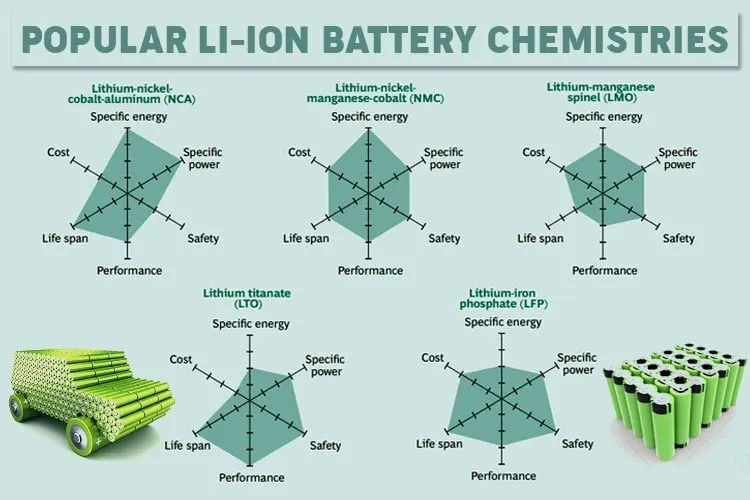
- An image is given below showing the battery chemistry.
- The Dark shade covering more Steps better the performance.
- We can see that the NMC chemistry is best in every aspects , it has high specific energy and rest of all the porperties are sufficient.
- LTO and LFP are best from the safety point of view and also have greater life span but compromised with cost and specific energy.
- The battery users can choose any chemistry according to their requirement by looking at these spider Graphics.
2. Type of Li+ion batteries based on their characteristics:
- Battery comparison can be done on the basis of different parameters like nominal voltage, specific energy , specific power, life cylce, safety and so on.
- Mainly there are six types of Li+ ion batteries, we will see the properties of each one by one then prepare a chart for the ease of comparison.
i). LITHIUM COBALT OXIDE (LCO):
- It has high Specific energy but specific power is not that good which results into low charge and discharge rate.
- Nominal voltage is 3.6V per cell and operating voltage is 3 to 4.2V per cell.
- Charge rate is 0.7 - 1C at 4.2V and Discharge rate is 1C at 2.5V cutoff, above 1C rate can result into adverse effect on battery life cycle and capacity.
- Life cycle is 500-1000 cycles(Consider one charge 0 to 100 % and discharge from 100 to 0% as 1 cycle) at rated operating conditions.
- Worst in safety point of view, not in use nowadays.
- Affordable.
- Applications are mobile, laptop , camera, etc.
ii).Lithium Manganese Oxide (LiMn2O4) — LMO
- It has low Specific energy but specific power is good which results into suffucient C rate.
- Nominal voltage is 3.8V per cell and operating voltage is 3 to 4.2V per cell.
- Charge rate is 0.7 - 1C , 3C maximum at 4.2V and Discharge rate is 1C and 10C at 2.5V cutoff.
- Life cycle is 300-700 cycles(Consider one charge 0 to 100 % and discharge from 100 to 0% as 1 cycle) at rated operating conditions.
- Better safety but worst in overall performance.
- Affordable.
- Applications are Electrical Powertrain, and powertools.
iii).Lithium Nickel Manganese Cobalt Oxide (LiNiMnCoO2) — NMC
- It has high Specific energy and better specific power ,which results into good capacity.
- Nominal voltage is 3.7V per cell and operating voltage is 3 to 4.2V per cell.
- Charge rate is 0.7 - 1C at 4.2V or 4.3V and Discharge rate is 1C and 2C at 2.5V cutoff.
- Life cycle is 1000-2000 cycles(Consider one charge 0 to 100 % and discharge from 100 to 0% as 1 cycle) at rated operating conditions.
- Good at safety and performance that why is a leading chemistry.
- Affordable.
- Applications are E bikes, E rikshaw and industrial equipments .
iv).Lithium Iron Phosphate(LiFePO4) — LFP
- It has low Specific energy and high specific power ,which results into higher C rates.
- Nominal voltage is 3.2V , 3.3V per cell and operating voltage is 2.5 to 3.65V per cell.
- Charge rate is 1C at 3.65V and Discharge rate is 1C ,25C (lower than 2V cause battery damage).
- Life cycle is 2000 and above cycles(Consider one charge 0 to 100 % and discharge from 100 to 0% as 1 cycle) at rated operating conditions.
- Best from the safety point of view and performnace is good.
- Affordable.
- Applications are E bikes, E rikshaw and at Discoms.
v).Lithium Nickel Cobalt Aluminum Oxide (LiNiCoAlO2) — NCA
- It has very high Specific energy and good specific power ,which results into better capacity.
- Nominal voltage is 3.6V per cell and operating voltage is 3-4.2V per cell.
- Charge rate is 0.7C at 4.2V and Discharge rate is 1C at 3V, Fast charging support for some batteries.
- Life cycle is 500 cycles(Consider one charge 0 to 100 % and discharge from 100 to 0% as 1 cycle) at rated operating conditions.
- Costly and high safety concerns.
- Applications are EV(Tesla), Industrial, medical devices.
vi).Lithium Titanate (Li2TiO3) — LTO
- It has very low Specific energy and good specific power ,which results into high C rates.
- Nominal voltage is 2.4V per cell and operating voltage is 1.8-2.85V per cell.
- Charge rate is 1C , 5C at 2.85V and Discharge rate is 10C ,30C at 1.8V, Fast charging support for some batteries.
- Life cycle is 3000-7000 cycles(Consider one charge 0 to 100 % and discharge from 100 to 0% as 1 cycle) at rated operating conditions.
- Expensive amongst all but safest chemistry.
- Applications are EV(Tesla), electric powertrain(Mitshubisi),Solar powered Street light.
Table for comparison of Different Lithium ion cells:
| S.No. | Battery |
Specific Energy(Wh/kg) |
Nominal Voltage(V) |
Operating Voltage(V) |
Charge rate |
Discharge rate |
Life Cycle |
Tempearture (Thermal Runaway) |
| 1. | LCO | 150-200 | 3.6 | 3-4.2 | 0.7C-1C | 1C | 500-1000 | 150 deg Celcius |
| 2. | LMO | 100-150 | 3.8 | 3-4.2 | 0.7C-1C | 1C-10C | 300-700 | 250 deg Celcius |
| 3. | NMC | 150-220 | 3.7 | 3-4.2 | 0.7C - 1C | 1C-2C | 1000-2000 | 210 deg Celcius |
| 4. | LFP | 90-120 | 3.2 | 2.5-3.65 | 1C | 1C,25C | 2000 and above | 270 deg Celcius |
| 5. | NCA | 200-260 | 3.6 | 3-4.2 | 0.7C | 1C | 500 | 150 deg Celcius |
| 6. | LTO | 50-80 | 2.4 | 1.8-2.85 | 1C,5C | 10C,30C | 3000-7000 | No runaway |