Week 1 Understanding Different Battery Chemistry
OBJECTIVE:
- To Prepare a table which includes materials & chemical reactions occurring at the anode and cathode of LCO, LMO, NCA, NMC, LFP and LTO type of lithium ion cells.
- To Compare the differences between each type of Li+ion batteries based on their characteristics.
Parts Of a Electro chemical cells:
The main parts of electro chemical cell are
- Electrodes(Positive and Negative Electrodes)
- Electrolyte
- Separator
- Current collectors (In Some cells)
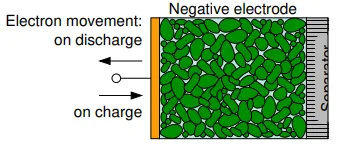
Function of Negative Electrode:
- In an electrochemical cell, the negative electrode is often ametal or an alloy or hydrogen (lead metal or paste for PbA).
During discharge, it gives up electrons to external circuit, is oxidized (OIL: “Oxidation is Loss (of electrons)”).
During charge, accepts electrons from external circuit, is reduced (RIG:“Reduction is Gain (of electrons)”).
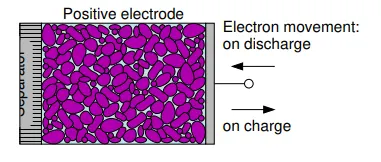
Function Of Positive Electrode:
- In an electrochemical cell, the positive electrode is often a metallic oxide, sulfide, or oxygen (lead oxide for PbA).
- During discharge, accepts electrons from circuit, is reduced.
- During charge, gives up electrons to external circuit, is oxidized
The function of the electrolyte:
- As electrons move in the external circuit, compensating ionsmust move internal to the cell.
- Cations are ions with net positive charge: during discharge they move through the electrolyte toward the positive electrode.
- Anions are ions with net negative charge: during discharge they move through the electrolyte toward the negative electrode.
- The electrolyte provides the medium for internal ion charge transfer between the electrodes (sulfuric acid for PbA) The electrolyte is typically a solvent containing dissolved chemicals—an acid, base, or salt—providing ionic conductivity.
- It must be an electronic insulator to avoid self discharge.
The functions of the separator & current collectors:
- The separator electrically isolates the positive and negative electrodes to avoid short circuit and self discharge of the cell
Often made from glass mat or fiber, or polyethylene, or a polymer, - Since electrodes are often made from powders, current collectors are metal foils—to which electrodes are adhered—that conduct electrical current to cell terminals.
Working of Lithium ion cells:
- Lithium ion cell works quit different than normal electochemical cell,they work on intercalation mechanism.
- Both electrodes depend on an intercalation mechanism rather than redox reactions.
- Lithium is stored in the electrodes much like water is stored in a sponge.
- Li is stored in the electrodes, and Li moves through the electrolyte.Li enters an electrode, becoming Li when an
electron is available; Li exits an electrode and becomes Li when it can give up an electron.
Requirements of the electrode structure:
- Intercalation involves insertion of lithium ions into crystalline lattice of host electrode without changing its crystal structure.
- These electrodes have two key properties: Open crystal structures, allowing insertion or extraction of lithium ions in the vacant spaces Ability to accept compensating electrons Within the electrode, the lithium atom’s electron is loosely shared with neighboring atoms The lithium is not tightly bonded in one place; it is actually quite free to move around.
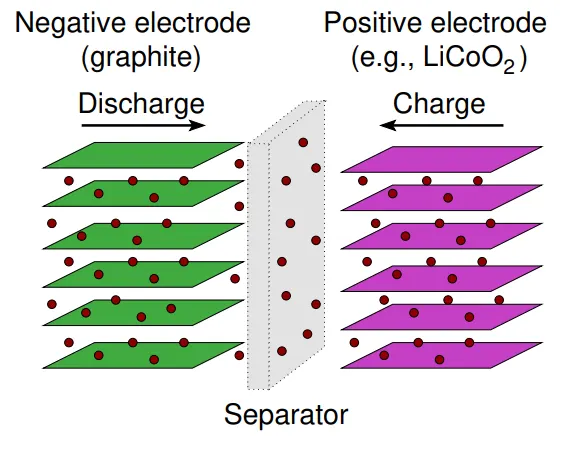
The discharge process:
- During discharge, Li exits the surface of the negative-electrode particles, gives up an electron, becoming Li in the electrolyte.
- Li diffuses outward from center of negative-electrode particles to equalize concentrations, replenishing Li at particle surface (over time).
- Meanwhile, electron travels through external circuit to positive electrode.
- Li joins with the electron, and Li enters positive-electrode particles at their surface.
- Li diffuses into positive-electrode particles to equalize concentration (over time).
The charge process:
- The process is completely reversible; thus lithium passes back and forth between electrodes during charging and discharging.
- During charge, Li exits surface of positiveelectrode particles, gives up an electron, becoming Li in the electrolyte.
- Meanwhile, the electron is forced (by charger) through external circuit to negative electrode.
- Li joins with the electron, and Li enters negative-electrode particles at their surface.
- Diffusion of Li in both electrodes equalizes internal concentrations (over time).
|
BATTERY CHEMISTRY |
POSITIVE ELECTRODE |
NEGATIVE ELECTRODE |
NOMINAL VOLTAGE |
SPECIFIC ENERGY (Wh/kg) |
C- Rate |
Max Temperature (degCelsius) |
Recharge cycles |
|
|
Charging |
Discharging |
|||||||
|
LCO (Lithium cobalt oxide) |
Lithium cobalt oxide (Licoo2) |
Graphite |
3.60 V |
150-200 |
0.7- 1C |
1C |
150 |
500-1000 |
|
MaxVolt-4.2 V |
MinVolt-2.5V |
|||||||
|
LMO (Lithium Manganese Oxide) |
Lithium Manganese Oxide- LiMn2O4 |
Graphite |
3.8 V |
100-150 |
0.7-1C MAX-3C |
1C 10C for short dur |
250 |
300-700 |
|
MaxVolt-4.2 V |
MinVolt-2.5 V |
|||||||
|
NMC (Lithium Nickel Manganese Cobalt Oxide) |
Lithium Manganese Cobalt Oxide-LiMnCo2 |
Graphite |
3.7 V |
150-220 |
0.7-1C |
1-2C |
210 |
1000-2000 |
|
MaxVolt-4.2V |
MinVolt-2.5 V |
|||||||
|
NCA (Lithium Nickel Cobalt Aluminium Oxide) |
Lithium Nickel Cobalt Aluminium Oxide-LiNiCoAlO2 |
Graphite |
3.6 V |
200-260 |
0.7-1C >1C is possible |
1C |
150 |
500 |
|
MaxVolt-4.2 V |
MinVolt-3 V |
|||||||
|
LFP (Lithium Iron Phosphate) |
Lithium Iron Phosphate-LiFePo4 |
Graphite |
3.3 V |
90-120 |
1C |
1C 40A (2s) |
270 |
>2000 |
|
MaxVolt-3.65 V |
MinVolt-2.5 V |
|||||||
|
LTO (Lithium Titanate) |
LMO or NMC |
Lithium Titanate-Li2TiO3 |
2.4 V |
50-80 |
1C Max-5C |
10C is possible for short |
>300 |
3000-7000 |
|
MaxVolt-2.85 V |
MinVolt-1.8 V |
|||||||
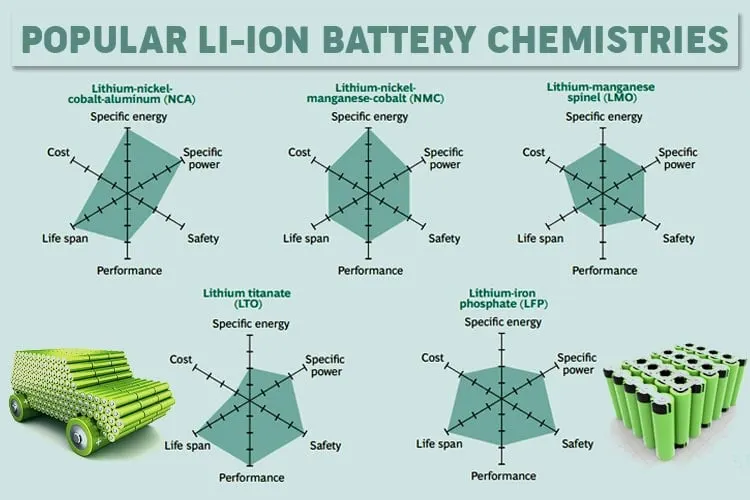
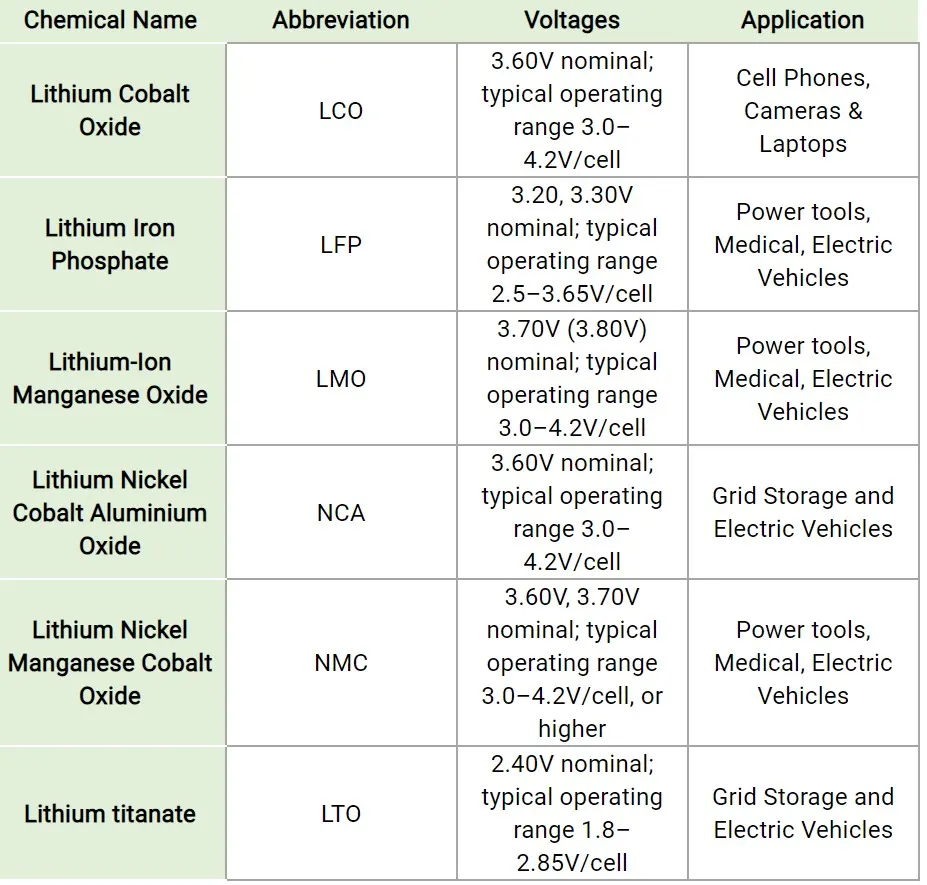
Applications:
References:
https://batteryuniversity.com/article/bu-205-types-of-lithium-ion