Week 1 Understanding Different Battery Chemistry
Aim: To prepare a table that includes materials & chemical reactions occurring at the anode and cathode of LCO, LMO, NCA, NMC, LFP and LTO type of lithium-ion cells and to give a detailed explanation on it.
Ans:
1. Introduction
Lithium-ion cells (Figure 1), in their most common form, consist of a graphite anode, a lithium metal oxide cathode and an electrolyte of a lithium salt and an organic solvent. Lithium is a good choice for an electrochemical cell due to its large standard electrode potential (–3.04 V) resulting in a high operating voltage (which helps both power and energy) and the fact that it is the metal with the lowest density (which reduces weight).
Fig. 1. Diagrammatic view of a lithium-ion cell
The construction of a typical cylindrical cell is shown in Figure 2, while Figure 3 shows a typical pouch cell. Such cells provide a relatively light and small source of energy and are now manufactured in very large quantities (>1 billion cells per year). In an automotive application, a lithium-ion battery consists of tens to thousands of individual cells packaged together to provide the required voltage, power and energy. Individual cells are normally mounted into a number of modules, which are then assembled into the complete battery pack as shown in Figure 4.
Fig. 2. The internal construction of a typical cylindrical cell
Fig. 3. The internal construction of a typical pouch cell
Fig. 4. CAD of the disassembled battery module, assembled module and whole battery package
Many countries have now put in place binding carbon dioxide emissions targets for cars, for example in Europe the requirements are for fleet average CO2 emissions of 130 g km–1 by 2015 and 95 g km–1 by 2022. It will be shown in Section 2 of this paper that by using a (lithium-ion) battery it is possible to significantly reduce a car's CO2 emissions. More lithium-ion batteries are now being used in automotive applications for this reason.
2. Automotive Applications for Lithium-ion Batteries
There is a range of applications for batteries in passenger cars. The ones that will be considered here were selected either because they already use lithium-ion batteries or because they could potentially do so in the future. Note that there are a number of standard automotive requirements that all lithium-ion batteries used in cars need to meet: these include life (8–15 years are typical requirements), temperature range (–40°C to at least +60°C, ideally 80°C) and vibration resistance (at least 4.5 root-mean-square-acceleration (grams)). Each application will now be briefly described.
2.1 Starting Lighting Ignition
Starting lighting ignition (SLI) is the ‘car battery’ that has been in almost every car for the last 100 years. Commonly this is called a ‘12 V battery’, but its normal voltage (while in use in the car and being charged by the alternator) is nearer 14 V. In almost all current production cars this is a lead-acid battery, but there are a few cars now that uses a lithium-ion battery either as standard (for example, the McLaren P1) or as an option (for example, some Porsche models). In the Porsche Boxster Spyder, the lithium-ion battery is a US$1700 option and has the same form factor and mounting points as the standard lead-acid battery, but weighs only 6 kg which is 10 kg lighter than the lead-acid option. It should be noted that Porsche supplies a conventional lead-acid battery as well as the lithium-ion one for use in cold temperatures where the lithium-ion pack may not be able to provide enough power to crank the engine.
2.2 Idle Stop
This is a system that is now fitted to the majority of European vehicles which switches the combustion engine off whenever the vehicle is stationary, restarting it when you go to drive off. It offers around a 5% saving in fuel economy at an estimated system cost of around US$350, which makes it an attractive solution for original equipment manufacturers (OEMs) looking to meet the European 2015 CO2 limits. The requirements for a battery for this application are very similar to those of an SLI battery, but the more frequent starting and stopping of the engine requires a longer cycle life. The vast majority of batteries for this application are still lead-acid, but a number of other options are used including ultracapacitors and lithium-ion which was first used in 2002 on the Toyota Vitz CVT, which to the author's knowledge was the first production car to use a lithium-ion battery pack.
Many idle-stop systems also intelligently control the vehicle's alternator, for example using it to generate maximum power when the vehicle is slowing down (giving a limited degree of regenerative braking capability) and these systems are frequently called micro hybrids.
2.3 Mild Hybrid
In a mild hybrid electrical energy is used to supplement the energy from the combustion engine. By use of a suitable control system to decide how to mix these two energy sources significant savings in fuel (typically 10%–15%, but up to 30% has been shown in some demonstrator vehicles) can be obtained for a moderate increase in system cost. Batteries for this application only require a small amount of power and energy. Most batteries for this application at present are nickel-metal hydride (NiMH), with lithium-ion first used in 2010 for the Mercedes S400 hybrid. As this paper is focused on lithium-ion batteries, NiMH batteries (which is an older technology that offers lower energy density than lithium-ion) will not be covered in further detail here.
Note that the number of mild hybrids produced is soon expected to significantly increase due to the use of 48 V systems within a vehicle. This shift is driven by the European 2020 fleet CO2 requirements. The use of 48 V was originally proposed in 2011 by Audi, BMW, Daimler, Porsche and Volkswagen and resulted in the LV 148 standard. Audi recently stated that they expect such systems to be in production within the next two years and it is expected that all 48 V systems will be based on lithium-ion batteries.
It should also be noted that most fuel cell vehicles will also be hybrids. For example, Toyota has recently announced that it will start sales of a fuel cell sedan in early 2015 and this is a mild hybrid using a small battery to supplement the fuel cell and increase the vehicle's overall efficiency.
2.4 Full Hybrid
In a full hybrid, the approach is similar to that of the mild hybrid, but the electrical power and stored energy are now high enough to power the car purely from electrical energy. The battery energy available normally limits the range in this mode to a few kilometres. An example of this sort of vehicle is the Toyota Prius (although this currently uses a NiMH battery pack), which is by far the most successful hybrid vehicle sold so far. It has around a 1-mile range in electric vehicle (EV) mode. Fuel consumption savings in a full hybrid are typically 30%–40%, for example on the 2014 Toyota Yaris the 1.33 gasoline (98 bhp / 73 kW) produces 114 g km–1 of CO2 emissions, while the hybrid (also 98 bhp / 73 kW) achieves 75 g km–1, a 34% reduction.
Batteries for this application must provide more power (to act as the sole source of power in the vehicle) and more energy than for a mild hybrid application. Most applications (by volume) are still NiMH, but a significant number of vehicles are now lithium-ion based, including the BMW Active Hybrid 3 which can drive for 2.5 miles at up to 37 mph on electric power alone. Hybrid electric vehicle (HEV) is a phrase that has been used to describe mild hybrid and full hybrid vehicles and has even been applied to some vehicles with little more than idle-stop systems (micro hybrids).
2.5 Plug-in Hybrid Electric Vehicle
The plugin hybrid electric vehicle (PHEV) could be considered to be a full hybrid with the ability to charge the battery from the grid. The vehicle is designed to initially preferentially use the electrical energy from its last charge until this is depleted, at which time it behaves like a full hybrid vehicle. Thus the energy obtained by charging from the grid replaces some energy that would have been required from the liquid fuel (gasoline or diesel), further lowering fuel consumption (and hence tailpipe CO2 emissions). The VW XL1 is a PHEV that offers 313 mpg and 24 g km–1 of CO2, but the Vauxhall Ampera (GM Volt) and Toyota Prius PHEV (note the Toyota Prius PHEV is a different vehicle to the ‘standard’ Toyota Prius which is a full hybrid vehicle) are more affordable options. All use lithium-ion batteries. The power required from the battery is similar to that required in a full hybrid, but more energy needs to be stored to make the effort to recharge from the grid worthwhile.
For the purposes of this paper, a range-extended electric vehicle (REEV) will be considered a type of PHEV.
2.6 Electric Vehicle
An EV has a battery as its only source of energy. An example of this type of vehicle is the Nissan Leaf. An EV has zero tailpipe emissions, although the Leaf is estimated to emit 66.83 g km–1 CO2 in the UK based on the CO2 produced by the mains electricity used to refuel it. The power required from an EV battery is the same as for a PHEV (both need to be able to power the car), but in an EV as much energy as practical is fitted to give a reasonable range (typically ~100 miles). This large energy requirement explains the ‘low cost’ requirement (in $/kWh terms) for EVs in Table I, as the battery cost needs to be compared with a conventional fuel tank (~€100 or ~US$130).
Table I
Typical Passenger Car Applications for Lithium-ion Batteries
| Application | Typical voltage(s), V | Typical Power levels, kW | Typical energy, kWh | Commonest battery type today | Special requirements |
|---|---|---|---|---|---|
| SLI | 14 | 3 | 0.7 | Lead-acid | Cranking at cold |
| Idle stop | 14 | 3 | 0.7 | Lead-acid | Cranking at cold |
| Mild hybrid | 48–200 | 10–30 | 0.3 | NiMH | Long cycle life |
| Full Hybrid | 300–600 | 60 | 1–2.5 | NiMH | Long cycle life |
| PHEV | 300–600 | 60 | 4–10 | Li-ion | Long cycle life |
| EV | 300–600 | 60 | 15+ | Li-ion | Low cost |
All of the applications listed above are summarised in Table I. The typical properties and requirements of the battery technology for each application are shown. The power and energy data in Table I can also be viewed as a chart, as shown in Figure 5.
Fig. 5. Power and energy requirements for different passenger vehicle battery applications
3. Lithium-ion Chemistries
Lithium-ion cells, in their most common form, consist of a graphite anode and a lithium metal oxide cathode and an electrolyte of a lithium salt and an organic solvent. While the basic format remains constant for all lithium-ion cells the detailed chemistry (i.e. cathode and/or anode) can be changed, altering the properties of the cell. It is not the aim of this paper to give a detailed explanation of the manufacture of the various cells or their chemistries as this is well covered elsewhere.
The main lithium-ion chemistries used in automotive applications are summarised in Table II. In all cases, the anode is graphite apart from the sixth entry in which the anode is a titanate.
Table II
Summary of the Main Lithium-ion Variants
| Cell level energy density, Wh kg–1 | Cell level energy density, Wh l–1 | Durability cycle life, 100% DoD | Price estimate, US$ Wh–1 | Power C-rate | Safety thermal runaway onset, °C | Potential, V | Temperature range in ambient conditions, °C | |
|---|---|---|---|---|---|---|---|---|
| LiCoO2 | 170–185 | 450–490 | 500 | 0.31–0.46 | 1 C | 170 | 3.6 | –20 to 60 |
| LiFePO4 (EV/PHEV) | 90–125 | 130–300 | 2000 | 0.3–0.6 | 5 C cont. 10 C pulse | 270 | 3.2 | –20 to 60 |
| LiFePO4 (HEV) | 80–108 | 200–240 | 2000 | 0.4–1.0 | 30 C cont.50 C pulse | 270 | 3.2 | –20 to 60 |
| NCM (HEV) | 150 | 270–290 | 1500 | 0.5–0.9 | 20 C cont.40 C pulse | 215 | 3.7 | –20 to 60 |
| NCM (EV/PHEV) | 155–190 | 330–365 | 1500 | 0.5–0.9 | 1 C cont. 5 C pulse | 215 | 3.7 | –20 to 60 |
| Titanate vs. NCM/LMO | 65–100 | 118–200 | 12,000 | 1–1.7 | 10 C cont. 20 C pulse | Not susceptible | 2.5 | –50 to 75 |
| Manganese spinel (EV/PHEV) | 90–110 | 280 | >1000 | 0.45–0.55 | 3–5 C cont. | 255 | 3.8 | –20 to 50 |
This table can be summarised in terms of key parameters that are required for the commercial application of these battery technologies in passenger vehicles, as in Table III below. Note that price has not been included in this table as all the ranges effectively overlap, with the exception of the more expensive titanate containing system.
While all these cell chemistries have been used in passenger vehicles and hence can be made adequately safe, the temperature at which thermal runaway starts is used here to illustrate the differences between the chemistries – the higher this temperature the safer the chemistry is considered to be. Life is given in Table II in terms of cycle life, while the ranking in Table III can be considered to also include calendar life.
Table III
Key Parameters of Lithium-ion Chemistries
| Parameter | Highest performing chemistry(s) | Lowest performing chemistry |
|---|---|---|
| Safety | Titanate, LiFePO4 | LiCoO2 |
| Power | LiFePO4 | LiCoO2 |
| Energy | LiCoO2, NCM | LiFePO4 |
| Life | Titanate, LiFePO4 | LiCoO2 |
Note that the chemistry that provides the best power (lithium iron phosphate (LiFePO4)) is the worst for energy. Both power and energy need to be considered when selecting candidate chemistries for applications and this idea will be explored further in Section 4.
The last parameter for consideration is low-temperature performance and this is best shown by a graph (Figure 6 which is based on data from lithium-ion added by the present author based on measurements of an automotive LiFePO4 lithium-ion cell).
Fig. 6. Low-temperature performance of selected battery chemistries
This graph shows that valve-regulated lead-acid (VRLA) battery technology offers significantly higher power at cold temperatures and so is better suited for cold cranking applications (which require the ability to crank the engine at –40°C).
4. Lithium-ion for Various Applications
One way to view the suitability of lithium-ion for various applications is to compare the power: energy ratio for the cells vs. the applications as shown in Figure 7. Here the yellow lines show the power: energy ratios for the various chemistries (from Table II), while the dots show the requirements for each of the applications (Figure 5). The lines closest to the dots are likely to be the best fit to the application from a power and energy viewpoint, as chemistries with lines a long way away will have a significant excess of power or energy beyond the requirements. This is likely to make them a more expensive solution (in terms of cost, weight and volume) than solutions with lines close to the dot.
Fig. 7. Power and energy and capabilities of various chemistries
It can be seen that there are good matches for the mild and full hybrid and PHEV, but not a particularly good match for the EV requirements.
This means that companies offering a range of different types of hybrid vehicles will normally need to select multiple chemistries (which also normally means multiple suppliers). For example, BMW uses A123 LiFePO4 cells in its hybrids, while it uses Samsung SDI (nickel-manganese-cobalt (NMC)) for its EV and PHEV vehicles, both of which can be seen to be sensible choices based on Figure 3. However there is no industry consensus, for example, while BMW selected NMC for its EVs, Honda uses titanate chemistry in its Fit EV and Renault uses spinel lithium manganese oxide (LMO) in the ZOE EV.
It should be noted that while lithium-ion batteries are in use in production cars, low-temperature operation, life (especially calendar life), temperature range, safety and cost are all areas that ideally need to be improved and these challenges still remain after many years of research and development. Some progress has been made, for example, battery packs have improved from 80 Wh kg–1 in the Mitsubishi iMiEV (launched in 2009) and Nissan Leaf (launched in 2010) to 97 Wh kg–1 in the new Kia Soul EV (launched in May 2014) which is a 4% per year average (compound) improvement. This is partly due to the automotive industry's long timescales (five or more years from part selection to volume production is common), but also due to the need for improvements without adversely impacting other parameters.
5. Future Developments
Much research is ongoing into lithium-ion batteries. The review of lithium batteries dates from 2009 but it is still a useful overview and many of the research topics it discusses have yet to make it into volume automotive applications. A theoretical model created at Rice University and Lawrence Livermore National laboratory which predicts how carbon components will perform as electrodes also have the potential to significantly benefit future lithium-ion cell developments.
A recent overview that focuses on energy and cost (and is so most relevant to EV applications) suggests that lithium-ion chemistries will improve by probably no more than 30% in terms of energy per unit weight and proposes a range of potential replacement chemistries. However, it should be remembered that an automotive battery pack is much more than just the chemistry, as the cells themselves have to be packaged using a pouch or can and then hundreds or possibly thousands of these cells need to be packaged in the car together with thermal management and electronic control equipment. A typical automotive battery pack today achieves 82 Wh kg–1 (for example, the Nissan Leaf) which is considerably lower than that achievable from the cells alone.
Recently prototype battery packs have been developed with significantly higher energy density. For example, the SmartBatt programme has recently demonstrated an EV battery pack with 148 Wh kg–1 while meeting all other automotive requirements, this pack was shown as CAD in Figure 4 and the assembled pack is shown in Figure 8. This was achieved by combining 1408 relatively high energy lithium-ion cells (each of 181 Wh kg–1) with innovative materials (including an aluminium hybrid foam sandwich material) and state of the art engineering (including a large number of crash test simulations to optimise the design).
Fig. 8. SmartBatt battery pack
Table IV gives the weight breakdown of the SmartBatt pack. The 85% gain in energy per unit weight obtained by the SmartBatt pack far exceeds the long term projections of a 30% improvement in energy per unit weight from lithium-ion chemistry improvements and together they suggest a 100% gain in energy per unit weight (to around 160 Wh kg–1) may be possible at the pack level for EV packs.
Table IV
SmartBatt Weight Breakdown
| Component | Mass, kg | Fraction, % |
|---|---|---|
| Housing | 8.5 | 5.5 |
| Module without cells | 16.6 | 10.7 |
| Cells | 125.3 | 80.6 |
| Electrical components | 2.1 | 1.4 |
| Electrical connections | 2.9 | 1.9 |
| TOTAL | 155.4 | – |
6. Conclusions
This paper has shown the range of applications for automotive batteries and summarised the different requirements for each. This has shown that while lithium-ion based battery packs could be used in all the major passenger car battery applications, they are best suited to use in PHEV and EV applications and are least suited to SLI applications. Even for the applications where lithium-ion is being used, it has been shown that different vehicle OEMs have selected different chemistries for the same application based on different interpretations of the trade-offs between the chemistries’ performance and the requirements of the specific application.
It has been stated that new lithium-ion chemistries offer limited potential for improvement (~30% in terms of Wh kg–1) which has resulted in significant research in non-lithium-ion based chemistries that offer the promise of significantly higher gains. However, it is shown here that, especially for EV battery packs, major weight gains can come from the overall design of the battery pack and these together with better chemistries suggest a doubling of the energy per unit weight for EV battery packs is possible in the relatively near future.
The materials & chemical reactions occur at the anode and cathode of LCO, LMO, NCA, NMC, LFP and LTO type of lithium-ion cells.
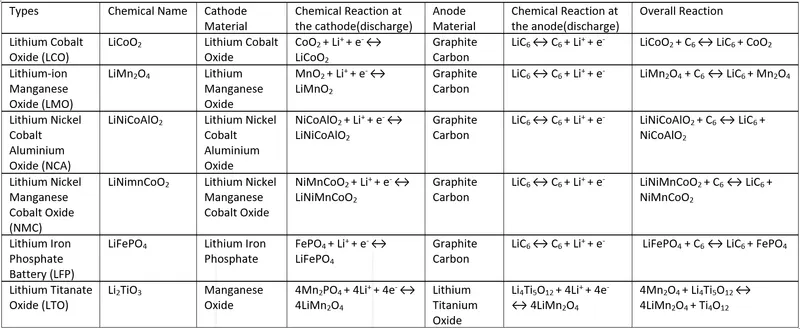
Aim: Compare the differences between each type of Li+ion battery based on their characteristics
1] LCO batteries: properties and usage
LCO stands for Lithium cobalt battery. Lithium cobalt oxide is one of the most common Lithium-ions, it has a chemical symbol which is LiCoO2 and is abbreviated as LCO. For simplification, Li-cobalt –which is the short term- can also be used for this type of battery. Cobalt is the core active material that defines the character of the battery.
Lithium-ion batteries and concept
The most popular technology of the battery sector currently is the lithium-ion battery. Relative to other types of batteries, lithium-ion batteries have better energy, power density and higher cycling ability. These qualities are extremely important in the use in modern applications like electrical and hybrid vehicles and most importantly energy storage systems which are used in renewable energy applications. The lithium-ion batteries chemistry is the same across the different lithium-ion battery types; during discharge, Lithium-ions are moved to the positive cathode from the negative anode through the organic electrolyte. The anodes in all various technologies of lithium-ion are all made from graphite. The differences are the cathode which contains changing cobalt, nickel or manganese concentrations. All various cathode types allow high lithium insertion and intercalation levels which result in large energy storage quantities.
LCO batteries technology and applications
LCO (Lithium cobalt oxide) was invented in the year 1991. Its anode material is LiaC6, the cathode material is LibCoO2 and the carrier is Li+. It is used in various applications ranging from electronic devices to all laptops and phone batteries. The majority of lithium-ion batteries for portable devices are cobalt-based. The system contains a cobalt oxide cathode (positive electrode) and graphite carbon anode (negative electrode).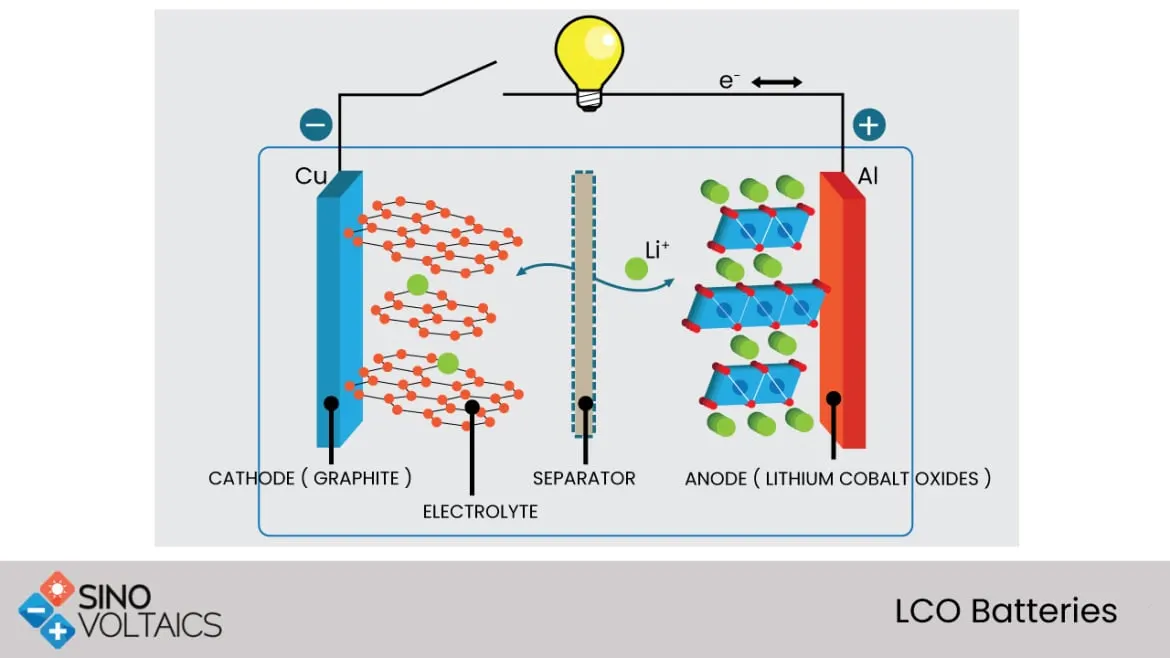
Advantages and disadvantages of LCO batteries
The main advantages of the LCO batteries are:
- High energy density.
- Long runtime makes it optimum for new technologies
The main disadvantages of the LCO batteries are:
- It has a relatively low discharge current so high load can lead to pack overheat
- The safety circuit of the LCO battery is typically limited to a 1C for charging and discharging.
- The internal resistance increases with cycling and ageing. This high internal resistance can cause the battery to become unserviceable due to a large voltage drop under the load after a couple of years of use.
2] LMO Batteries: properties and usage
LMO stands for Lithium manganese oxide batteries, which are commonly referred to as lithium-ion manganese batteries or manganese spinel. This battery was discovered in the 1980s, yet the first commercial lithium-ion battery made with a cathode material made from lithium manganese was produced in 1996.
Lithium-ion batteries and concept
The most popular technology of the battery sector currently is the lithium-ion battery. Relative to other types of batteries, lithium-ion batteries have better energy, power density and higher cycling ability. These qualities are extremely important in the use in modern applications like electrical and hybrid vehicles and most importantly energy storage systems which are used in renewable energy applications. The lithium-ion batteries chemistry is the same across the different lithium-ion battery types; during discharge, Lithium-ions are moved to the positive cathode from the negative anode through the organic electrolyte. The anodes in all various technologies of lithium-ion are all made from graphite. The differences are the cathode which contains changing cobalt, nickel or manganese concentrations. All various cathode types allow high lithium insertion and intercalation levels which result in large energy storage quantities.
LMO batteries technology and applications
LMO (Lithium magnesium oxide) was invented in the year 1996. Its anode material is LiaC6, the cathode material is LibMn2O4 and the carrier is Li+. It is used in different applications like power tools and electric cars.LMO batteries have the ability to deliver a lot of energy in a short period of time, which makes them extremely useful for use in power tools like drills. In 1996, lithium manganese oxide was first used as a cathode material. A three-dimensional spinel structure was formed by this structure, this improves the flow of ions between the electrodes. The high flow decreases the internal resistance and increases loading capability.LMO batteries are usually used in medical devices and equipment, power tools, electric bikes and more. Because of their thermal resistance and higher safety. LMO batteries can also be used for laptops and electric cars.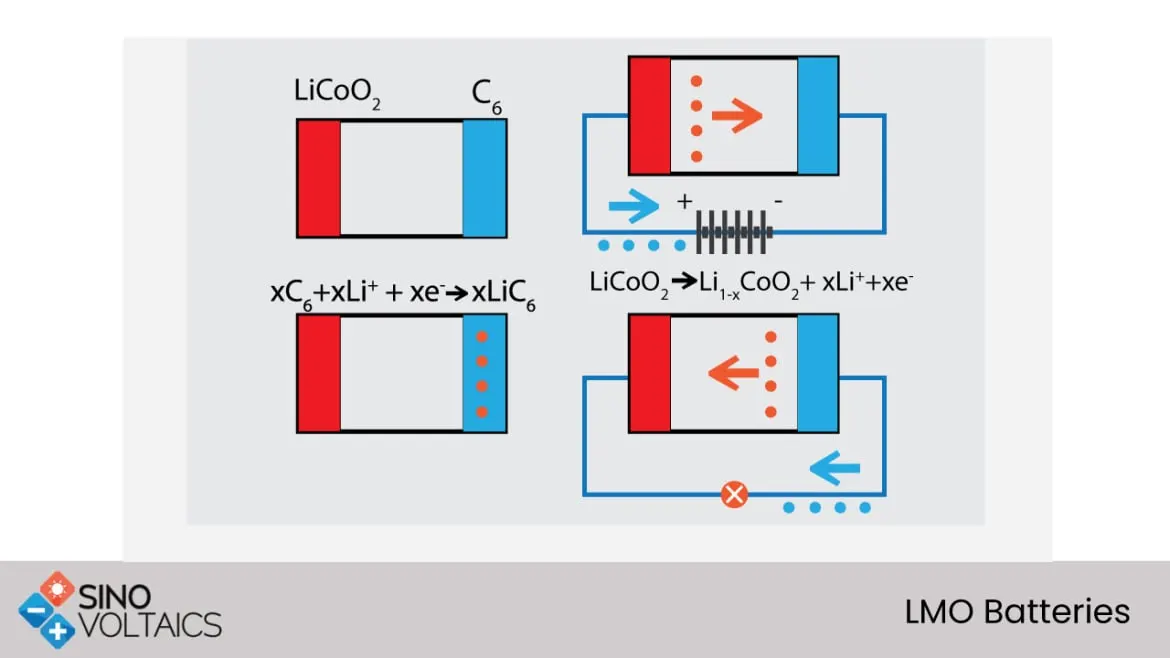
Advantages and disadvantages of LMO batteries
The main advantages of the LMO batteries are:
- High-temperature stability and safety are relative to other Li-ion types as it has integrally high thermal stability thus need less safety circuitry than cobalt system.
- High rate capability due to low internal cell resistance which benefits fast charging and high current discharging.
The main disadvantage of the LMO batteries is:
- Lower capacity relative to the cobalt-based system, yet it still has an energy density that is nearly 50% higher than the nickel-based system.
3] NCA batteries: properties and usage
NCA battery stands for Lithium nickel cobalt aluminium oxide-based battery (LiNiCoAlO2). Also, NCA batteries are becoming more and more important in in-grid storage and electrical power terrain applications.
Lithium-ion batteries and concept
The most popular technology of the battery sector currently is the lithium-ion battery. Relative to other types of batteries, lithium-ion batteries have better energy, power density and higher cycling ability. These qualities are extremely important in the use in modern applications like electrical and hybrid vehicles and most importantly energy storage systems which are used in renewable energy applications. The lithium-ion batteries chemistry is the same across the different lithium-ion battery types; during discharge, Lithium-ions move to the positive cathode from the negative anode through the organic electrolyte. The anodes in all various technologies of lithium-ion are all made from graphite. The differences are the cathode which contains changing cobalt, nickel or manganese concentrations. All various cathode types allow high lithium insertion and intercalation levels which result in large energy storage quantities.
NCA (Lithium nickel cobalt aluminium oxide) battery was invented in the year 1999. Its anode material is LiaC6, the cathode material is LibNi0.8Co0.15Al0.05O2 and the carrier is Li+. It is used in different applications like power grid applications, medical devices and electric cars. Most notably Tesla deploys NCA batteries in their electric vehicle's system. NCA batteries can store the same amount of energy as NMC.NCA batteries are not widely common in the consumer industry but are quite promising in the electric car industry.
Advantages and disadvantages of NCA batteries
The main advantages of the NCA batteries are:
- High specific energy
- Reasonably good specific power
- Long life span
- NCA cathodes contain the most energy amount by weight and volume (as NMC).
The main disadvantages of the NCA batteries are:
- Less safety than other Li-ion battery types (they require extra safety features and circuits for use in electric cars for example)
- Higher cost in comparison to other Li-ion battery types
4] NMC Batteries: properties and usage
NMC stands for Lithium Nickel Manganese Cobalt Oxide battery. (LiNiMnCoO2)The cathode combination of NMC (nickel-manganese-cobalt) is among the most successful Li-ion systems.
Lithium-ion batteries and concept
The NMC systems can serve as a Power Cell or an Energy Cell. The most popular technology of the battery sector currently is the lithium-ion battery. Relative to other types of batteries, lithium-ion batteries have better energy, power density and higher cycling ability. These qualities are extremely important in the use in modern applications like electrical and hybrid vehicles and most importantly energy storage systems which are used in renewable energy applications. The lithium-ion batteries chemistry is the same across the different lithium-ion battery types; during discharge, Lithium-ions move to the positive cathode from the negative anode through the organic electrolyte. The anodes in all various technologies of lithium-ion are all made from graphite. The differences are the cathode which contains changing cobalt, nickel or manganese concentrations. All various cathode types allow high lithium insertion and intercalation levels which result in large energy storage quantities. The name Lithium-ion is after the active materials; it can be either expressed by words or shortened by the chemical symbols.
NMC batteries technology and applications
NMC (Nickel Manganese Cobalt Oxide) battery was invented in the year 2008. Its anode material is LiaC6, the cathode material is LibNi1–x–yCoxMnyO2 and the carrier is Li+. They commonly use it in different applications like Energy Systems and electric cars.NMC combines the best of nickel and manganese. Nickel has high specific energy but poor stability; manganese can form a spinel structure so as to achieve low internal resistance yet provides low specific energy. Joining the metals increases the strengths of both parts.NMC batteries are widely used for power tools, energy storage systems (EES) which need frequent cycling and electrical power trains like automotives. The cathode combination typically used is 1-1-1 which means one-third nickel, one-third manganese and one-third cobalt. This reduces the raw material cost due to lowered content of cobalt. Another known combination for NCM is 5-3-2 (5 parts nickel, 3 parts cobalt and 2 parts manganese). Other combinations are also possible.
Advantages and disadvantages of NMC batteries
The main advantages of the NMC batteries are:
- NMC cells provide a longer life cycle
- Lower cost
- Higher energy density
- NMC cathodes contain the most energy amount by weight and volume.
The main disadvantages of the NMC batteries are:
- Adding silicon to graphite has the downside of making the anode grow and shrink through charging and discharging, leading to mechanical instability of the cell.
- Slightly lower voltage than cobalt systems.
5] LFP batteries: properties and usage
A lithium iron phosphate (LFP) battery is a type of lithium-ion battery that is capable of charging and discharging at high speeds compared to other types of batteries. It is a rechargeable battery consisting of LiFePO4 as its cathode material; hence the name.
Lithium iron phosphate batteries have several distinctive features, including:
- Better power density
- Low discharge rate
- Flat discharge curve
- Less heating
- The higher number of charge cycles
- Increased safety
Lithium iron phosphate (LFP) batteries are also known as lithium ferrophosphate batteries.
Lithium Ferro Phosphate technology (also known as LFP or LiFePO4), which appeared in 1996, is replacing other battery technologies because of its technical advantages and very high level of safety.
Due to its high power density, this technology is used in medium-power traction applications (robotics, AGV, E-mobility, last-mile delivery, etc.) or heavy-duty traction applications (marine traction, industrial vehicles, etc.)
The long service life of the LFP and the possibility of deep cycling make it possible to use LiFePO4 in energy storage applications (stand-alone applications, Off-Grid systems, self-consumption with battery) or stationary storage in general.
Major advantages of Lithium Iron Phosphate:
- Very safe and secure technology (No Thermal Runaway)
- Very low toxicity for the environment (use of iron, graphite and phosphate)
- Calendar life > 10 ans
- Cycle life: from 2000 to several thousand (see chart below)
- Operational temperature range:up to 70°C
- Very low internal resistance. Stability or even decline over the cycles.
- Constant power throughout the discharge range
- Ease of recycling
Life-cycle of Lithium Iron Phosphate technology (LiFePO4)
Lithium Iron Phosphate technology is that which allows the greatest number of charge/discharge cycles. That is why this technology is mainly adopted in stationary energy storage systems (self-consumption, Off-Grid, UPS, etc.) for applications requiring long life.
The actual number of cycles that can be performed depends on several factors:
- Quality of Lithium Cell
- Level of power in C-Rate (1C rate means full discharge or charge in 1 hour, 2C is the same but in half an hour)
- Depth of Discharge (DOD)
- Operational environment: temperature, humidity, etc.
6] LTO batteries: properties and usage
LTO batteries are lithium titanate (Li2TiO3) or li-titanate batteries, which is a class of batteries that is used in a growing number of applications. They are high power batteries, so they are perfect for use in fast-charging stations.
Lithium-ion batteries and concept
The most popular technology of the battery sector currently is the lithium-ion battery. Relative to other types of batteries, lithium-ion batteries have better energy, power density and higher cycling ability. These qualities are extremely important in use in modern applications like electrical and hybrid vehicles and most importantly energy storage systems for renewable energy applications. The lithium-ion batteries chemistry is the same across the different lithium-ion battery types; during discharge, Lithium-ions move to the positive cathode from the negative anode through the organic electrolyte. The anodes in all various technologies of lithium-ion are all made from graphite. The differences are the cathode which contains changing cobalt, nickel or manganese concentrations. All various cathode types allow high lithium insertion and intercalation levels which result in large energy storage quantities.
LTO batteries technology and applications
LTO (Lithium tintate) was invented in the year 2008. Its anode material is Li4+aTi5O12, the cathode material is LibFePO4 and the carrier is Li+. They use it in different applications like UPS, electrical power trains, solar-powered street lights, fast-charge stations and forklifts. Other applications for LTO batteries include aerospace and military uses, and more importantly wind and solar energy storage and smart grids creation. Li-titanate is used instead of the graphite in the anode of a common lithium-ion battery and the material is formed into a spinel structure. The cathode material is either LMO or NMC. As mentioned, they use li-titanate batteries in electric vehicles, yet LTO batteries have lower energy density than other Li-ion battery types, which can be a disadvantage in efficiently powering vehicles. Still, the density of LTO batteries is higher than other non-Li-ion batteries.
Advantages and disadvantages of LTO batteries
The main advantages of the LTO batteries are:
- Excellent low-temperature discharge characteristics
- Zero strain property, no formation of SEI film nor lithium plating when charging at low temperature or fast charging
- Long lifetime
- Fast charge capability and wide temperature range
- Among the safest types of Li-ion batteries
The main disadvantages of the LTO batteries are:
- High cost
- The lower inherent voltage or lower energy density
End...
Thank You