Week 1 Understanding Different Battery Chemistry
1.
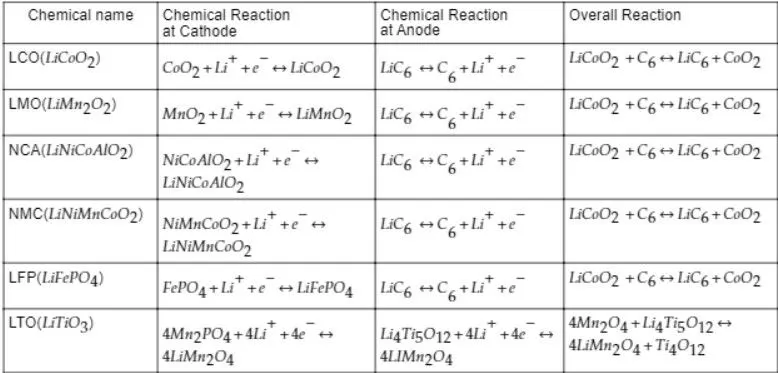
Aim: To Prepare a table which includes materials & chemical reactions occurring at the anode and cathode.
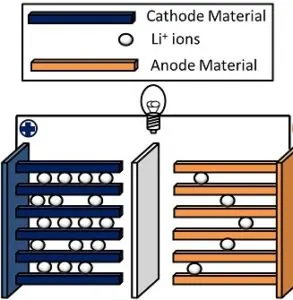
A lithium-ion battery or Li-ion battery is a type of rechargeable battery composed of cells in which lithium ions move from the negative electrode through an electrolyte to the positive electrode during discharge and back when charging. Li-ion cells use an intercalated lithium compound as the material at the positive electrode and typically graphite at the negative electrode.
Li-ion batteries have a high energy density, no memory effect (other than LFP cells) and low self-discharge. Cells can be manufactured to either prioritize energy or power density. They can however be a safety hazard since they contain flammable electrolytes and if damaged or incorrectly charged can lead to explosions and fires.
Generally, the negative electrode of a conventional lithium-ion cell is made from carbon. The positive electrode is typically a metal oxide. The electrolyte is a lithium salt in an organic solvent. The electrochemical roles of the electrodes reverse between anode and cathode, depending on the direction of current flow through the cell.
The most common commercially used anode (negative electrode) is graphite, which in its fully lithiated state of LiC6 correlates to a maximal capacity of 1339 C/g (372 mAh/g). The positive electrode is generally one of three materials: a layered oxide (such as lithium cobalt oxide), a polyanion (such as lithium iron phosphate) or a spinel (such as lithium manganese oxide). More experimental materials include graphene-containing electrodes, although these remain far from commercially viable due to their high cost.
2.
Differences between each type of Li+ion batteries
| Battery | Advantages | Disadvantages | Application | Voltage | Capacity | Cost(Approximately) |
| LCO | High specific energy | Short life span, low thermal stability and limited load capabilities (specific power), Cobalt is expensive | mobile phones, laptops and digital cameras | 3-4.2V | 240Wh/Kg | $250/KWh |
| LMO | Lower internal resistance and improved current handling, high thermal stability and enhanced safety | Cycle and calendar life are limited | Electric vehicles such as the Nissan Leaf, Chevy Volt and BMW i3, Power tools, medical devices, electric powertrains | 3-4.2V | 150Wh/Kg | $300/KWh |
| NMC | Good overall performance and excels on specific energy, lowest self-heating rate | High cost due to cobalt | E-bikes, medical devices, EVs, industrial | 3.5-4.2V | 220Wh/Kg | $420/KWh |
| LFP | High current rating and long cycle life, besides good thermal stability, enhanced safety and tolerance if abused. | Higher self-discharge, less specific energy | Portable and stationary needing high load currents and endurance | 2.5-3.6V | 120Wh/Kg | $580/KWh |
| NCA | high specific energy, reasonably good specific power, long life span | High cost and marginal safety | Medical devices, industrial, electric power train (Tesla) | 3-4.2V | 300Wh/Kg | $350/KWh |
| LTO | Fast charging, safe, high discharge current of 10C | Low specific energy | UPS, electric powertrain (Mitsubishi i-MiEV, Honda Fit EV), solar-powered street lighting |
3-4.2V | 280Wh/Kg | $300/KWh |