Week 1 Understanding Different Battery Chemistry
Aim: Prepare a table which includes materials & chemical reactions occurring at the anode and cathode of LCO, LMO, NCA, NMC, LFP and LTO type of lithium ion cells.Give your detailed explanation on it.
Theory: Let us first know about lithium ion battery.
A lithium-ion battery or Li-ion battery is a type of rechargeable battery composed of cells in which lithium ions move from the negative electrode through an electrolyte to the positive electrode during discharge and back when charging. Li-ion cells use an intercalateds lithium compound as the material at the positive electrode and typically graphite at the negative electrode.
Li-ion batteries have a high energy density, no memory effect and low self discharge. Cells can be manufactured to either prioritize energy or power density.They can however be a safety hazard since they contain flammable electrolytes and if damaged or incorrectly charged can lead to explosions and fires.
Li-ion batteries consist of largely four main components: cathode, anode, electrolyte, and separator. Below shows the diagram of lithium ion battery.
When this battery is connected to the load the battery supplies current and starts discharging, The anode release lithium ion to cathode generating a flow of electron from anode to cathode and hence the current will flow from cathode to anode while discharging.
Now we will see exactly the opposite behaviour of the above case i.e charging. Here when the battery is plugin to get charge the flow of electron is from cathode to anode which in turns charge the battery for further use.
- Lithium Cobalt Oxide (LCO)
- Lithium Manganese Oxide (LMO)
- Lithium Iron Phosphate (LFP)
- Lithium Nickel Manganese Cobalt Oxide (NMC)
- Lithium Nickel Cobalt Aluminum Oxide (NCA)
- Lithium Titanate (LTO)
Each of this above batteries have different characteristic and are made for different working conditions.
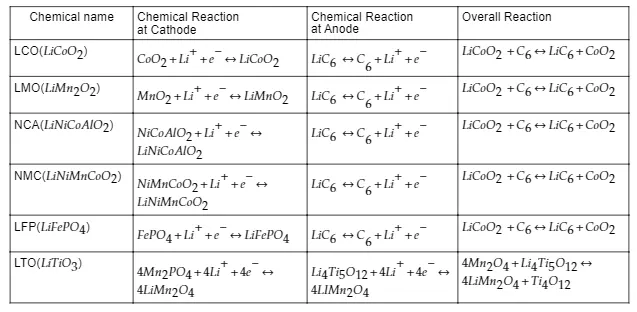
Lithium cobalt oxide (LCO) battery was invented back in year 1991. Its anode material is LiaC6, the cathode material is LibCoO2 and the carrier is Li+.It is used in various applications ranging from electronic devices to all laptops and phone batteries. The majority of lithium-ion batteries for the portable devices are cobalt based. The system contains a cobalt oxide cathode (positive electrode) and graphite carbon anode (negative electrode). The chemical reaction in the battery is shown in the above figure.
A lithium ion manganese oxide battery (LMO) is a lithium ion cell that uses manganese dioxide, MnO as the cathode material. They function through the same intercalation/de-intercalation mechanism as other commercialized secondary battery technologies, such as LiCoC Cathodes based on manganese-oxide components are earth-abundant, inexpensive, non-toxic, and provide better thermal stability.
Lithium nickel cobalt aluminum oxide battery has been since 1999 for special application. It shares similarities with NMC by offering high specific energy, reasonably specific power and a good life span.
Lithium nickel manganese cobalt oxide battery offers a combination of nickel, manganese and cobalt. They are also known as lithium manganese cobalt oxide battery. This battery has a high specific power.
Lithium Iron Phosphate batteries which is also known as Li-phosphate battery. This battery uses phosphate as cathode material. This has low resistance which enhances their thermal stability and safety.
Lithium Titanate oxide battery is a rechargable battery which has a benifit of being faster to charge than other lithium ion batteries but it has a disadvantage of having a much low energy density.
Aim: Compare the differences between each type of Li+ion batteries based on their characteristics.
Theory: Above we have seen 6 different types of batteries. Now here we see major difference in characteristic can be found when chossing the battery. The major thing that can be differenciated from one another.
- Nominal voltage: This is the system voltage at which the device is designed to operate. The rated voltage is higher than the nominal voltage to ensure the safety operation of the device.
- Cycle: The process of charging and discharging for a single time is called as one cycle. If the cycle is higher the the battery has higher life span.
- Thermal runaway: The thermal runaaway begins when heat generated within the battery is more that of the heat decipated from the battery. Internal batery temperature will rise contineously, causing the battery current to rise creating a domino effect. The rise in temperature in a single battery will begin to affect other batteries nearby and the pattern will continue.
- Specific energy: It is the amount of energy stored per unit mass. This is very important deciding factor that decide how much energy or power from different batteries for same amount of weight.
Below figure shows Specific energy of different lithium ion batteries:
1. Nominal voltage: Most of the are very close when it comes to characteristics. LMO(3.7) has the highest range and LTO(2.4) has the lowest range in volts.
2. Cycle life: They differ by a significant amount by each other. LTO battery has the longest life cycle and LMO is exactly opposite to it.
3. Charge current rate: Higher is this value, lesser is the time required to get full charge.LTO and LTP are the highest.
4. Discharge current rate: If we need higher discharge rate and faster charging time we should choose a higher rated battery. LTO has a discharge rate 10 time higher than the others.
5. Thermal runaway: This is a situation when the heat generated inside the battery is not decipated of the battery. LTO has the highest temperature rating, NCA and LCP has lowest temperature rating.
6. Specific energy: The specific energy density can be calculated by integrating from 0 to T_cutoff. The units of specific energy density is Wh Kg^-1. lithium ion with cobalt cathode offers the highest energy density. Power density indicate how much power a battery can deliver on demand.
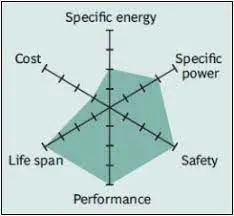
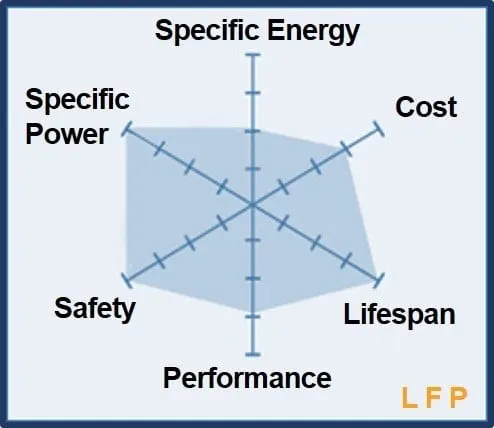
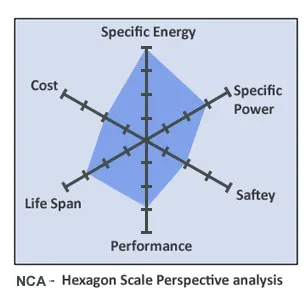
For easy selection of the battery the 6 key feature is given a value between a range of 0 to 5 and this 6 parameters are listed below:
- Specific energy
- Specific power
- Safety
- Performance
- Life span
- Cost
Now lets see each battries one by one:
1. LCO: Lithium cobalt has high specific energy but offers only moderate performance, specific power, safety and life span.
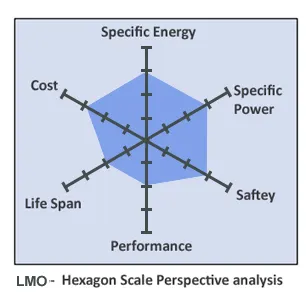
2. LMO: This is moderate in overall performance, newer design of Li-manganese offers improvement specific power, safety and life span.
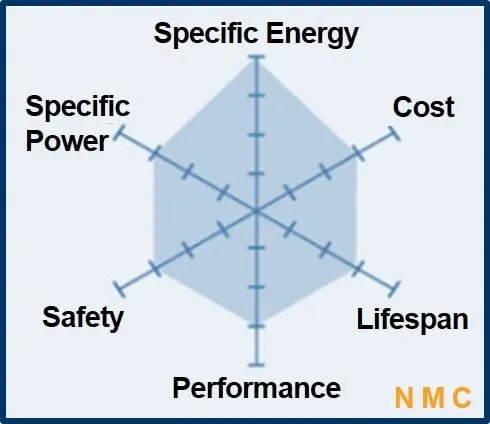
3. NMC: This has good overall performance and excels on specific energy. This battery is prefered for EV and has lowest self heating rate.
4. LPF: LI phosphate has excellent safety and long life span but moderate specific energy.
5. NCA: High energy and power density as well as life span makes NCA a preferance for EV.
6. LTO: Li-titanate excels in safety, low temperature performance and life span. Efforts are made to improve the specific energy and lowers the cost.