Week 1 Understanding Different Battery Chemistry
Week 1 Understanding Different Battery Chemistry
1.Prepare a table which includes materials & chemical reactions occurring at the anode and cathode of LCO, LMO, NCA, NMC, LFP and LTO type of lithium ion cells.Give your detailed explanation on it
2.Compare the differences between each type of Li+ion batteries based on their characteristics
SOLUTION 1:
| BATTERY | CATHODE | ANODE | CATHODE REACTION | ANODE REACTION | ELECTROLYTE (SALT AND SOLVENT) |
| Lithium Cobalt(LCO) |
Lithium Cobalt Oxide (LiCoO2 ) |
Graphite(C6 ) |
Li1-xCoO2 + xLi+ + xe- ``leftrightarrow`LiCoO2 |
LiC6 `leftrightarrow`6C+Li++e- |
Lithium hexafluorophosphate(LiPF6) and Ethylene Carbonate |
|
Lithium Manganese(LMO) |
Lithium Manganese Oxide (LiMn2O4) |
Graphite(C6 ) |
Li1-xMO2 + xLi+ + xe- `leftrightarrow`LiMO2 |
LiC6 `leftrightarrow`6C+Li++e- |
Lithium hexafluorophosphate(LiPF6) and Ethylene Carbonate |
| Lithium Aluminium(NCA) |
Lithium Nickel Cobalt Aluminium Oxide (LiNiCoAlO2) |
Graphite(C6 ) |
Li1-xNiCoAlO2 + xLi+ + xe- `leftrightarrow`LiNiCoAlO2 | LiC6 `leftrightarrow`6C+Li++e- |
Lithium hexafluorophosphate(LiPF6) and Ethylene Carbonate |
|
Lithium Nickel Manganese Cobalt(NMC) |
Lithium Nickel Manganese Cobalt Oxide (LiNiMnCoO2) |
Graphite(C6 ) |
Li1-xNiMnCoO2 + xLi+ + xe- `leftrightarrow`LiNiMnCoO2 |
LiC6 `leftrightarrow`6C+Li++e- |
Lithium hexafluorophosphate(LiPF6) and Ethylene Carbonate |
|
Lithium Iron Phosphate (LFP) |
Lithium Iron Phosphate (LiFePO4) |
Graphite(C6 ) |
Li1-xFePO4 + xLi+ + xe- `leftrightarrow`LiFePO4 |
LiC6 `leftrightarrow`6C+Li++e- |
Lithium hexafluorophosphate(LiPF6) and Ethylene Carbonate |
| Lithium Titanate(LTO) |
Lithium Manganese Oxide (LiMn2O4) or Lithium Nickel Manganese Cobalt Oxide (LiNiMnCoO2) |
Titanate(TiO12) |
Same as the above reactions | Li3Ti3O12 `leftrightarrow`Li3Ti3O12 +3Li++3e- |
Lithium hexafluorophosphate(LiPF6) and Ethylene Carbonate |
DETAILED EXPLANATION:
Chemical reactions happening in each battery is based on the basic working principle of Lithium ion batteries. When we happened to know about the working principle of Li ion batteries it is easy to understand the working nature of above batteries. Let we discuss the working nature of Li ion batteries:
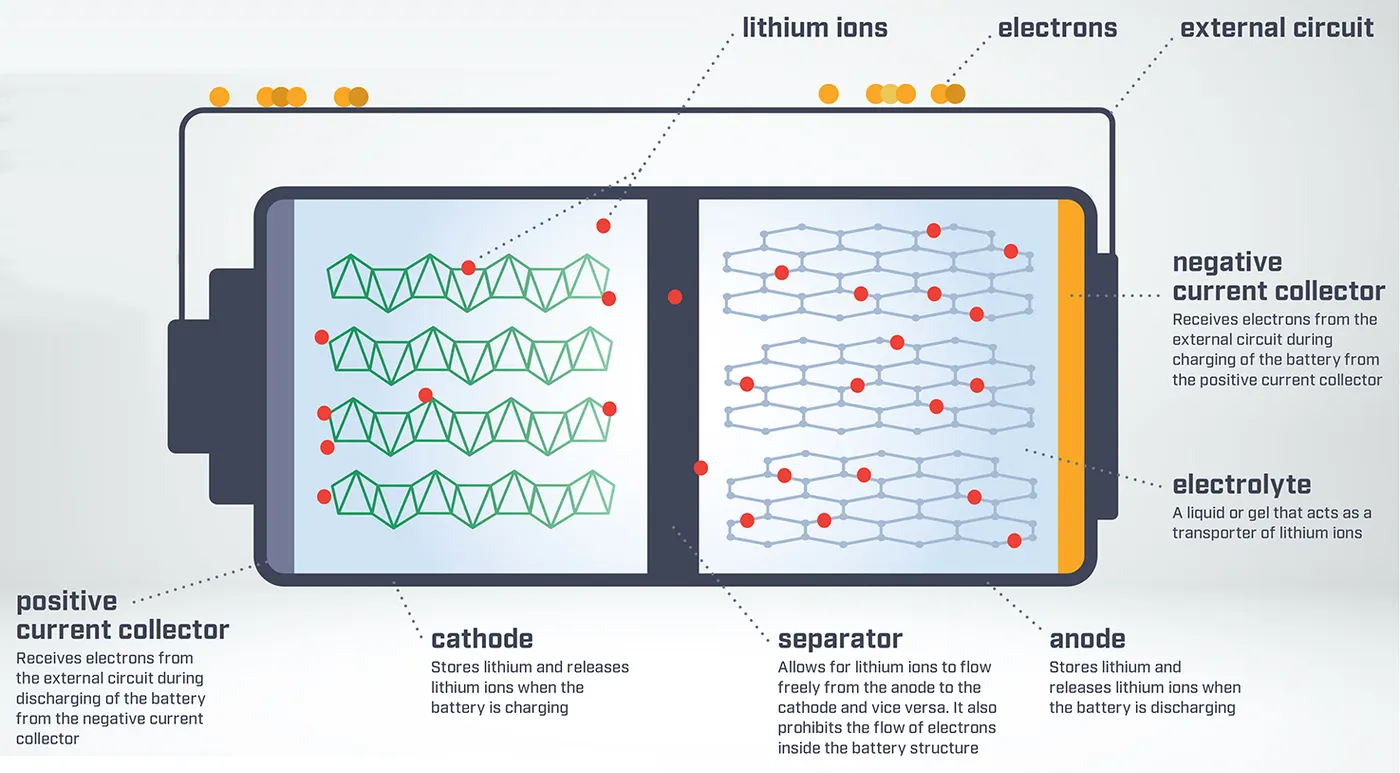
During discharge time Li ions moves from the negative electrode to positive electrode through the electrolyte and vice-versa in case of charging. Electrolytes allow only ions and not electrons, There is an separator to prevent the short circuits.
For example we take the battery of Lithium Manganese. When we charge the battery with external source, the electrons are attracted by positive terminal of the source from lithium manganese oxide . Electrons attracted by the positive terminal will move to the negative anode which is a graphite. This makes the positive ions of lithium get attracted to the negative electrode and thus the ions move through electrolyte, reaches the graphite. Thus it forms a lithium graphite, and all ions gets gets shifted to graphite which means the battery is fully charged.
While a load is connected across the battery, its starts discharging. Lithium ion from the lithium graphite leaves while discharging and become oxidized which means the electron gets moving from negative terminal to positive terminal through the load. The lithium ions gets oxidized by passing through the electrolyte and gets stabe forming lithium manganese oxide. Which means fully discharged. At charging redcution takes place and during discharging oxidation takes place which is known to be redox reaction.
SOLUTION 2:
SPECIFIC POWER DENSITY : Power density is measured in watts per kilogram (W/kg) and is the amount of power that can be generated by the battery with respect to its mass.
SPECIFIC ENERGY DENSITY : Energy density is measured in watt-hours per kilogram (Wh/kg) and is the amount of energy the battery can store with respect to its mass.
Lithium Cobalt Oxide(LiCoO2) — LCO
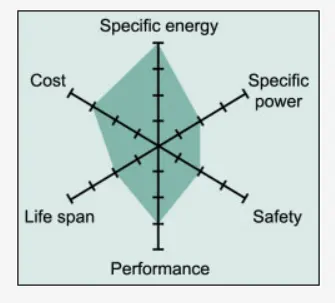
Very high specific energy, limited specific power. Cobalt is expensive. Serves as Energy Cell. Battery cycle range 500–1000. 3.60V nominal; typical operating range 3.0–4.2V/cell. Specific energy 150–200Wh/kg. Applications are Mobile phones, tablets, laptops, cameras.
Lithium Manganese Oxide (LiMn2O4) — LMO
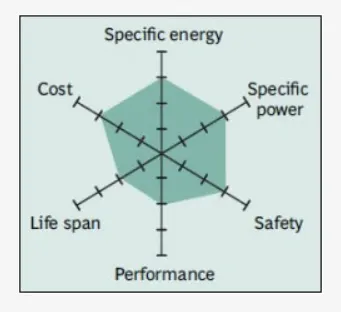
High power but less capacity; safer than Li-cobalt; commonly mixed with NMC to improve performance. 3.70V (3.80V) nominal; typical operating range 3.0–4.2V/cell. Specific energy 100–150Wh/kg, Cycle life 300–700, Applications are Power tools, medical devices, electric powertrains.
Lithium Nickel Manganese Cobalt Oxide (LiNiMnCoO2) — NMC
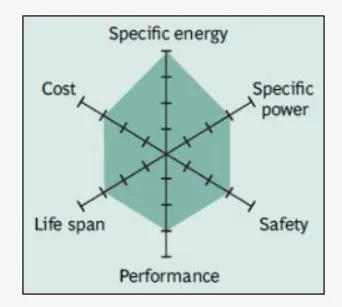
Provides high capacity and high power, Serves as Hybrid Cell, 3.60V, 3.70V nominal; typical operating range 3.0–4.2V/cell, Specific energy 150–220Wh/kg, Cycle life 1000–2000, Applications E-bikes, medical devices, EVs, industrial.
Lithium Iron Phosphate(LiFePO4) — LFP
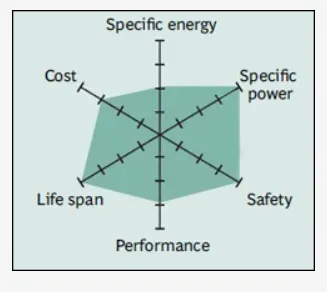
Very flat voltage discharge curve but low capacity. One of safest Li-ions, 3.20, 3.30V nominal; typical operating range 2.5–3.65V/cell, Cycle life 2000 and higher, Specific energy 90–120Wh/kg, Applications Portable and stationary needing high load currents and endurance.
Lithium Nickel Cobalt Aluminum Oxide (LiNiCoAlO2) — NCA
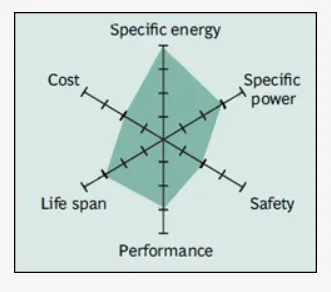
Shares similarities with Li-cobalt. Serves as Energy Cell. Mainly used by Panasonic and Tesla. 3.60V nominal; typical operating range 3.0–4.2V/cell, Cycle life 500, Specific energy 200-260Wh/kg, Applications Medical devices, industrial, electric powertrain (Tesla).
Lithium Titanate (Li2TiO3) — LTO
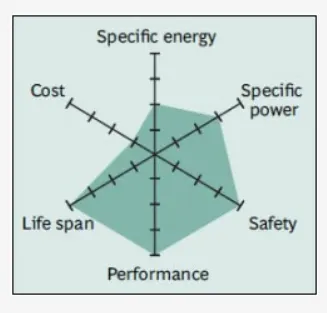
Long life, fast charge, wide temperature range but low specific energy and expensive. Among safest Li-ion batteries. Ability to ultra-fast charge; 2.40V nominal; typical operating range 1.8–2.85V/cell, Specific energy 50–80Wh/kg, Cycle life 3,000–7,000, Applications UPS, electric powertrain (Mitsubishi i-MiEV, Honda Fit EV), solar-powered street lighting.