Final Project: Design of an Electric Vehicle
Create a MATLAB model of electric car which uses a battery and a DC motor. Choose suitable blocks from Powertrain block set. Prepare a report about your model including following:
Objectives:
1. System level configurations
2. Model parameters
3. Results
4. Conclusion
EV's NECESSITY:
The electric car (EV) is a relatively new concept in the world of the automotive industry. Although some companies have based their entire model of cars around being proactive and using electricity, some also offer hybrid vehicles that work off both electricity and gas. An electric car such as Nissan Leaf, Ford Focus Electric or Tesla Model S, Chevrolet Volt is a great way for you to not only save money but also help contribute towards a healthy and stable environment.
Cars produce a lot of carbon emissions that are ejected into our natural atmosphere, leaving us vulnerable to things like pollution and greenhouse gases. In order to positively help the environment we live in, an electric car is a great step forward.
By buying an electric car, you can also receive government subsidies for being environmentally conscious. Although you may end up paying more for your vehicle, the positives greatly overshadow the negatives. However, there are still two sides to consider when you’re thinking about investing in an electric vehicle. EV’s get their power from rechargeable batteries installed inside the car. These batteries are not only used to power the car but also used for the functioning of lights and wipers.
Electric cars have more batteries than a regular gasoline car. It’s the same kind of batteries that are commonly used when starting up a gasoline engine. The only difference comes in the fact that in electric vehicles, they have more of them, which are used to power the engine. An electric car can be a great way for you, as a consumer, to save a lot of money on gas. However, there are so many different reasons why you should invest in an electric car in the modern-day of technology.
NO GAS REQUIRED: Electric cars are entirely charged by the electricity you provide, meaning you don’t need to buy any gas ever again. Driving fuel-based cars can burn a hole in your pocket as prices of fuel have gone all-time high.
MORE CONVENEINT: The electric vehicle is easy to recharge, and the best part is you will no longer need to run to the fuel station to recharge your car before hitting the road! Even a normal household socket could be used for charging an electric car.
SAVINGS: These cars can be fuelled for very low prices, and many new cars will offer great incentives for you to get money back from the government for going green. Electric cars can also be a great way to save money in your own life.
NO EMISSIONS: The biggest advantage of an electric vehicle is its green credential. Electric cars are 100 percent eco-friendly as they run on electrically powered engines. It does not emit toxic gases or smoke in the environment as it runs on a clean energy source. They are even better than hybrid cars as hybrids running on gas produce emissions. You’ll be contributing to a healthy and green climate.
POPULARITY: EV’s are growing in popularity. It is nearly three times as efficient as cars with an internal combustion engine. With popularity comes all new types of cars being put on the market that are unique, providing you with a wealth of choices moving forward.
SAFE TO DRIVE: Electric cars undergo the same fitness and testing procedures test as other fuel-powered cars. An electric car is safer to use, given their lower center of gravity, which makes them much more stable on the road in case of a collision. In case an accident occurs, one can expect airbags to open up and electricity supply to cut from the battery. This can prevent you and other passengers in the car from serious injuries. They are even less likely to explode in the absence of any combustible fuel or gas.
COST-EFFECTIVE: Earlier, owning an electric car would cost a bomb. But with more technological advancements, both cost and maintenance have gone down. The mass production of batteries and available tax incentives further brought down the cost, thus, making it much more cost-effective.
LOW MAINTENANCE: Electric cars run on electrically powered engines, and hence there is no need to lubricate the engines, anything related to the combustion engine or a ton of maintenance tasks that are usually associated with a gas engine. Other expensive engine work is a thing of the past. Therefore, the maintenance cost of these cars has come down. You don’t need to send it to the service station often as you do for a standard gasoline-powered car.
REDUCED NOISE POLLUTION: Electric cars put a curb on noise pollution as they are much quieter. Electric motors are capable of providing smooth drive with higher acceleration over longer distances.
BATTERY & COST: Batteries are an integral part of an electric vehicle. Most electric vehicle batteries are lithium ones, and their costs are improving every year. The full capacity of a lithium-ion battery cell should be good for 300 to 500 cycles. A good battery could last you up to ten years. With the improving technologies, the cost of these batteries is expected to come down even more.
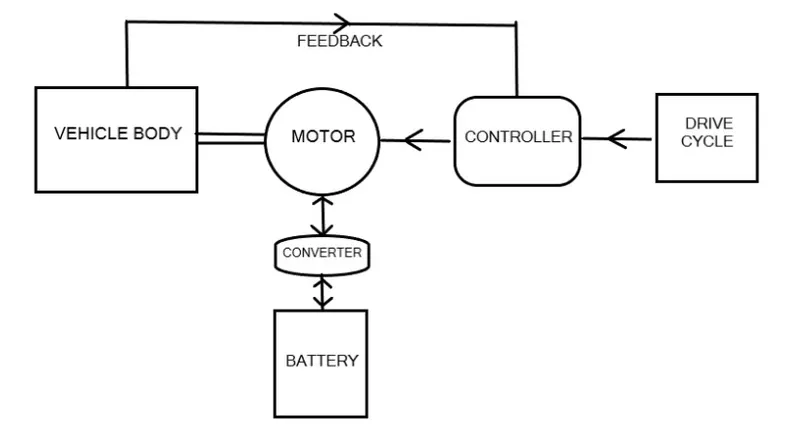
BLOCK DIAGRAM OF EV:
Basic idea and outline of EV vehicle.
Simulink model for EV:
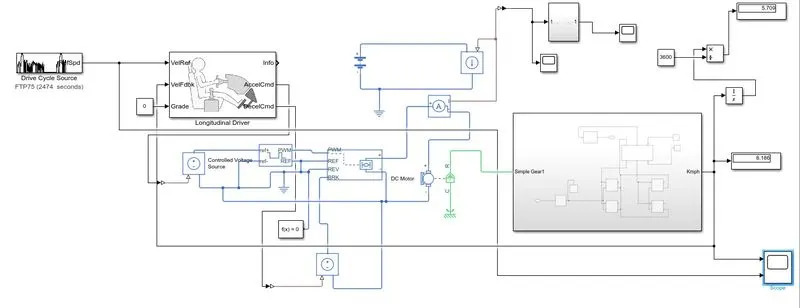
This simulink model consists of a
- drivecycle
- longitudional driver
- battery
- controlled voltage source
- H-Bridge
- controlled PWM voltage
- solver configuration
- controlled current source
- DC motor
- current sensor
- electrical reference
- mechanical rotational reference
- scope
- display
- integrator
- divider
- adder
- gain
- vehicle body
- tire
- inertia
- simple gear
- rate transition
- Discrete time integrator
- Zero order hold
- PS constant
- constants
Detailed explanation on the process:
Vehicle Body subsystem:
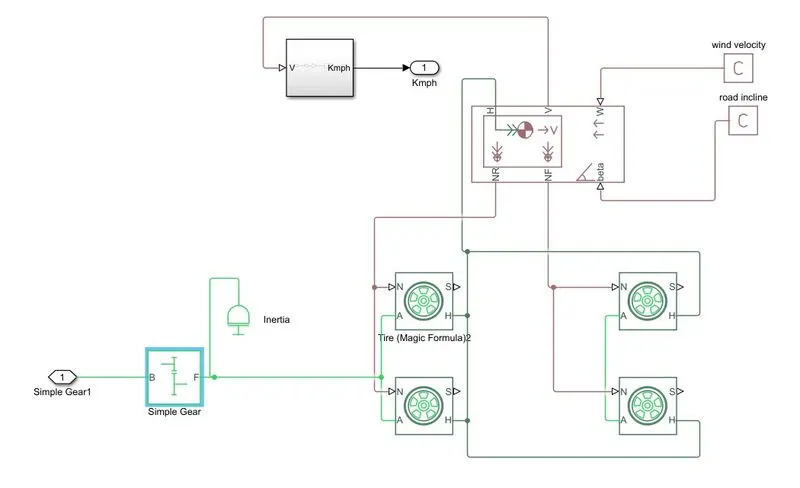
This is the subsystem of the vehicle body where the subsystem consists of vehicle body, tire(magic formula), PS constant, simple gear, inertia and an another subsystem to convert miles into Kilometers.
Vehicle body:
Vehicle body consists of all parametrs which mainly includes mass, distribution of weights from centre of gravity, aero-dynamics, road inclination, wind factor.
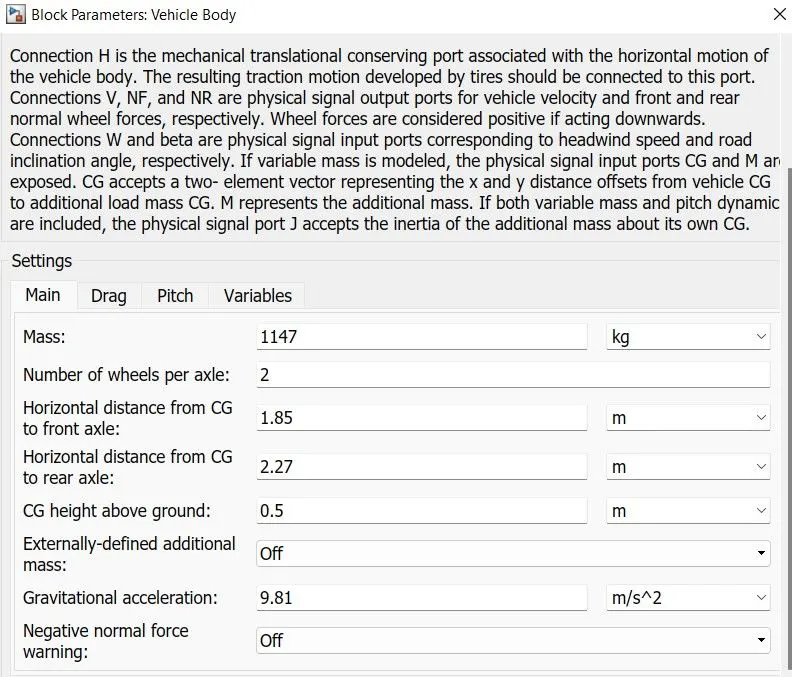
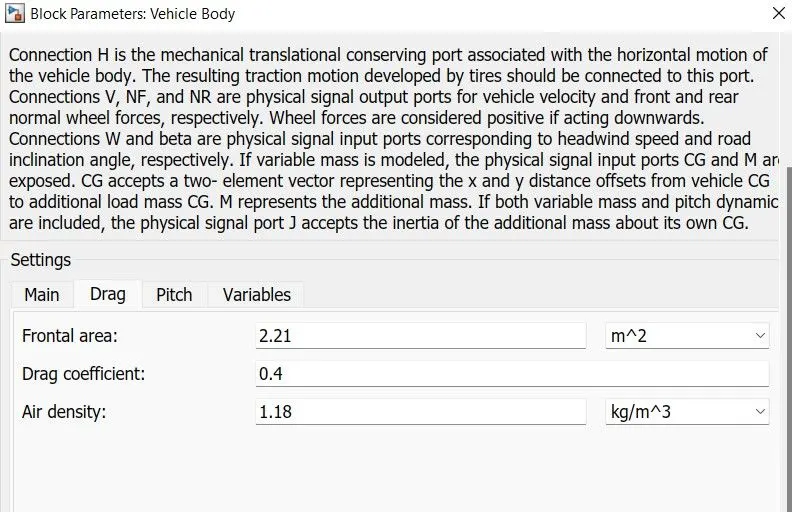
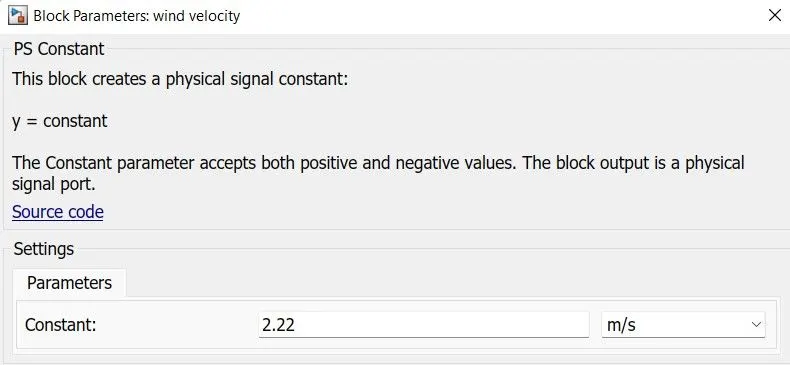
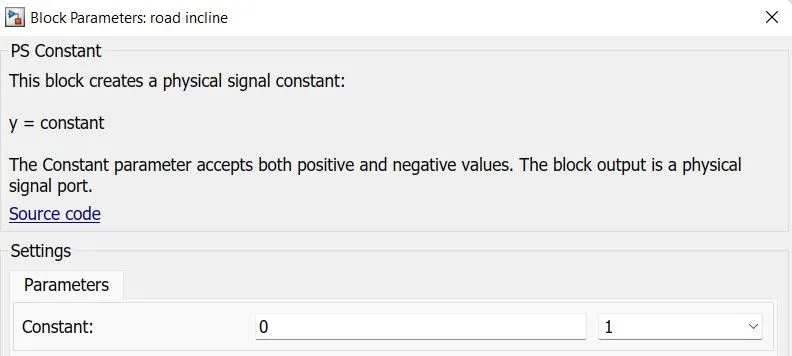
Wind velocity and road inclination simulation is done by the blocks of PS constant where they could convert the digital into physical signals.
TIRE (magic formula):
The Tire (Magic Formula) block models the tire as a rigid wheel-tire combination in contact with the road and subject to slip. When torque is applied to the wheel axle, the tire pushes on the ground (while subject to contact friction) and transfers the resulting reaction as a force back on the wheel. This action pushes the wheel forward or backward.
The Magic Formula is a specific form for the tire characteristic function, characterized by four dimensionless coefficients, B, C, D, and E, or stiffness, shape, peak, and curvature. A is an axle, H is a hub, s is slip and N is the nominal force acting on the tire and connected with the NR of vehicle body.
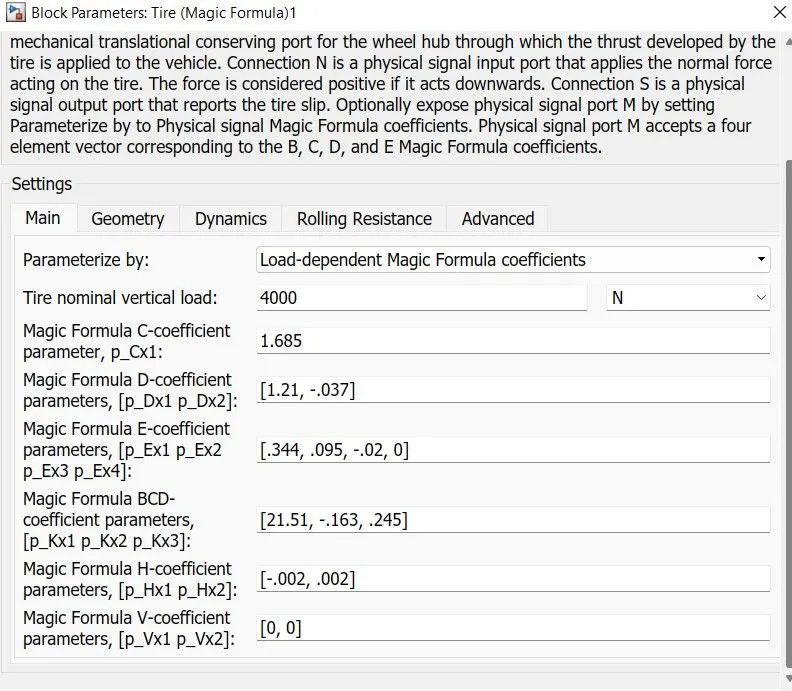
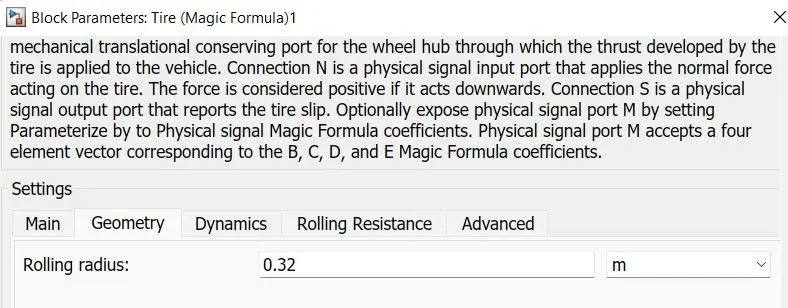
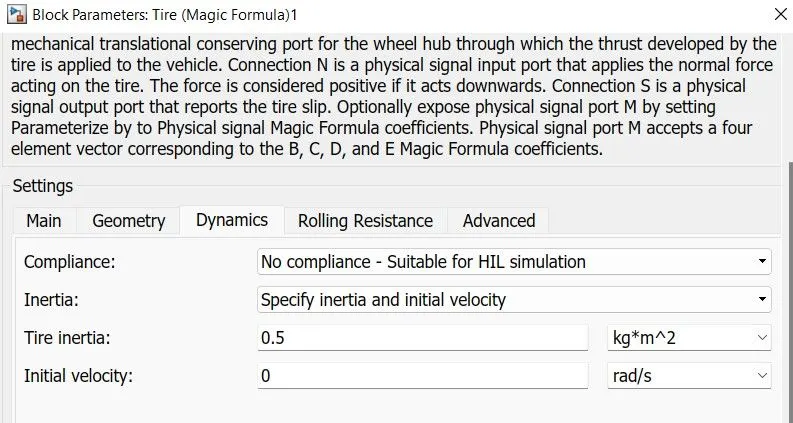
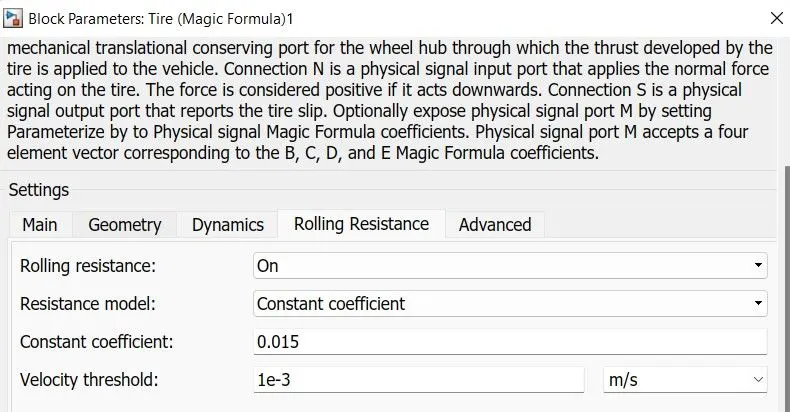
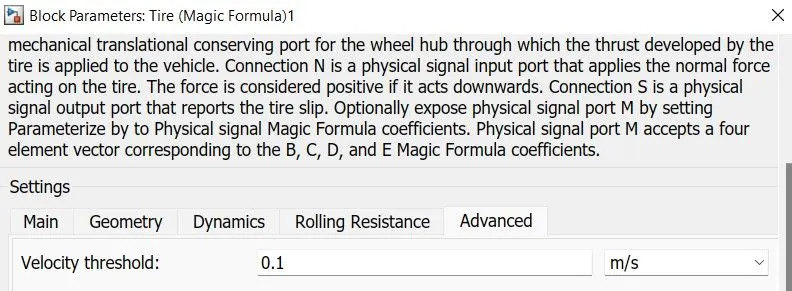
Following are the parameters assigned for simulation.
SIMPLE GEAR:
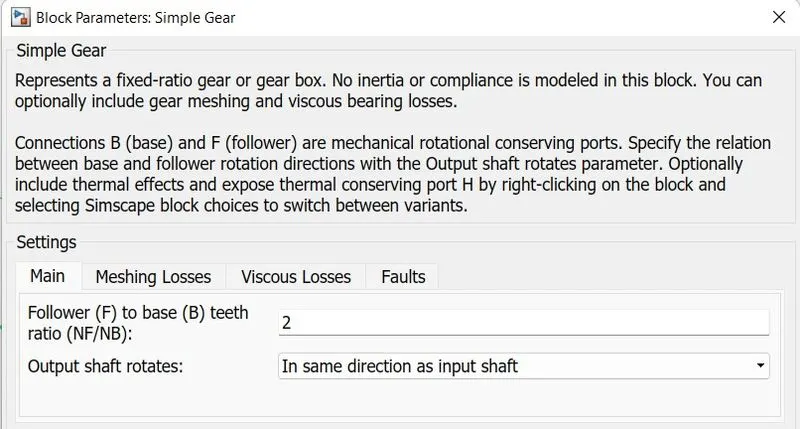
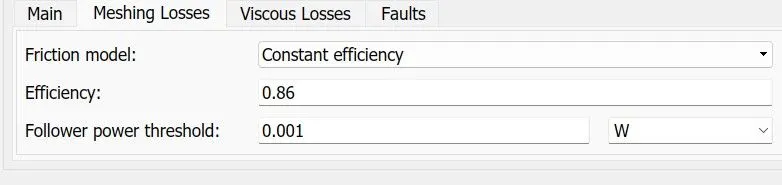
Gear has a input driving from motor and connected along with the axle. Along with that the inertia is connected.
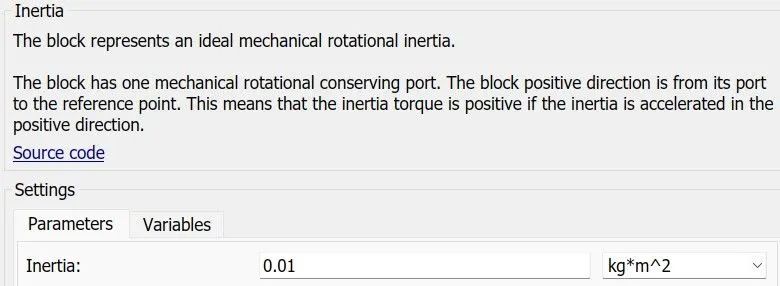
The subsystem to covert miles to km:
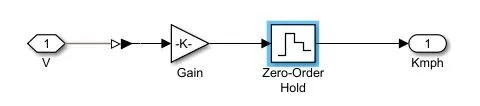
The longitudional velocity from vehicle body is connected to the gain (i.e) 1.6 and zero-order hold. The Zero-Order Hold block holds its input for the sample period you specify.
And the output from subsytem is connected with the integrator block. The integrator block integrates values from the subsystem with respect to time for determining the distance and to convert it into hours by dividing with constant value 3600.
DC MOTOR:
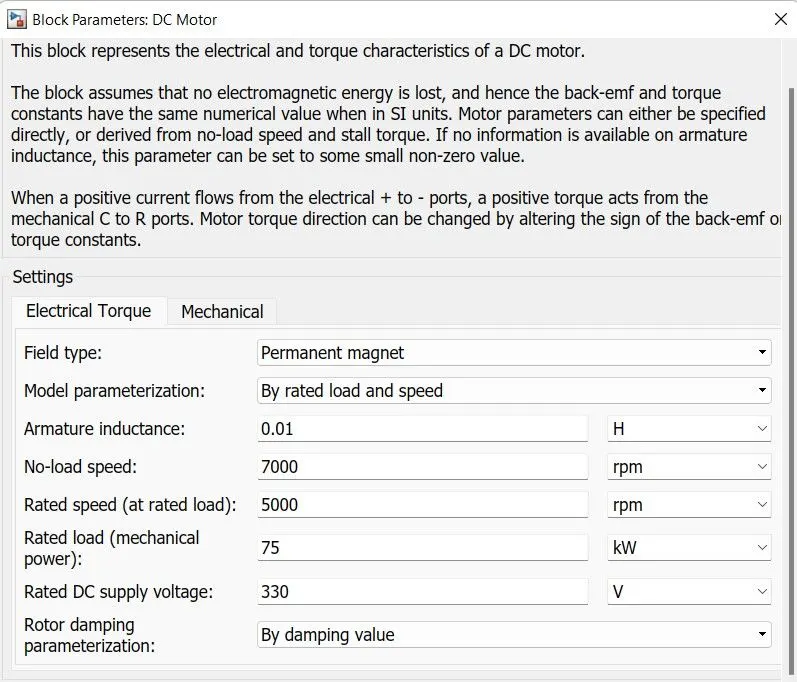
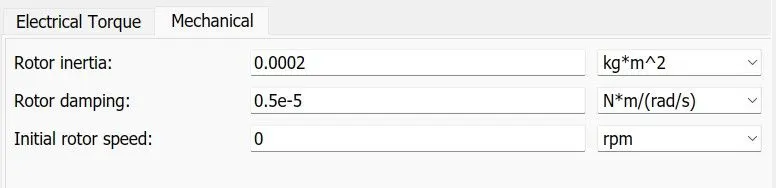
These are the following parameters used in the DC block. The input to DC motor is given by H-bridge. Where H bridge acts as a converter and aslo a battery source. This gives required power for the motor to start.
H-BRIDGE:
The H-Bridge block output is a controlled voltage that depends on the input signal at the PWM port. If the input signal has a value greater than the Enable threshold voltage parameter value, the H-Bridge block output is on and has a value equal to the value of the Output voltage amplitude parameter. If it has a value less than the Enable threshold voltage parameter value, the block maintains the load circuit using one of the following three Freewheeling mode options:
- via one semiconductor switch and one freewheeling diode
- via two freewheeling diode
- via 2 semiconductor switches and one freewheeling diode.
The first and third options are sometimes referred to as synchronous operation.
The signal at the REV port determines the polarity of the output. If the value of the signal at the REV port is less than the value of the Reverse threshold voltage parameter, the output has positive polarity; otherwise, it has negative polarity.
Braking mode is invoked when the voltage presented at the BRK port is larger than the Braking threshold voltage. Regardless of whether in PWM or averaged mode, when in braking mode the H-bridge is modeled by a series combination of two resistances R1 and R2.
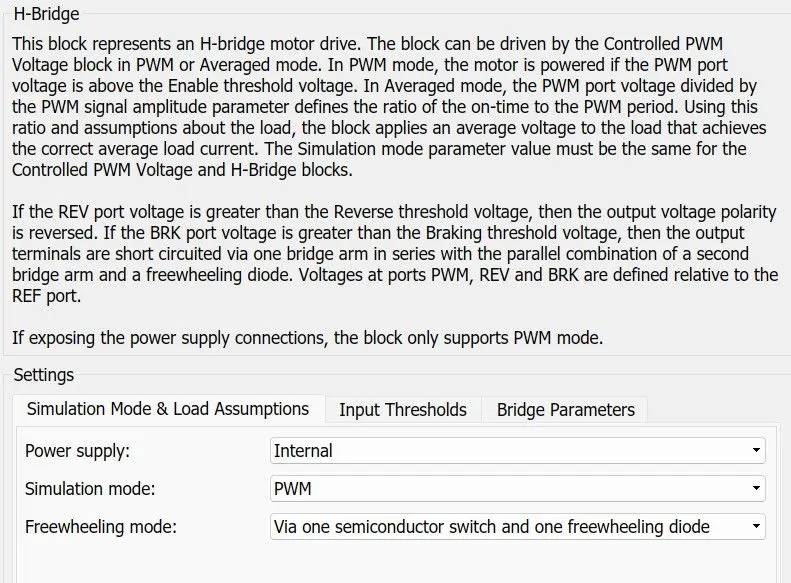
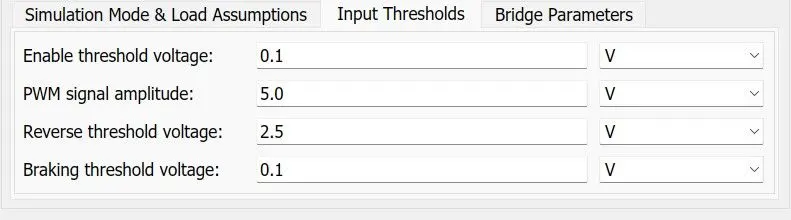
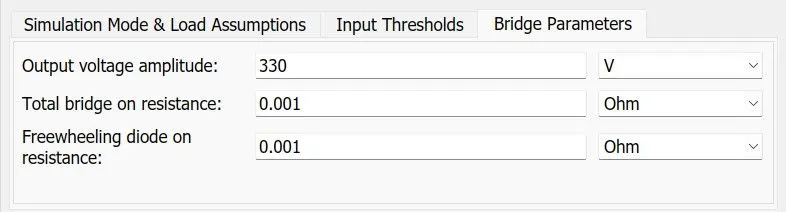
Following are the parameters assigned to H-Bridge. And the input to H-brige is controlled by CONTROLLED PWM VOLTAGE.
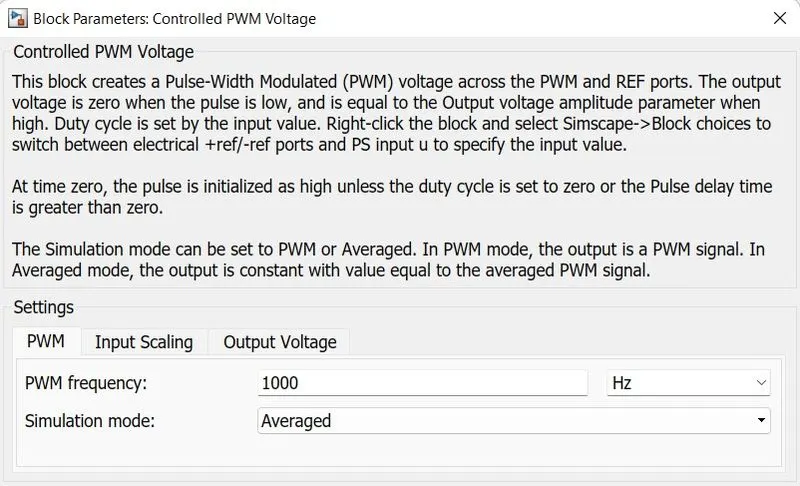
The Controlled PWM Voltage block represents a pulse-width modulated (PWM) voltage source.


There is a controlled voltage source connected at reference port of the Controlled PWM voltage.
The Controlled Voltage Source block represents an ideal voltage source that is powerful enough to maintain the specified voltage at its output regardless of the current flowing through the source.
The output voltage is V = Vs. This controlled voltage source is connected with a port of acceleration command of the longitudional driver block. And the decelration command is connected with another controlled voltage source along the brake port of H-Bridge.
LONGITUDIONAL DRIVER:
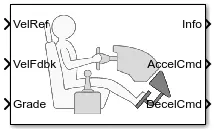
The Longitudinal Driver block implements a longitudinal speed-tracking controller. Based on reference and feedback velocities, the block generates normalized acceleration and braking commands that can vary from 0 through 1.
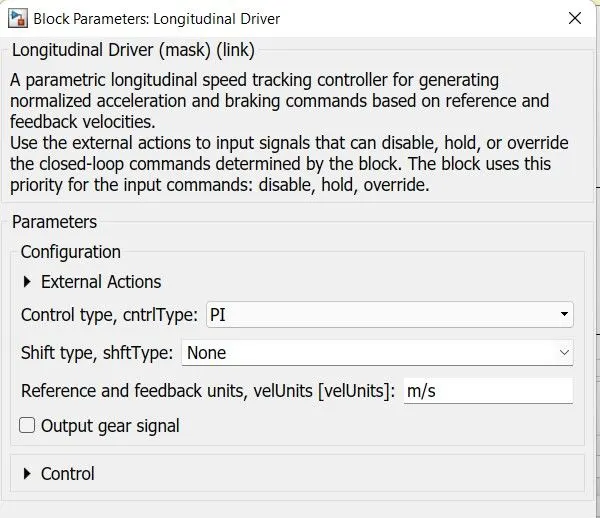
Grade port of the block is assigned to 0. Vehiclespeed feedback is taken from the subsystem of vehicle body. Drivecycle is connected to the vehicle reference port.
DRIVE CYCLE:
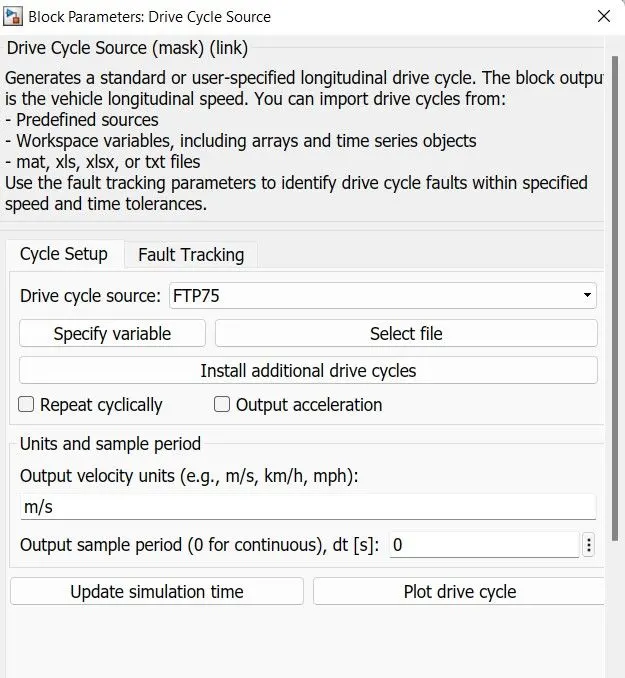
And there is a SOC subsystem to know the charging and discharging of a battery when driving a drivecycle with required systems. Where a current sensor is connected between H bridge and motor terminal to sense the flow of current to motor. And we consider at starting stage the battery is fully charged. The battery is connected along the controlled current source and to the SOC subsystem.
BATTERY:
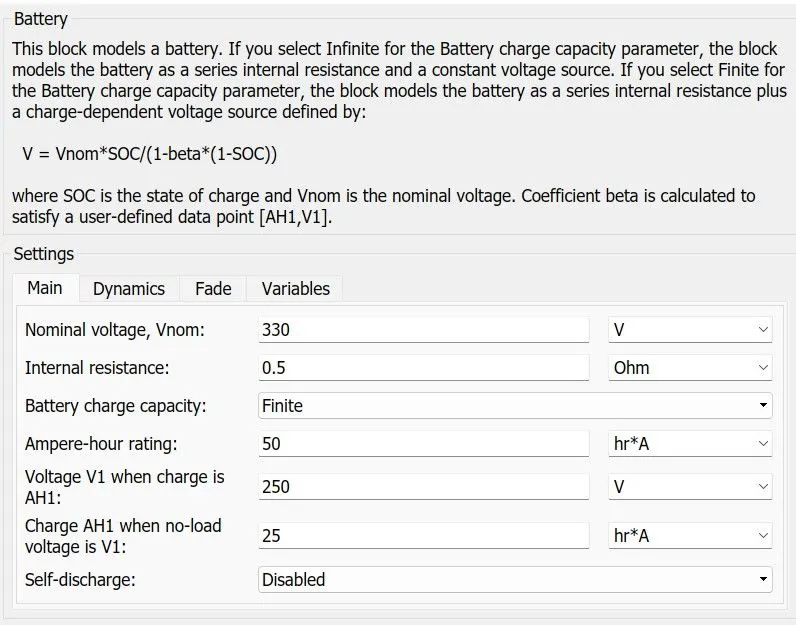
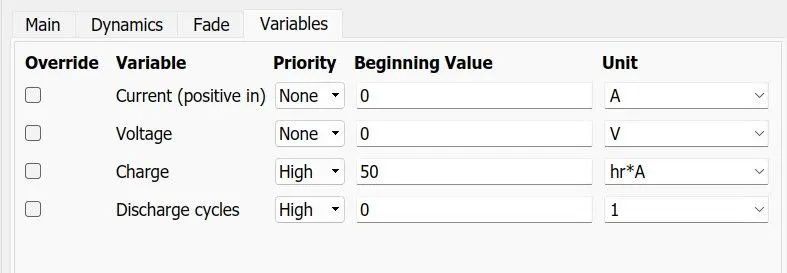
SOC SUBSYSTEM:
This subsystem consists of rate transition, gain, discrete time integrator.
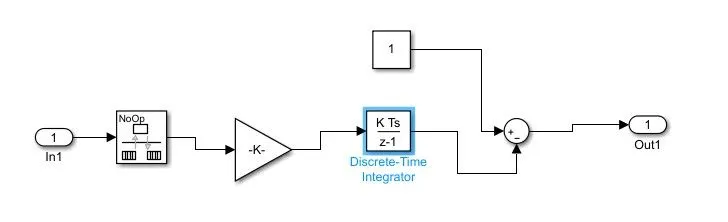
RATE TRANSITION:
The Rate Transition block transfers data from the output of a block operating at one rate to the input of a block operating at a different rate.
GAIN:
Gain value is 1/(50*3600).
DISCRETE TIME INTEGRATOR:

Use the Discrete-Time Integrator block in place of the integrator block to create a purely discrete model. With the Discrete-Time Integrator block, you can:
-
Define initial conditions on the block dialog box or as input to the block
-
Define an input gain (K) value
-
Output the block state
-
Define upper and lower limits on the integral
-
Reset the state with an additional reset input.
And then connected to scope to view the discharging time.
RESULT:
SOC:
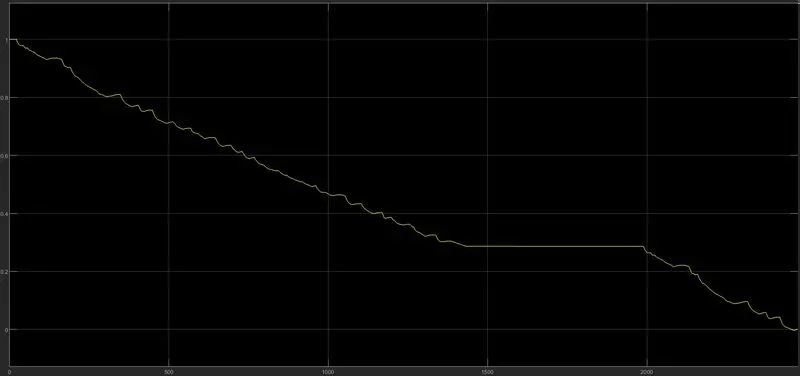
We can see many small spikes moving upwards that is the battery gets charged while braking because of the regenerative system. At starting the charge was full and at the end of simulation-only 10% of charge is left.
CURRENT:
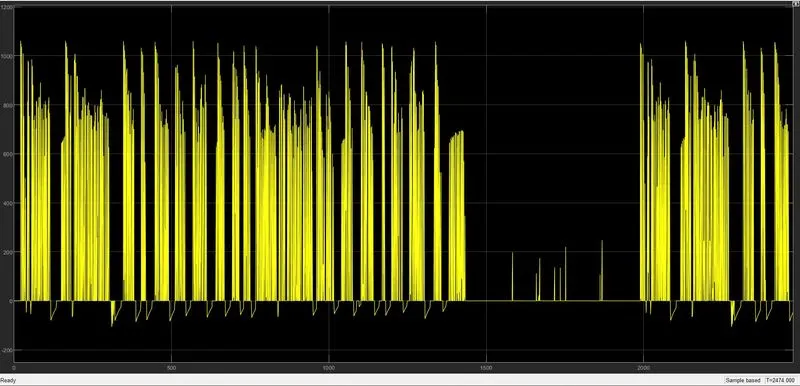
Below plot shows the current drawn by the motor from the battery and there are negative spikes shows us the motor acts as a generator at regenerative braking method which acts as a source and charge the battery.
SPEED:
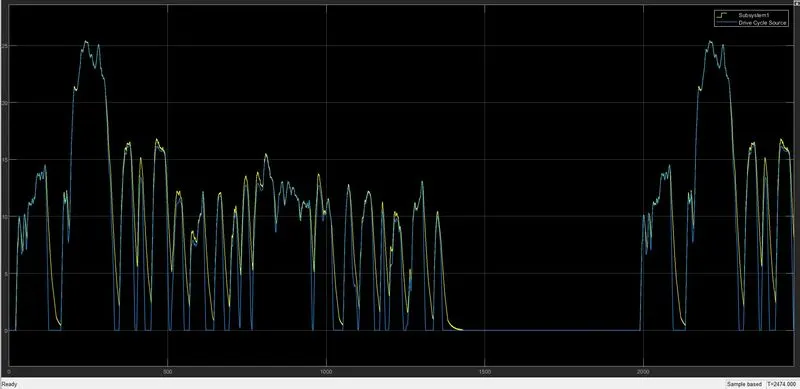
Above plot shows the comparison between drive cycle and vehicle speed. This plot tells whenever the speed increases or decreases , feedback signal sent to the longitudional driver gives the command for acceleration or deceleration or braking. In such a way the Controlled PWM voltage sends the signal to H bridge on or off and following operations are done in the simulation.
CONCLUSION:
SIMULINK MODEL of EV is designed and travelled 5.09km in the drive cycle of FTP75.
LINK: https://drive.google.com/file/d/1-NnfOnnMHoVz1tWe5G_6Kb7eS7yGvZdz/view?usp=sharing