Project 2 Thermal modeling of battery pack
THERMAL MODELLING OF A BATTERY PACK
OBJECTIVE:
For a 10 cell series lithium ion battery model, simulate the thermal effects and compare life cycle performance at various temperatures, charge & discharge rates using MATLAB.
SOLUTION:
Model of 10 series lithium ion battery
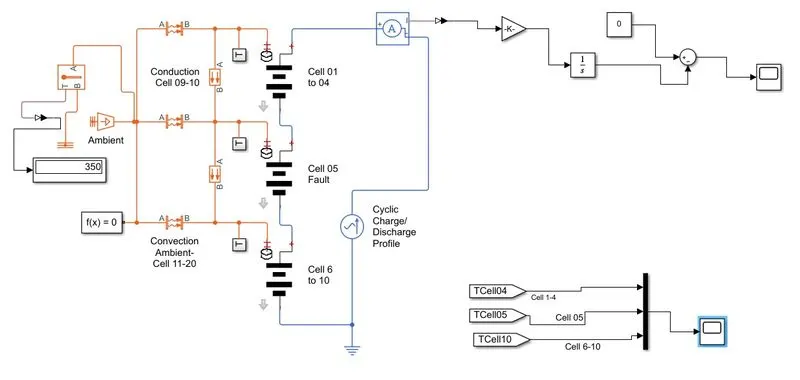
Blocks used to built are lithium cell, conductive heat transfer, convective heat tansfer, temperature source, PS converter, Temperature sensor, current sensor, AC current source, gain block, Integrator, Sum, Scope, GoTo, From To, Solver configuration, Thermal referrence, Mux.
This model shows how the faulted battery works with the good ones and how the thermal effect changes accordingly. The ambient temperature is set and the temperature is transferred by convective method between two bodies using fluid motion to the lithium cell. Then conductive heat transfer block is used for conduction of heat between the materials. Temperature sensor is used to sense the temperature from the temperature source and display is connected to view the value of ambient temperature. AC source is connected to have a cyclic charge and discharge characteristics when connected across the series battery pack. Current sensor is connected across the battery to sense the charging and discharging current. Then it is converted to ampere hours and integrated with respective to time. Thus the discharge and charging cycles are plotted. We could see the block with the T inside it. It is a subsystem having a temperature sensor to sense the cells temperature while functioning. We could compare the results of faulty cell and good cells to get a clear view on thermal effects and discharge rates.
Cell 1 to 4, Cell 5, Cell 6 to 10 parameters
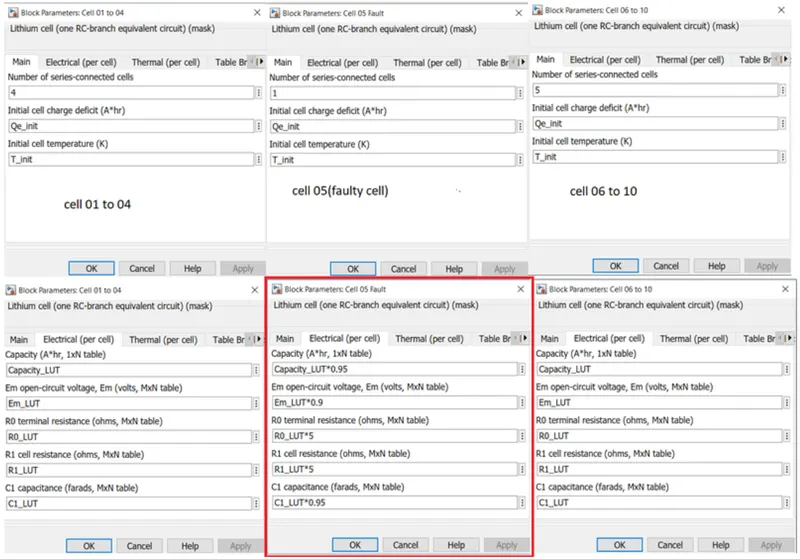
Electrical parameters alone changed for the cell 5 to make it as a faulty one. Initial temperatures are varied for cells along with the ambient temperature.
Controlled Heat Flow Rate Source:
The Controlled Heat Flow Rate Source block represents an ideal source of thermal energy that is powerful enough to maintain specified heat flow at its outlet regardless of the temperature difference across the source.
Conductive Heat Transfer:
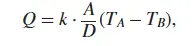
The Conductive Heat Transfer block represents a heat transfer by conduction between two layers of the same material. The transfer is governed by the Fourier law:
Convective Heat Transfer:
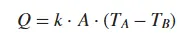
The Convective Heat Transfer block represents a heat transfer by convection between two bodies by means of fluid motion. The transfer is governed by the Newton law of cooling:
The Temperature Sensor block represents an ideal temperature sensor, that is, a device that determines the temperature differential measured between two points without drawing any heat.
Connections A and B are thermal conserving ports that connect to the two points where temperature is being monitored. Port T is a physical signal port that outputs the temperature differential value.
The block positive direction is from port A to port B. The measured temperature is determined as T = TA – TB.
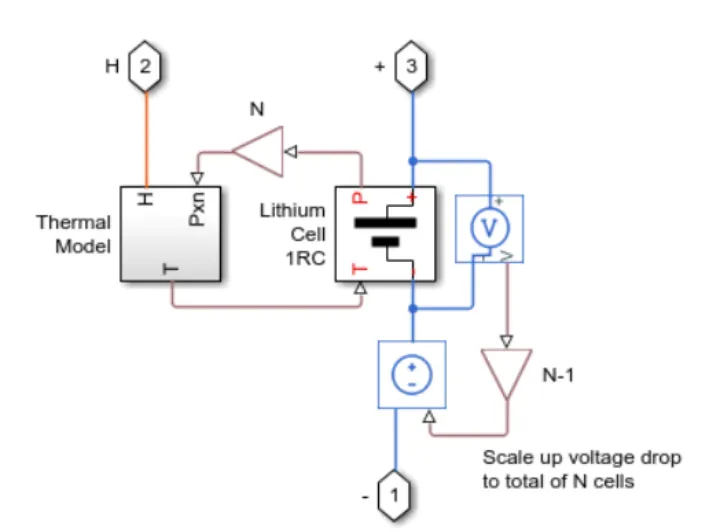
Inside the cell there is a subsystem of thermal model and lithium cell 1RC equivalent circuit. Voltage sensor connected across the cell to detect the voltage drop and gain added to it to scale up the voltage drop to total number of cells connected, Then it is fed to current-voltage source where to mainatin the voltage output regardless of current passing through the block. There is another subsystem inside the cell which looks like a equivaelnt circuit.
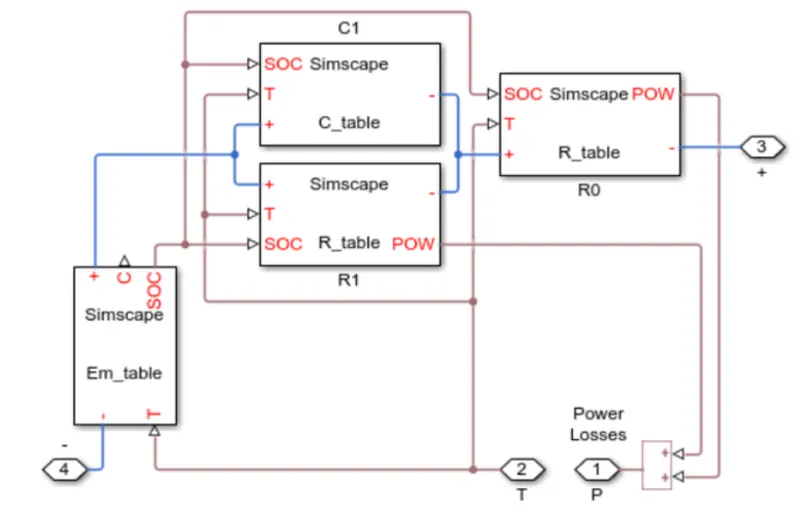
Resistance R1 is connected across the capacitor C1 and connected in series with R0. Capacitor table, R1, R2 table totally depends on SOC, T. The Em_table which is nothing but a voltage source will receives the temperature value and based on that SOC value is taken from the table and given to C1, R1, R0. The power losses are taken from R1, R2 and fed to thermal model subsystem. Temperature sensor connected across thermal mass and source to sense the temperature. Then the signal is fed to the RC circuit subsystem.
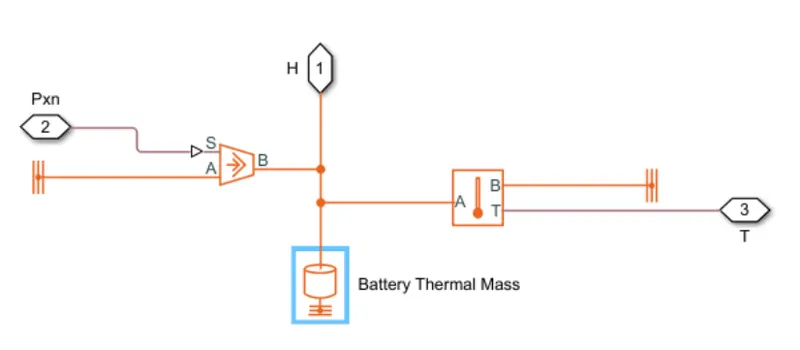
The power lossed are fed to the controlled heat flow rate source represents an ideal source of thermal energy that is powerful enough to maintain specified heat flow at its outlet regardless of the temperature difference across the source. The battery thermal mass is connected along which reflects the ability of a material or a combination of materials to store internal energy. The property is characterized by mass of the material and its specific heat.
RESULT:
Ambient temperature- 299k
Cells temperature- 299k
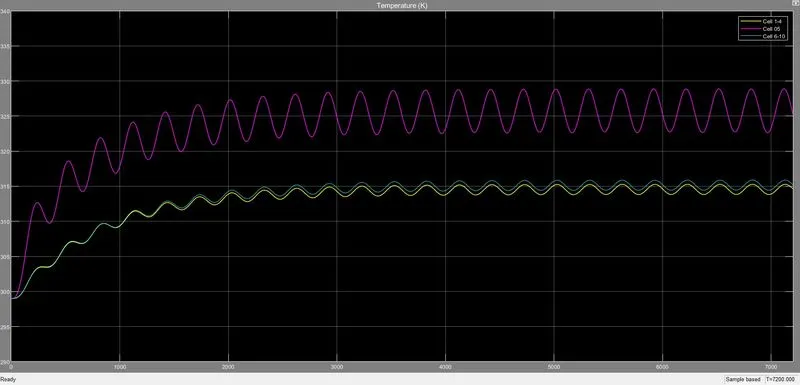
Faulty cell 5 in purple one shows much deviation on the temperature.
Charge and discharge cycle rates: For 3600 secs battery pack has completed 6 cycles.
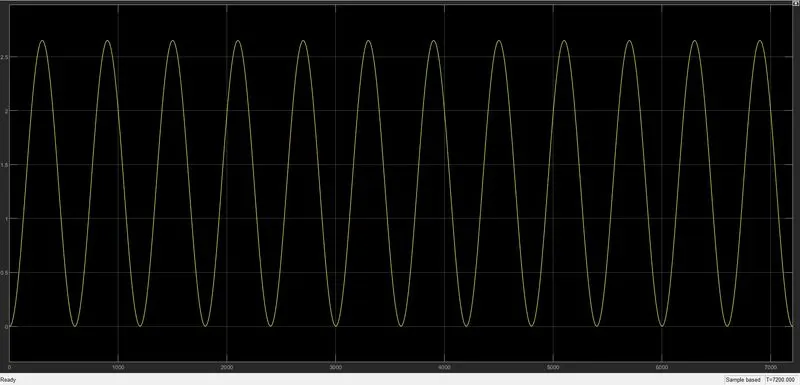
Ambient temperature- 299k
Cells temperature 1to4, 6to10- 299k
Cell temperature 5 - 3 - 200k
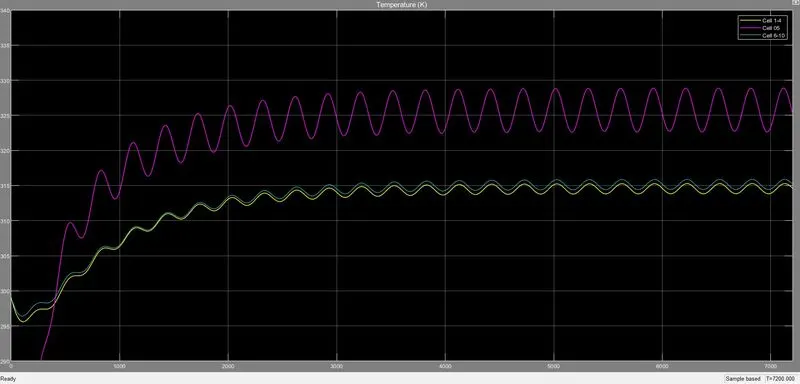
Faulty cell 5 in purple one shows much deviation on the temperature.
Charge and discharge cycle rates: For 3600 secs battery pack has completed 6 cycles.
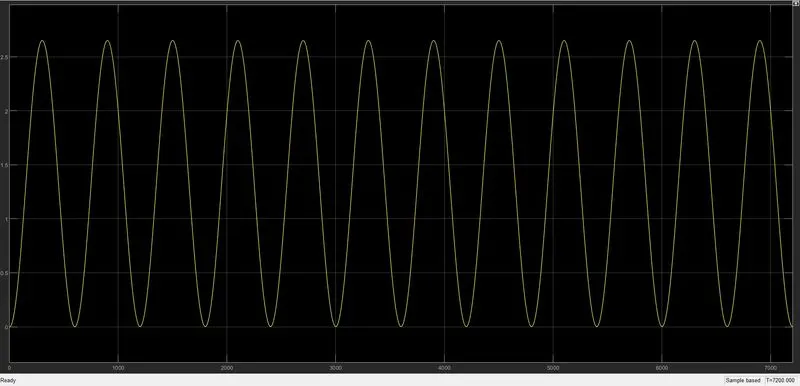
Ambient temperature- 350k
Cells temperature- 299k
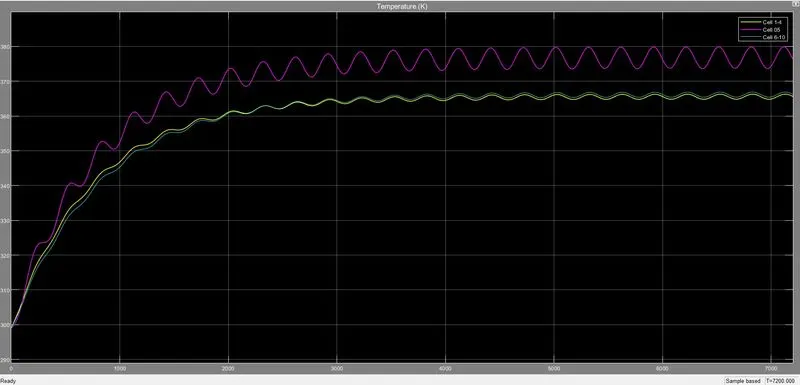
When ambient temperature is increased every cells in battery pack is increased.
SOC remains the same
LINK: https://drive.google.com/file/d/1kvtsMi9CcO7MB47tsT39v-j6quZM4Ufo/view?usp=sharing