Week 1 Understanding Different Battery Chemistry
Ans.1)
The table to compare different types of Li-ion batteries are:-
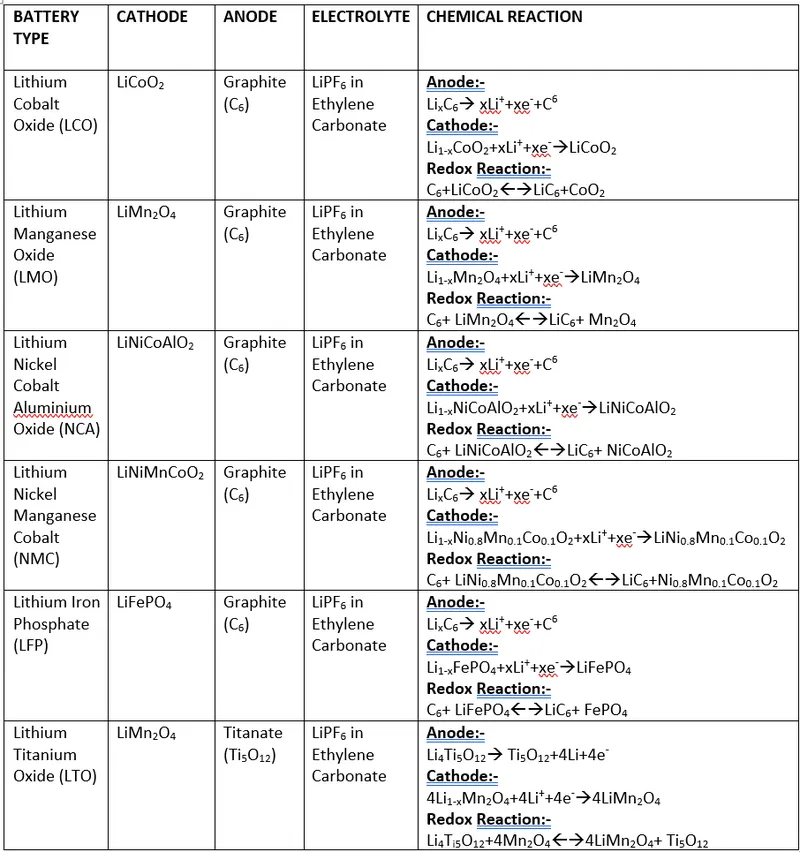
Types of Lithium ion battery are:-
1. Lithium cobalt oxide :- LiCoO2 (LCO)
Also known as lithium cobaltate or lithium-ion cobalt batteries, lithium cobalt oxide batteries are made from lithium carbonate and cobalt. They have a cobalt oxide cathode and use graphite carbon as their anode material; during discharge, lithium ions move from anode to cathode, with the flow reversing when the battery is charging. This type of battery has some drawbacks. including a relatively short battery life and limited specific power, additionally, these batteries are not as safe as other types
2. Lithium Manganese Oxide :- LiMn2O4 (LMO)
The first commercial lithium-ion cells made with lithium manganese oxide as a cathode material were produced in 1996 by Moli Energy. Lithium manganese oxide batteries are notable for their high temperature stability and are also safer than other lithium-ion battery types For this reason, they are often used in medical equipment and devices, but they may also be used in power tools, electric bikes and more. It is also possible to use lithium manganese oxide batteries to power laptops and electric powertrain cars.
3. Lithium Nickel Cobalt Aluminium Oxide :- LiNiCoAlO2 (NCA)
Lithium nickel cobalt aluminum oxide batteries are also called NCA batteries and are becoming increasingly important in electric powertrains and in grid storage. NCA batteries are not common in the consumer industry, but are promising for the automotive industry. NCA batteries provide a high-energy option with a good lifespan, but they are not as safe as they could be compared to other lithium-ion battery types and are quite costly.
4. Lithium Nickel Manganese Cobalt Oxide :- LiMnCoO2 (NMC)
Also known as lithium manganese cobalt axide or NMC batteries, include a cathode made of a combination of nickel, manganese and cobalt. Like other lithium-ion battery varieties, NMC batteries can have either a high specific energy density or a high specific power. They cannot. however, have both properties. This battery type is most common in power tools and in powertrains for vehicles. *The cathode combination ratio is usually 60% nickel, 20% manganese and 20% cobalt. This means that the raw materials cost is lower than it is for other lithium-ion battery options, as cobalt can be quite expensive These batteries may come down in price further in the future, as some battery makers are planning to switch their battery chemistry to a higher % of Nickel, so that they can use less cobalt. This battery type is commonly preferred for electric vehicles due to its very low self-heating rate.
5. Lithium Iron Phosphate :- LiFePo4 (LFP)
Lithium iron phosphate batteries, also known as li-phosphate batteries, use phosphate as a cathode. They benefit from low resistance properties, which enhance their safety and thermal stability. Other benefits include durability and a long lifecycle-fully charged batteries can be stored with little change to the total lifespan of the battery's charge. Li-phosphate batteries are often the most cost effective option as well when their long battery life is taken into consideration. However, the lower Voltage of the li-phosphate battery means that it has less energy than other types of lithium batteries. Accordingly, these batteries are often used in electric motorcycles as well as other applications that need a long lifecycle and significant safety.
6. Lithium Titanium Oxide:- LiTiO2 (LTO)
Finally, lithium titanate, also known as li-titanate, is a class of batteries that allows for ever-increasing applications, the main advantage of the li-titanate battery is its remarkably fast recharge time. Currently, manufacturers of electric vehicles and bikes use li-titanate batteries, and there is potential for this type of battery to be used in electric buses for public transportation. However, these batteries have lower inherent voltage, or lower energy density, than other lithium-ion battery varieties, which can present issues with powering vehicles efficiently. Even so, the density of lithium titanate batteries is still higher than other non-lithium-ion batteries, which is a plus.
Ans.2)
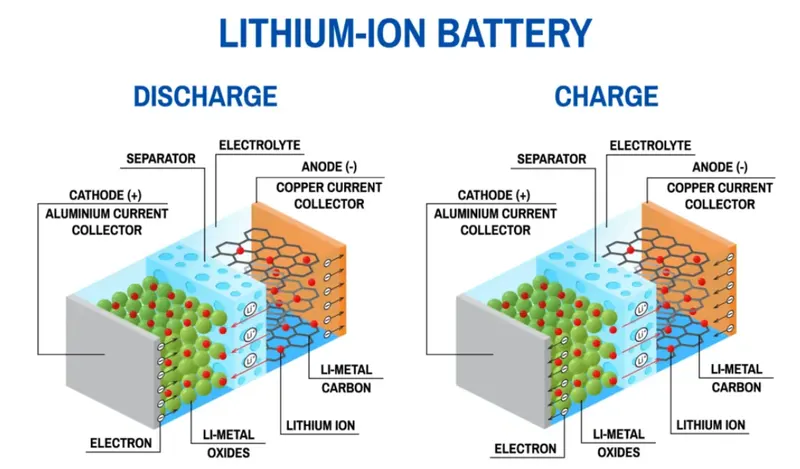
The differences between the lithium ion batteries can be differentiated on the characteristics:-
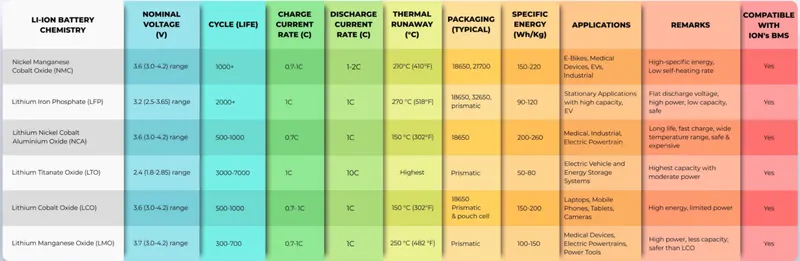
Nominal Voltage :- Most of the batteries are very close when it comes to characteristics. LMO (3.7) has the highest range and LTO (2.4) has the lowest range in volts.
Cycle life :- They differ by a significant amount from each other. LTO battery has the longest life cycle so that it can last longer period of time and it is exactly opposite for the LMO type batteries.
Charge current rate :- Higher the charge current, the less time the battery will take to get fully charged. LTO and LTP are highest NCA comes close to its condenders.
Discharge current rate :- If we need higher discharge rates and faster charging times we should choose a high rated battery instead. LTO has a discharge rate 10 times higher than the others and it t-is one of the safest batteries.
Thermal runaway :- A thermal runaway occurs in situations where an increase temperature changes the conditions in at way that causes increase in temperature often leading a destructive result. LTO has the highest temperature rating in this and NCA and LCP has its lowest.
Specific energy :- The specific energy density can be calculated by integrating from 0 to t_cutoff. We can obtain the specific energy density in Wh Kg^-1. Lithium ion with cobalt cathodes offer the highest energy densities. This types of applications are cell phones, laptops and digital cameras. Power density indicates how much power a battery can deliver on demand.
The type of Li+ion batteries based on their characteristics:-
1. Lithium cobalt oxide :- LiCoO2 (LCO)
Voltages:- 360V nominal typical operating range 30-42V/cell
Specific energy (capacity):- 150-200Wh/kg Specialty cells provide up to 240Wh/kg
Charge (C-rate) :- 0.7-1C, charges to 4.20V (most cells),3h charge typical. Charge current above 1C shortens battery life.
Discharge (C-rate) :- 1C ,2.50V cut off Discharge current above 1C shortens battery life
Cycle life :- 500-1000 related to depth of discharge load temperature
Thermal runaway :- 150°C (302°F) Full charge promotes thermal runaway
Applications :- Mobile phones, tablets laptops cameras
2. Lithium Manganese Oxide :- LiMn2O4 (LMO)
Voltages :- 3.70V (3.80V) nominal; typical operating range 3.0-4.2V/cell
Specific energy (capacity) :- 100-150Wh/kg
Charge (C-rate) :- 0.7-1C typical, 3C maximum, charges to 4.20V (most cells)
Discharge (C-rate) :- 1C, 10C possible with some cells 30C pulse (5s). 2.50V cut-off
Cycle life :- 300-700 (related to depth of discharge temperature)
Thermal runaway :- 250°C (482°F) typical High charge promotes thermal runaway
Applications:- Power tools medical devices, electric powertrains
3. Lithium Nickel Cobalt Aluminium Oxide :- LiNiCoAlO2 (NCA)
Voltages :- 3.60V nominal, typical operating range 3.0-4.2V/cell
Specific energy (capacity) :- 200-260Wh/kg , 300Wh/kg predictable.
Charge (C-rate) :- 0.7C ,charges to 4.20V (most cells), 3h charge typical, fast charge possible with some cells
Discharge (C-rate) :- 1C typical, 3.00V cut-off, high discharge rate shortens battery life
Cycle life :- 500 (related to depth of discharge, temperature)
Thermal runaway :- 150 degrees C (302 degrees F) typical, High charge promotes thermal runaway
Applications :- Medical devices, industrial, electric powertrain (Tesla)
4. Lithium Nickel Manganese Cobalt Oxide :- LiMnCoO2 (NMC)
Voltages :- 3.60V, 3.70V nominal, typical operating range 3.0-4.2 V/cell, or higher
Specific energy (capacity) :- 150-220 Wh/kg
Charge (C-rate) :- 0.7-1C charges to 4.20V, some go to 4.30V, 3h charge typical. Charge current above 1C shortens battery life.
Discharge (C-rate) :- 1C, 2C possible on some cells: 2.50V cut-off
Cycle life :- 1000-2000 (related to depth of discharge temperature)
Thermal runaway:- 210°C (410°F) typical. High charge promotes thermal runaway
Applications :- E-bikes, medical devices, EVs, industrial applications
5. Lithium Iron Phosphate :- LiFePo4 (LFP)
Voltages :- 3.20, 3.30V nominal typical operating range 2.5-3.65V/cell
Specific energy (capacity) :- 90-120Wh/kg
Charge (C-rate) :- 1C typical charges to 3.65V, 3h charge time typical
Discharge (C-rate) :- 1C, 25C on some cells, 40A pulse (2s) 2.50V cut-off (lower that 2V causes damage)
Cycle life :- 2000 and higher (related to depth of discharge temperature)
Thermal runaway :- 270°C (518°F) Very safe battery even if fully charged
Applications :- Portable and stationary needing high load currents and endurance
6. Lithium Titanium Oxide:- LiTiO2 (LTO)
Voltages :- 2.40V nominal, typical operating range 1.8-2.85V/cell
Specific energy (capacity) :- 50-80Wh/kg
Charge (C-rate) :- 1C typical, 5C maximum charges to 2.85V
Discharge (C-rate) :- 10C possible, 30C 5s pulse, 1.80V cut-off on LCO/LTO
Cycle life :- 3,000-7,000
Thermal runaway :- One of safest Li-ion batteries
Applications :- UPS, electric powertrain, solar-powered street lighting