Week-3 Challenge: ADVISOR Tool
Ans1)
ADVISOR:-
Advisor is a MATLAB/Simulink based simulation program for rapid analysis of the performance and fuel economy of light and heavy-duty vehicles with conventional (gasoline/diesel), hybrid-electric, full-electric, and fuel cell powertrains. New features are. developed under the title "Advanced Vehicle Simulator".
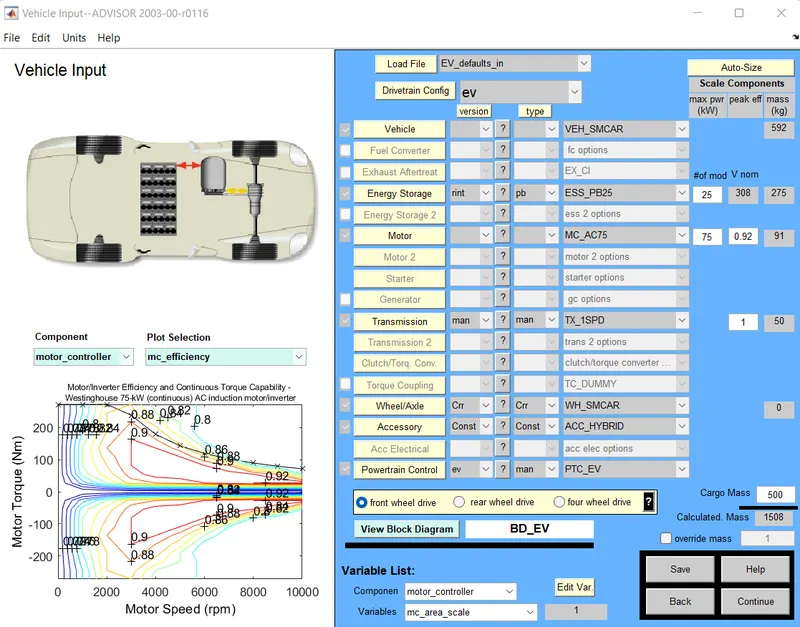
The above figure shows the input parameters available from the tool and can modify the mass value and other parameters like motor, generator, axle, etc., based on our requirement. The mass of the vehicle is 592 kg, mass of the battery is 275 kg mass of the motor is 91 kg, mass of the transmission is 50 kg and the cargo mass is 500 kg, total mass is 1508 kg. The number of battery used is 25 pieces and the battery voltage is 308 volts.
Drive cycle in Advisor tool: It consists of 119 different drive cycle which contains the data of speed and time according to the cycle. Here in this project. FTP (Federal Test Procedure) drive cycle is used. The FTP drive cycle is American drive cycle, it has been created by US EPA (Environmental Protection Agency) to represent a commuting cycle with a part of urban driving including frequent stops and a part of highway driving.
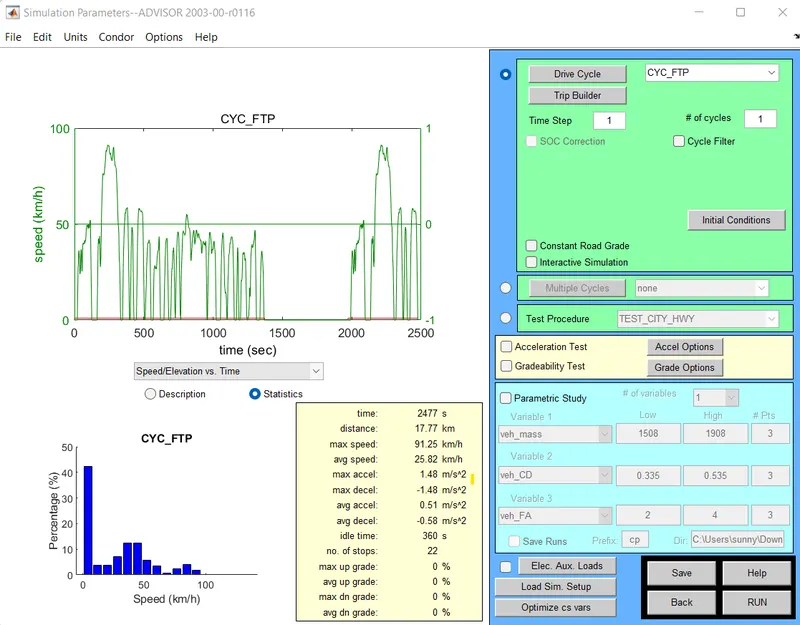
The above figure consists of max speed average speed of the vehicle, overall time and distance, Maximum acceleration and deacceleration of the vehicle, idle time, number of stops, and grade percentage. Here the total distance covered is 17.77 km approx. The maximum speed of the vehicle is around 91.25 kmph and average speed maintained by the vehicle is 25.82 kmph. The time taken to cover the distance is 2477 sec. The maximum acceleration of the vehicle is 1.48 m/s2 and the average acceleration maintained is 0.51 m/s2. The number of stops captured as 22 times which the vehicle is in idle position i.e., keyoff time. The idle time taken by the vehicle for 22 stops as 360 sec, the average time taken for each stop as 16 seconds which represents the vehicle deaccelerate and reach O speed. The maximum deacceleration of the vehicle is -1.48 m/s2 and the average deaccelerate of the vehicle is -0.58 m/s2. The straight line represents 0 % gradebility.
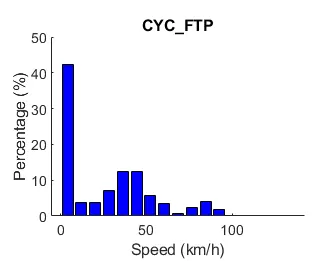
The above figure shows the actual speed maintained overall the distance of 17.77 km.
• For (0-16) kmph of speed is maintained as 43% of the total distance (7.6 km).
• For (16-32) kmph of speed is manintained as 8% of the total distance. (1.4 km).
• For (32-48) kmph of speed is maintained as 13% of the total distance (2.3 km).
• For (48-64) kmph of speed is maintained as 7% of the total distance (1.2 km).
• For (64-80) kmph of speed is maintained as 3% of the total distance (0.5 km).
• For (80-91) kmph of speed is maintained as 6% of the total distance (1 km).
Ans2)
A battery consists of two or more electric cells connected together. The cells convert chemical energy to electrical energy. The cells consist of positive and negative electrodes in an electrolyte. It is the chemical reaction between the electrodes and the electrolyte which generates. DC electricity. In the case of secondary or rechargeable batteries the chemical reaction can be reversed by reversing the current and the battery returned to a charged state. These criteria will include specific energy, energy density, specific power, typical voltages. amphour efficiency, energy efficiency, commer cial availability, cost, operating temperatures, self-discharge rates, number of life cycles and recharge rates. The cells can be connected in series to give the overall voltage required. Traction batteries for EVs are usually specified as 6V or 12 V, and theseunits are in turn connected in series to produce the voltage required.
In the lead acid cells the negative plates have a spongy lead as their active material. while the positive plates have an active material of lead dioxide. The plates are immersed in an electrolyte of dilute sulfuric acid. The sulfuric acid combines with the lead and the lead oxide to produce lead sulfate and water. electrical energy being released during the process. The overall reaction is
Pb+ PbO2 + 2H2SO4-----> 2PbSO4 + 2H2O
- Battery Capacity=335volt
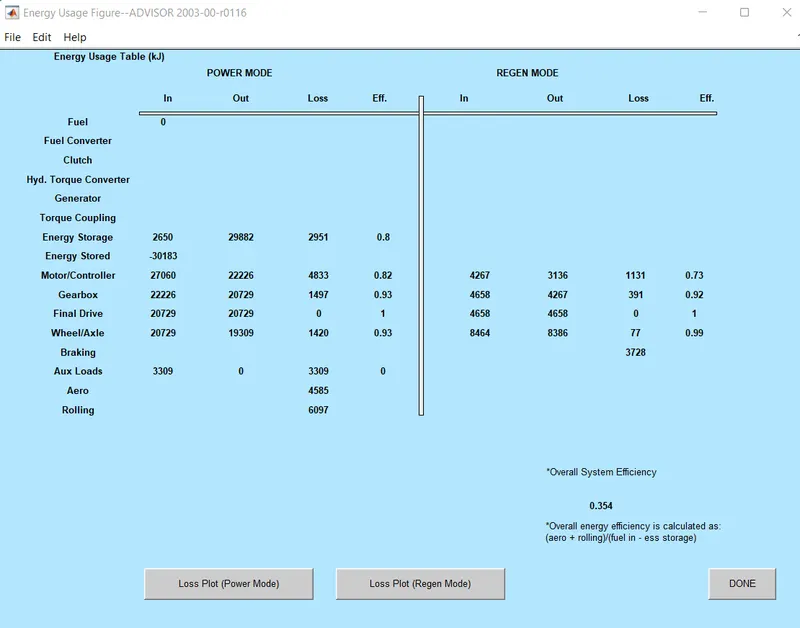
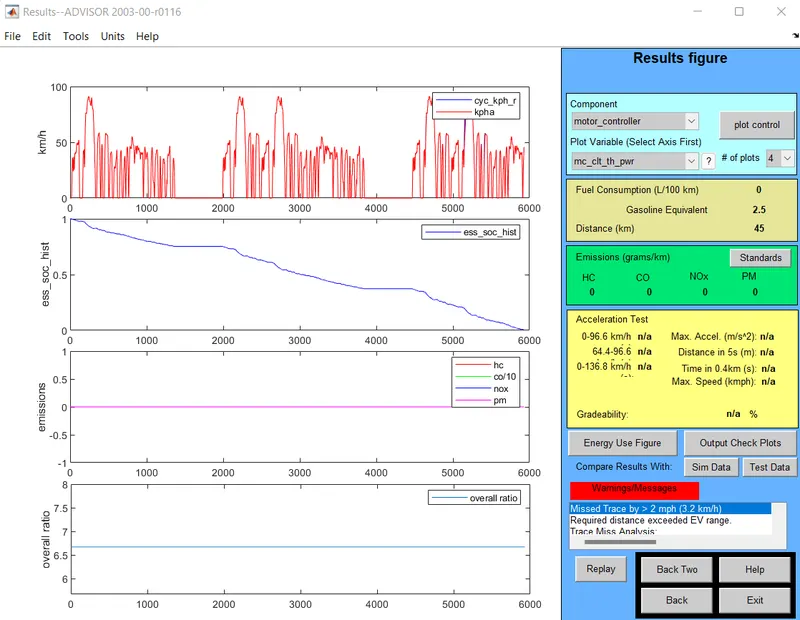
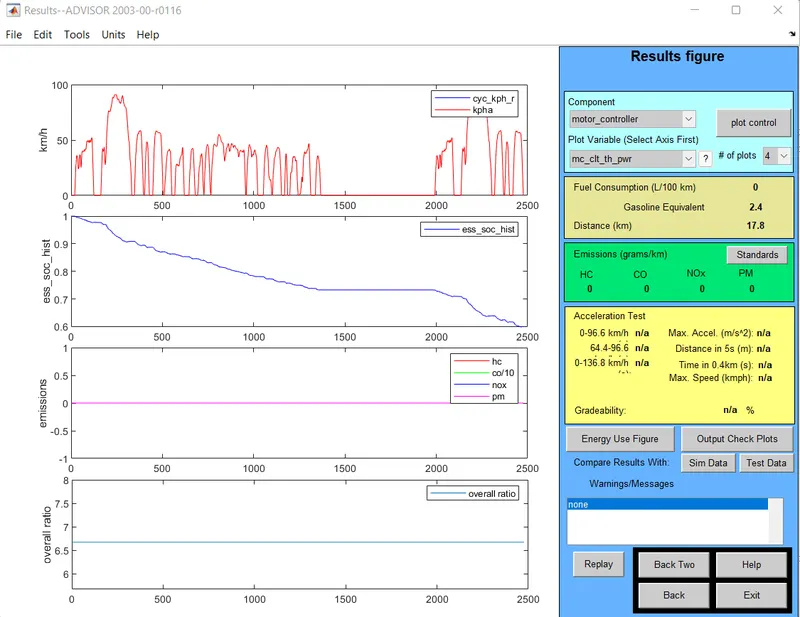
The above figure shows that the Electric vehicle with a cargo mass of 500 kg can travel to a distance of 45 km by increasing the battery capacity to 335 Volts and increasing the cycle to 3 times.
As the battery voltage increases, the overall efficiency and the state of charge also increases.
Ans3).
Gradeability:-
Gradeability is defined as the highest grade a vehicle can ascend maintaining a particular speed. When designing an automobile, various performance targets are kept in view, the major ones being weight, fuel economy, power, torque. speed, and acceleration, gradeability is given a lesser significance unless a special purpose vehicle is being designed like a Sports Utility Vehicle (SUVs) or other heavy duty vehicles.
In this project, the vehicle used as hybrid (toyato prius) and the drive cycle used as prius.
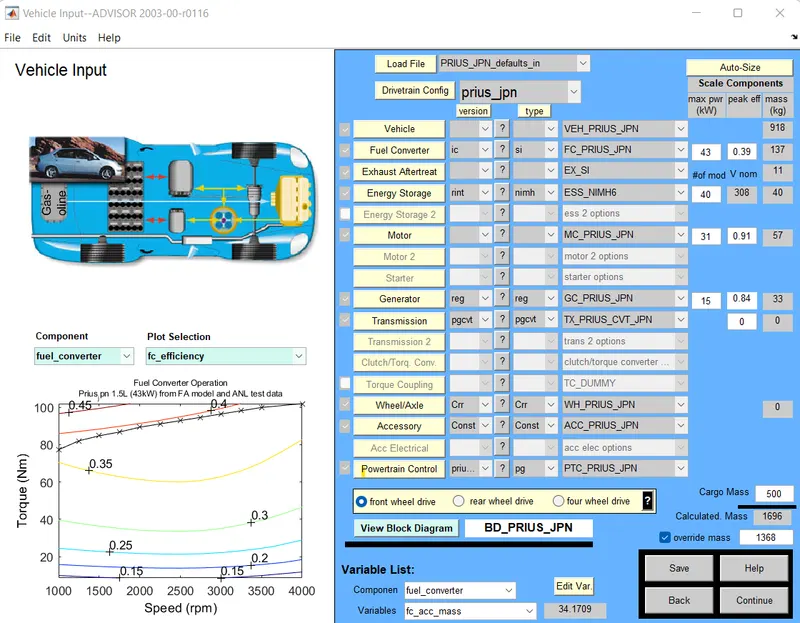
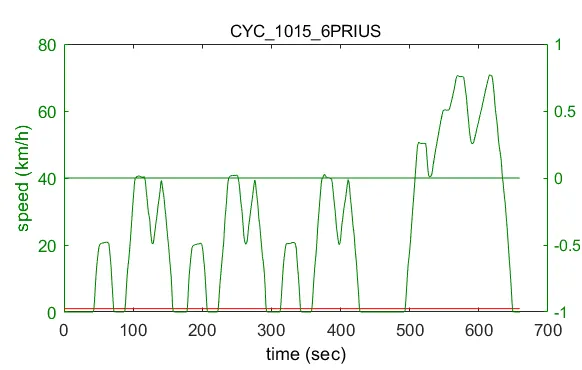
The Gradability is obtained by varying the speed or maintaining the constant speed and time (10sec) and repeat the simulation with different speed which defines that the vehicle can maintain constant speed at an angle of the slope.
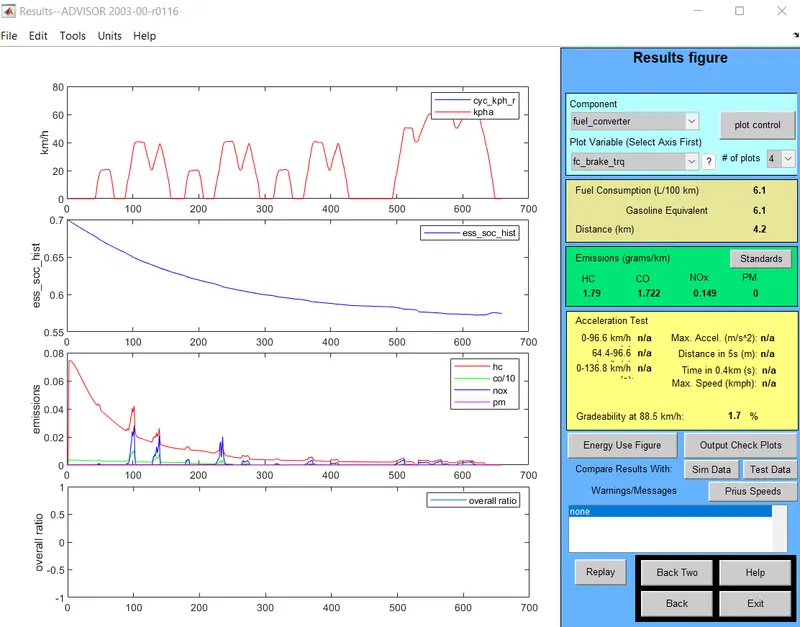
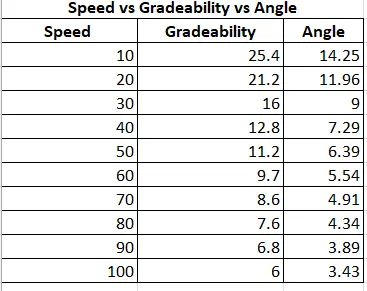
At an Particular angle the vehicle can move at that max speed in order to reduce the emission and energy consumption.
We can conclude that,
- 1. As the mass increases, the velocity decreases and energy consumption increases in any vehicle.
- 2. Hybrid vehicle can achieve high torque than the electric vehicle and ic engine.
- 3. Hybrid vehicle can attain high speed than the electric vehicle.
- 4. By changing the battery capacity, the state of charge increases which inturn the overall efficiency also increases.