Week 1 Understanding Different Battery Chemistry
1)
Lithium-ion cells, in their most common form, consist of a graphite anode, a lithium metal oxide cathode, and an electrolyte of a lithium salt and an organic solvent. Lithium is a good choice for an electrochemical cell due to its large standard electrode potential (-3.04 V) resulting in a high operating voltage (which helps both power and energy) and the fact that it is the metal with the lowest density (which reduces weight). At the anode, neutral lithium is oxidized and converted to Li+. . This results in the reduction of Co(IV) to Co(III) when the electrons from the anode reaction are received at the cathode.
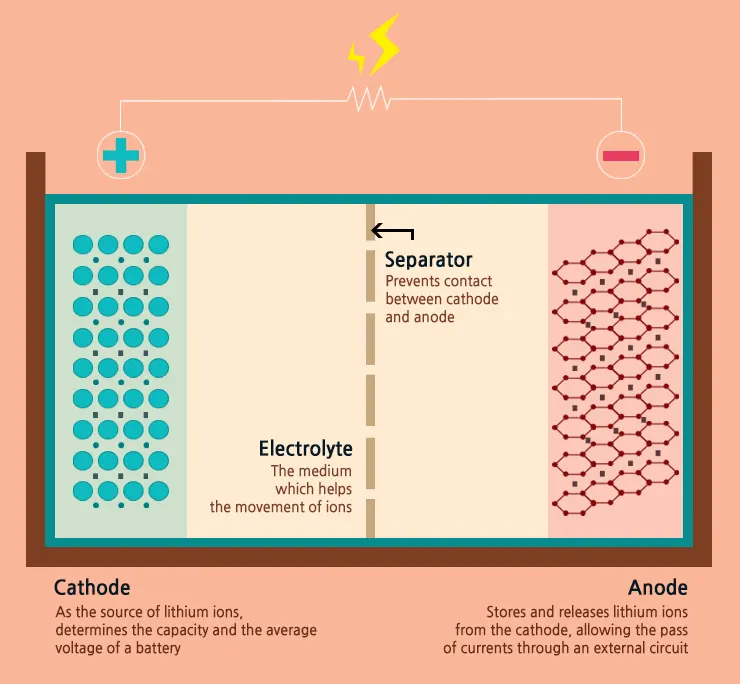
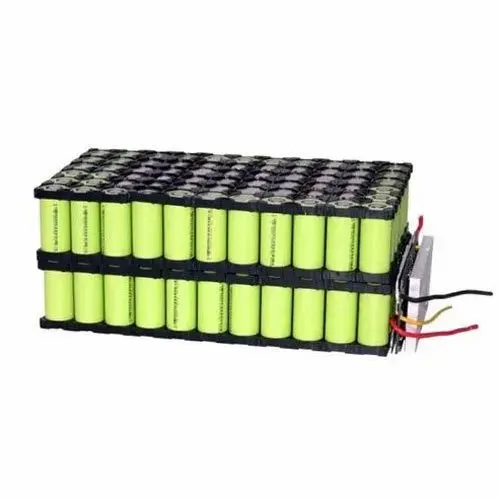
Figure:1 Figure:2
The construction of a typical cylindrical cell is shown in the above Figure 1, which is in a typical pouch cell. Such cells provide a relatively light and small source of energy and are now manufactured in very large quantities (>1 billion cells per year). In an automotive application, a lithium-ion battery consists of tens - thousands of individual cells packaged together to provide the required voltage, power, and the remaining Individual cells are normally mounted into a number of modules, which are assembled as a battery pack(collectively) as shown in Figure 2 above.
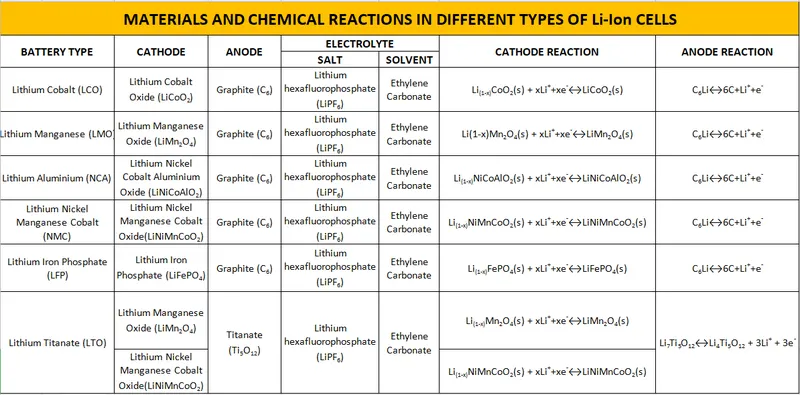
Lithium Cobalt Oxide(LCO):
These are manufactured from lithium carbonate and cobalt and are also known as lithium cobaltate or lithium-ion cobalt batteries. These batteries are used in cell phones, laptops, and electronic cameras because of their high specific energy. They have a cobalt oxide cathode and a graphite carbon anode, and lithium ions migrate from the anode to the cathode during discharge, with the flow reversing when the battery is charged.
The disadvantages, including short battery life and low specific power.
Lithium Manganese Oxide(LMO):
These are sometimes known as lithium manganate or lithium-ion manganese batteries, or li-manganese or manganese spinel batteries. The technology for this sort of battery was initially discovered in the 1980s, with the first publication in the Materials Research Bulletin in 1983. Moli Energy manufactured the first commercial lithium-ion cells using lithium manganese oxide as the cathode material in 1996.
High-temperature stability distinguishes lithium manganese oxide batteries from others, which are also safer than other lithium-ion battery types.
Lithium Nickel Cobalt Aluminium(NCA):
These batteries are making their way into electric vehicles and grid storage, also they are not widely used in consumer electronics, but they have great potential in the automobile industry. The batteries offer a high-energy choice with a long lifespan, but they are less safe than other lithium-ion battery types and are rather expensive. To ensure driver safety, NCA batteries must be accompanied by monitoring systems.
Lithium Nickel Manganese Cobalt(NMC):
A cathode combination of nickel, manganese, and cobalt is one of the most successful Li-ion systems. These systems, like Li-manganese, can be modified to serve as Energy Cells or Power Cells. The capacity of a silicon-based anode can be increased beyond calculations but at the cost of reduced loading capability and shorter cycle life. The anode grows and shrinks with charge and discharge, making the cell mechanically unstable. Silicon added to graphite has the disadvantage of growing and shrinking with charge and discharge, making the cell mechanically unstable.
Lithium Iron Phosphate(LFP):
These batteries have low resistance and strong electrochemical performance. The nano-scale phosphate cathode material allows for this. The high current rating and long cycle life, as well as strong thermal stability, increased safety, and tolerance if mistreated, are the main advantages.
Cold temperatures limit performance and excessive storage temperatures shorten service life in most batteries, and Li-phosphate is no exception. Li-phosphate batteries have a higher self-discharge than typical Li-ion batteries, which can lead to age balancing difficulties.
Lithium Titanate Oxide(LTO):
It is a type of battery that has a growing number of uses. Because of its superior nanotechnology, the lithium-titanate battery has an extremely rapid recharge time. Li-titanate batteries are being employed by makers of electric vehicles and bicycles, and this type of battery has the potential to be used in electric buses for public transit.
These batteries could be used for military and aerospace applications, as well as storing wind and solar energy and constructing smart grids.
2)
The lithium-ion battery market is estimated to grow from USD 37.4 billion in 2018 to USD 92.2 billion by 2024, at a CAGR of 16.2% between 2018 and 2024.
There are different types of lithium-ion batteries and the main difference between them lies in their cathode materials. Different kinds of lithium-ion batteries offer different features, with trade-offs between specific power, specific energy, safety, lifespan, cost, and performance.
| Lithium-ion battery Types | SP | SE | SF | LS | CS | PF |
|---|---|---|---|---|---|---|
|
Lithium Cobalt Oxide |
L |
H |
L |
L |
L |
M |
|
Lithium Manganese Oxide |
M |
M |
M |
L |
L |
L |
|
Lithium Nickel Manganese Cobalt Oxide |
M |
H |
M |
M |
L |
M |
|
Lithium Iron Phosphate |
H |
L |
H |
H |
L |
M |
|
Lithium Nickel Cobalt Aluminum Oxide |
M |
H |
L |
M |
M |
M |
|
Lithium Titanate |
M |
L |
H |
H |
H |
H |
- SP stands for specific power
- SE stands for specific energy
- SF stands for safety
- LS stands for lifespan
- CS stands for cost
- PF stands for performance
- L stands for low
- M stands for moderate
- H stands for high