Week 1 Understanding Different Battery Chemistry
1) Types of Lithiums-ion batteries are -
- Lithium Cobalt Oxide (LCO)
- Lithium Manganese Oxide (LMO)
- Lithium Nickel Manganese Cobalt Oxide (NMC)
- Lithium Iron Phosphate (LFP)
- Lithium Titanium Oxide (LTO)
- Lithium Nickel Cobalt Aluminium Oxide (NCA)
Chemical reactions occurring at the anode and cathode at different types of Li-ions batteries -
| S.No | Types of Lithium ion cell | Chemical Formula | Anode Material | Cathode Material | Anode Reaction | Cathode Reaction |
| 1 | Lithium Cobalt Oxide (LCO) | LiCoO2 | Graphite Carbon | Lithium Cobalt Oxide | LiC6 ⇌ C6 + Li+ + e- | CoO2 + Li+ + e- ⇌ LiCoO2 |
| 2 | Lithium Manganese Oxide (LMO) | LiMn2O4 | Graphite | Manganese Oxide | LiC6 ⇌ C6 + Li+ + e- | MnO2 + Li+ + e- ⇌ LiMnO2 |
| 3 | Lithium Nickel Manganese Cobalt Oxide (NMC) | LiNiCoMnO2 | Graphite Carbon | Nickel Manganese | LiC6 ⇌ C6 + Li+ + e- | Li(1-x)(Ni(1-x-y)Mn(x)Co(y))O2 + xLi+ + xe- -> LiNiMnCoO2 |
| 4 | Lithium Iron Phosphate (LFP) | LiFePO4 | Graphite Carbon | Lithium Iron Phosphate | LiC6 ⇌ C6 + Li+ + e- | Li(1-x)FePO4 + xLi+ + ye- -> LiFePO4 |
| 5 | Lithium Titanium Oxide (LTO) | Li2TiO3 | Graphite Carbon | Lithium Titanate Oxide | Li7Ti5O12 ⇌ Ti5O12 + 4Li+ + 4e- | 4Li(1-x)Mn2O4 + 4Li+ + 4e- -> LiMn2O4 |
| 6 | Lithium Nickel Cobalt Aluminium Oxide (NCA) | LiNiCoAlO2 | Graphite Carbon | Nickel Cobalt Aluminium | LiC6 ⇌ C6 + Li+ + e- | NiCoAlO2 + Li+ + e- -> LiNiCoAlO2 |
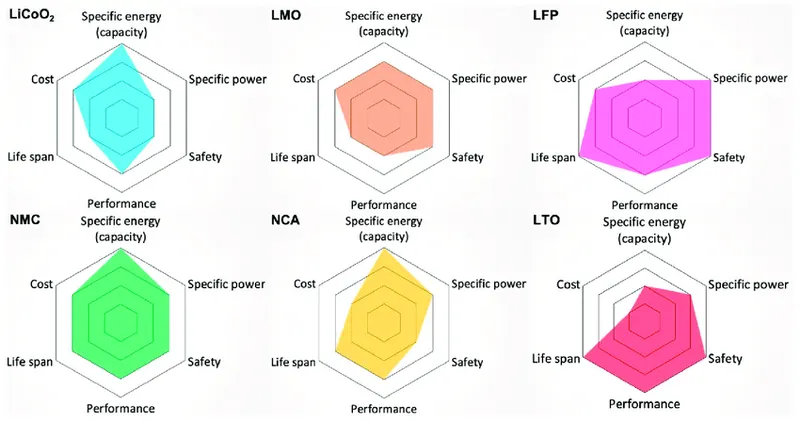
2) Differences between types of Li+ion batteries based on their characteristics -
a) Lithium Cobalt Oxide (LCO) :
Also known as lithium cobaltate or lithium-ion cobalt batteries, lithium cobalt oxide batteries are made from lithium carbonate and cobalt . Due to their very high specific energy , these batteries are used for cell phones, laptops and electronic cameras . They have a cobalt oxide cathode and use graphite carbon as their anode material; during discharge, lithium ions move from anode to cathode, with the flow reversing when the battery is charging .
b) Lithium Manganese Oxide (LMO) :
Lithium manganese oxide batteries are also commonly called lithium manganate or lithium-ion manganese batteries and are sometimes referred to as li-manganese or manganese spinel . Lithium manganese oxide batteries are notable for their high temperature stability and are also safer than other lithium-ion battery types . For this reason, they are often used in medical equipment and devices, but they may also be used in power tools, electric bikes and more . It is also possible to use lithium manganese oxide batteries to power laptops and electric powertrain cars .
c) Lithium Nickel Manganese Cobalt Oxide (NMC) :
Also known as lithium manganese cobalt oxide or NMC batteries, lithium nickel manganese cobalt oxide batteries are made of several materials common in lithium-ion battery types . They include a cathode made of a combination of nickel, manganese and cobalt .
d) Lithium Iron Phosphate (LFP) :
Lithium iron phosphate batteries, also known as li-phosphate batteries, use phosphate as a cathode . They benefit from low resistance properties, which enhance their safety and thermal stability .
e) Lithium Titanium Oxide (LTO) :
Applications for these batteries can include military and aerospace uses, and they may also be used for storing wind and solar energy and creating smart grids . Furthermore, Battery Space suggests these batteries could also be used in system-critical backups for power systems .
f) Lithium Nickel Cobalt Aluminium Oxide (NCA) :
Lithium nickel cobalt aluminum oxide batteries are also called NCA batteries, and are becoming increasingly important in electric powertrains and in grid storage .