Week-6 Challenge: EV Drivetrain
1) Types of Converter Circuits Used in Vehicles -
a) AC to DC Converter
AC to DC converter also know as Rectifier which converts AC coming from source to DC . Example of this type of converter are Mobile phone chargers , laptop chargers etc . This type of converter circuit consist of diode , capacitor and step down transformer . It is of two types -
- Half wave rectifier
- Full wave rectifier
In case of EV and hybrid vehicles which are to be charged from external source gets AC supply and converts its to DC to charge battery pack . In case of regenerative mode when the motor acts as generator and start producing current which is AC in nature gets converted into DC for charging battery pack .
b) DC to AC Converter
DC to AC converter converts the DC to AC . The DC supply from battery source gets converted in AC for equipments which works on AC supply . The common example of this type of converter is Inverter used in houses . The DC supply from battery gets converted into AC and then it is supplied to house . These type of converters are also know as Inverters .
In case of EV/hybrid vehicles , when the car needs energy from battery source , these battery gives DC supply and it is converted into AC for the motor to function .
c) DC to DC Converter
These type of converters are known as Choppers . It is used to vary the value of DC supply . It works by taking DC supply and converts its waveform to sqaure wave which is AC in nature with the help of switching element . This AC waveform passes through filter which gets converted into DC .
In case of EV/Hybrid Vehicles , these type of converters are used for tunning radio which does not require full dc voltage but only require some amount of voltage .
d) AC to AC Converter -
These type of converters are known as Cycloconverters . It works by taking input AC waveform of particular voltage and frequency and outputs a different AC waveform of different voltage and frequency .
In EV/Hybrid vehicles these type of converters are used for dimming lights , motor speed control etc .
2) Average Voltage = Battery Voltage * Duty Cycle
=> Avg Vtg = 72V * 0.7 = 50.4V
We know Speed-Torque eqn is given as ,
w = V/k(o) - Ra*T/(k(o))^2
Putting values in above equation , we get
w = 72 - 1.0204Tm
=> Tm = 70.56 - 0.98w
Comparing eqn(s) Tm and Tv we get
70.56 - 0.98w = 24.7 + (0.0051)w^2
=> (0.0051)w^2 + 0.98w = 45.86
By solving quadratic eqn , we get two values of w ,
w = 38.9 and -231 rad/sec
Speed in rpm = 38.9 * 60/(2*3.14) = 371.79 rpm
Hence this is the Steady state speed .
3) Mathematical Model -
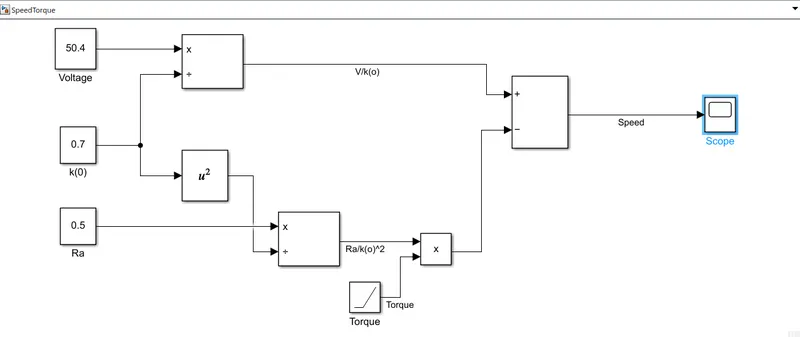
- Result
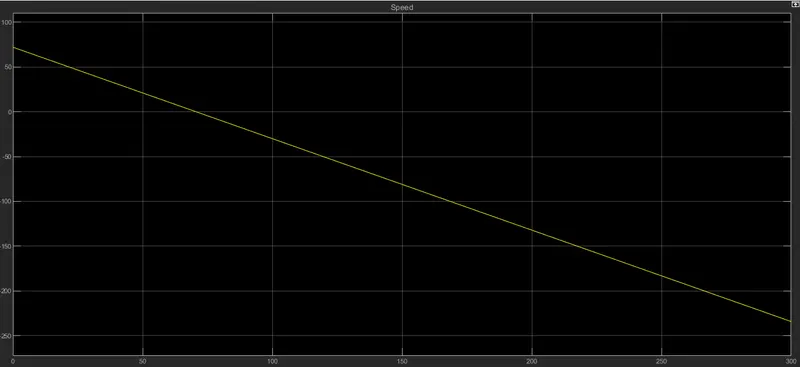
4) Observations -
- In this blog Tesla has discussed about the various types of motors he came acrossed . In early's 1960 in electric vehicle brushed type dc motor with contactor was used , which is not in use in todays generation . By the use of this type of motor the losses were high . So late it is replaced by Brushless type DC motor and 3-phase induction motor .
- In brushless dc motor and 3-phase induction motor , the stator is same . The only difference is of type of rotor used .
- In brushless dc motor , rotor is made up of permanent magnets which produces magnetic fields which comes in contact with stator windings . When supply is given to stator , torque is produce and in result which helps the motor to run . By using this type motor gives efficiency is very good .
- In 3-phase induction motor , the rotor is made of laminated sheets and conductors are provided in the slots . When supply is given to stator , it produces rotating magnetic field which comes in contact of rotor. Due to this rotating magnetic field torque is produce in rotor which helps it to run . The limitation of using this type of motor is that it runs on AC supply . So we have to use converter Inverter to convert DC supply from battery source to AC supply .
- So Brushless DC motor is used for Hybrid/Plug-in hybrid vehicles and 3-phase induction motor is used for pure electric vehicles .