Week-4 Challenge WOT Condition Part-2
1a) DIFFERENCE BETWEEN MAPPED ENGINE AND DYNAMIC MODEL OF ENGINE -
- MAPPED ENGINE :
- MAPPED engine model are known as Static models .
- These models runs the simulation based on data saved on lookup tables
- The simulation is faster .
- It is used if we have data from dynamometer or design tool .
- Specifications for torques , current etc and other parameters are to be entered for simulation .
- DYNAMIC MODEL :
- These models runs the simulation based on actual components like motor and its accessories , generator and its accessories or engine and its accessories .
- Consumes time due to calculation at real time activates .
- It is used when we need the more detailed dynamic model and has component level data .
- It is used to analyze the impact of individual engine component performance .
1b) STEPS FOR CHANGING MODEL TYPE -
Mapped and Dynamic model of engine is basically used in electric vehicles . Steps to change the model varient with figures are below ,
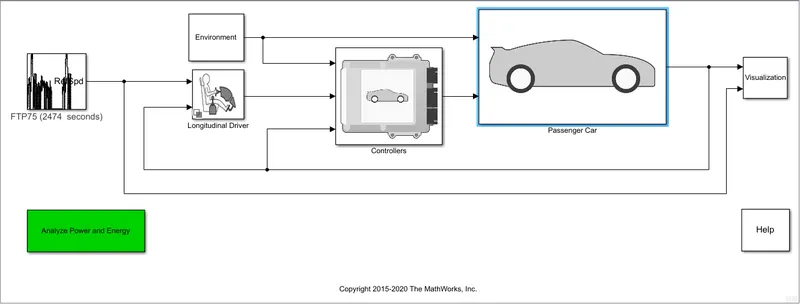
- Step 1 , Open the EV Powertrain Controller model . The simulink model will open like this .
- Step 2 , open the passenger car block , we will see Electrical and Drivetrain blocks .
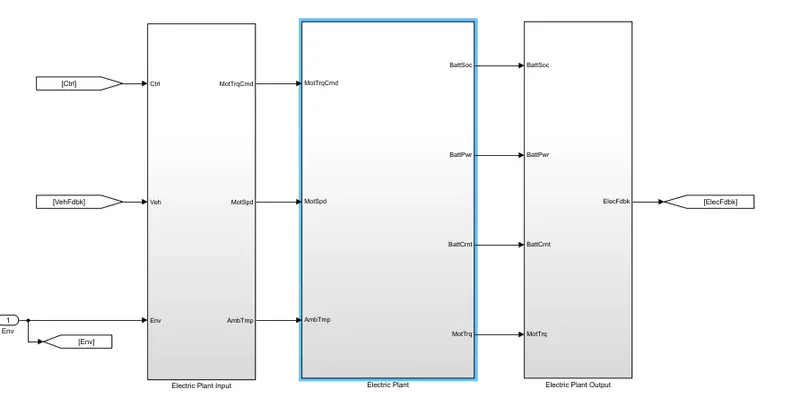
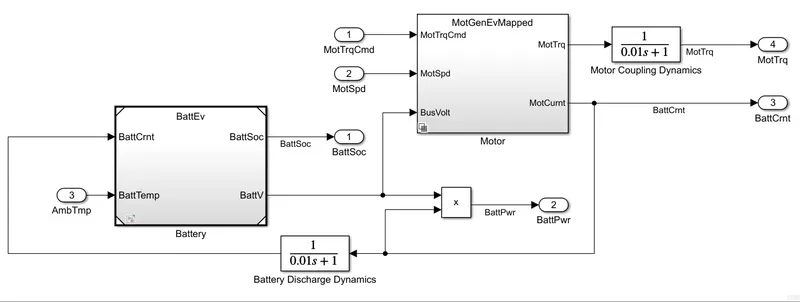
- Step 3 , Click on Electric Plant block , we will come across MotorGenerator block . By default it will be in Mapped varient .
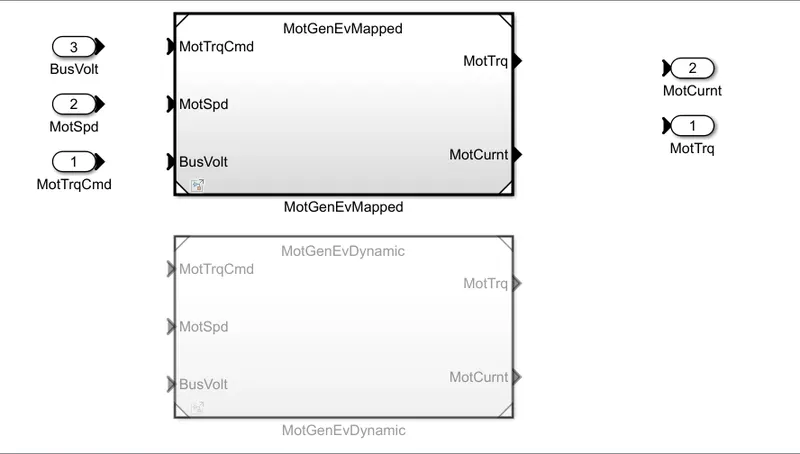
- Step 4 , By clicking on the MotorGenerator EV Mapped block , we see two blocks naming MotoGen Ev Mapped and other MotoGen Ev Dynamic block . By default the Mapped block is active and dynamic block is inactive .
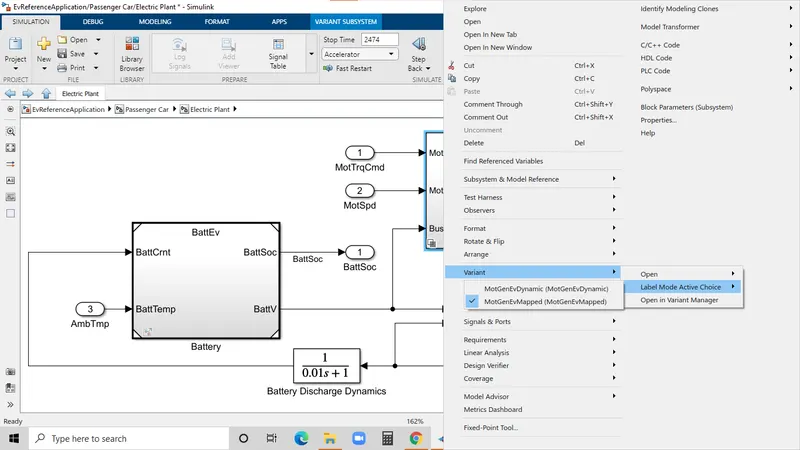
- Step 5 , we will go back in electric plant subsystem and right click on Moto Generator Ev Mapped block . Scroll to varient , then go to label mode active choice , and click on Moto Generator Ev Dynamic like shown in figure below ,
- Step 6 , Now the Dynamic block will be active .
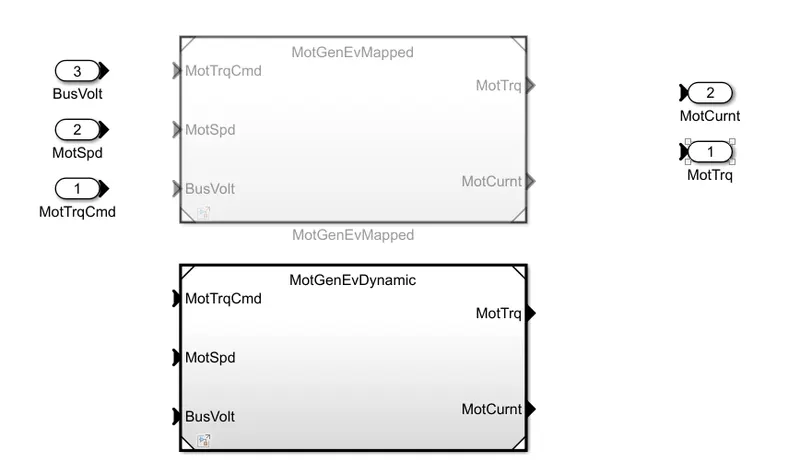
This is how we can change the model type .
2) CALCULATION OF MPG (MILES PER GALLON) -
The figure below shows how the value for miles per gallon is calculated .
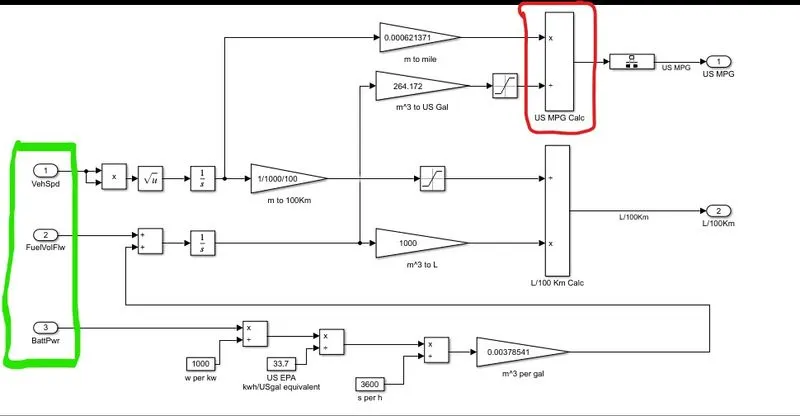
- In the above figure , there are three inputs or parameters which are responsible for the calculation of Miles per gallon . The three inputs are shown in green box and these are vehicle speed , Fuel volume and battery power .
- The vehicle speed is integrated with respect to time to get distance . The value of distance is then multiplied with the gain block having value of 0.000621317 to convert the unit of distance from meter to miles .
- The fuel volume value is added with the battery power value in m^3 per gallon and the integrated . This integrated value is multiplied with the gain block having value 264.172 to convert the unit from cubic meter to US gallon .
- The battery power value is divided by 1000 to change it to kw . This value is further divided by 33.7 to convert battery power to gallon . The value of one US gallon is equal to 33.7 kwh . The outcome value is further divided by 3600 to get the value in m^3 per gallon which is further added with fuel volume value .
- Finally the value of vehicle speed is divide by the value of fuel vloume . This is how the value of MPG is calculated .
FACTORS FOR MODEL FUEL FLOW -
Factors which are to be considered or are responsible for fuel efficiency are ,
- Vehicle Speed
- Battery Power
- Fuel Volume Flow
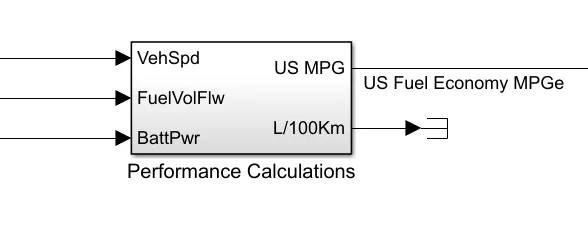
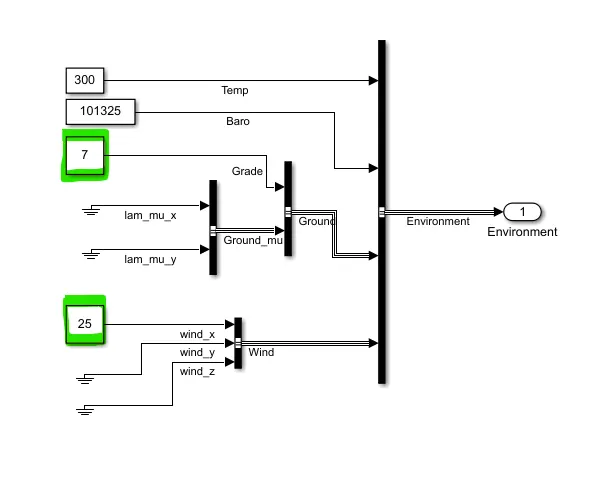
3) Open the Environment block in HEV Model . In this block value of gradient and wind velocity will be zero as these are default value . Now changing the value of both ,
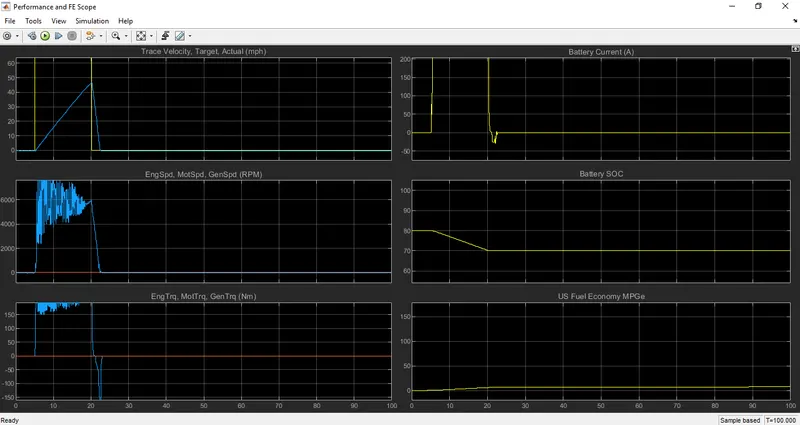
Gradient is 7 and wind velocity is 25 km/h and WOT drive cycle selected now running the model for 100 sec and the output we get is shown below ,
- Observations
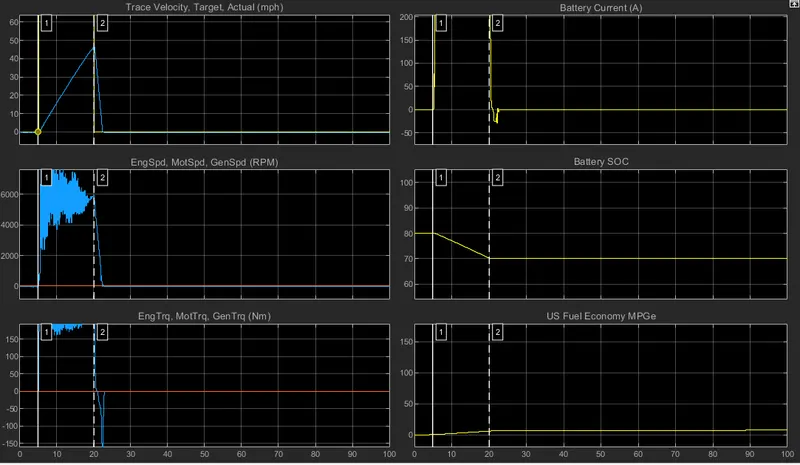
At velocity 67.1 mph or 107.9 kmph ,
- Battery current is 5.703 x 10^2 Amp .
- Engine speed is 3.6 x 10^(-15) rev/min .
- Motor Speed is 5.938 x 10^3 rev/min .
- Generator speed is 3.6 x 10^(-15) rev/min .
- Battery State of charge is falling from 80% to 70% .
- Engine torque is 1.322 x 10^(-17) Nm .
- Motor torque is 2.006 x 10^2 Nm .
- Generator torque is Zero .
- US Fuel Economy MPG is 57.38 mpg .
4) COMPARISON BETWEEN HEV AND EV POWERTRAIN MODEL -
NOTE - We will consider Gradeability be 7 and Wind Velocity be 25 kmph for both the powertarain models .
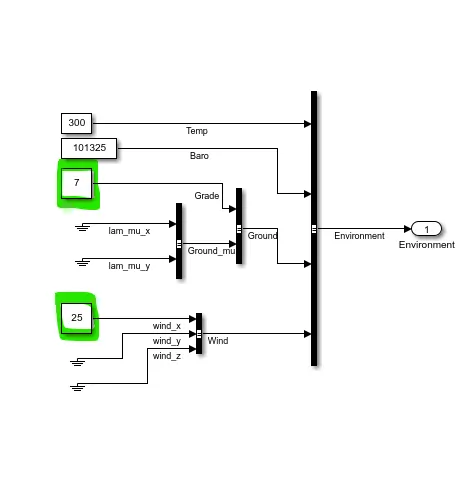
The Output of both the models are shown below . The first one is of HEV model and second one is of EV model .
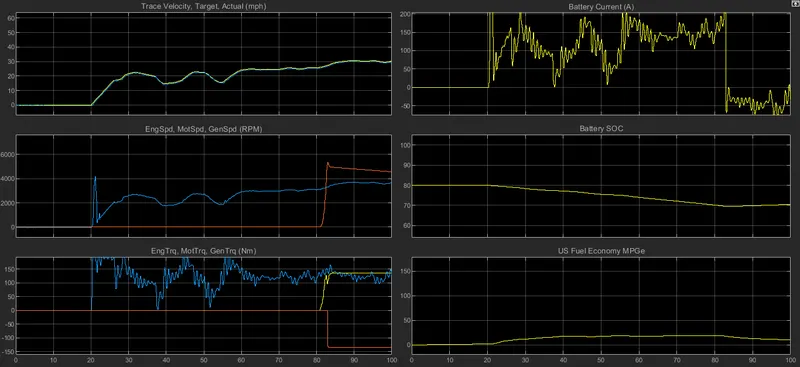
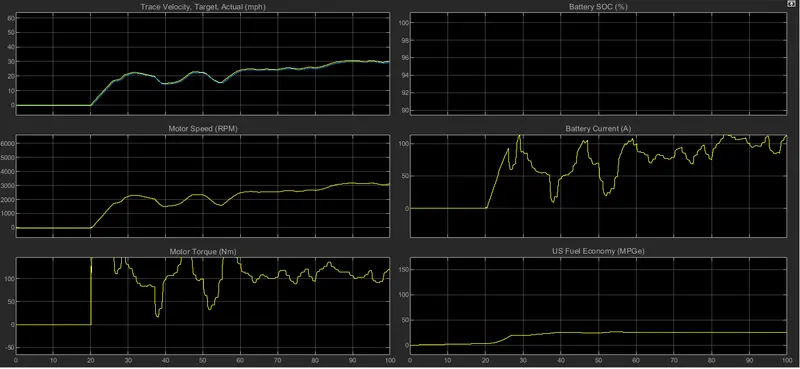
| S.No | Parameters | Unit | HEV | EV |
| 1 | Maximum Velocity | Kmph | 56.4 | 56.5 |
| 2 | RMS Velocity | Kmph | 23.1 | 23.4 |
| 3 | Engine Speed Maximum | RPM | 4121 | - |
| 4 | Engine Speed RMS | RPM | 1285 | - |
| 5 | Motor Speed Maximum | RPM | 6771 | 5872 |
| 6 | Motor Speed RMS | RPM | 2760 | 2391 |
| 7 | Engine Torque Maximum | Nm | 161.9 | - |
| 8 | Engine Torque RMS | Nm | 47.3 | - |
| 9 | Battery SOC Maximum | % | 80 | 80 |
| 10 | Battery SOC Minimum | % | 69.7 | 71 |
| 11 | Battery SOC RMS | % | 75.2 | 75 |
| 12 | Battery Current Maximum | Amp | 214 | 101.4 |
| 13 | Battery Current RMS | Amp | 49 | 21.3 |
| 14 | US Fuel Economy MPG | MPG | 92 | 203.4 |
| 15 | US Fuel Economy RMS | MPG | 33 | 174.3 |