Week 1 Understanding Different Battery Chemistry
1. Prepare a table that includes materials & chemical reactions occurring at the anode and cathode of LCO, LMO, NCA, NMC, LFP, and LTO type of lithium-ion cells. Give your detailed explanation of it.
I.] Prepare a table that includes materials & chemical reactions occurring at the anode and cathode of LCO, LMO, NCA, NMC, LFP, and LTO type of lithium-ion cells.
|
Battery Type |
Abbrivation of battery type |
Chemical Formula |
Anode Material |
Cathode material |
Electrolyte |
Anode reaction |
Cathode reaction |
Overall reaction |
|
LCO |
Lithium Combalt Oxide |
LiCoO2 |
Graphite carbon |
Lithium Cobalt Oxide |
Lithium salt in an organic solvent |
C6 + e− + Li+ ↔ LiC6 |
LiCoO2 ↔ Li1−CoO2+ Li+ + e− |
LiCoO2 + C6 ↔ CoO2+LiC6 |
|
LMO |
Lithium Manganese Oxide |
LiMn2O4 |
Graphite carbon |
Lithium Manganese Oxide |
lithium halide dissolved in an organic solvent |
C6 + e− + Li+ ↔ LiC6 |
LiMnO2 ↔ Li1−Mn2O4+ Li+ + e− |
LiMn2O4 +C6 ↔ LiC6 +Mn2O4 |
|
NMC |
Lithium Nickel Manganese Cobalt Oxid |
LiMO2 |
Graphite carbon |
Lithium Nickel Manganese Cobalt Oxid |
Lithium salt in an organic solvent |
C6 + e− + Li+ ↔ LiC6 |
LiMO2 ↔ Li1−MO2 + Li+ + e− |
Li1−xMO2 + LixCn ↔ LiMO2+ nC |
|
LFP |
Lithium Iron Phosphate |
LiFePO4 |
Graphite carbon |
Lithium Iron Phosphate |
Lithium salt in an organic solvent |
C6 + e− + Li+ ↔ LiC6 |
LiFePO4 ↔ Li1−FePO4 + Li+ + e− |
LiFePO4 + 6C ↔ LiC6+ FePO4 |
|
NCA |
Lithium Nickel Cobalt Aluminium Oxide |
LiNiCoAlO2 |
Graphite carbon |
Lithium nickel Cobalt Aluminium Oxide |
Lithium salt in an organic solvent |
C6 + e− + Li+ ↔ LiC6 |
LiNiCoAlO2 ↔ Li1−NiCoAlO2 + Li+ + e− |
6C + LiNiCoAlO2 ↔ LiC6+ NiCoAlO2 |
|
LTO |
Lithium Titanium Oxide |
Li4Ti5O12 |
Lithium Titanium Oxide |
Lithium Titanium Oxide |
Lithium salt in an organic solvent |
Ti5O12 + 4Li+ + 4e− ↔ Li4Ti5O12 |
4LiMn2O4 ↔ 4Mn2O4 + 4Li+ + 4e− |
Li4Ti5O12 + 4Mn2O4 ↔ 4LiMn2O4 + Ti5O12 |
Now we can see the detailed explanation of Lithium ion battery and see about how it working, construction.
What is battery? and how it work?
- A battery is a device consisting of one or more electrochemical cells with external connections for powering electrical devices.
- When a battery is supplying electric power, its positive terminal is the cathode and its negative terminal is the anode.
- The terminal marked negative is the source of electrons that will flow through an external electric circuit to the positive terminal.
- When a battery is connected to an external electric load, a oxidation reaction converts high-energy reactants to lower-energy products, and the free-energy difference is delivered to the external circuit as electrical energy.
- Here below i have shown the picture Lithium ion battery internal structure.
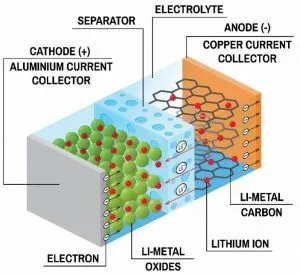
From the above picture we know what is separator, positive current collector, negative current collector, electrolyte, anode and cathode.
Seperator: Allows for lithium ions to flow freely from the anode to the cathode and vice versa. It is also prohibits the flow of electrons inside the battery structure or prevent internal short cirucit of two electrods.
Positive current collector: Receives electrons from the external circuit during discharging of the battery fromt the negative current collector. It is made of aluminium foil.
Negative current collector: Receives electrons from the charging of the battery from the positive current collect. It is made of copper foil.
Electrolyte: A liquid or gel that acts as a transporter of lithium ions.
Anode: stores lithium and releases lithium ions when the battery is discharging.
Cathode: stores lithium and releases lithium ions when the battery is charging.
Lets take an example Lithium cobalt oxide(LiCoO2) or inshort LCO battery and see how its work.
- Lithium-ion batteries typically contain a lithium-metal oxide, such as lithium-cobalt oxide (LiCoO2). This supplies the lithium-ions.
- Lithium-metal oxides are used as cathode.
- Lithium-carbon compounds are used as anode.
- These materials are used because they allow for intercalation. (Intercalation means that the molecules are able to insert something into them).
- In this case, the electrodes are able to have lithium-ions move easily in and out of their structures.
- The hexagonal spider graphic of LCO battery is shown below.
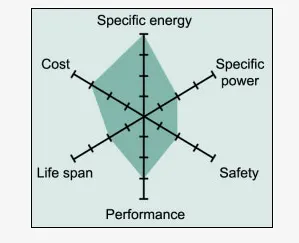
- It summarizes the performance of Li-cobalt in terms of
- specific energy(specific energy means amount of energy stored per Kg(mass) its unit is Wh/Kg) or capacity that relates to runtime.
- specific power(specific power or specific density means amount of energy stored per cubic meter(Volume) its unit is Wh/lt or the ability to deliver high current.
- safety.
- performance at hot and cold temperatures.
- life span reflecting cycle life and longevity.
- cost.
Chemisty involved in LCO type lithium ion battery:
In cathode:
Reduction takes place at the cathode. There, cobalt oxide combines with lithium ions to form lithium-cobalt oxide (LiCoO2).
Lithium ions are absorbed by the lithium dioxide and the electrode is reduced as it also receives the electrons from the circuit.
CoO2 + Li+ + e- → LiCoO2
In anode:
Oxidation takes place at the anode. There, the graphite intercalation compound LiC6 forms graphite (C6) and lithium ions.
Lithium is oxidized. Lithium ions are released from the carbon, along with electrons.
LiC6 → C6 + Li+ + e-
Here is the full reaction (left to right = discharging; right to left = charging):
LiC6 + CoO2 ↔ C6 + LiCoO2
Lithium ion battery during discharging:
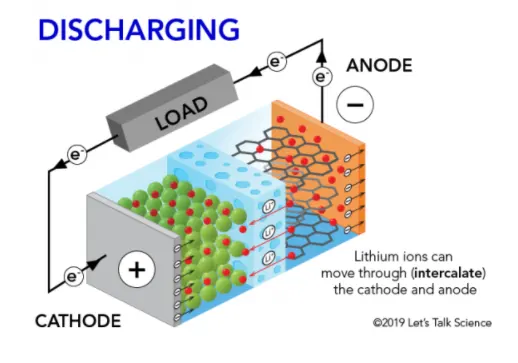
- When the lithium-ion battery connected to load then the battery is powering it, positively charged lithium ions (Li+) move from the negative anode to the positive cathode.
- They do this by moving through the electrolyte until they reach the positive electrode. There, they are deposited.
- In the other hand the electrons are move from the anode to the cathode through the externaley connected load at battery terminals.
- When the battery is in use, the lithium ions flow from the anode to the cathode, and the electrons move from the cathode to the anode.
Lithium ion battery during charging:
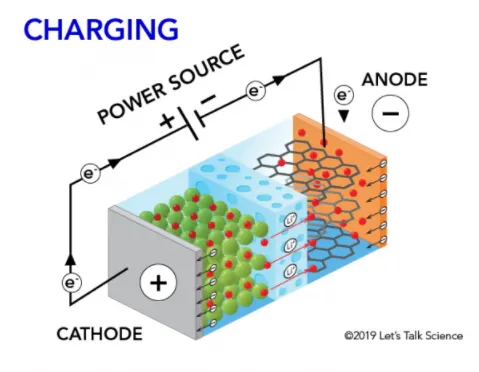
- When you charge a lithium-ion battery, the exact opposite process happens.
- The lithium ions move back from the cathode to the anode[ and the electrons move from the anode to the cathode.
- When the battery is charging, the lithium ions flow from the cathode to the anode, and the electrons move from the anode to the cathode.
From the above explanation now we can understand lithium ion battery construction and working.
2.Compare the differences between each type of Li+ion batteries based on their characteristics
In the six types of lithium ion battery charactristic there are certain factors for which are differentiated from one another and it can be given in below:
Nominal Voltage: It is the system voltage at which the device is designed to operate. The rated voltage is usually higher than the nominal voltage to ensure the safe operation of the device.
Cycle: The charge and discharge when took place each for a single time, makes a Cycle. The higher the cycles can take place, the higher is the lifespan.
The current rate (C): This is used to determine the fast charging capability and short-circuit discharge capability of a battery.
Thermal Runaway: In simplest terms, thermal runaway begins when the heat generated within a battery exceeds the amount of heat that is dissipated to its surroundings. If the cause of excessive heat creation is not remedied, the condition will worsen. Internal battery temperature will continue to rise, causing battery current to rise, creating a domino effect. The rise in temperature in a single battery will begin to affect other batteries nearby, and the pattern will continue, thus the term “runaway".
Specific Energy: It is the amount of energy stored per unit mass (Wh/Kg). This is a very important deciding factor that decides how much energy or power we are going to get from different batteries with the same amount of weight.
The main differences between the 6 types of Li+ ion batteries can be differentiated based on their characteristics and that was tabulated below.
|
Battery Type |
Abbrivation of battery type |
Voltages |
Specific energy |
Charge |
Discharge |
Cycle life |
Thermal runaway |
Applications |
Remarks |
|
LCO |
Lithium Combalt Oxide |
3.60V nominal; typical operating range 3.0–4.2V/cell |
150–200Wh/kg. Specialty cells provide up to 240Wh/kg. |
0.7–1C, charges to 4.20V (most cells); 3h charge typical. Charge current above 1C shortens battery life. |
1C; 2.50V cut off. Discharge current above 1C shortens battery life. |
500–1000 |
150°C (302°F). Full charge promotes thermal runaway |
Mobile phones, tablets, laptops, cameras |
Very high specific energy, limited specific power. Cobalt is expensive. Serves as Energy Cell. Market share has stabilized. |
|
LMO |
Lithium Manganese Oxide |
3.70V (3.80V) nominal; typical operating range 3.0–4.2V/cell |
100–150Wh/kg |
0.7–1C typical, 3C maximum, charges to 4.20V (most cells) |
1C; 10C possible with some cells, 30C pulse (5s), 2.50V cut-off |
300–700 |
250°C (482°F) typical. High charge promotes thermal runaway |
Power tools, medical devices, electric powertrains |
High power but less capacity; safer than Li-cobalt; commonly mixed with NMC to improve performance. |
|
NMC |
Lithium Nickel Manganese Cobalt Oxid |
3.60V, 3.70V nominal; typical operating range 3.0–4.2V/cell, or higher |
150–220Wh/kg |
0.7–1C, charges to 4.20V, some go to 4.30V; 3h charge typical. Charge current above 1C shortens battery life. |
1C; 2C possible on some cells; 2.50V cut-off |
1000–2000 |
210°C (410°F) typical. High charge promotes thermal runaway |
E-bikes, medical devices, EVs, industrial |
Provides high capacity and high power. Serves as Hybrid Cell. Favorite chemistry for many uses; market share is increasing. |
|
LFP |
Lithium Iron Phosphate |
3.20, 3.30V nominal; typical operating range 2.5–3.65V/cell |
90–120Wh/kg |
1C typical, charges to 3.65V; 3h charge time typical |
1C, 25C on some cells; 40A pulse (2s); 2.50V cut-off (lower that 2V causes damage) |
2000 and higher |
270°C (518°F) Very safe battery even if fully charged |
Portable and stationary needing high load currents and endurance |
Very flat voltage discharge curve but low capacity. One of safest Li-ions.Used for special markets. Elevated self-discharge.Used primarily for energy storage, moderate growth. |
|
NCA |
Lithium nickel Cobalt Aluminium Oxide |
3.60V nominal; typical operating range 3.0–4.2V/cell |
200-260Wh/kg; 300Wh/kg predictable |
0.7C, charges to 4.20V (most cells), 3h charge typical, fast charge possible with some cells |
1C typical; 3.00V cut-off; high discharge rate shortens battery life |
500 |
150°C (302°F) typical, High charge promotes thermal runaway |
Medical devices, industrial, electric powertrain (Tesla) |
Shares similarities with Li-cobalt. Serves as Energy Cell. Mainly used by Panasonic and Tesla; growth potential. |
|
LTO |
Lithium Titanium Oxide |
2.40V nominal; typical operating range 1.8–2.85V/cell |
50–80Wh/kg |
1C typical; 5C maximum, charges to 2.85V |
10C possible, 30C 5s pulse; 1.80V cut-off on LCO/LTO |
3,000–7,000 |
One of safest Li-ion batteries |
UPS, electric powertrain (Mitsubishi i-MiEV, Honda Fit EV), solar-powered street lighting |
Long life, fast charge, wide temperature range but low specific energy and expensive. Among safest Li-ion batteries. Ability to ultra-fast charge; high cost limits to special application. |
Nominal Voltage: Most of them are very close when it comes to this characteristic. LMO(3.7) has the highest range and LTO(2.4) has the lowest range in volts.
Cycle Life: They differ by a significant amount from each other mostly. LTO battery has the longest life cycle that's why it can last for a longer period of time and it is exactly the opposite for the LMO type batteries.
Charge Current Rate: Higher the charge current, the less time the battery will take to get fully charged. LFP and LTO are highest, NCA comes close to its contenders but finishes last in this case.
Discharge Current Rate: In severe cases, you can cause an internal short circuit and/or even an explosion. Most consumer applications require only 1C from their batteries. If you need higher discharge rates and faster charging times, you should definitely choose a high-rate battery instead. LTO has a discharge rate 10 times higher than others, that is why it is one of the safest batteries out there.
Thermal Runaway: It is discussed before, a Thermal runaway occurs in situations where an increase in temperature changes the conditions in a way that causes a further increase in temperature, often leading to a destructive result. It is a kind of uncontrolled positive feedback. We know that the higher the temperature at
which the thermal runaway will occur, the safer the battery will be. LTO has the highest temperature rating in this and NCA & LCO has the lowest.
Specific Energy: The Specific energy density can be calculated by integrating from 0 to t (time to reach the cut-off potential) the expression V(t)*I*A dt and then dividing for (3600*Mw). In this way, you can obtain the specific energy density in Wh /kg . Lithium-ion with cobalt cathodes(NCA-type batteries) offer the highest energy densities. Typical applications are cell phones, laptops, and digital cameras. Power Density (W/kg) indicates how much power a battery can deliver on-demand.
Relative performance, functional and safety characteristics of six leading Li-ion battery chemistries are shown below.
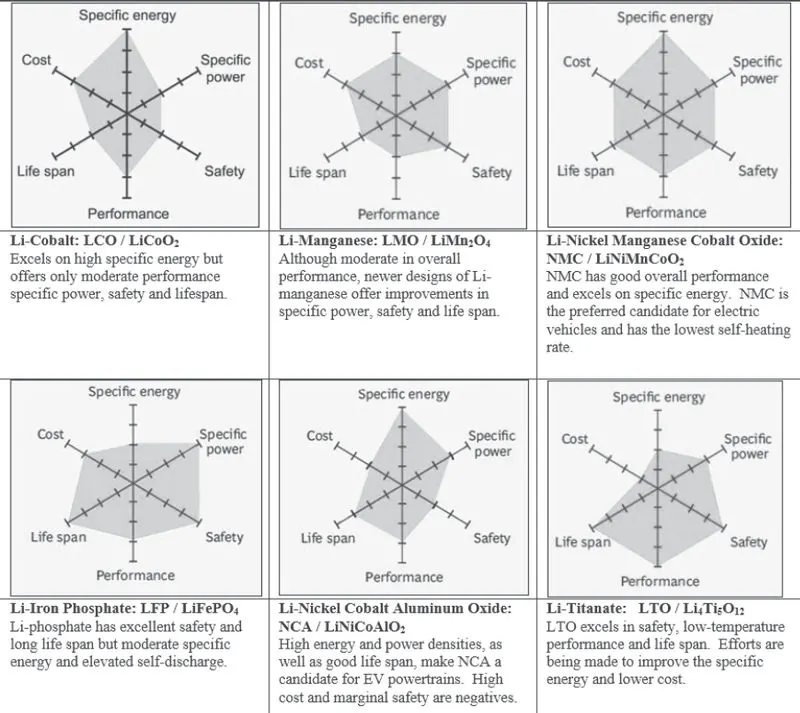
For ease way of choosing a battery from a layman's perspective, the 6 key buying point are being considered and these 6 key features are given a value within 0-5 range for all the 6 types of batteries and then all of them are given with the same parameters which are considered in case of "5 Point Hexagonal Analysis" of the batteries.
The 6 factors are as follows:
1. Specific Energy
2. Specific Power
3. Safety
4. Performance
5. Life Span