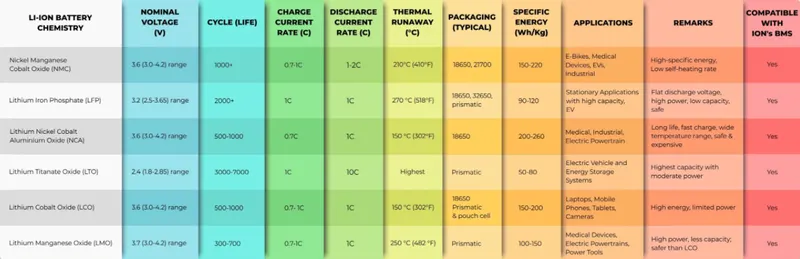
Week 1 Understanding Different Battery Chemistry
1.Prepare a table which includes materials & chemical reactions occurring at the anode and cathode of LCO, LMO, NCA, NMC, LFP and LTO type of lithium ion cells.Give your detailed explanation on it.
A lithium ion battery is a family of rechargeable battery types in which lithium ions move from the negative electrode to the positive electrode during discharge and back when charging. Chemistry, performance, cost and safety characteristics vary across lithium-ion battery types. Unlike lithium primary batteries (which are disposable), lithium ion battery use an intercalated lithium compound as the electrode material instead of metallic lithium.
Lithium-ion batteries are common in consumer electronics. They are one of the most popular types of rechargeable battery for portable electronics, with one of the best energy-to-weight ratios, high open circuit voltage, low self-discharge rate, no memory effect and a slow loss of charge when not in use. Beyond consumer electronics, lithium-ion batteries are growing in popularity for military, electric vehicle and aerospace applications due to their high energy density.
Lithium-ion batteries were first proposed by M. S. Whittingham at Binghamton University in the 1970s. Whittingham used titanium(II) sul-fide as the cathode and lithium metal as the anode
The electro chemical properties of lithium intercalation in graphite were first discovered in 1980 by Rachid Yazami et al., who showed the reversible intercalation of lithium into graphite in a lithium/polymer electrolyte/graphite half cell.
In 1981, Bell Labs developed a workable graphite anode to provide an alternative to the lithium metal battery. Following cathode research performed by a team led by John Goodenough, in 1991 Sony released the first commercial lithium-ion battery. Their cells used layered oxide chemistry, specifically lithium cobalt oxide. In 1983, Dr Michael Thackeray, Goodenough and cowork-ers identified mangnese spinel as a cathode material.
Spinel showed great promise, given low cost, good electronic and lithium ion conductivity and three-dimensional structure, which gives it good structural stability. Although a pure manganese spinel fades with cycling, this can be overcome with chemical modification of the material. A manganese spinel is currently used in commercial cells.
Secondary lithium-ion batteries almost exclusively use nonaqueous electrolytes in either a liquid, gel polymer, or solid polymer form. Liquid electrolytes are the most commonly used form and are based on a solution of lithium salt in one or more types of organic liquid solvents.
A gel electrolyte is an ionically conductive material where the lithium salt and solvents are dissolved in a mixture of polymers forming a gelled matrix for the solution. Finally, a solid electrolyte is an electrolyte material that is in the form of solid matter instead of liquid or gel.
Basic Undertanding of Battery
Tabular representation of chemical reaction of all types of lithium ion Battery
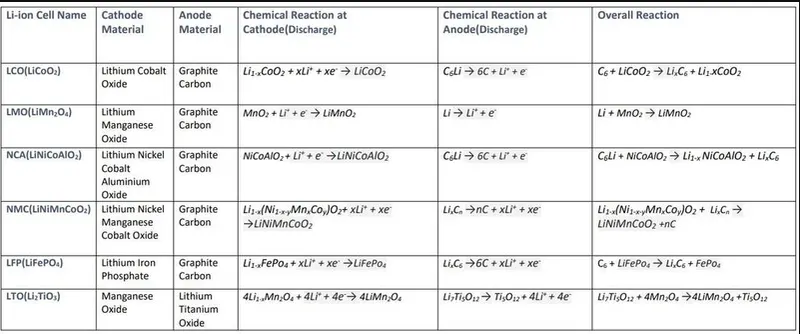
Lithium Cobalt Oxide
Cobalt acid lithium battery has high discharge platform, high specific capacity, stable product performance, and good cycle performance, but its safety performance is poor. The cost is very high, it is mainly used for medium and small type batteries, which is widely used in mobile phones, portable computers, cameras, camera, electric cars, solar energy storage, UPS power supply, medical equipment, space and other fields. The nominal voltage is 3.7V.
Lithium Cobalt Oxide, LiCoO2 (LCO), is an inorganic compound commonly used as a anode material for lithium ion batteries.
During Charging
Anode: LiCoO2 = Li1-xCoO2+xLi++xe-
Cathode: 6C+xLi++xe- = LixC6
During Discharging
Anode: Li1-xCoO2+xLi++xe-=LiCoO2
Cathode: LixC6=6C+xLi++xe-
Electrolyte
Solvent: cyclic carbonate (PC, EC); Chain carbonates (DEC, DMC, EMC); Carboxylic esters (MF, MA, EA, MA, MP, etc.); (for dissolving lithium salts);
Lithium salts: LiPF6, LiClO4, LiBF4, LiAsF6, etc.
Additives: film forming additives, conductive additives, flame retardant additives, overcharge protection additives, additives to control H2O and HF in electrolyte, additives to improve low temperature performance, multi-functional additives.
Advantage
-
Lithium cobalt oxide battery has stable cell structure because of lithium cobalt oxide.
-
Lithium cobalt oxide has a higher capacity than other anode materials.
-
The comprehensive properties of lithium cobalt oxide are better than other anode materials.
-
Lithium cobalt oxide processing is more convenient.
-
The consistency of lithium cobalt oxide is good after processing.
-
The discharge rate of lithium cobalt oxide is high.
-
Lithium cobalt oxide has high power.
-
Lithium cobalt oxide battery has good market prospects.
Disadvantage
-
Cobalt ore is scarce and the domestic storage of high-quality cobalt ore is limited.
-
The price of cobalt ore is high. By the middle of 2018, the price of cobalt ore has reached 700,000 yuan/ton.
-
It has small cycle times. Currently, the cycle of lithium cobalt oxide can only reaches 500 times, but compared with that of lithium titanate, which can reach 20,000 times, lithium cobalt oxide has lower cycle times as anode materials.
Lithium Mangnese Oxide
Lithium manganate oxide battery refers to the battery that uses lithium manganate oxide as an anode material. Its nominal voltage is 3.7V. It is the mainstream power battery at present. This kind of battery has ordinary energy density and cycling life. It has environmental protection and no patent limitation. But lithium manganate oxide is not very stable, easy to decompose gas, may lead to swell, and its high-temperature performance is poor.
Lithium manganate oxide, whose chemical formula is LiMn2O4 (LCM), is one of the promising lithium ion anode materials. Compared with traditional anode materials such as lithium cobalt oxides, lithium manganate oxide has rich resources, low cost, no pollution, good safety and nice rate capability. It is an ideal anode material for power battery.
Lithium manganate oxide tends to be spinel type. LiMn2O4 spinel manganese acid lithium is the first anode material with 3D Li ion channel that made by Hunter in 1981. So far, it has been attracted attention from many scholars and researchers both at home and abroad. As an electrode material, it has low price and high potential, environment friendly and good safety performance, and is the most promising anode materials of new generation of lithium ion battery to replace LiCoO2.
Charging Process
When the battery is charged by the power source, the electron on the anode runs to the cathode from the external circuit. The lithium ion (Li+) goes into the electrolyte from the anode, passes through the small winding hole in the separator, reaches the cathode, and combines with the electrons that have already come over.
The reaction on the anode: LiMn2O4==Li1-xMn2O4+Xli++Xe(electron)
The reaction on the cathode: 6C+XLi+Xe==LixC6
Discharging Process
When the battery discharges, the electron on the cathode runs from the external circuit to the anode, and the lithium ion goes into the electrolyte from the cathode, passes through the small winding hole in the separator runs to the anode, and combines with the electrons that have already come over.
The reaction on the anode
Li1-xMn2O4+xli++xe(electron)=LiMn2O4
The reaction on the cathode
LixC6=6C+xLi+xe
Advantage and Disadvantage
Lithium manganate oxide has the advantages of good rate capability, easy preparation and low cost. The disadvantage is that the dissolution of manganese leads to poor high-temperature performance and cycling performance.
The high-temperature performance and cycling performance are greatly improved by doping aluminum and sintering granulation, which can basically meet the actual use.
In general, lithium manganate oxide battery has low cost, good stability and wonderful low-temperature performance, but its high-temperature performance is poor, and it has slightly faster attenuation.
The anode materials have low cost, good safety, and nice low-temperature performance, but the material itself is not so stable, and easy to decompose to produce gas, so they tend to be mixed with other materials, in order to reduce the cost of batteries.
However, the attenuation of cycling life goes quickly, and prone to bulge. Its high-temperature performance is poor, and cycling life is relatively short. It is mainly used for large and medium size batteries, power battery. The nominal voltage is 3.7 V.
Nickel Cobalt Aluminium
The lithium nickel cobalt aluminium oxides (NCA) are a group of substances comprising metal oxides. Some of them are important due to their application in lithium ion batteries. NCAs are used as active material on the positive pole (which is the cathode when the battery is discharged). NCAs are mixed oxides comprising the cations of the chemical elements lithium, nickel, cobalt and aluminium. The most important representatives have the general formula LiNiₓCoyAlzO₂ with x + y + z = 1.
The LiNiCoyAlO2 (NCA) material obtained by doping Co and Al elements exhibits exceptional electrochemical properties . Among the series of materials with different ratios of Ni, Co, and Al elements, LiNi0.8Co0.15Al0.05O2 is the most widely researched material and has attracted full attention and commercialization due to its low cost, nontoxicity, and high-energy density. Tesla is the first company to employ NCA cathode materials to power cars, and it has achieved remarkable success in the electric vehicle industry.
Nickel Mangnese Cobalt Oxide
Li NMC batteries are a type of lithium rechargeable battery. The main difference between such products is the use of a complex alloy that contains nickel, manganese and cobalt. A battery anode is made from a mixture of these metals, which can significantly increase the power of the power source. A feature of the Li-Nickel-Manganese-Cobalt oxide battery is that even at the production stage, you can change the characteristics of the battery by increasing or decreasing the content of the elements that make up the battery.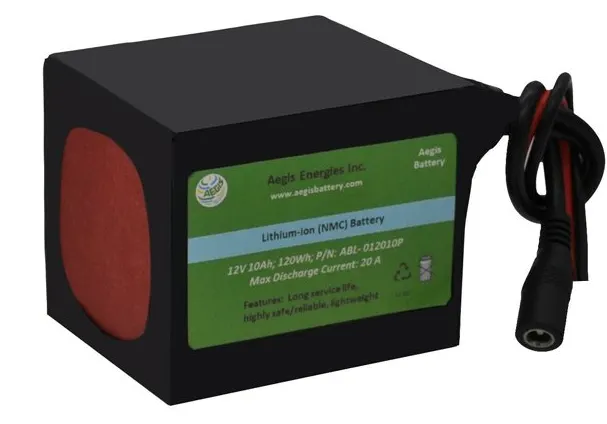
Specifications and Li NMC device Given the features of Li NMC, which were given above, the capacity indicators, even with the same size of the battery, can differ significantly. Nevertheless, to get an idea of the characteristics of this battery, it is worth bringing the basic parameters of a battery of this type. Voltage: 3.7 V Capacity: 3000 mAh or more. Number of charge-discharge cycles: at least 1000. Thermal breakdown: + 210˚С. The indicated voltage value is nominal. The maximum battery charge is possible up to a value of 4.3 volts.
Advantages and disadvantages
The main advantage of Li NMC batteries is its high electrical capacity. This indicator can reach 220 W * h / kg. Accordingly, in any portable devices, this quality reduces the weight of the batteries. Electric batteries consisting of Li NMC batteries have high capacitance values.
If necessary, you can make an assembly for 10 Ah, 25 Ah and even 60 Ah, while the capacity of one cell can reach 7500 ampere-hours. If it is necessary to obtain high discharge currents, then Li NMС elements, as a rule, are manufactured with a relatively small capacity (3,000 - 4,000 mAh).
The disadvantages of elements of this type are standard for new technologies. As a rule, the high cost of products does not allow to completely replace obsolete battery models with newer ones. Li NMC batteries made in China can be bought relatively inexpensively, especially if you purchase a bulk batch of goods.
LFP
lithium-ion battery using lithium iron phosphate (LiFePO 4) as the cathode material, and a graphitic carbon electrode with a metallic backing as the anode. The energy density of LiFePO 4 is lower than that of lithium cobalt oxide.
-
Energy density: 325 Wh/L (1200 kJ/L)
-
Nominal cell voltage: 3.2 V
-
Specific energy: 90–160 Wh/kg (320–580 J/g or kJ/kg)
-
Specific power: around 200 W/kg
-
Energy/consumer-price: 3–12 Wh/US$
-
Time durability: 10 years
The main drawback of LiFePO is its low electrical conductivity. Therefore, all the LiFePO4 cathodes under consideration are actually LiFePO4/C (composite made with carbon).Because of low cost, low toxicity, well-defined performance, long-term stability, etc. LiFePO4 is finding a number of roles in vehicle use, utility scale stationary applications, and backup power LFP batteries are cobalt-free.
LTO
A lithium-titanate battery is a modified lithium-ion battery that uses lithium-titanate nanocrystals, instead of carbon, on the surface of its anode. This gives the anode a surface area of about 100 square meters per gram, compared with 3 square meters per gram for carbon, allowing electrons to enter and leave the anode quickly.
This technology is known for its very fast charging, low internal resistance/high charge and discharge-rate, very high cycle life, and excellent endurance/safety. It has found use mostly in electric vehicles and energy storage (Toshiba, YABO, and Altair Nanotechnologies), and wristwatches (Seiko). More recently, it is beginning to find use in mobile medical devices due to its high safety. One underlying reason for this technology’s characteristics is that the chemistry uses nanocrystals on the anode instead of carbon, which provides much more effective surface area. Unfortunately, however, this battery has lower terminal voltages than other Lithium types.
- Specific energy: approximately 30-110Wh/kg
- Energy density: as high as 177 Wh/L
- Specific power: 3,000-5,100 W/kg (peak load)
- Discharge efficiency: approximately 85%; charge efficiency over 95% (low-rate)
- Energy/consumer-price: 0.5 Wh/dollar
- Service or shelf life: >10 years (some to 20 years)
- Self-discharge: 2-5 %/month
- Cycle durability: 6,000 cycles to 90% capacity (some models >10,000 cycles)
- Nominal cell voltage: 1.9 to 2.4V (Toshiba SCiB cells 1.5-2.7V operating; 2.3V nominal)
- Cut-off voltage: 1.5V typical (some at 1.7V)
- Temperature: -40 to +55°C (extended models)
- Charging technique is using standard constant current, followed by constant voltage until the amps threshold is reached.
Chemistry
Li4Ti5O12 + 6LiCoO2 ← → Li7Ti5O12 + 6Li0.5CoO2 (E=2.1V)
2.Compare the differences between each type of Li+ion batteries based on their characteristics
Lithium Ion Batt
Lithium and lithium-ion batteries are both incredibly useful and make huge contributions to most people’s daily lives. Their applications are endless, from lifesaving medical technology to remote control toy cars, it’s hard to imagine a modern world without them. Both these types of batteries provide a form of portable power, they will provide charge to a compatible electric circuit no matter where you are.
The difference between lithium and lithium-ion batteries is that one is not rechargeable (primary cell) and the other can be recharged (secondary cell). In addition to this, Lithium batteries have a shelf life up to four times longer than lithium-ion batteries and are also much cheaper and easier to make.
Conversely, the items we rely on to hold their charge for extended periods of time are best powered using Lithium batteries. Whether it’s a medical pacemaker or safety features like a smoke alarm, Lithium batteries are preferred as they last for so much longer. And, although we’d like to point out that it’s very rare, Lithium-ion batteries have been known to catch fire and explode, a feature we thankfully don’t see from Lithium batteries.
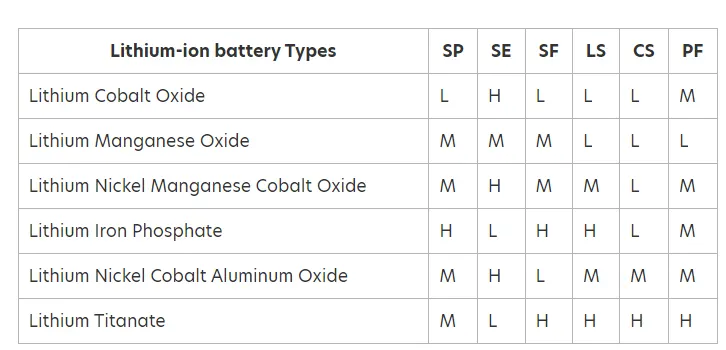
- SP stands for specific power
- SE stands for specific energy
- SF stands for safety
- LS stands for lifespan
- CS stands for cost
- PF stands for performance
- L stands for low
- M stands for moderate
- H stands for high